
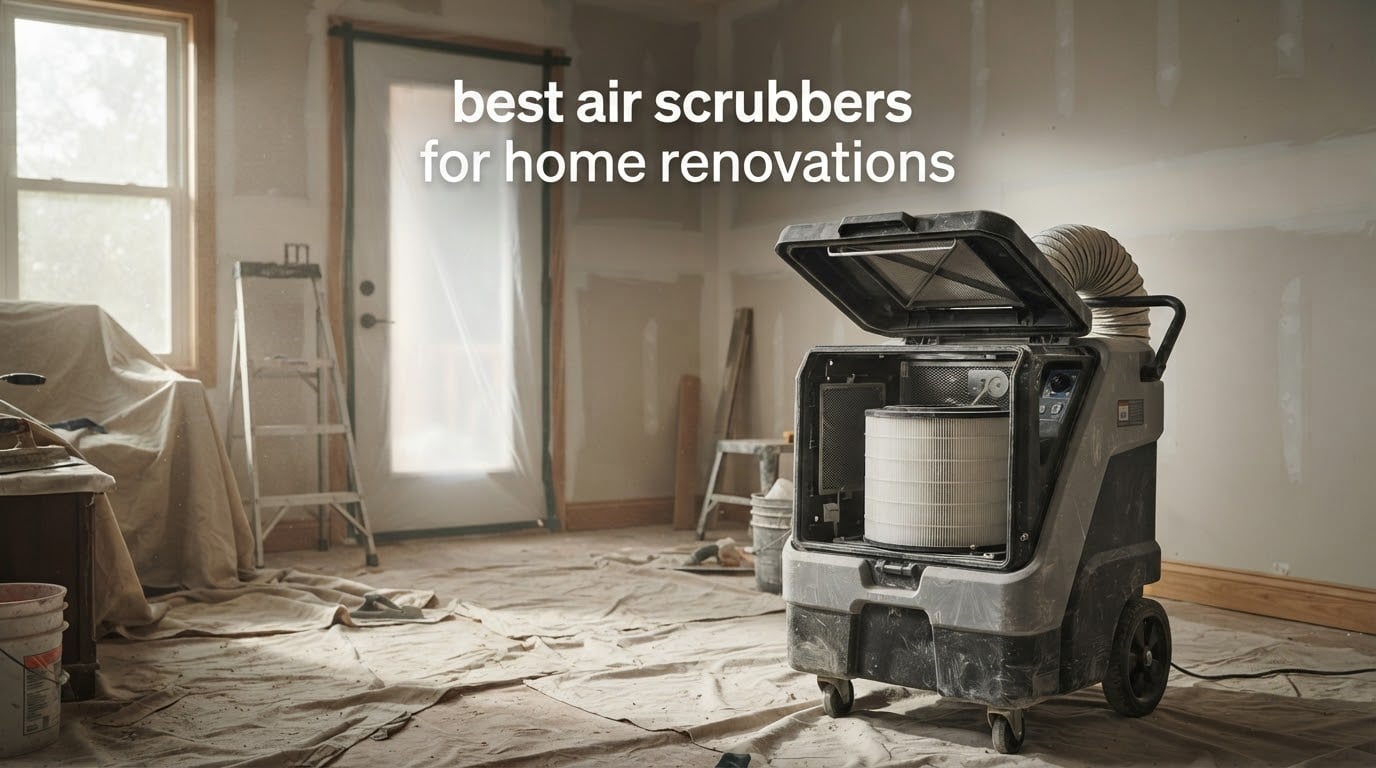
Renovation dust is not house dust. Cutting drywall, demoing tile, or grinding down popcorn ceilings puts so much fine particulate into the air that it hangs there for days and travels into every room you were trying to protect. A good air scrubber is the machine that pulls that dust toward itself instead of letting it drift, which is why it belongs in the same conversation as zip walls and daily cleanups rather than as a comfort purchase.
We spent several weeks working through the top portable air scrubbers for home renovations, comparing airflow ratings, filter staging, weight, warranty length and real buyer feedback across ten machines. The short version: the best air scrubber for most homeowners is a sealed 500 to 550 CFM three-stage unit, and the difference between a good one and a disappointing one has far less to do with brand than most roundups suggest.
If your renovation is a water damage or mold job rather than a planned remodel, our guide to the best HEPA air scrubbers for water restoration is a better fit, since those jobs need higher airflow and different filter logic.
Table of Contents
What Is an Air Scrubber? A Definition Before the Picks
An air scrubber is a portable, wheeled filtration machine that pulls room air through a pre-filter, a true HEPA filter and often an activated carbon stage, then returns the cleaned air to the room, capturing the fine construction dust that settles throughout a renovation.
Two things separate it from a home air purifier. A scrubber is built as a sealed negative air machine, which means you can duct the outlet and hold the work zone under negative pressure so dust is drawn in rather than pushed out. And it uses commercial-grade filter media rated at 99.97% of particles at 0.3 microns, not the thin sheets most residential purifiers rely on.
It is worth being blunt about the limits. A scrubber does not clean whole houses, it does not remove paint fumes or VOCs unless there is a carbon stage, and it does nothing about dust that has already settled on your floors and shelves. Source control, containment and a shop vac still do the heavy lifting. What the scrubber does is keep the airborne fraction from taking over the house, and it does that extremely well.
Top 3 Picks for Best Air Scrubbers for Home Renovations in October
Three units came out ahead when we weighed airflow against weight, warranty and the feedback volume behind each listing.

The Best Air Scrubbers for Home Renovations in 2026
All ten machines below are portable, wheeled three-stage units built for construction and renovation work. We ordered them by how well they suit a residential remodel rather than by raw airflow.
| Product | Specifications | Action |
|---|---|---|
| BlueDri Air Shield 550 |
|
Check Latest Price |
 VEVOR 550 CFM Air Scrubber VEVOR 550 CFM Air Scrubber |
|
Check Latest Price |
 AlorAir CleanShield HEPA 550 AlorAir CleanShield HEPA 550 |
|
Check Latest Price |
 MOUNTO HEPA500 MOUNTO HEPA500 |
|
Check Latest Price |
 Abestorm Filteair HEPA 550 Abestorm Filteair HEPA 550 |
|
Check Latest Price |
 CADPXS Shield-550 CADPXS Shield-550 |
|
Check Latest Price |
 AlorAir PureAiro HEPA 870 AlorAir PureAiro HEPA 870 |
|
Check Latest Price |
 MOUNTO 1000 CFM HEPA1000 MOUNTO 1000 CFM HEPA1000 |
|
Check Latest Price |
 Dri-Eaz HEPA 700 Dri-Eaz HEPA 700 |
|
Check Latest Price |
 XPOWER X-3400A XPOWER X-3400A |
|
Check Latest Price |
1. BlueDri Air Shield 550 HEPA Air Scrubber for Renovation Dust Control
BlueDri Air Shield 550 HEPA Air Scrubber, Water Damage Restoration Equipment Air Purifier, Covers 1400 Sq. Ft, Daisy Chain Capable, For Commercial Use, Blue, BD-AS-550
550 CFM class negative air machine
3-stage HEPA filtration
Covers 1400 sq ft
39 pounds
1-year parts, 5-year housing
Pros
- Largest review base in the group at 755 ratings
- HEPA stage rated 99.97% at 0.3 microns
- uses widely available standard 15.75 inch filters
- daisy chain capable for multi-room jobs
- users report visible clearing in about 20 minutes of demo dust
Cons
- Audible on the highest setting
- optional carbon filter sold separately
- housing seal is not perfectly tight
- only captures airborne dust and not settled dust
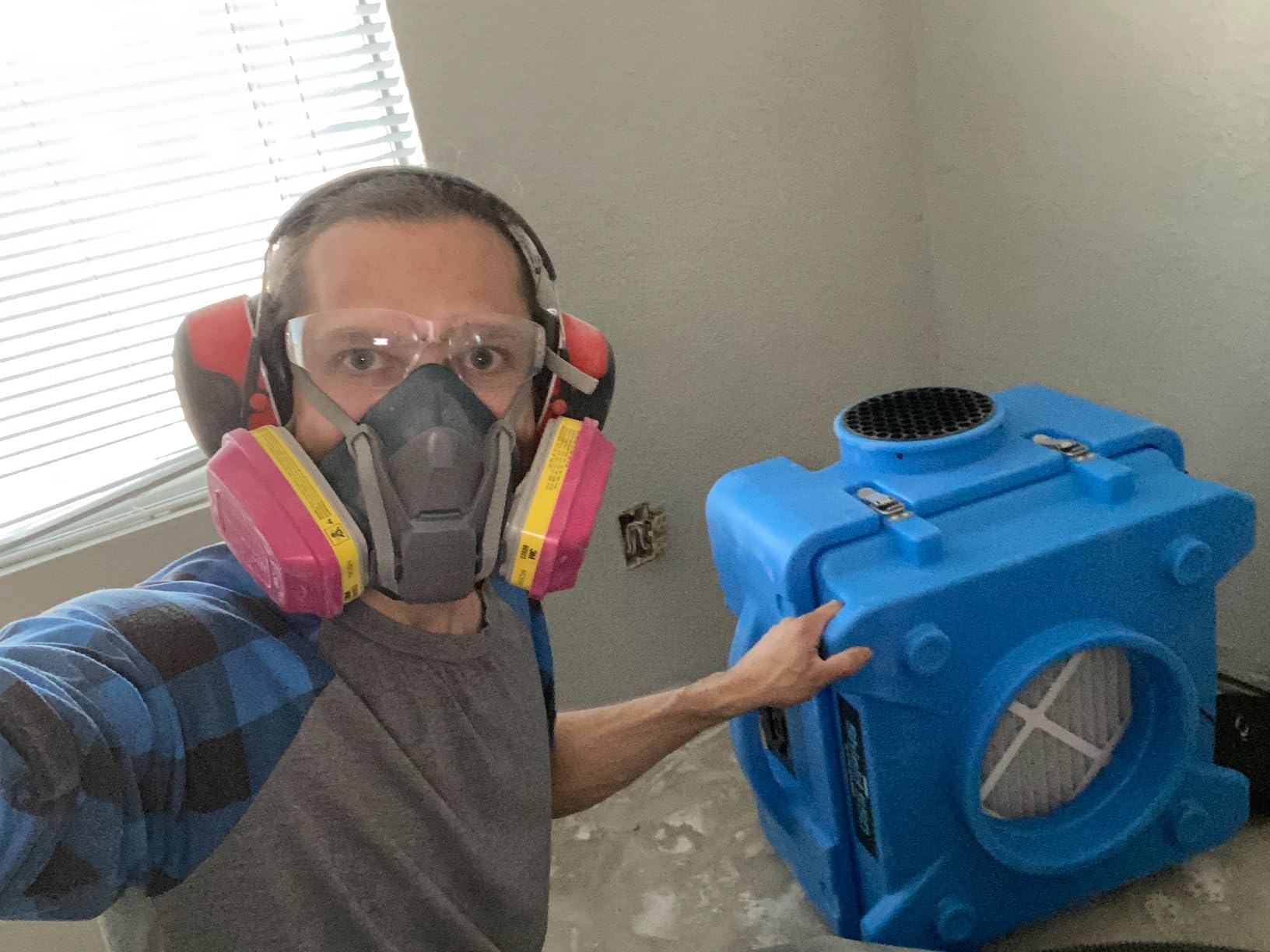
The BlueDri Air Shield 550 is the machine we ended up recommending to most people, and the reason is unglamorous: it is the best-documented one. At 755 ratings averaging 4.6 stars, this is the only listing in the group with a long enough owner history to say something confident about how it behaves after a full month of drywall sanding.
Owners consistently report the same thing during demo day, popcorn ceiling removal and mold remediation: the air visibly clears in roughly 20 minutes, and several describe the unit paying for itself by removing hours of re-cleaning in adjoining rooms. The spec sheet claims at least 40% more airflow than leading competitors in the 550 class, and the manufacturer states 99.97% efficiency at 0.3 microns on the HEPA stage.
What drew us in is the filter story. It runs standard 15.75 by 15.75 by 0.75 inch filters that are widely available and compatible with B-air brand filters, which means you are not hunting for a proprietary SKU at every change. That matters more during a dusty remodel than any feature on a control panel.
When the BlueDri earns its price over cheaper 550s
For a full gut renovation with multiple rooms open at once, the daisy chain capability is the deciding factor. You can link machines to extend coverage rather than buying a second standalone unit, and the 1400 sq ft rated coverage means a single machine handles a large open plan area without being undersized.
If your job is a single bathroom or a one-room refresh, that capacity is overkill and you are paying for headroom you will not use.
Where the BlueDri disappoints
Reviewers report it is clearly audible on the highest setting, comparable to a table saw, so in an occupied living space you will want it on a lower speed. The optional carbon filter is not included, which catches people out on paint and adhesive jobs.
One recurring note is that the housing seal is not perfectly tight and lets some dust escape, and of course it only handles airborne dust, never the film already settled on horizontal surfaces. Plan on a shop vac regardless.
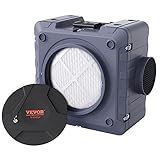
2. VEVOR 550 CFM Air Scrubber with 3-Stage Filtration
VEVOR Air Scrubber 550 CFM 3-Stage Filtration Stackable Negative Machine
550 CFM adjustable airflow
MERV-10, carbon and H13 HEPA
Filter change indicator and timer
35 pounds
Daisy chains to 1650 CFM
Pros
- Lowest cost in the group with a full three-stage filter stack
- plug and work with no assembly
- daisy chains up to three machines for 1650 CFM combined
- lightest full size unit here at 35 pounds
- filter change light and resettable timer
Cons
- General equipment importer rather than a restoration specialist
- fewer customer review photos than the established brands
- replacement filter sizing and ongoing filter supply are not covered in the listing
The VEVOR is the value entry point into commercial air scrubbers, and the reason is the filter stack. Most machines in this class give you a pre-filter and a HEPA; this one ships a MERV-10 pre-filter, a carbon filter and an H13 HEPA rated at 99.97% of particles as small as 0.3 microns, at the lowest cost we reviewed.
Around three quarters of its 311 ratings are five-star, and the praise is consistent about the same things: the control panel, the daisy chain sockets and the fact that it works straight out of the box. There is no assembly, and the 35 pound weight with a foldable handle means one person can carry it and stack it when it is not running.
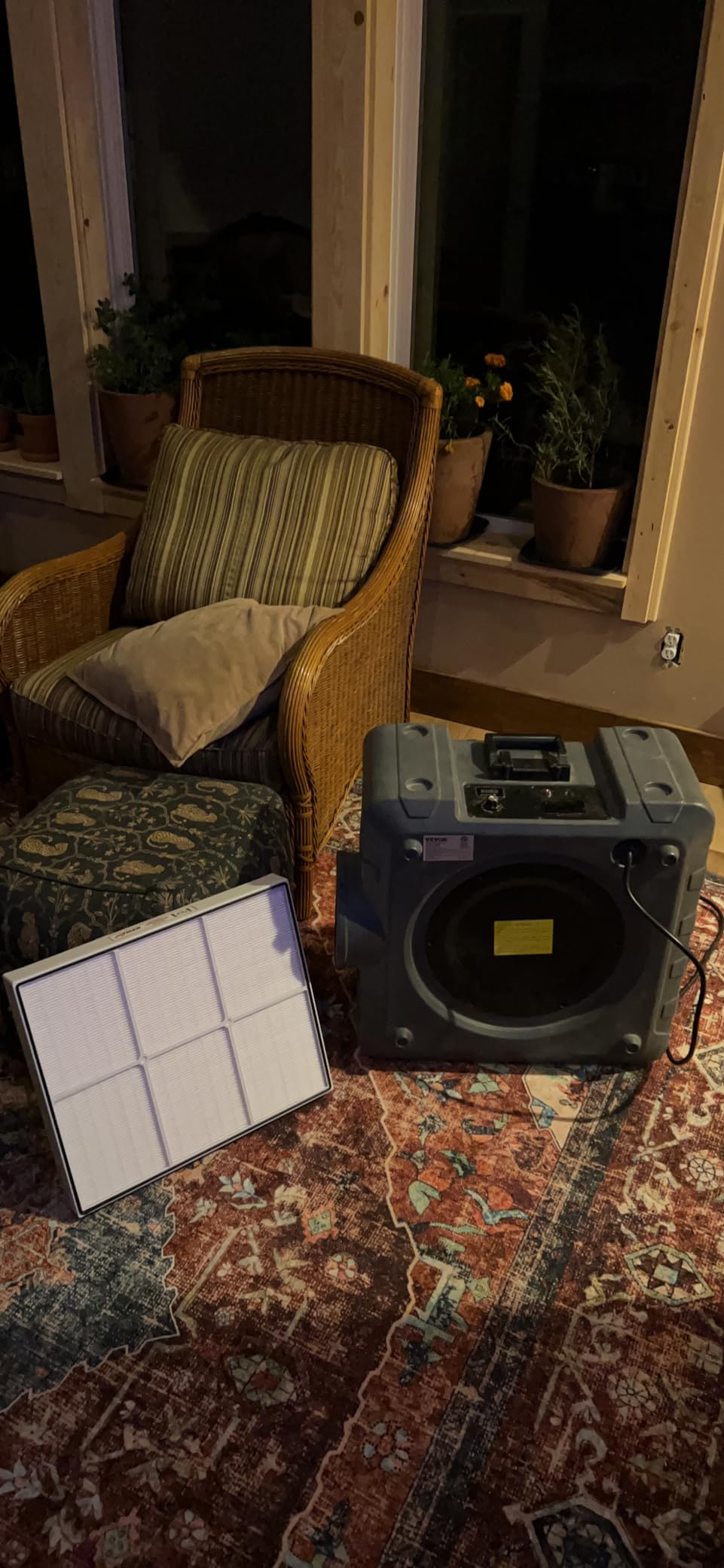
The adjustable airflow is more useful than it sounds. A 15.5 inch intake and 8.5 inch outlet let you dial the same machine to a single bathroom during grout removal or turn it up for a whole open-plan demo.
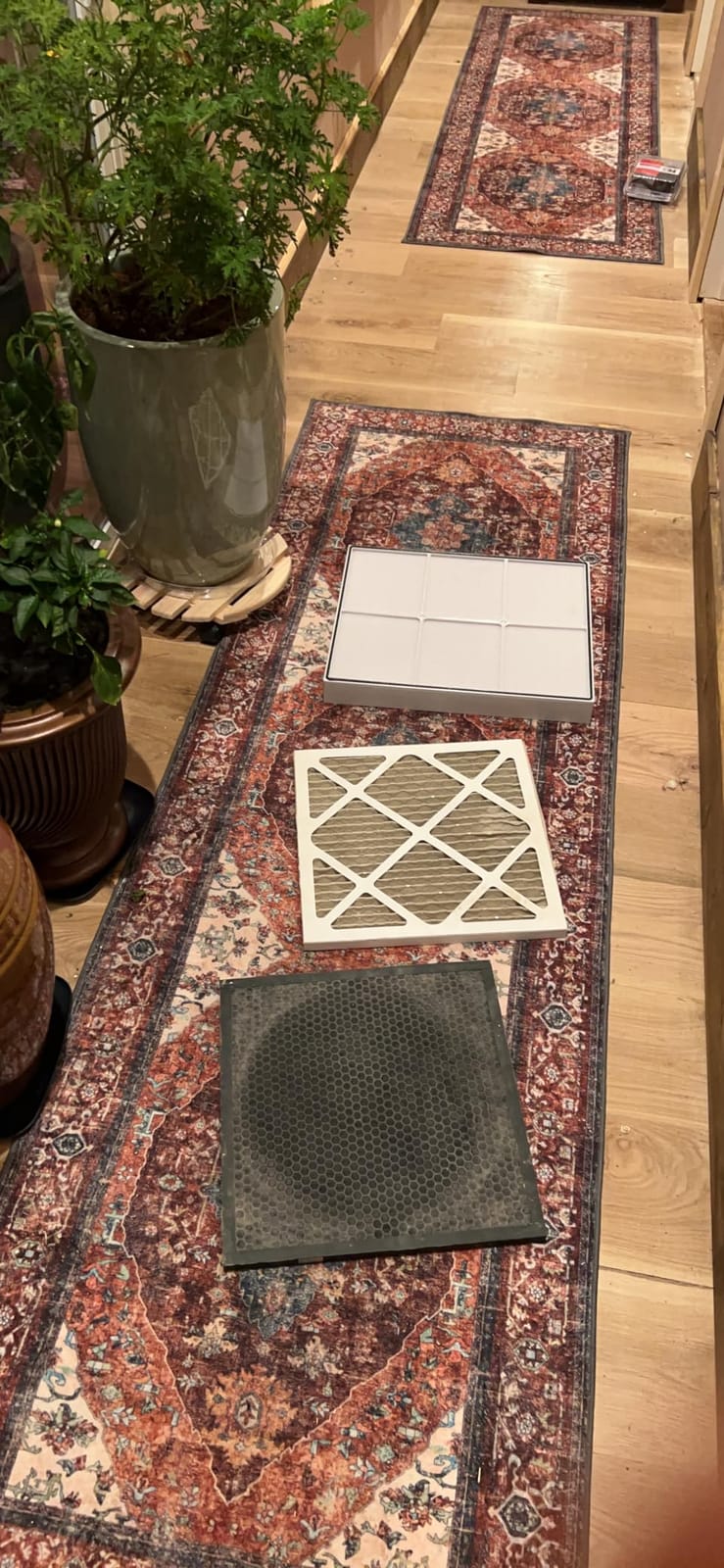
Why we picked this as the budget option
For a first renovation scrubber, most of the money goes into the machine, and this one keeps the essentials and cuts the rest. The filter change indicator light, the resettable timer and the overheat-protection circuit breaker are the kind of details you usually only get on pricier units, and they are all here.
At 35 pounds it is also the easiest full-size machine to move between the bathroom, the kitchen and the garage as the job moves around.
What to watch out for with the VEVOR
The honest downside is brand depth. VEVOR is a general equipment importer rather than a restoration specialist, so support and parts experience are thinner than the long-established restoration names. Reviewers also note that replacement filter sizing and ongoing filter supply are not addressed in the listing, and that it has fewer customer review photos than the better known brands.
It is also a newer listing than the alternatives here, so its long term reliability record is simply shorter. If you are filtering water damage rather than renovation dust, look at our water restoration air scrubber guide instead.
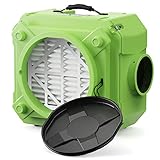
3. AlorAir CleanShield HEPA 550 for Long-Term Ownership
ALORAIR HEPA Air Scrubber with 3 Stage Filtration, Water Damage Restoration
270-550 CFM adjustable airflow
MERV-10, carbon and HEPA stages
ETL certified
39.6 pounds
10 year limited warranty
Pros
- Longest stated housing coverage at 10 years
- stacks horizontally and vertically and daisy chains to 1650 CFM
- includes a 2 pack of MERV-10 filters
- ETL certified for electrical safety on active job sites
- rotomolded polyethylene shell built to survive transport
Cons
- Black protective cover must be removed before use
- ducting for inlet and outlet is an optional extra
- free filter offer requires adding machine and filter to the cart in the same order
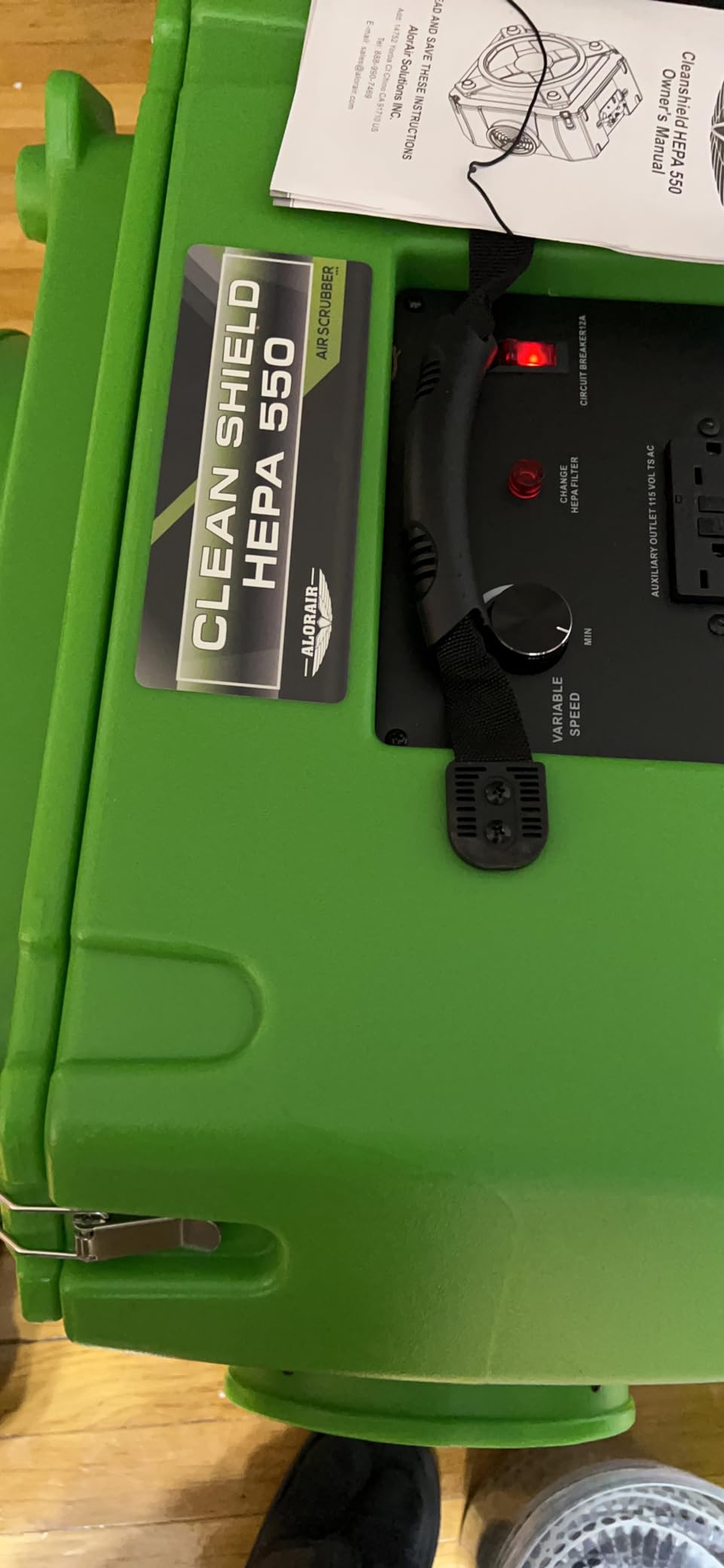
AlorAir is a California damage restoration company that sells its own equipment, and that shows up in the CleanShield HEPA 550 in ways competitors cannot copy. The 10 year limited warranty is the longest stated housing coverage in this group, and the machine is ETL certified for electrical safety, which is not a meaningless detail when you are running power tools on a wet floor nearby.
About 74% of its 183 ratings are five-star, with buyers pointing to the three-stage filtration, the stacking design and the warranty as the reasons they bought. The rotomolded polyethylene shell is built to take being stacked and carried between jobs without cracking, and a two pack of MERV-10 filters comes in the box.
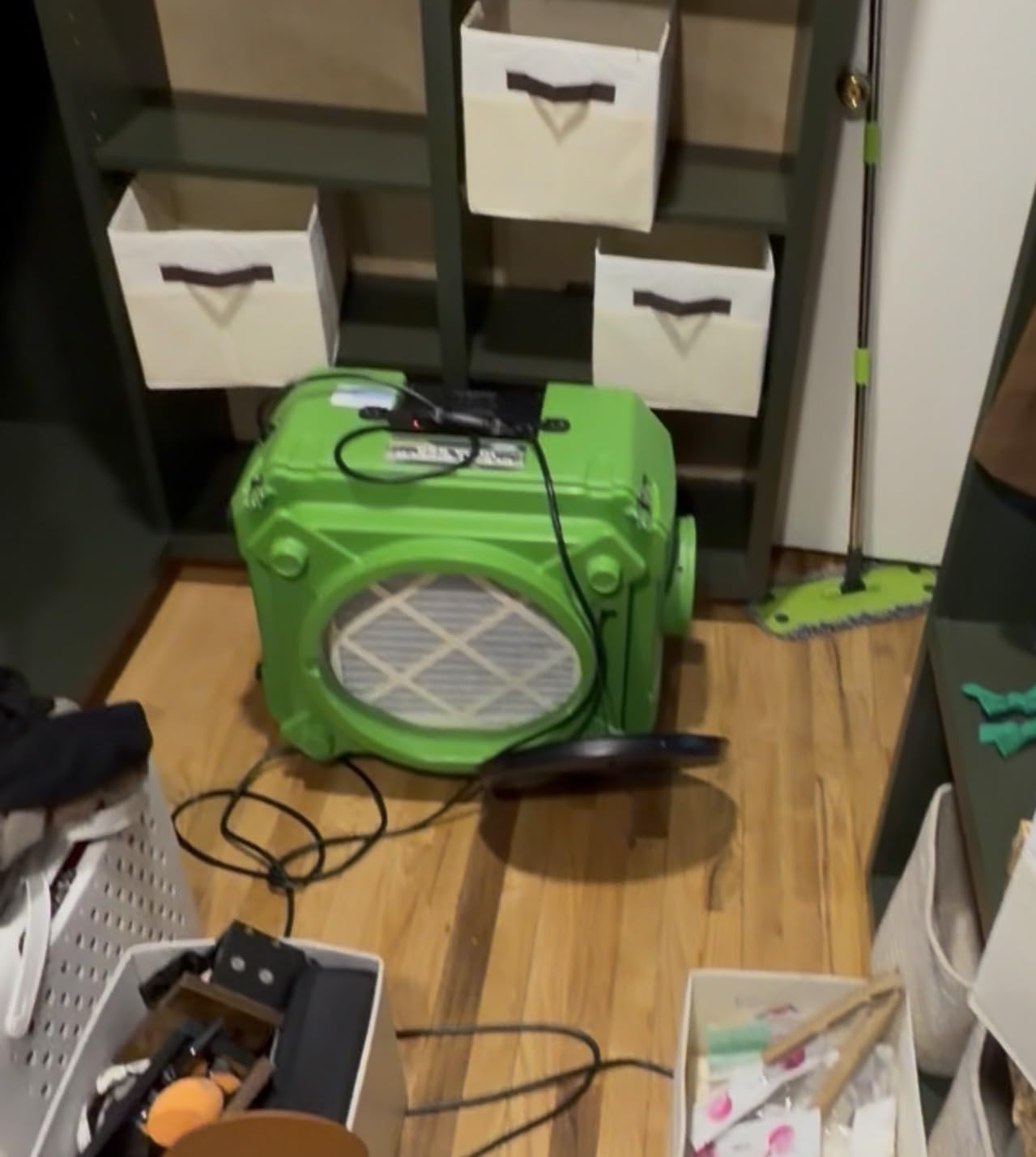
Airflow runs from 270 to 550 CFM, with a control panel, airflow range adjustment, a resettable circuit breaker and a filter change indicator light. It stacks horizontally or vertically and daisy chains up to three machines for 1650 CFM combined.
What the warranty actually buys you
Across a six month renovation with near-continuous run hours, a 10 year warranty is the difference between a machine you service and a machine you replace. AlorAir is also the manufacturer that offers free MERV-10 filters when the scrubber and the filter are added to the cart together, which quietly lowers the running cost.
ETL certification matters for a residential job too, because you will be plugging this into a circuit you also use for a dust extractor.
Small frictions before first use
Two setup annoyances show up repeatedly in the reviews. The black protective cover over the machine has to come off before you switch it on, and if you skip that step you will be troubleshooting for twenty minutes. Ducting for the inlet and outlet is an optional extra, so budget for it if you plan to run it as a negative air machine.
Owners also note the speed range is slightly narrower than on premium models, which is a fair trade for the warranty and the certification.
4. MOUNTO HEPA500 for Moving Between Rooms
MOUNTO HEPA500 Commercial 500cfm Air Purifier Hepa Air Scrubber Negative Air Machine Roto-Molded (Blue)
500 CFM variable speed
Filter change light and dual GFCI outlet
cETL listed
41.35 pounds
1 year parts, 10 year housing
Pros
- Filter change light
- dual GFCI outlet and stackable design simplify job site deployment
- quick access filter compartment speeds up swaps
- rotomolded housing survives repeated transport between rooms
- 10 year housing warranty
- cETL listed with circuit breaker protector
Cons
- 500 CFM is a step down from the 550 CFM class
- heaviest 500 CFM unit here at just over 41 pounds
- tall square footprint is less convenient to nest into a corner
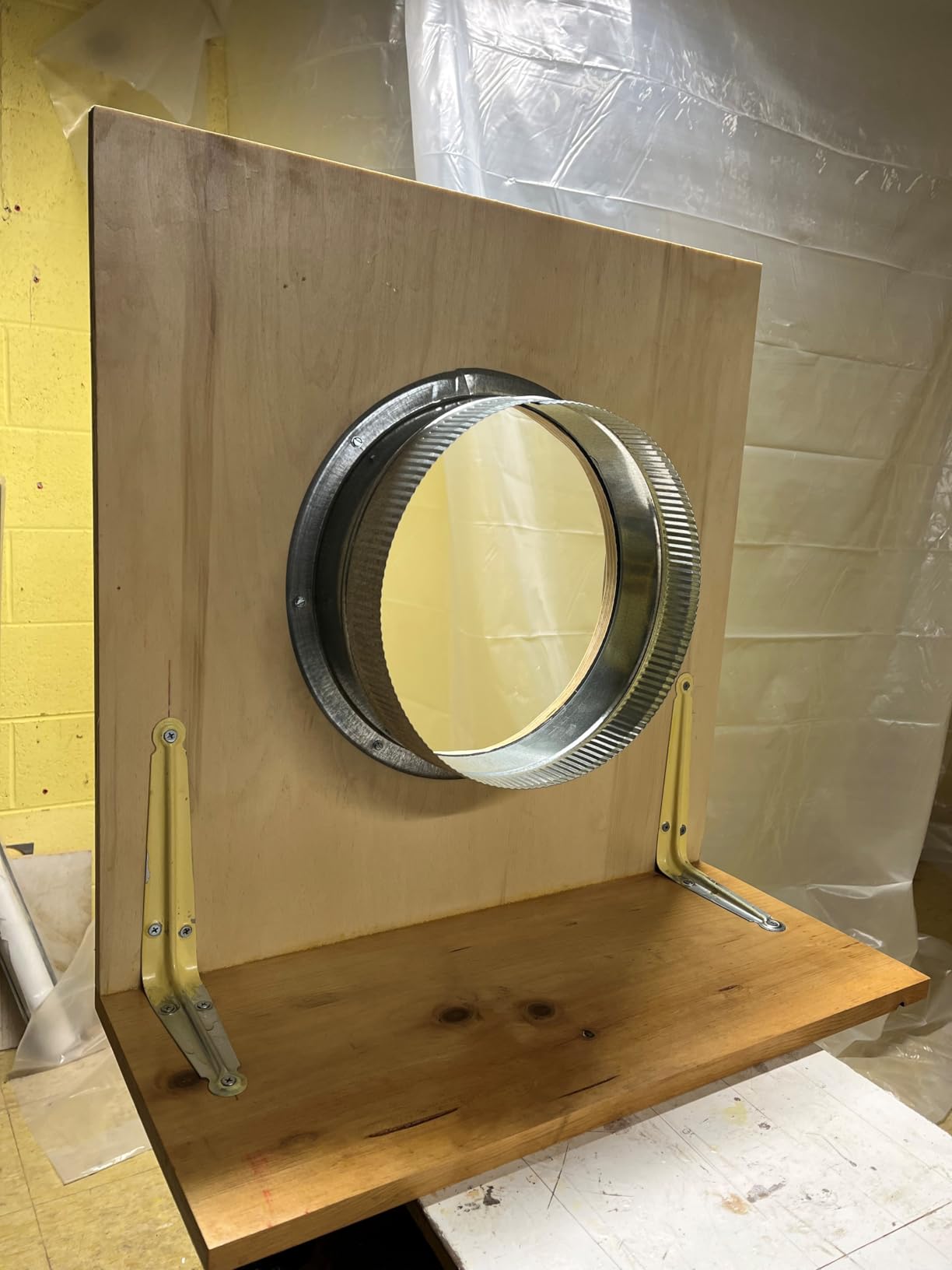
The MOUNTO HEPA500 is a compact 500 CFM workhorse aimed squarely at the kind of job this article is about: home repair, construction sites, sewage remediation and water or fire damage. Seventy-eight percent of its 157 ratings are five-star, and reviewers keep naming the same three practical wins.
First is the filter change light, which is more useful than it sounds when the pre-filter is clogging every two days of heavy drywall sanding. Second is the dual GFCI outlet, which lets you chain equipment without hunting for a free circuit. Third is the quick access filter compartment, which speeds up swaps in a way that screw-fastened housings do not.
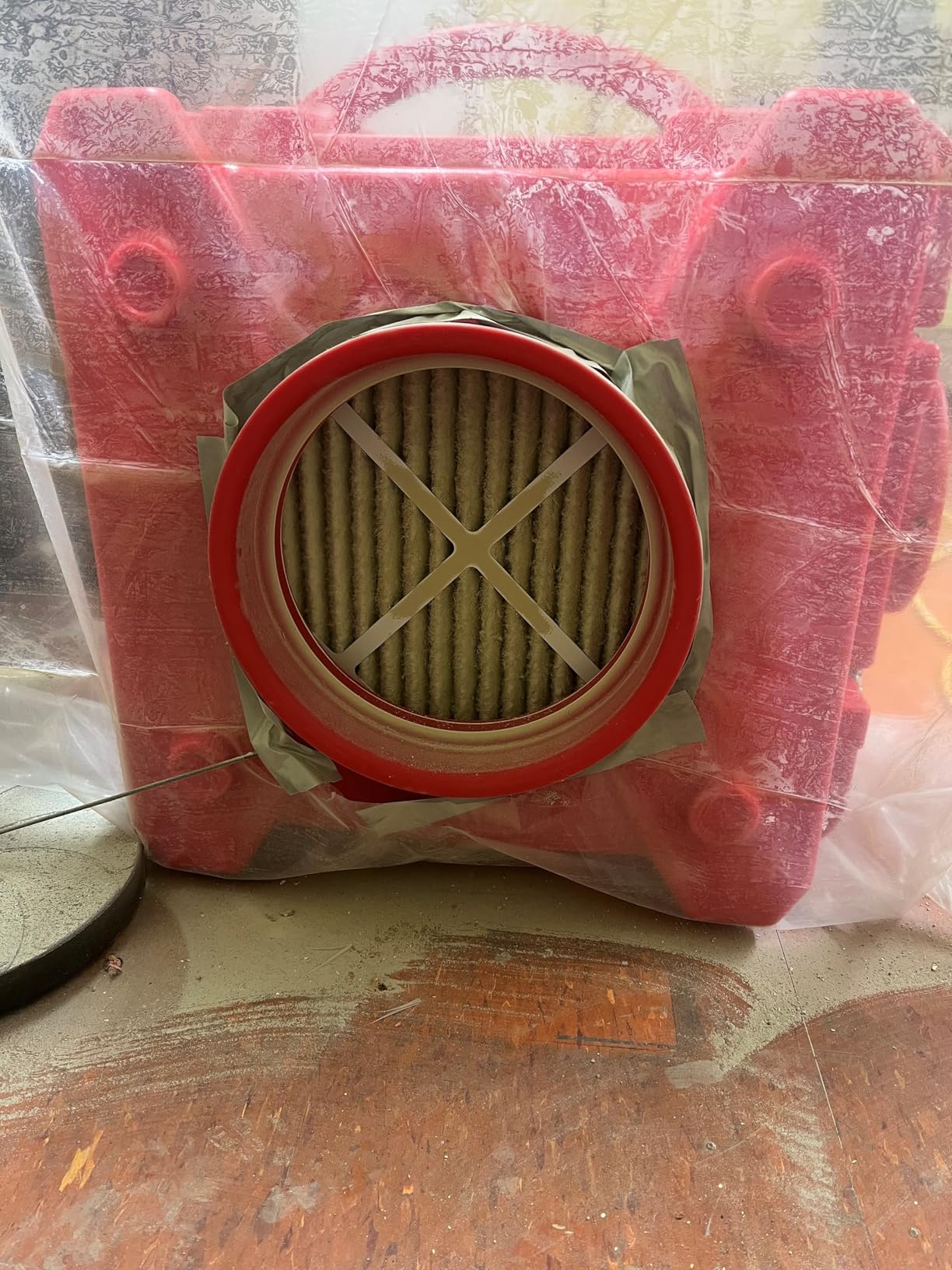
The rotomolded plastic housing and cETL listing mean it is built for repeated transport between rooms, and the 10 year housing warranty sits alongside 1 year parts and labor.
Where the 500 CFM class actually makes sense
For a bathroom, a bedroom or a single-floor renovation where you are sealing the work zone and running the machine inside it, 500 CFM is genuinely sufficient. The rule of thumb contractors use is roughly four to six air changes per hour in the contained room, and a 500 CFM unit clears a typical small work zone comfortably.
It is when you open up the whole main floor that the extra 50 CFM of the 550 class starts to matter.
The weight question on the MOUNTO 500
At just over 41 pounds it is the heaviest 500 CFM machine here, and the tall square footprint is less convenient to nest into a corner than flatter models. If your work zone involves stairs, that combination is worth thinking about before you commit.
Owners also mention the 500 CFM rating itself as the main trade-off against neighbouring 550 machines, so if you are borderline on sizing, the 50 CFM extra buys you headroom rather than features.
5. Abestorm Filteair HEPA 550 for Multi-Machine Setups
Abestorm HEPA 550 Air Scrubber with 3-Stage Filteration, GFCI Connection
270-550 CFM adjustable
MERV-10, carbon and HEPA stages
Built-in GFCI outlet
Covers 800 sq ft
39.6 pounds
Pros
- Full three-stage stack including activated carbon
- built-in GFCI outlet lets three machines stack and daisy chain for 1650 CFM
- can be configured as a negative air machine with a separately sold duct
- rotomolded shell described as ultra-sturdy
- covers up to 800 sq ft
Cons
- Black protective cover must be removed before first use
- negative air ducting is sold separately
- brand has a smaller service footprint than the long-established restoration manufacturers
The Abestorm Filteair HEPA 550 shares its footprint and airflow range with several competitors, which owners read as the industry-standard 550 shell, and that is a compliment in this category. Twenty inch by twenty five by fifteen inches at 39.6 pounds means it fits through doorways and stacks in corners without a dolly.
Seventy-eight percent of its 145 ratings are five-star. The praise centres on the built-in GFCI outlet that lets you stack up to three machines for 1650 CFM combined airflow, and on the activated carbon stage, which is a real asset during paint and adhesive days rather than a gimmick.
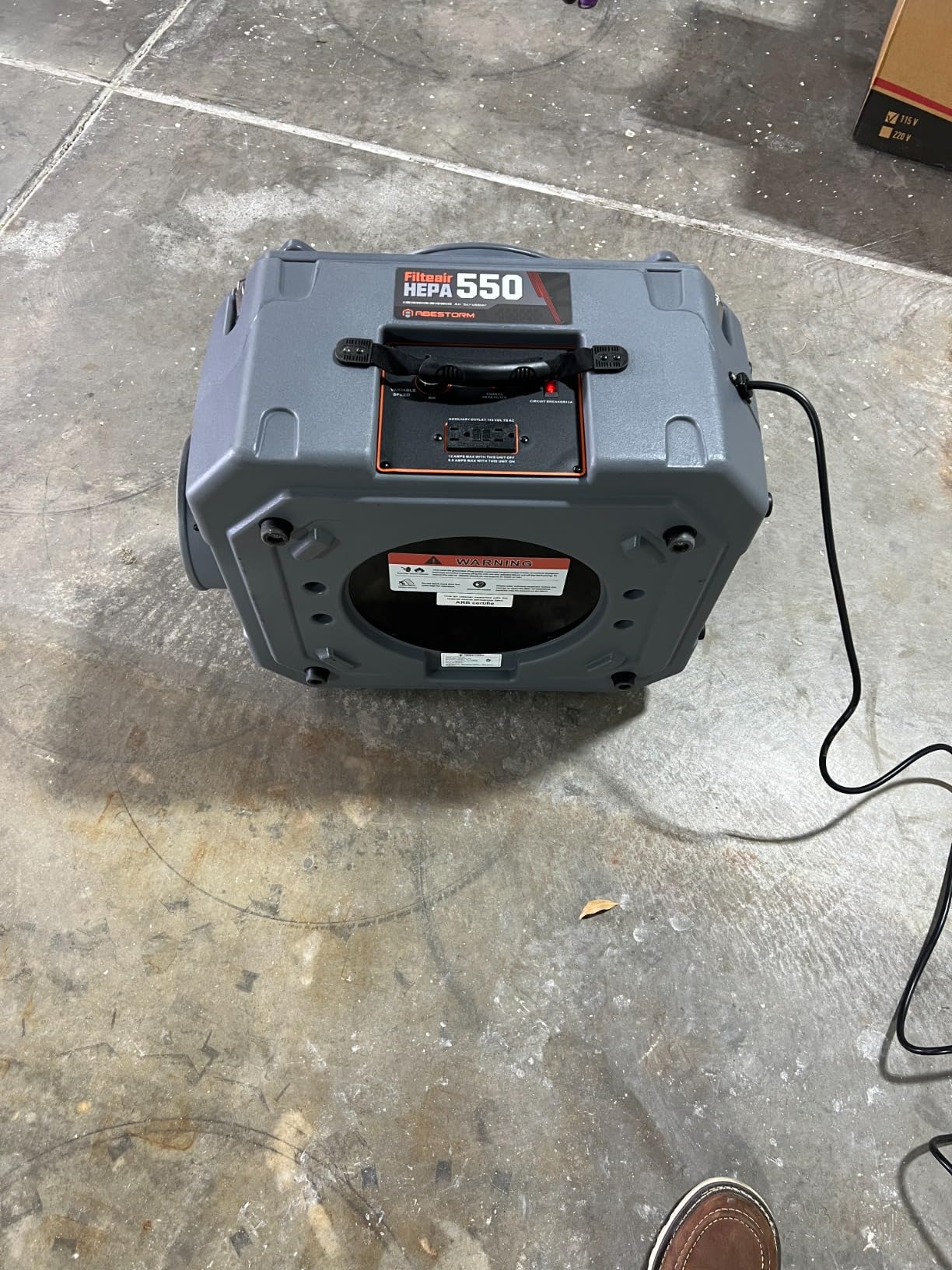
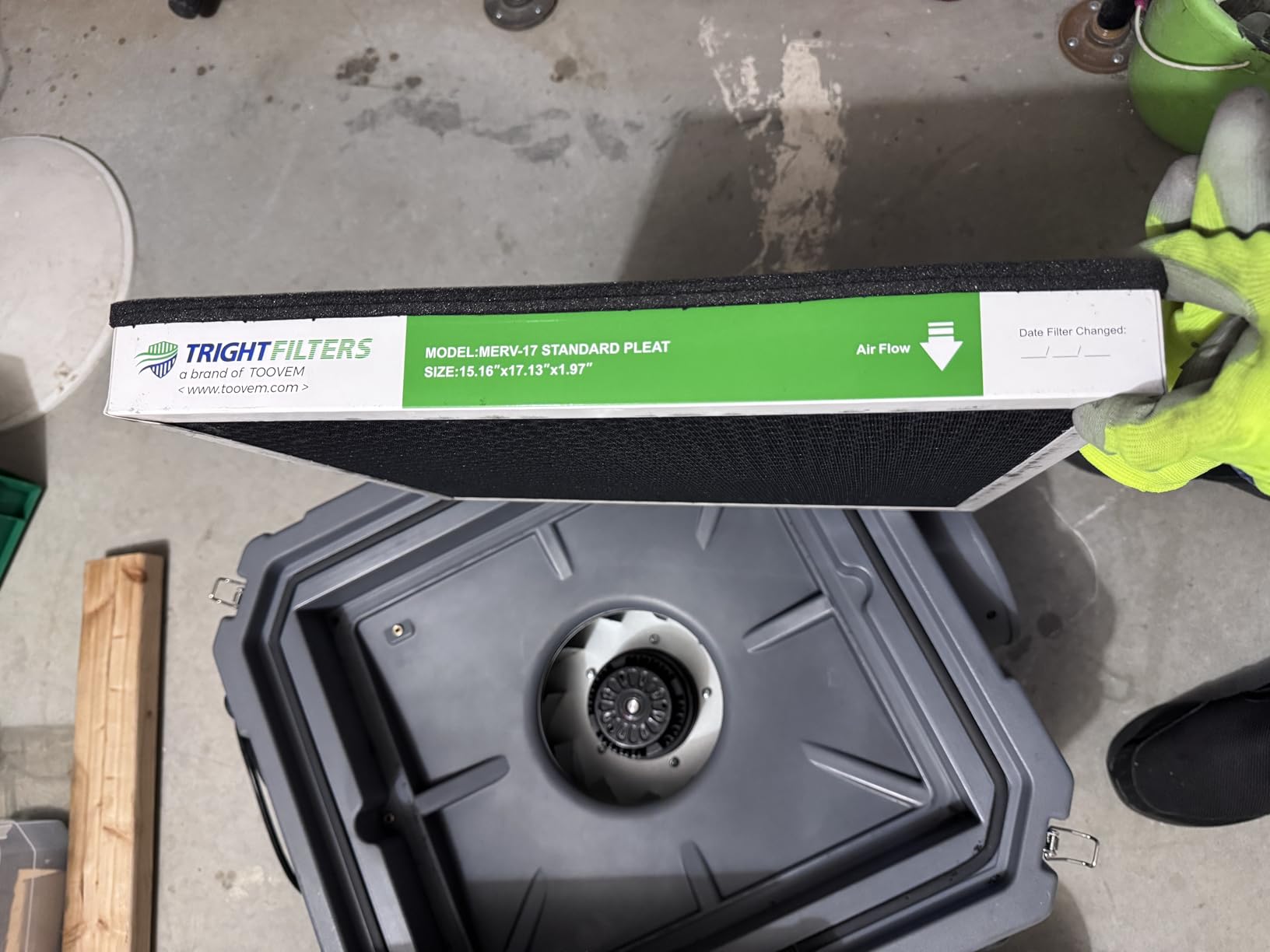
Coverage is stated at up to 800 square feet or 5500 cubic feet, with airflow adjustable from 270 to 550 CFM, and a filter change indicator light for the days when the pre-filter clogs fast.
When stacking beats buying a bigger single machine
If your renovation covers two disconnected work zones, such as a kitchen at one end of the house and a bathroom at the other, daisy chaining three of these lets you pressurise each zone separately. A single larger machine can only sit in one place, and moving it back and forth wastes hours of your run time.
The GFCI outlet also means you are not running extension cords across a walkway, which is a genuine safety point in an occupied house.
Setup steps people forget
The black protective cover has to be removed before first use, and that is the single most common complaint in the reviews. Negative air ducting is sold separately, so the containment setup is an extra purchase rather than an included accessory.
Buyers also note the brand has a smaller service footprint than the long-established restoration manufacturers, so if you want local support rather than shipping a machine back, factor that in.
6. CADPXS Shield-550 for Fast Filter Changes
CADPXS Shield-550 Air Scrubber 550 CFM with 3-Stage Filtration
550 CFM negative air machine
MERV-10, carbon and HEPA
3-stage filtration
33.5 pounds
10 year limited warranty
Pros
- Tool-free filter access through two quick latches
- side-mounted control panel stays reachable when exhausting upward
- hour meter keeps showing hours when unplugged
- illuminated power cord on dark job sites
- owners running it 24/7 with tenants report no noise complaints
- 10 year limited warranty
Cons
- Filter change indicator can stay lit or trip early
- rigid handle does not fold flat for stacking
- carbon and HEPA filters are bonded together and must be replaced as one
- replacement HEPA filter availability has been inconsistent
The CADPXS Shield-550 wins on serviceability, and during a dusty renovation that matters more than another brand badge. Filter access is through two quick latches and a lift-up lid, so there are no four screws to lose on a job site, and at 33.5 pounds it is the lightest full size 550 CFM machine in this group.
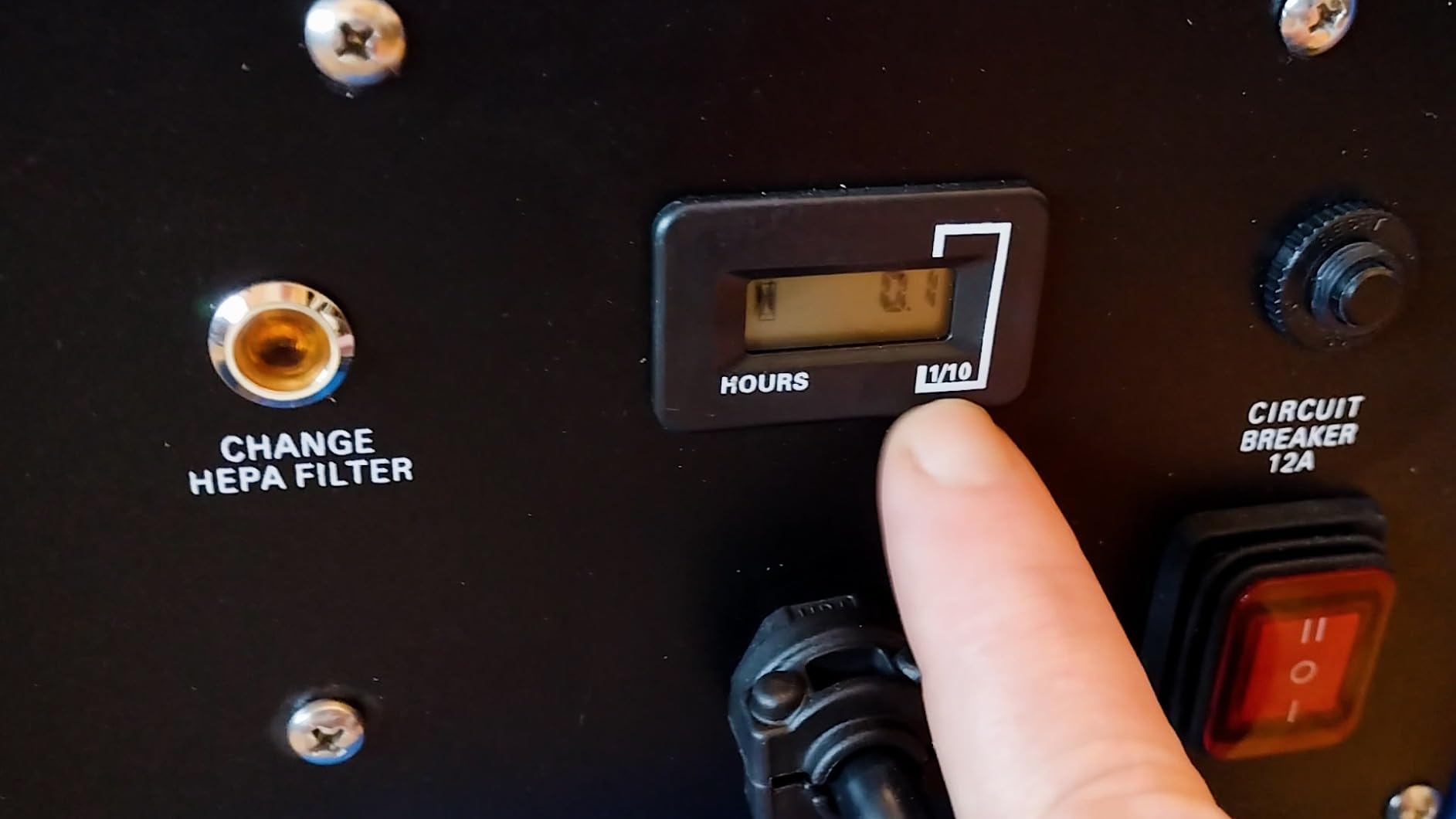
Two details genuinely impressed us in the spec sheet. The hour meter is persistent, meaning it keeps displaying run hours even when the machine is unplugged, which is the only way to actually track filter intervals over a long job. And the illuminated power cord is a small thing that becomes obvious the moment you are working in an unlit basement.
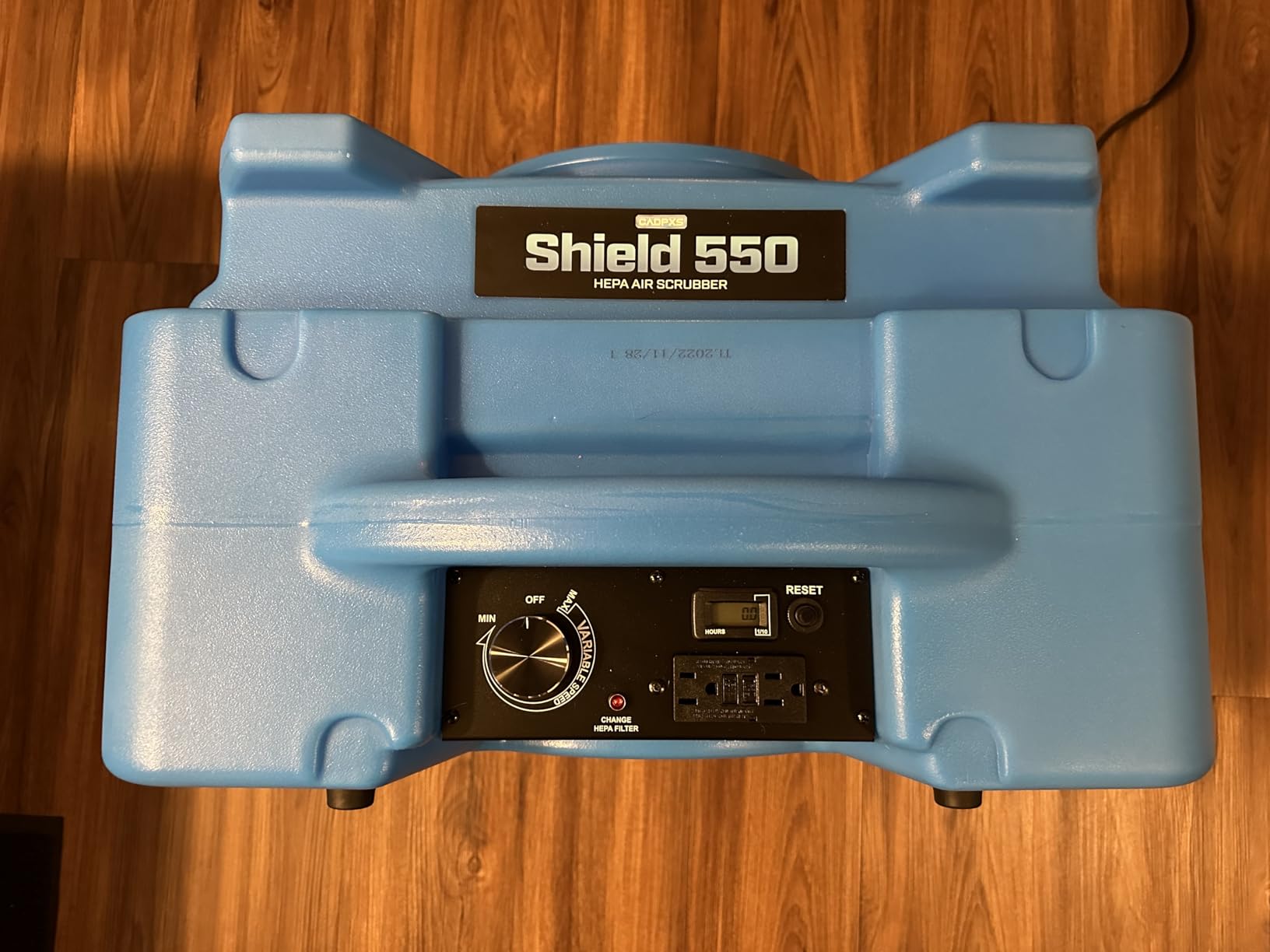
Owners running it continuously in an occupied home with tenants in place report strong filtration and no noise complaints, which is unusual feedback for a 550 CFM unit.
Why the hour meter changes how you maintain filters
Most people change filters on a guess. A persistent hour meter lets you log real run time and change the pre-filter on a schedule, which is the difference between a clean HEPA element at full airflow and a loaded one that has quietly cut your CFM.
Combined with the side-mounted control panel, which stays reachable when the unit is configured to exhaust upward, it means you are not crawling behind the machine to reset anything in a dark corner.
Two real drawbacks
The filter change indicator light is the most common complaint: several buyers report it stays illuminated regardless of whether the filter was replaced, or trips early, which forces them onto their own schedule. The carbon and HEPA filters are also bonded together and cannot be replaced independently, so you replace both even when only one is spent.
Replacement HEPA filter availability has been inconsistent according to reviewers, and the rigid carrying handle does not fold flat for stacking. Confirm your filter source before you commit, especially on a long project.
7. AlorAir PureAiro HEPA 870 for Maximum Airflow Per Watt
ALORAIR PureAiro HEPA Max 870 Air Scrubber 3-Stage Filtration, Blue
3-stage filtration with variable speed
14 inch inlet and 8 inch outlet
Hour meter and filter light
37 pounds
10 year housing, 1 year parts
Pros
- Largest intake in its class moving more air than comparable units
- hour meter display plus filter change light
- daisy chain GFCI duplex outlet and stackable design
- variable speed with regulator
- 10 year housing warranty
- lighter at 37 pounds than most 550 class units
Cons
- Lowest customer rating in the group at 4.1 stars
- highest one-star share among mid-priced units
- premium cost for its airflow class
- carbon and HEPA filters are separately sold
The AlorAir PureAiro HEPA 870 has the largest intake in this group at 14 inches with an 8 inch outlet, and physically larger intake means more real air moved at the same fan speed. It also carries an hour meter display, a filter change light, a daisy chain GFCI duplex outlet and variable speed control with a regulator, all in a 37 pound rotomolded housing.
It is cETL listed with a circuit breaker protector and carries an EPA registration number, which matters if your renovation involves any materials you would rather treat with a properly registered unit.
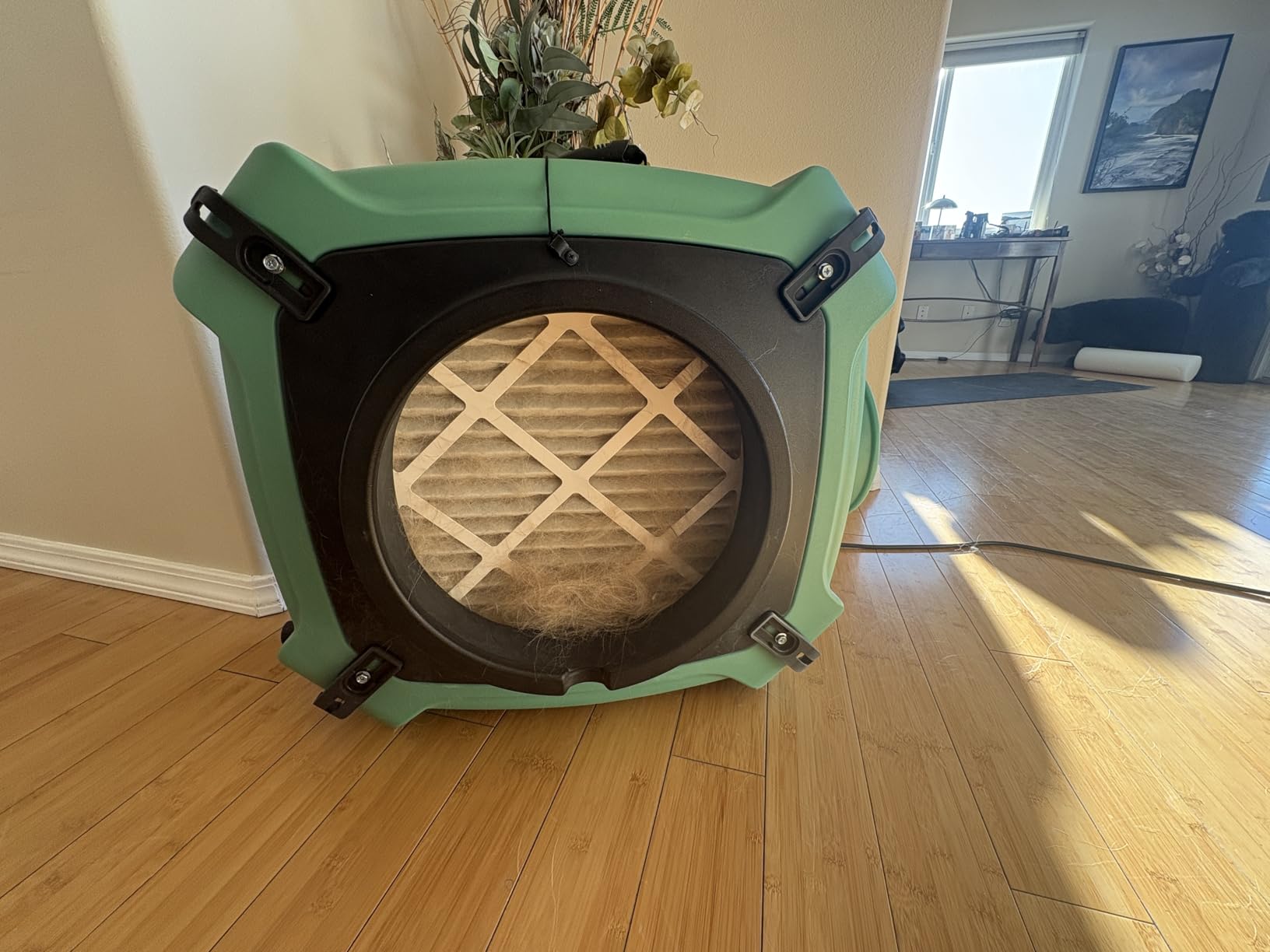
Here is the honest caveat. This is the lowest rated product we reviewed at 4.1 stars, with a notable 14 percent three-star share and the highest one-star share among the mid-priced units. The features are well received, but buyers appear less satisfied with the value relative to the cost.
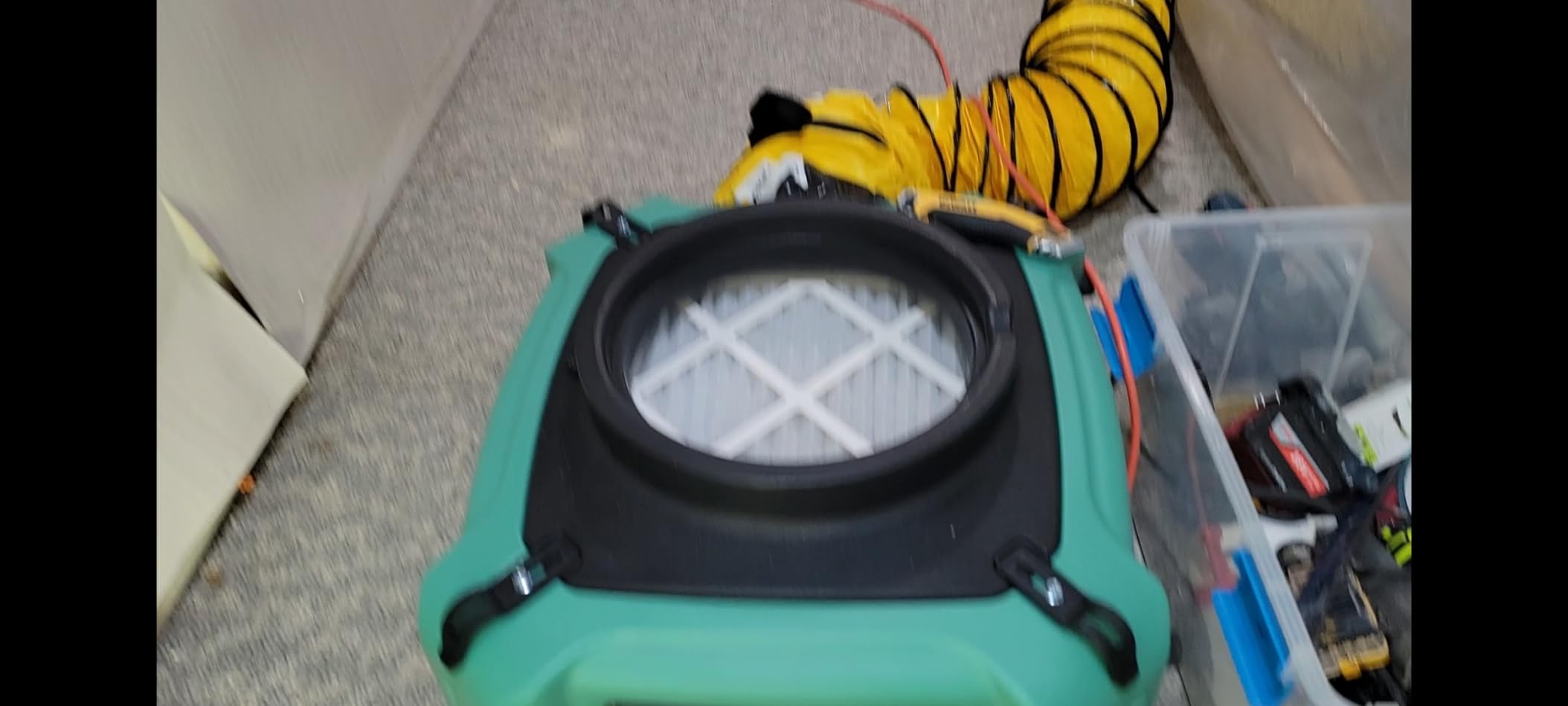
When the large intake earns its cost
If your renovation includes a large open area, a double-height living space or a long hall of connected rooms, the bigger intake reduces the number of machines you need. One unit doing the work of two is where the extra spend pays off.
Variable speed with a regulator also lets you drop to a background level once the heavy sanding is done and keep it running overnight at a lower noise level.
Where buyers are less happy
Beyond the rating, the complaints cluster on value. The carbon and HEPA filters are separately sold, which pushes the real cost of ownership above the sticker figure, and the premium cost for its airflow class is hard to justify in a single-room job.
With a 10 year housing warranty and 1 year parts and labor behind it, the warranty is strong, but treat the 4.1 star average as a real signal of unit-to-unit variability before you buy two of them.
8. MOUNTO HEPA1000 1000 CFM for Heavy Dust Loads
MOUNTO 1000cfm Portable Industrial Air Purifier Negative Air Scrubber – Powerful 1HP Motor, True HEPA Filter, 2-Speed, Handle and wheels 3-Year Warranty
1000 CFM airflow
1 HP motor
6 inch true HEPA filter
79 pounds with wheels
3 year warranty
Pros
- Highest airflow in the group
- suited to large open renovation areas
- 1 HP motor gives real headroom under high dust loads
- 6 inch true HEPA rated 99.97% at 0.3 microns
- wheels and handle make a 79 pound machine movable on the flat
- 2 speed control trades noise for airflow
Cons
- Only 2 speed settings so airflow cannot be fine-tuned
- 79 pounds is the heaviest unit here and impractical between floors without help
- large 24 by 24 by 33 inch tower footprint
- only 39 ratings so the long term record is thin
The MOUNTO HEPA1000 is the pick for big open renovation zones rather than single rooms. At 1000 CFM with a 1 HP motor, it is by far the highest airflow machine we reviewed, and the 6 inch true HEPA filter is rated at 99.97 percent of particles as small as 0.3 microns.
Eighty percent of its 39 ratings are five-star, and owners credit the raw airflow, the true HEPA element and the fact that the built-in wheels make a 79 pound machine manageable on a flat job site. The rotomold housing is described as lightweight and rugged for its size, and setup is described as intuitive with no complex commissioning.
This is the machine for demolition of an entire floor, gutting a house, or a main-floor renovation where you will not be sealing off a small contained room.
When 1000 CFM is the right call
The extra airflow is what keeps up with a grinder or a demo saw running in an open space. In a sealed work zone, the 500 and 550 class machines already cycle the air many times an hour, so the extra 450 CFM is largely wasted.
The 1 HP motor also has genuine headroom for high dust loads, which is the situation where smaller machines start to strain and a loaded filter cuts their effective airflow.
The weight problem to plan around
At 79 pounds this is by far the heaviest unit here, and while the wheels help on a flat surface, moving it between floors is impractical without help. The 24 by 24 by 33 inch tower footprint also needs a corner you can spare for months at a time.
Two speed settings means you cannot fine-tune airflow the way variable-speed units allow, and with only 39 ratings the long term reliability record is thinner than the 550 class machines here. If you want something you can carry up an attic ladder, look elsewhere on this list.
9. Dri-Eaz HEPA 700 for Professional Jobsites
Dri-Eaz HEPA 700 Air Scrubber, Industrial Air Filtration System, Optional Activated Carbon Filter, 700 CFM
700 CFM professional grade
Pre-filter, optional carbon and true HEPA
8-speed touchscreen
42 pounds
Made in the USA
Pros
- 8-speed touchscreen lets you drop to low speed for quiet operation in occupied spaces
- touchscreen monitors HEPA filter health directly
- stackable and ductable at a manageable 42 pounds
- one owner cleared a 4000 sq ft house in under 3 hours
- made in the USA
- costs less than hiring a professional cleanup company using the same model
Cons
- Replacement filters are genuinely hard to source with listings often for the older HEPA 500
- app and Wi-Fi setup requires a business profile which is awkward for home users
- some units arrived with a damaged blower motor
- carbon filter is an optional extra with a linked page that can point to the wrong size
The Dri-Eaz HEPA 700 has the strongest feature set in the group and the biggest practical problem. The touchscreen gives you eight speeds and monitors HEPA filter health directly, which removes the guesswork from filter life entirely, and at 700 CFM it clears large areas fast. One owner used it to clear a 4000 square foot house in under three hours.
It is made in the USA, is ductable and stackable, and at 42 pounds is manageable for a machine of its capability. Buyers also point out that it costs less than hiring a professional flood cleanup company that uses the same model, which is the calculation that decides it for a lot of owners.
The touchscreen is also what makes it viable in an occupied home, since you can drop to low speed overnight instead of running full blast or switching it off.
When the touchscreen filter monitoring pays off
On a long renovation, most people either change filters far too early and waste money, or too late and lose airflow. A unit that reports HEPA health on screen removes the judgement call, and the eight speed range lets you match output to the phase of work.
Effective as an odor and VOC removal unit when paired with carbon filters and lay-flat ducting, it is one of the few machines here that handles paint week as well as drywall week.
The filter sourcing problem is real
By far the dominant complaint is filter sourcing. Buyers report being unable to find correct 700-series filters through normal channels, with listings often pointing to the older HEPA 500 instead. Carbon filters are a separate optional purchase, and the linked product page can point at the wrong size.
There is also app and Wi-Fi setup that requires creating a business profile, which is awkward for home users, and a small share of reports of units arriving with a damaged blower motor from poor packaging. Check the filter SKU before you buy, not after.
10. XPOWER X-3400A for Carrying It Up the Stairs
XPOWER X-3400A Air Scrubber 3 Stage Filtration, Negative Air Machine w/Power Outlets, 3 Stage Airbourne Cleaner, Scrubber HEPA Filter System for Water Damage Restoration, Commercial & Home Use, Blue
600 CFM airflow
3 separate filter stages
Negative air machine capable
28.8 pounds
Built-in power outlets
Pros
- Lightest unit in the roundup at 28.8 pounds and easy for one person to carry
- three separate filter stages matched to different particle sizes
- variable speed lets it drop to a background level
- proven on basement renovation work including tile removal and concrete saw and jackhammer jobs
- built-in power outlets on the control panel
Cons
- Replacement filters are expensive relative to the machine
- anecdotal report of under-performing on very fine powders in a small space
- audible on maximum speed in an occupied room
- only 19 ratings so the thinnest feedback base here
The XPOWER X-3400A is the one to buy if weight is the deciding factor. At 28.8 pounds it is the lightest machine in this roundup by a wide margin, and a single person can carry it up to a third floor or down into a basement without help, which no other 600 CFM class unit here allows.
The filtration design is three separate filter stages matched to different particulate sizes, so bulk dust is caught before it reaches the HEPA element and filter life is extended. Variable speed adjustment runs from low to high, which lets you drop it to a background level when people are in the room.
Owners report it outperforming residential air purifiers they previously owned, and one used it successfully on basement renovation work clearing dust from tile removal and a concrete saw and jackhammer job. There are no 1-star or 2-star reviews at all, and 75 percent of its 19 ratings are five-star.
Why light weight changes the whole job
An air scrubber you can move without a second person is a machine you will actually use correctly. Owners tend to run a machine from one room rather than the ideal spot when the alternative is hauling 80 pounds up a staircase, and placement drives containment more than any feature on the control panel.
Built-in power outlets on the control panel also mean you can power a small tool from the machine itself during a basement job.
Where the XPOWER falls short
Replacement filters are expensive relative to the machine, and that cost recurs every time the pre-filter needs attention during heavy drywall work. There is also an anecdotal report of it under-performing on very fine powders in a small space, so if you are dealing with very fine dust in a confined area, a higher rated HEPA element may serve you better.
It is clearly audible on maximum speed in an occupied room, and at 19 ratings it has the thinnest feedback base in the group, so treat the rating with appropriate caution and expect to be the first person to find the right filter cadence for your own job.
How to Choose: CFM, ACH, and the Two-Thirds Rule
Size the machine to the contained work zone, not to the whole house. Multiply the room’s floor area in square feet by the ceiling height in feet to get its volume in cubic feet, then divide that volume by 60 and multiply by your target air changes per hour to get the CFM you need.
A twelve by fourteen foot room with eight foot ceilings is 1344 cubic feet. At five air changes per hour you need about 112 CFM for a comfortable air change rate, but renovation dust is coarse and heavy, so targeting more like eight to ten changes per hour puts you at roughly 180 to 224 CFM of real delivery, which is why a single 500 CFM unit is comfortable rather than oversized in a room that size.
The two-thirds rule is a shortcut used for smaller residential air cleaners: take two thirds of the room’s floor area in square feet to get an approximate clean air delivery rate. On a 1400 square foot open plan area it suggests roughly 930 CFM, which is why the units here cluster so tightly in the 500 to 550 range and where a single machine can go.
Filter staging is the second decision. A MERV-10 pre-filter is the part that saves money in a dusty job, because it catches plaster and drywall chunks before they blind the HEPA. A carbon stage is what handles paint, primer, adhesive and cleaning chemical odors, and it is an optional extra on several machines here. A UV-C light stage is a bonus rather than a necessity, and one machine in this group does not have it at all.
Finally, look at warranty length and filter availability together. A 10 year housing warranty from a brand with an established service network is worth more than a 1 year warranty on a brand you have never heard of, and widely available standard-size filters will cost you less over a six month renovation than a proprietary cartridge.
Setting Up an Air Scrubber in an Occupied Home
Contractors on r/Construction and r/HomeImprovement treat an air scrubber as one part of a system rather than a standalone product, and that is the single most useful thing to copy from them. Here is the sequence that works.
1. Seal the work zone. Hang a zip wall or plastic sheeting with taped seams, and cover any supply registers, return vents and door gaps in the zone. Dust travels through the HVAC system faster than it travels through a doorway.
2. Position the unit with the intake facing the dust source. Contractors consistently say source capture with a flexible hose beats relying on room wide air cleaning alone, so put the intake as close to the cut or the demo as you safely can.
3. Duct the outlet to negative air. Run the exhaust to a window or an exterior opening, which pulls the room slightly below the pressure of the rest of the house and stops dust migrating into the rooms you are not working in.
4. Run the machine before you start, during the work, and for several hours after. Starting it early clears the existing dust load before the first cut, and the post-work run is what actually removes the airborne fraction that got past containment.
5. Check the pre-filter daily during heavy sanding days. A clogged pre-filter cuts your effective airflow, and in a dusty job it can clog in a matter of days rather than weeks.
For very small jobs, a box fan with a 20 by 20 inch filter is a recurring recommendation in r/HomeImprovement and can handle a closet or a small bathroom for a fraction of the cost. Be clear about what it is: it is not a sealed negative air machine, it does not create containment, and it will not hold up for a full renovation. For a whole house job, the box fan and Corsi-Rosenthal approach is a cheap addition, not a replacement.
If anyone in the house is asbestos sensitive or immunocompromised, talk to a professional before running any filtration unit in an active work zone, and do not disturb suspect materials at all.
Filter Costs, Noise, and Running Costs
Filter cost is the running cost that actually matters, and it is the one buyers most often underestimate. The machines here mostly use standard sizes, which is good news, but the carbon and HEPA stages are frequently sold separately, so the first filter change after purchase is rarely the last expense of the project.
On a dusty renovation, check the pre-filter daily and wash it rather than replacing it where the design allows. The difference between a clean pre-filter and a loaded one is the difference between full rated CFM and a fraction of it, and a loaded pre-filter is the single most common reason a scrubber seems to underperform.
Filter availability is a real deal-breaker that owners call out repeatedly. One machine in this group is widely criticised because listings often point to an older model rather than the current one, and its carbon and HEPA filters are bonded together so both must be replaced at once. Confirm that you can source the correct filter for your machine, and check the cost, before you buy rather than during demolition week.
Noise is the other common complaint, and it is worth planning around. The largest units are audible on maximum speed in an occupied room, which is why variable speed and a low setting matter in a lived-in house. Running a machine at low speed overnight while the family sleeps in another room is a better compromise than switching it off, since a stopped scrubber stops cleaning.
Electricity cost is real but secondary. A scrubber of this class draws enough to be noticeable on a bill if it runs continuously for months, so pairing it with a timer, or using the hours meter to log actual run time, keeps you honest about what the machine is doing and when.
Frequently Asked Questions
Do air scrubbers really work?
Yes, but within a defined scope. A portable air scrubber with a true HEPA stage removes fine airborne dust effectively, which is the fraction that makes a house unlivable during a remodel. It does not remove settled dust from surfaces, it does not strip paint fumes unless there is a carbon stage, and it does not cover an entire house on its own. Combined with containment and daily cleanup, it is the single most effective machine for airborne renovation dust.
Which is better, an air purifier or an air scrubber?
For a renovation, an air scrubber. An air purifier is designed to circulate air within a single room and is not sealed well enough to hold negative pressure. A scrubber has a commercial grade filter stack, a sealed housing and ductable intake and outlet ports, so it can be run as a negative air machine to keep dust inside the work zone. A purifier is the right tool after the renovation, for everyday indoor air quality.
Which air scrubber is best for removing construction dust?
For most homeowners, a 500 to 550 CFM three-stage unit with a MERV-10 pre-filter and a true HEPA element is the right class. The BlueDri Air Shield 550 is the pick we recommend most often, because its 1400 square foot coverage, daisy chain capability and widely available standard filters suit a multi-room job. Lightweight and stair-friendly situations favour the XPOWER X-3400A, and open-plan demolition jobs justify a 1000 CFM machine.
What is the 2/3 rule for air purifiers?
The two-thirds rule is a sizing shortcut: take roughly two thirds of the room floor area in square feet to estimate the clean air delivery rate you need. On a 900 square foot room it suggests about 600 CFM. It was designed for residential air cleaners in ordinary conditions, so for renovation dust it is a starting point rather than a target, and you will want more capacity than the rule suggests.
How often should I replace the filter in an air scrubber?
On a dusty renovation, check the pre-filter daily and clean or replace it as soon as it looks loaded, which can be every few days during heavy drywall sanding. Change the HEPA element based on run hours rather than instinct, and use the filter change indicator or hour meter where the machine has one. Across a typical two to four month project, expect to replace the pre-filter many times and the HEPA element at least once.
What size air scrubber do I need for my room?
Multiply the floor area in square feet by the ceiling height to get room volume, then divide by 60 and multiply by your target air changes per hour. A 12 by 14 foot room with 8 foot ceilings is 1344 cubic feet, so five air changes per hour needs about 112 CFM. For dusty renovation work aim higher, and remember that a single 500 CFM unit is comfortable for a room of that size.
Can an air scrubber protect the rest of my house during a renovation?
Only when it is set up as part of a containment system. Seal the work zone with a zip wall or taped plastic, close off supply registers and returns, duct the scrubber outlet to a window so the zone sits under negative pressure, and run the unit before, during and after the work. The scrubber holds dust in; the barrier and the cleanup routine do most of the rest.
What are people saying about the VEVOR air scrubber?
Owners treat the VEVOR 550 CFM as the value entry point into commercial air scrubbers. Around three quarters of its 311 ratings are five-star, with praise for the three-stage MERV-10, carbon and H13 HEPA stack, the plug-and-play setup, the filter change light and the fact that it weighs 35 pounds. The recurring negatives are thinner brand support and replacement filter sizing that the listing does not address clearly.
The Best Air Scrubber for Your Renovation
For most homeowners running a remodel, the best air scrubber for home renovations is the BlueDri Air Shield 550, with the AlorAir CleanShield HEPA 550 as the pick for anyone planning to keep the machine for years, and the XPOWER X-3400A when stairs are part of the job.
The pattern across our ten picks is consistent: 500 to 550 CFM, a MERV-10 pre-filter, a true HEPA stage, a carbon option for paint week, and a housing you can move to wherever the work actually is. Buy within that class, confirm your filter source before you start, and set the machine up inside a sealed zone rather than in the doorway. That is most of the battle won before demo day begins.