

The best car amplifier for a subwoofer is a mono Class D amplifier whose continuous RMS output at your subwoofer’s final ohm load matches or slightly exceeds the subwoofer’s own RMS rating. Two numbers decide the match: how much continuous power the subwoofer is rated for, and what the voice coils add up to once they are wired together. Everything else on the spec sheet is a detail compared with those two.
That is why the ten monoblocks and multi-channel amps below span such a wide range. The BOSS Audio Systems R1100M is a 2-ohm stable Class A/B unit that suits a factory system with no RCA outputs, while the Rockford Fosgate R1200-1D is a pure Class D design rated at 1200 watts RMS into 1 ohm. Both are legitimate answers to the same question, because the question behind the question is always: how much clean power does this particular subwoofer need, and at what impedance can you feed it?
We spent weeks reading owner reviews, cross-checking spec sheets against what buyers actually measured, and sorting the field by use case rather than by brand loyalty. Nothing here is sponsored, and every pick has an honest downside listed. If you still need a subwoofer, our guide to the best car audio subwoofers pairs well with this list.
Table of Contents
Top 3 Picks for Car Subwoofer Amplifiers in 2026

BOSS R1100M
- Class A/B monoblock
- 2-ohm stable
- 1100W max at 2 ohm
- RCA plus speaker-level inputs
- remote sub level control
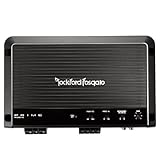
Rockford R1200-1D
- Class D monoblock
- 1200W RMS at 1 ohm
- 800W RMS at 2 ohm
- 400W RMS at 4 ohm
- CEA-2006 compliant

AUDIOZERONE ZE1000.1
- Class D monoblock
- 1000W RMS at 1 ohm
- 650W RMS at 2 ohm
- 400W RMS at 4 ohm
- 2 inch tall chassis
All 10 Best Car Amplifiers for Subwoofers Compared (October 2026)
The table below lists every amplifier in this roundup with its headline configuration. Use it to narrow the field by output level first, then read the individual reviews for the caveats that matter to your install.
| Product | Specifications | Action |
|---|---|---|
| BOSS R1100M |
|
Check Latest Price |
| Rockford R1200-1D |
|
Check Latest Price |
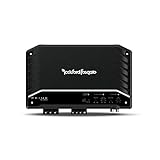 Rockford R2-1200X1 Rockford R2-1200X1 |
|
Check Latest Price |
| AUDIOZERONE ZE1000.1 |
|
Check Latest Price |
 Taramps HD 3000 Taramps HD 3000 |
|
Check Latest Price |
 Kenwood KAC-9106D Kenwood KAC-9106D |
|
Check Latest Price |
 Taramps BASS 400 Taramps BASS 400 |
|
Check Latest Price |
 Pioneer GM-A6704 Pioneer GM-A6704 |
|
Check Latest Price |
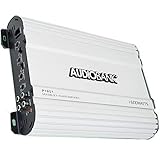 Audiobank P1601 Audiobank P1601 |
|
Check Latest Price |
 Taramps TS1200X4 Taramps TS1200X4 |
|
Check Latest Price |
1. BOSS Audio Systems R1100M – Best Overall Car Amplifier for Subwoofers
BOSS Audio Systems R1100M 1100 Watt Monoblock Car Amplifier
Class A/B monoblock
2-ohm stable
1100W max at 2 ohm
Remote sub level control
4.4 lbs
Pros
- Largest review base in the group at over 11000 ratings
- remote subwoofer level control included
- accepts both RCA and speaker-level inputs
- low-pass filter and bass boost
- 6 year warranty
Cons
- Class A/B topology draws more current than a Class D design
- 1100W is a maximum rating rather than RMS
- no protection status indicators during setup
This is the amplifier we recommend first, and the reason is not raw power. More than 11000 owner ratings averaging 4.4 stars makes this the best-documented monoblock in the group, which means the long-term failure pattern is well understood rather than a surprise. It sits at number 3 in Car Mono Amplifiers on Amazon, a ranking built on actual sales rather than marketing spend.
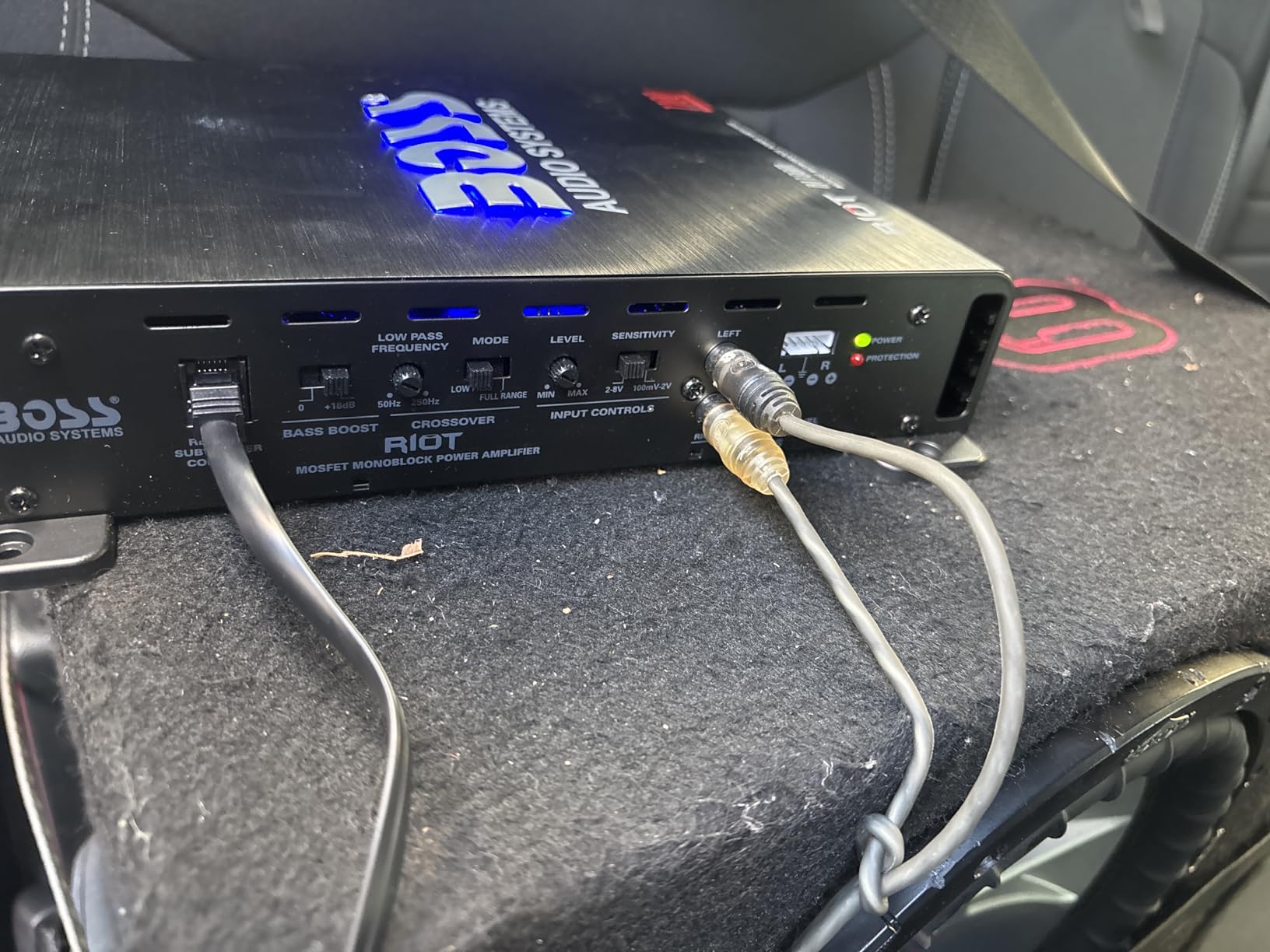
It is a Class A/B monoblock rated as 2-ohm stable, with 1100W maximum at 2 ohms and 550W maximum at 4 ohms. A MOSFET power supply, a variable low-pass filter, bass boost, and thermal, short and overload protection circuits round out a simple, forgiving design that a first-time installer can set up in an afternoon.
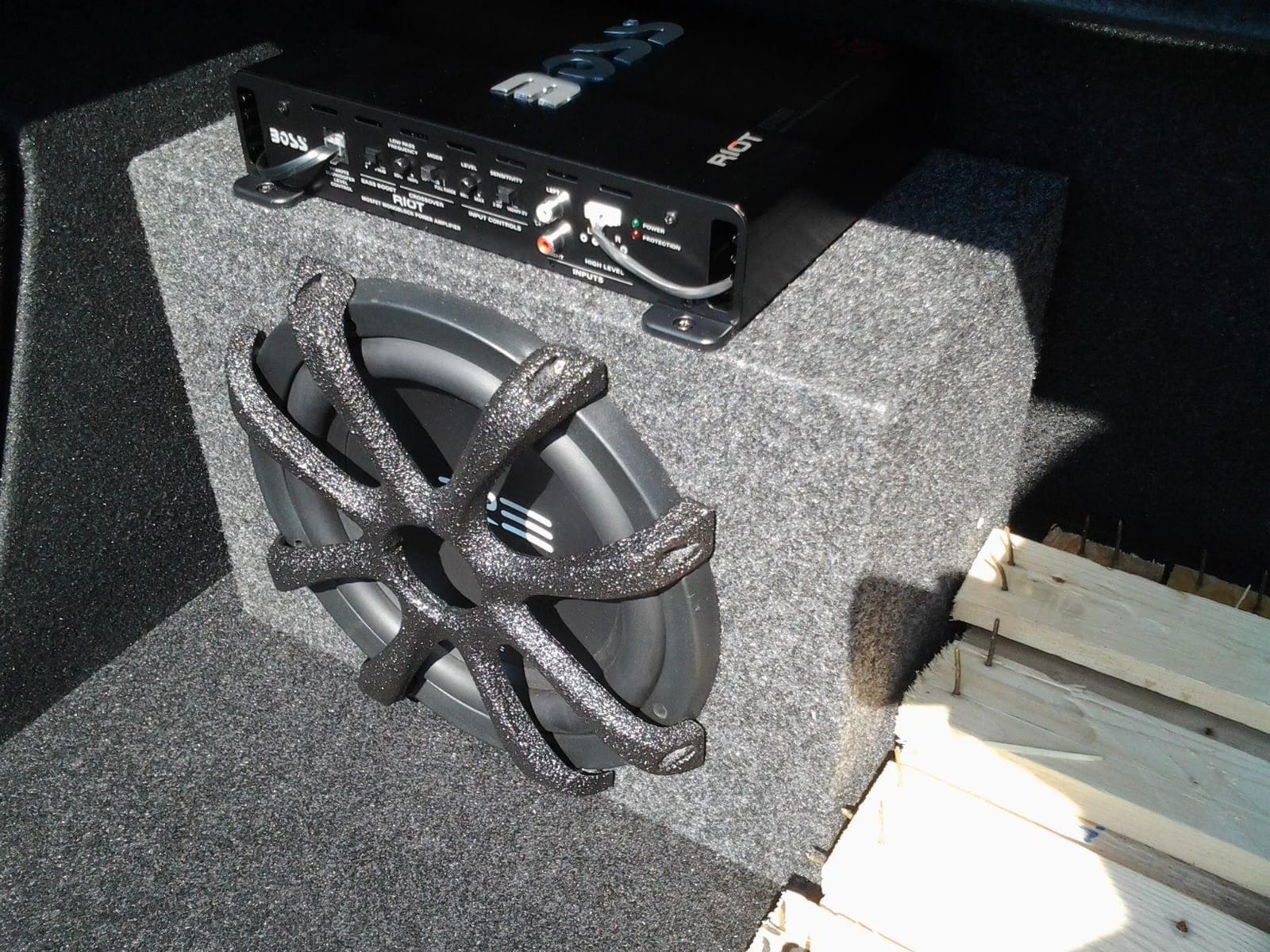
Two details make this the practical pick. The included remote subwoofer level control lets you trim bass from the driver’s seat, and the RCA plus speaker-level inputs mean it connects to a factory head unit that has no RCA outputs at all. The chassis is 2.25 inches tall and weighs 4.4 pounds, so it fits under a seat or deep in a trunk without drilling.
Be aware of one thing before you order: 1100W is a headline maximum, not a continuous figure, so real clean output into 2 ohms sits meaningfully below that number. The amp also draws more current than a Class D equivalent of the same output, which matters if your factory alternator and battery are already working hard. On a heavily loaded electrical system, expect to add wiring and a Big 3 upgrade.
When this amp fits your build
Choose the R1100M if you are adding bass to a factory stereo, if your subwoofer is wired to present a 2-ohm or 4-ohm load, and if you want a dash knob without buying one separately. It suits a single 10-inch or 12-inch subwoofer in a daily driver, and the 6-year warranty gives some long-term reassurance that budget rivals cannot match.
It is also the sensible pick for a first system where you will add a second subwoofer later. Because it is only 2-ohm stable, the upgrade path means adding a second amplifier rather than wiring a harder load into this one.
When to buy something else
Skip it if you plan to run competition-style output, because a single Class A/B unit at this level cannot feed a 1-ohm load and will not deliver the current a high-SPL build needs. It is also the wrong choice for a tightly sealed install with no airflow, where a Class D chassis with a much smaller heat load is the safer option.
If your subwoofer is rated well above 500 watts RMS, look at the Class D monoblocks further down this list instead. You want headroom, and a Class A/B design at a lower efficiency simply does not have it.
2. Rockford Fosgate R1200-1D – Best Rated Monoblock With Honest RMS Numbers
Rockford Fosgate R1200-1D Prime 1,200 Watt Class-D Mono Amplifier
Class D monoblock
1200W RMS at 1 ohm
800W RMS at 2 ohm
400W RMS at 4 ohm
7.1 lbs
Pros
- Genuine CEA-2006 compliant power ratings
- 4.6 star average with 82 percent five-star ratings
- Class D efficiency reduces electrical demand
- stable at both 1 ohm and 2 ohm
- aluminum alloy chassis
Cons
- Carries a higher price than budget monoblock options
- entry-level Prime series feature set
- no remote subwoofer level control listed
The R1200-1D is the amplifier we trust when the buyer cares most about honest power figures. It is rated 1200 watts RMS at 1 ohm, 800 watts RMS at 2 ohms, and 400 watts RMS at 4 ohms under CEA-2006 compliance, which is the standard that forces manufacturers to publish real continuous output rather than a headline maximum.
That is a genuine differentiator. In this roundup several competitors advertise a maximum wattage and then stop, leaving you to guess the continuous figure. A 4.6-star average from 1163 reviews, with 82 percent of buyers handing over five stars, suggests the gap between the label and the reality is smaller here than elsewhere.
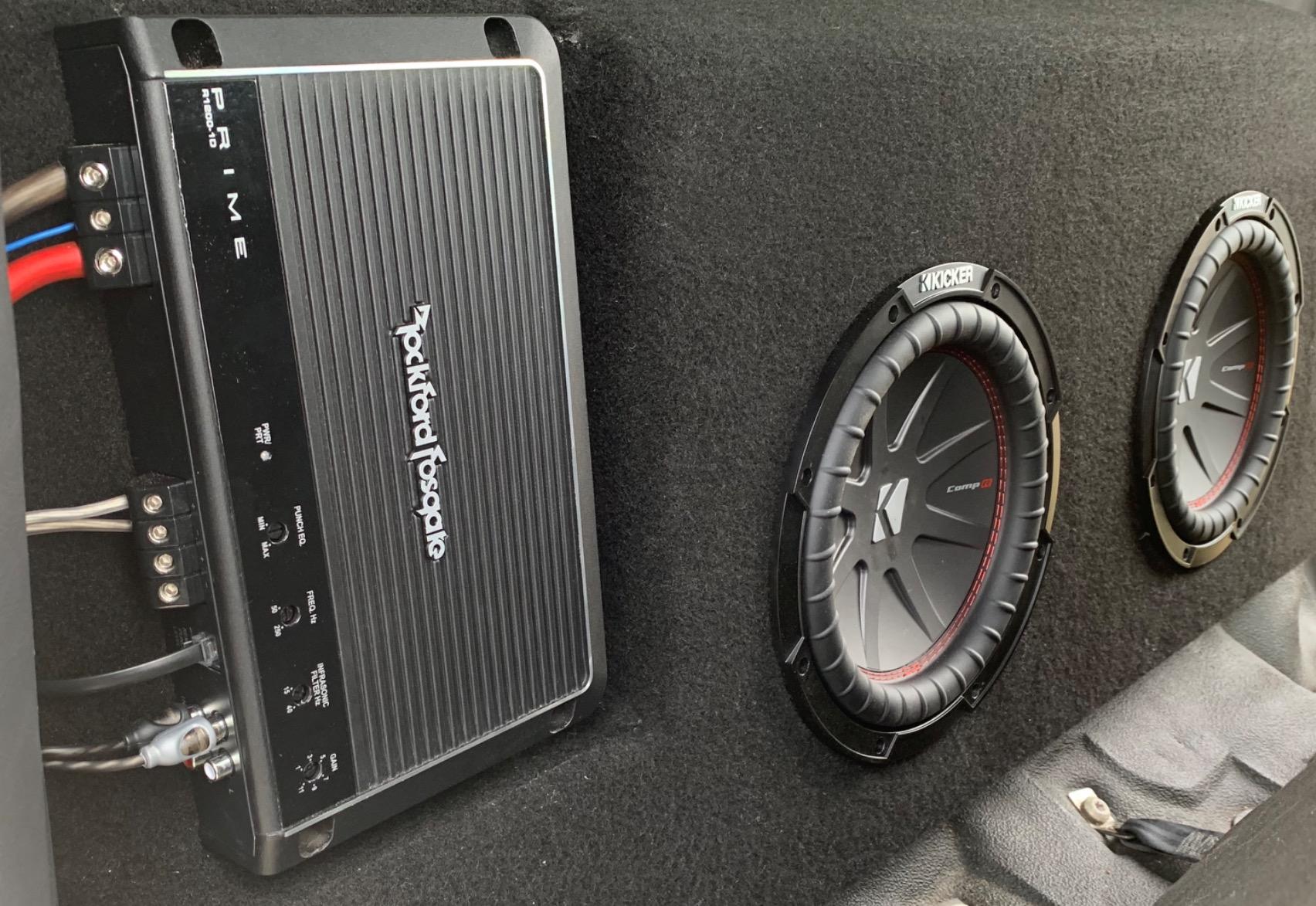
Class D efficiency is the other reason this one stands out. Switching designs waste far less energy as heat, so the amplifier asks less of the vehicle’s charging system while delivering considerably more current into a 1-ohm load than the Class A/B options here. The aluminum alloy body handles the residual heat well, and the unit weighs 7.1 pounds.
Feature-wise it is deliberately plain. There is no remote level control in the specification list, and the Prime series sits below Rockford Fosgate’s Punch and BD lines in tuning electronics. If you want a dashboard knob and a calibration circuit, the R2-1200X1 below covers that, and if you want a lower-cost entry point the AUDIOZERONE covers the wattage.
Check the R1200-1D if power headroom is the priority
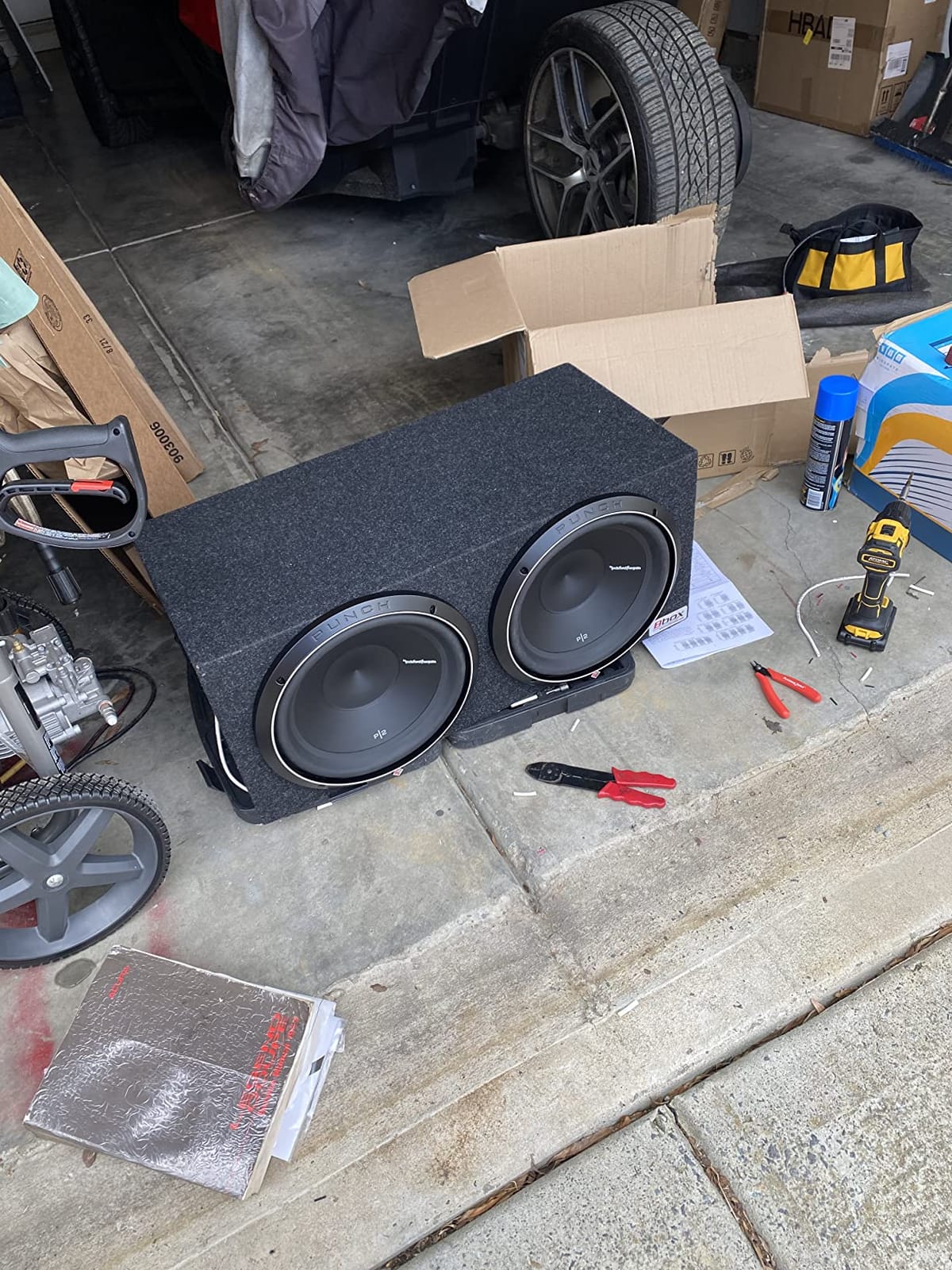
This is the pick for a single 12-inch subwoofer rated around 800 to 1000 watts RMS, or for two 8-inch or 10-inch drivers you intend to wire to a 2-ohm load. Buying an amplifier with more capability than the subwoofer needs is the cheapest form of insurance against clipping distortion, and that is exactly what this unit provides.
It also suits anyone who plans to grow the system. One amplifier here covers a modest subwoofer today and a pair of subs later without a second purchase.
Where it falls short
The price is the first hurdle, since this sits well above the entry-level Class D options in this list. Second, the lack of a remote subwoofer level control means you will be reaching into the trunk to trim bass, or adding a separate knob wired to the remote lead.
If your build is entirely new and your priority is a finished, driveable system rather than maximum output, you are paying for capability you may never use. In that case a mid-tier monoblock or a four-channel amp is a better use of the same money.
3. Rockford Fosgate R2-1200X1 – Best Subwoofer Amplifier for Sound Quality
Rockford Fosgate Prime R2-1200X1 1200-Watt Mono Amplifier
Class D mono amplifier
1200W RMS at 1 ohm
C.L.E.A.N. gain calibration
Variable infrasonic filter
Remote level control
Pros
- Highest average rating in the roundup at 4.7 stars
- C.L.E.A.N. circuitry guides correct gain setting
- variable infrasonic filter protects the subwoofer from deep distortion
- remote level control included
- Punch EQ bass boost
Cons
- Highest price in this group of monoblock amplifiers
- only a 1-year manufacturer warranty
- larger and heavier footprint than compact budget amps
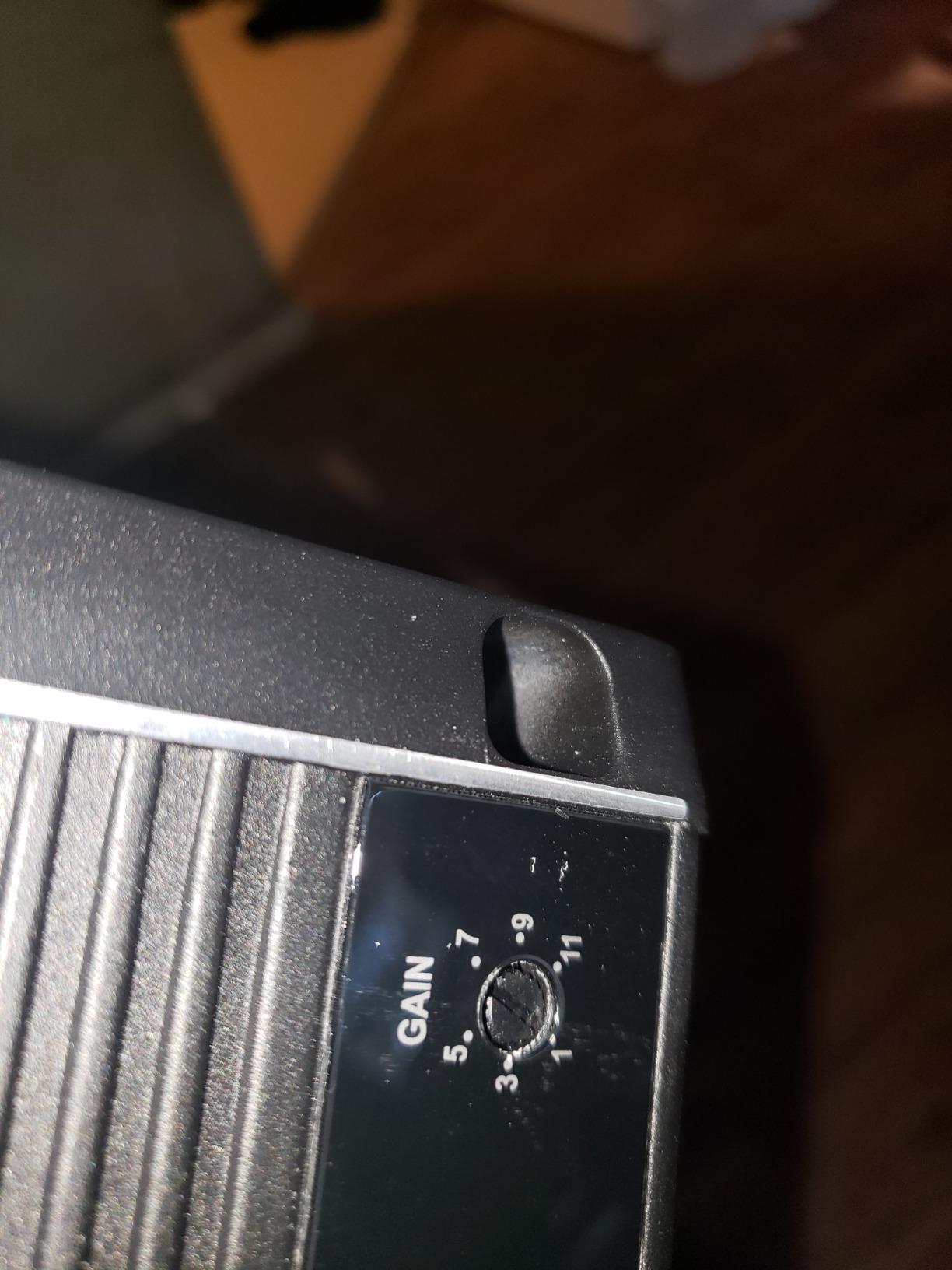
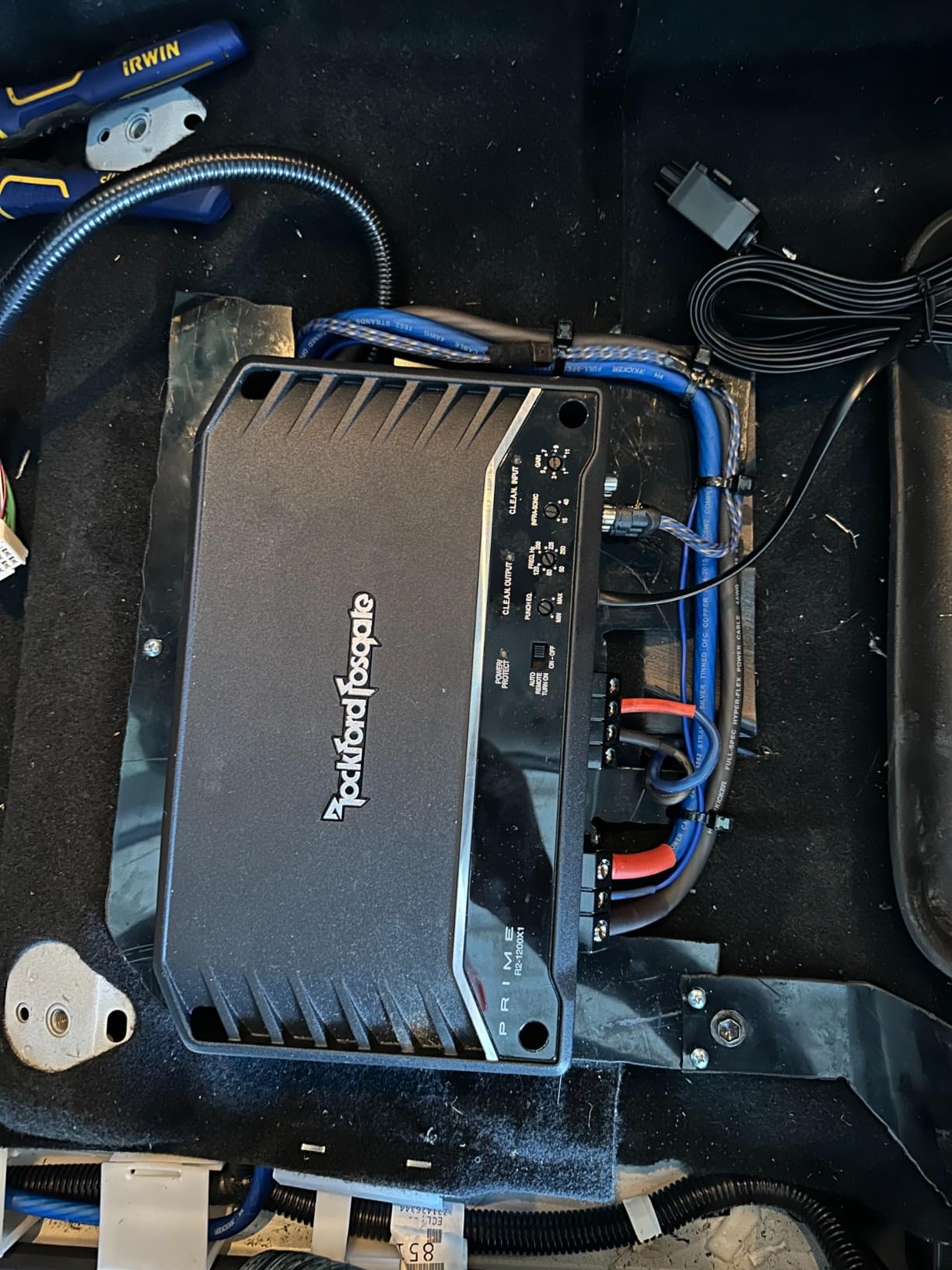
At 4.7 stars from 436 reviews, this is the highest-rated amplifier we included, and the reason is tuning hardware rather than brute output. The C.L.E.A.N. circuit monitors the signal and indicates when distortion appears, which turns the most error-prone part of installing a subwoofer amplifier into a guided process instead of a guess.
Underneath, the power stage is the same shape as the R1200-1D: 400 watts RMS at 4 ohms, 800 watts RMS at 2 ohms, and 1200 watts RMS at 1 ohm. The P.O.W.E.R. supply raises output as system voltage climbs, so the amplifier gains a little headroom from a healthy charging system.
The variable infrasonic filter is the feature that matters most for subwoofer longevity. A subwoofer playing below its usable excursion range wastes power and distorts badly, and rolling off those frequencies before they reach the driver is cheaper than a blown voice coil. Combined with the integrated Punch EQ, it gives a decent starting point for correction without a separate digital signal processor.
It is also full-range, so the same filtering controls let it drive door speakers if a compact build needs one amplifier for everything. The remote level control is included, which the cheaper Rockford model in this list does not offer.
Who this amplifier suits
Pick the R2-1200X1 if you are building a sound-quality-oriented system where the subwoofer integrates with the front stage rather than dominating it. It is also our choice for anyone nervous about clipping a costly subwoofer on a first powerful install, because the calibration circuit removes most of the guesswork from gain setting.
For a single high-quality 12-inch subwoofer, or a pair of 10-inch drivers on a 2-ohm load, the power and the filtering both line up well.
Reasons to pass
This is the most expensive monoblock in the roundup, and for many installs the R1200-1D delivers comparable continuous power for noticeably less money. The 1-year manufacturer warranty is also shorter than the coverage offered by several rivals, which matters if you plan to keep the car for a long time.
The footprint is also large. If trunk space is tight, a compact 2-inch chassis like the AUDIOZERONE or the Taramps BASS 400 is a better physical fit, and we would rather you buy the amplifier that physically fits than the one with the longest feature list.
4. AUDIOZERONE ZE1000.1 – Best Value Car Amplifier for Subwoofers
AUDIOZERONE Car Audio Amplifier ZE1000.1 2000W Monoblock Class D MOSFET Subwoofer Audio, 1-4 Ohm Stable, Low Pass Crossover, Mosfet Power Supply, Stereo
Class D monoblock
1000W RMS at 1 ohm
650W RMS at 2 ohm
400W RMS at 4 ohm
6.6 lbs
Pros
- Independently measured output lands close to the rated figures
- stays cool under sustained load with 10-inch and 12-inch subwoofers
- 1-ohm stable
- compact 2 inch tall chassis
- strong power-to-price ratio
Cons
- Allen-key style screw terminals are criticized for loosening under bass vibration
- some units reported failing after a few months
- basic adjustment controls with no RCA output
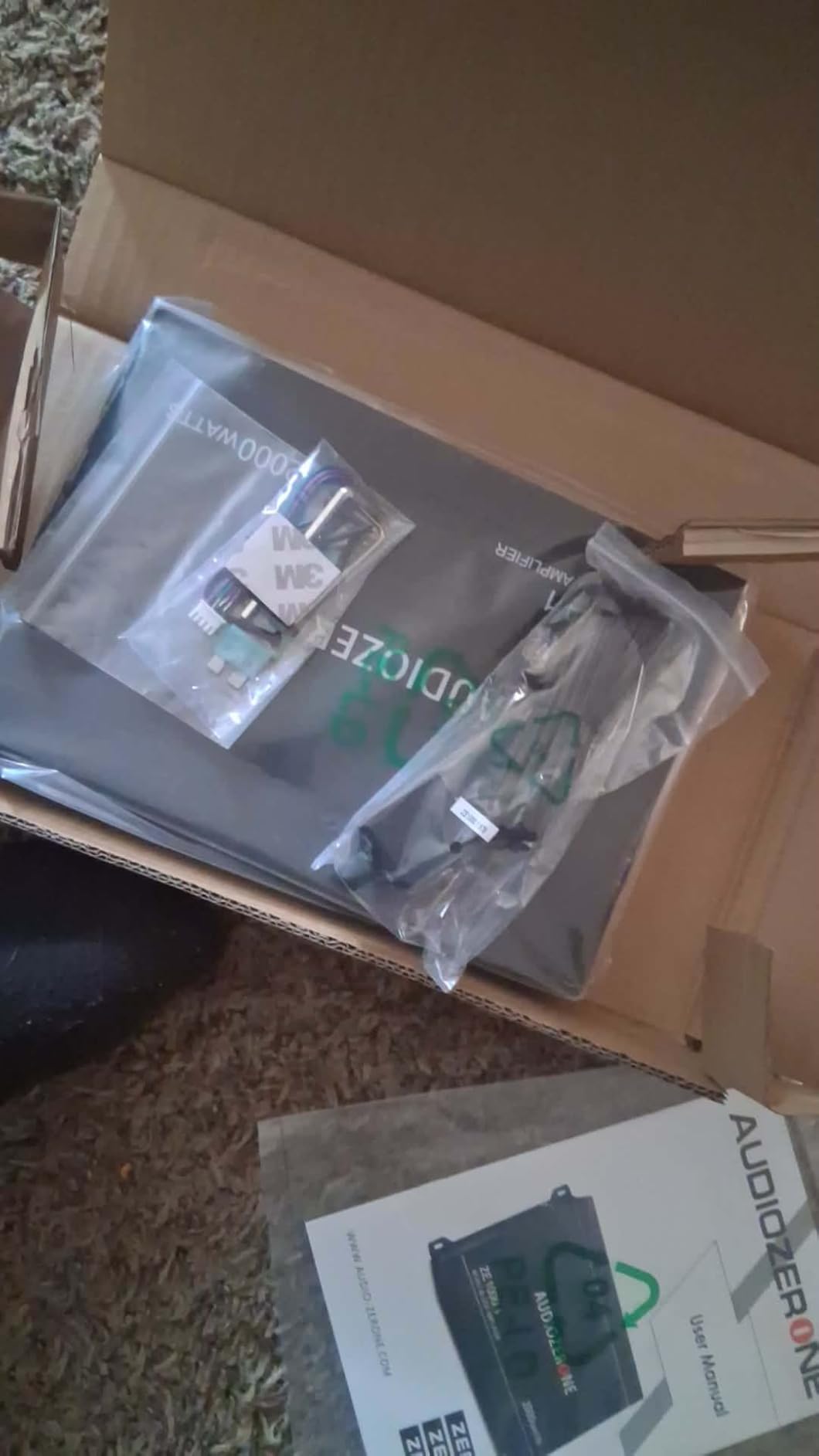
The ZE1000.1 is the pick we return to when the goal is the most usable Class D power per unit of money. It is rated 1000 watts RMS at 1 ohm, 650 watts RMS at 2 ohms, and 400 watts RMS at 4 ohms, and independent measurements have landed near 997 watts, 666 watts, and 412 watts at those same loads. That is unusual accuracy for a value-tier amplifier.
Owners repeatedly single out how cool it runs. Class D efficiency means the chassis sheds heat instead of storing it, and reviewers driving 10-inch and 12-inch subwoofers hard report no thermal complaints at all. The 2-inch-tall, 11 by 6.9 inch chassis at 6.6 pounds mounts almost anywhere a monoblock will fit.
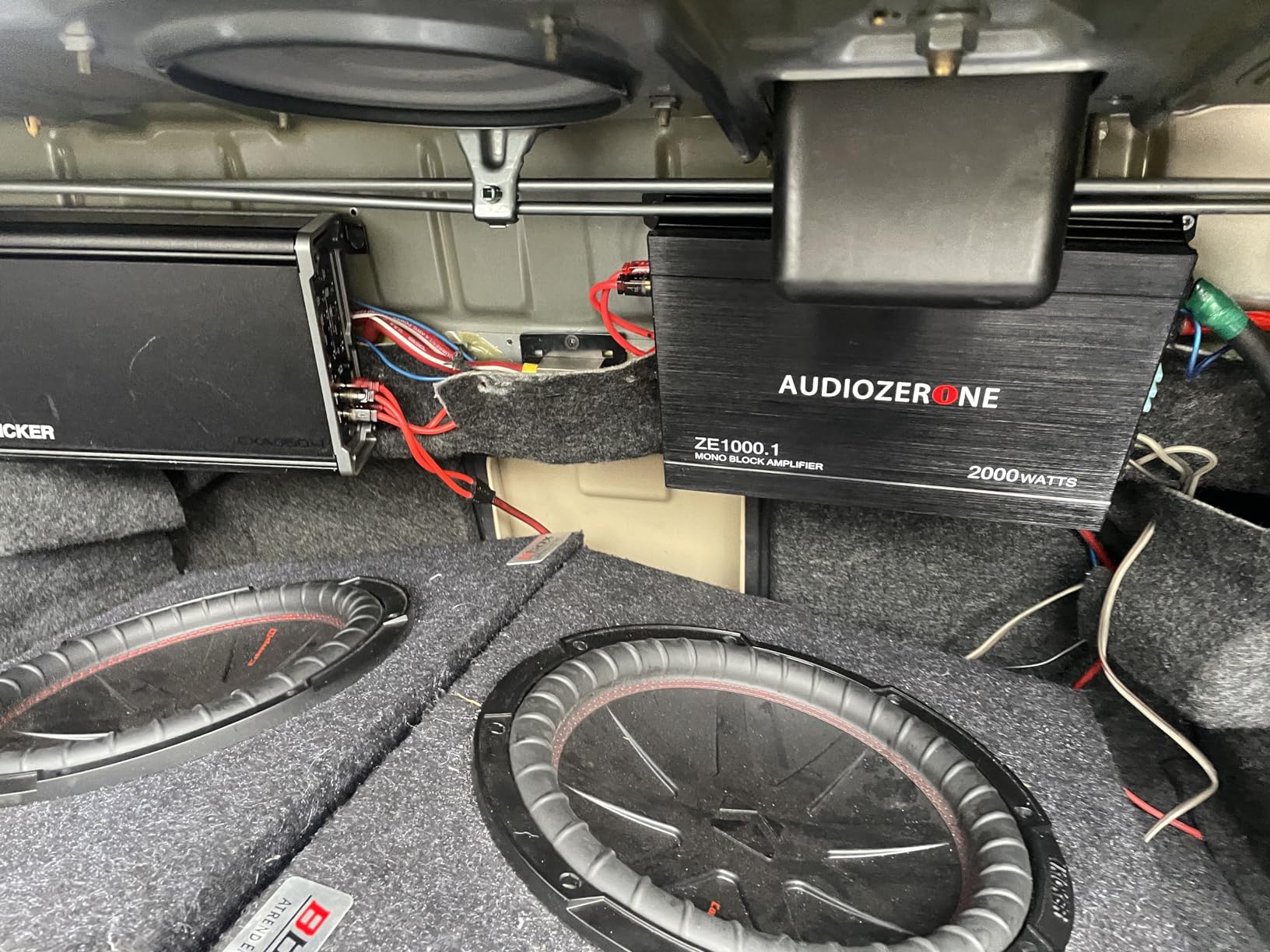
It is stable at 1, 2 and 4 ohms with a low-pass crossover, thermal, overload and short circuit protection, and it operates down to a 14.4 volt supply, which is worth checking if your vehicle spends time running very low voltage. At 755 reviews with a 4.4-star average, the feedback volume is large enough to trust.
The weakness is hardware, not circuitry. The screw terminals for power, ground, remote and speaker output are the most common complaint, and they can loosen under the vibration of heavy bass if they are not re-checked after installation. The adjustment controls are also basic, with no RCA output pass-through and limited filtering options.
Best use for the ZE1000.1
This is the amplifier for a single 12-inch subwoofer rated around 600 to 800 watts RMS, wired to present a 1-ohm or 2-ohm load, in a daily-driver build where efficiency and reliability under repetition matter more than feature depth. It is also our default recommendation for a first proper monoblock.
If you need a remote knob from the factory, this amplifier does not include one. Budgeting for an aftermarket level control is a small addition, and we would rather flag that now than have you discover it on install day.
Where caution is warranted
There is a recurring theme in reviews of units failing after a few months, with blown internal fuses or a dead short reported, along with a handful of units arriving dead on delivery. Exchanges have been honored in those cases, but a warranty claim is an inconvenience you may not want to repeat.
Also remember that 1000 watts RMS at 1 ohm is a lot of current. Feeding it properly means a heavy-gauge power wire, a correctly sized fuse, and a charging system that can keep up. On an otherwise factory electrical setup, budget for that work before the amplifier goes in.
5. Taramps HD 3000 – Best High Power Monoblock for Competition Builds
Taramps HD 3000 1 Ohm 3000W RMS Full Range Monoblock Car Audio Amplifier
Class D monoblock
3000W RMS at 1 ohm
Stable at 1, 2 and 4 ohm
Full range 10Hz-20kHz
Variable HPF, LPF, gain, bass boost
Pros
- 3000W RMS at 1 ohm
- full 10Hz-20kHz response makes it usable beyond a dedicated subwoofer
- stable at 1
- 2 and 4 ohm loads
- variable HPF
- LPF
- gain and bass boost
- RCA input with monitor level remote support
Cons
- Highest share of 1-star reviews among the well reviewed models here
- needs substantial power and ground wiring
- 150A fuse rating demands a near full capacity upgrade
- 1-year warranty
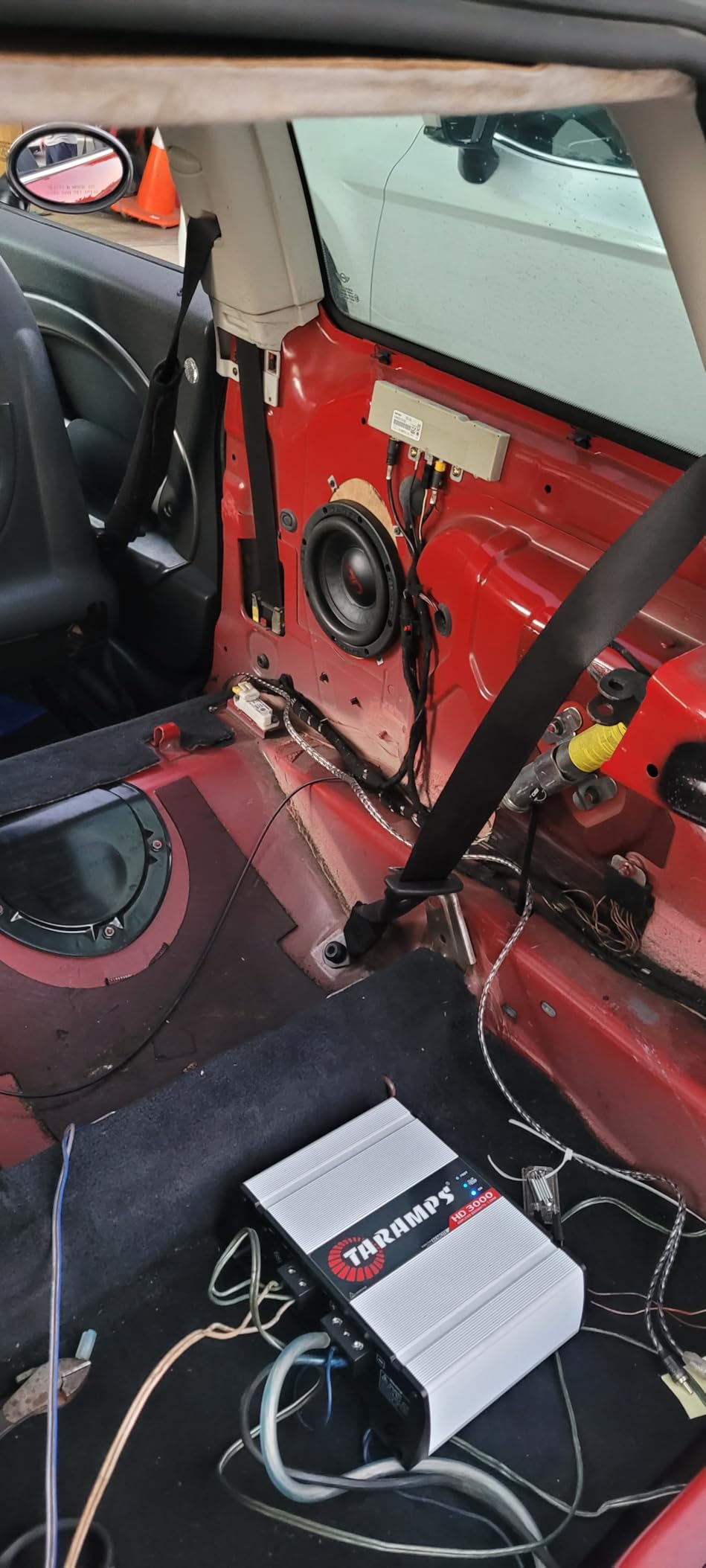
Nothing else in this roundup comes close to 3000 watts RMS at 1 ohm, and if your goal is a high-output competition build the HD 3000 is the only sensible choice here. At 4.3 stars from 783 reviews it sits mid-pack for rating, but the wattage is in a different class from everything else on this list.
The full-range 10Hz to 20kHz frequency response is unusual for a monoblock. Most dedicated subwoofer amplifiers roll off hard above 200Hz, while this one can drive mid-bass or full-range drivers alongside a subwoofer, which some competition builds use to share one amplifier.
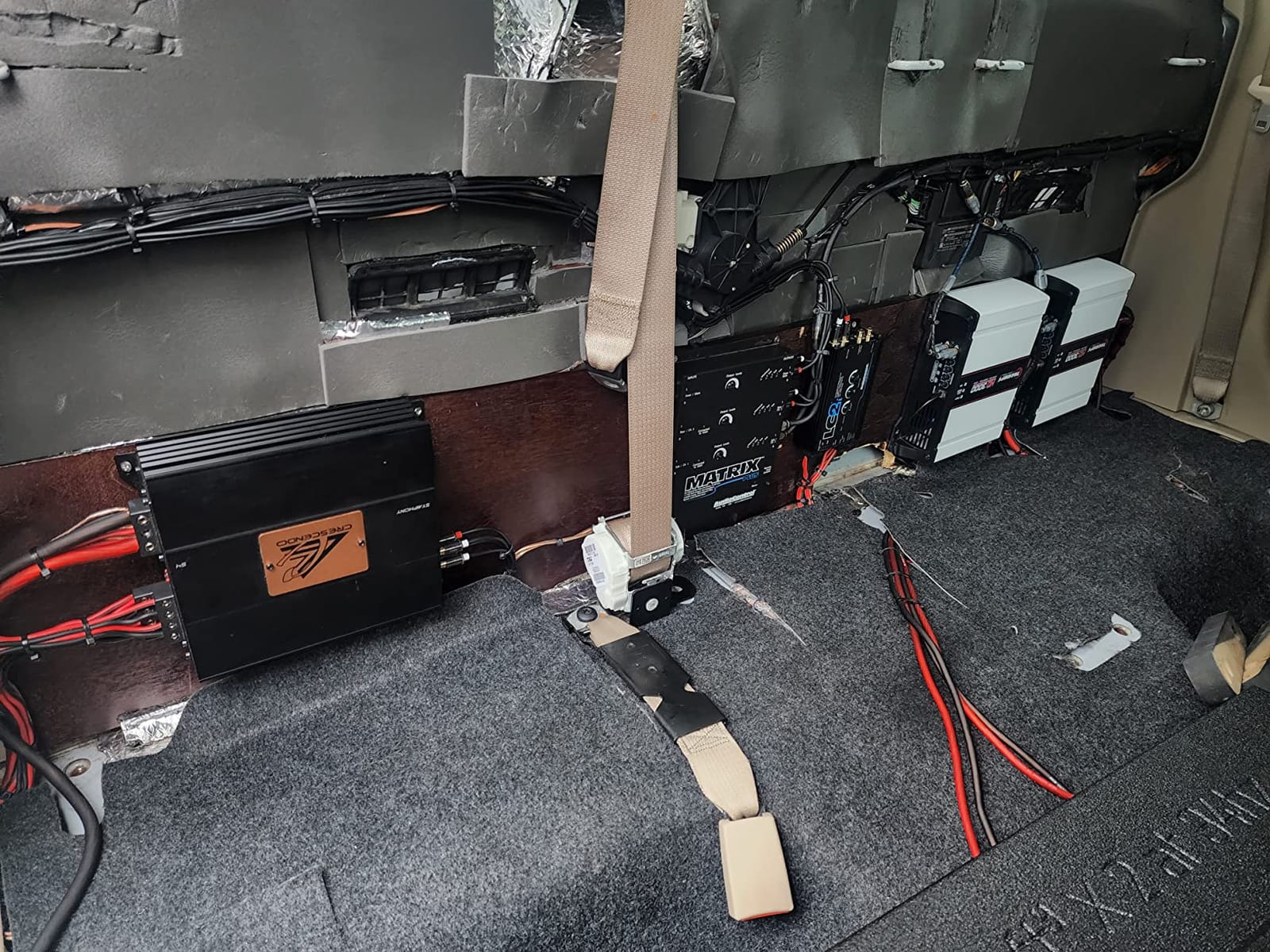
Control is generous: variable high-pass, low-pass, gain and bass boost, plus an RCA input and compatibility with a monitor-level remote. The aluminum housing and surface-mount format suit a trunk or seat install, and the specification sheet calls for 4 AWG power cabling, 9 AWG output cables and a 150A fuse, which tells you immediately what the electrical side of this build involves.
That fuse rating is the real headline. A 150A fuse on a factory charging system is not realistic, so this amplifier pairs with a high-output alternator, an upgraded battery, and a Big 3 replacement. Plan the electrical work before you buy the subwoofer, not after.
When the HD 3000 is the right tool
Choose it for a single high-excursion 15-inch subwoofer, for multiple 12-inch subwoofers, or for an SPL build where the system is designed to be driven into its limits in a controlled setting. Stable operation at 1, 2 and 4 ohms also means the wiring plan is flexible as the system grows.
The 10 percent of buyers who leave a one-star rating are worth understanding too. Early failures do appear in the feedback, and for a build you intend to use hard, that is a real risk factor rather than a footnote.
When it is the wrong choice
This amplifier is far more than a daily driver needs. If your subwoofer is rated 400 to 600 watts RMS, the AUDIOZERONE ZE1000.1 or the Rockford R1200-1D will drive it with headroom, run cooler, and cost less to install. Overbuying a subwoofer amplifier mostly wastes money and adds strain to the electrical system.
It is also a poor match for a tight sealed install with minimal airflow, and the 1-year warranty is thin for a component you may run at high temperature. If your build is modest, be honest about the numbers and pick a mid-range Class D unit instead.
6. Kenwood KAC-9106D – Best Subwoofer Amplifier for Factory Systems
Kenwood KAC-9106D 2000W Monoblock Class D Car Audio Power Amplifier
Class D mono sub amp
1000W RMS at 2 ohm
500W RMS at 4 ohm
24 dB per octave LPF
Speaker-level inputs
Pros
- Speaker-level inputs with signal-sensing turn-on for direct factory head unit integration
- steep 24 dB per octave low-pass filter from 50-200Hz
- 500W RMS at 4 ohm and 1000W RMS at 2 ohm
- established major car audio brand
- CEA-2006 compliant
Cons
- Output ceiling of 1000W at 2 ohm is modest for a 2000W class monoblock
- legacy design with a lower recent sales rank
- longer and larger chassis than modern compact units
- 1-year warranty
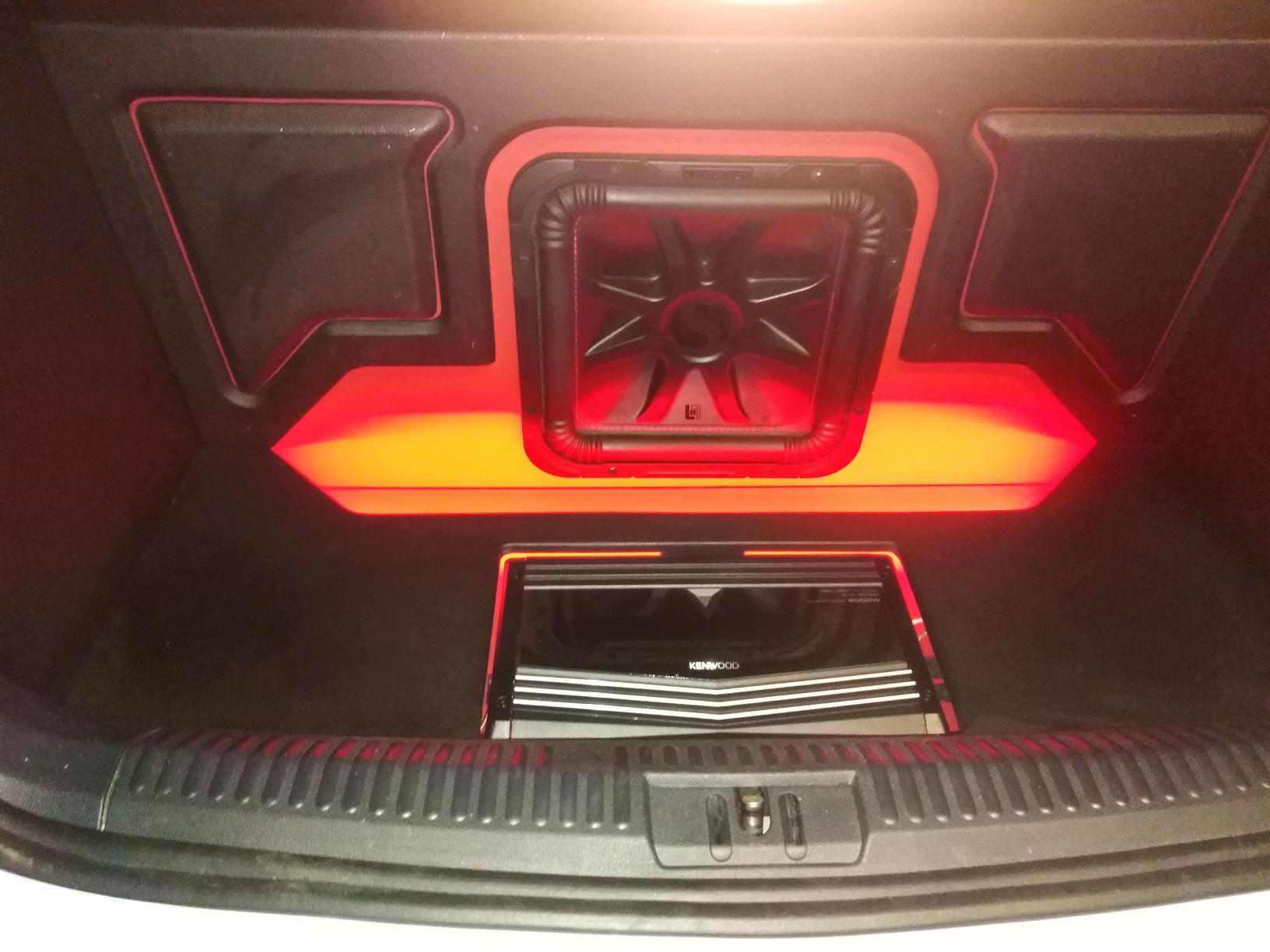
The KAC-9106D solves a specific problem better than anything else here: adding a subwoofer to a factory head unit that has no RCA outputs. The speaker-level inputs and signal-sensing turn-on let the amplifier wake up from the speaker signal itself, so no line output converter and no manual turn-on wire are required.
That is why it is our factory-integration pick, and why it earns a place on a roundup otherwise dominated by high-power Class D designs. Kenwood remains a recognised name in car audio, and the 4.3-star average from 494 reviews reflects an amplifier that does one job competently rather than everything half well.
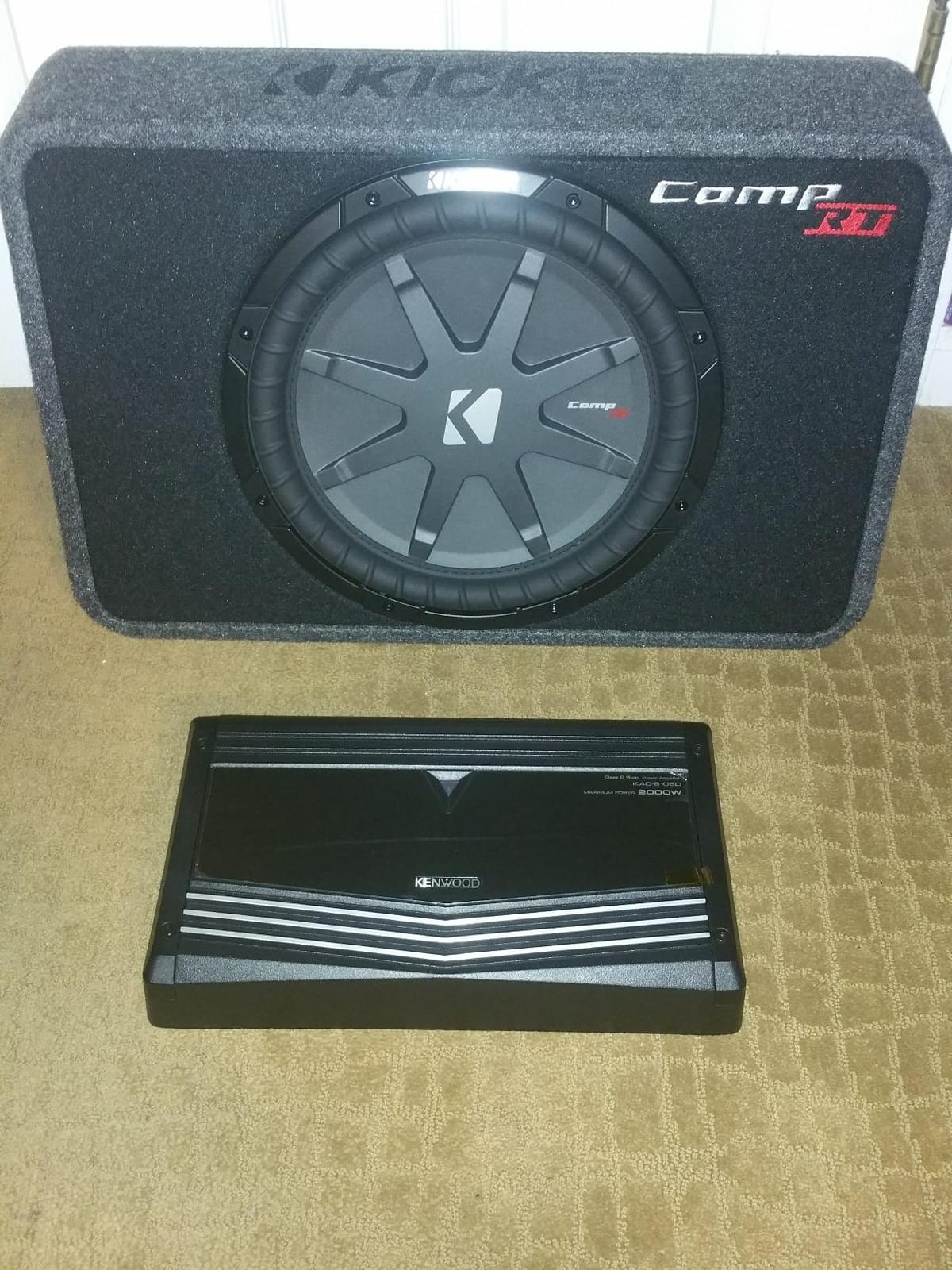
The low-pass filter is the other standout. A variable 50Hz to 200Hz control at 24 dB per octave is a steep slope, which means the subwoofer receives a much cleaner signal than it would from a 12 dB per octave control. Steeper filtering means less intermodulation distortion in the voice coil and less wasted excursion.
Output is 500 watts RMS at 4 ohms and 1000 watts RMS at 2 ohms under CEA-2006, with Class D efficiency limiting the load on the vehicle’s charging system. The chassis is larger and longer than modern compact monoblocks, so measure your trunk space before committing.
When this Kenwood makes sense
Buy the KAC-9106D if you are adding a single subwoofer to a factory system, if you want a steep crossover slope for a cleaner subwoofer signal, and if you would rather not install a separate line output converter. It pairs naturally with a mid-range 12-inch subwoofer in a sealed or small ported enclosure.
It is also a sensible choice when the head unit has no RCA pre-outs at all, since a speaker-level connection is then the only practical option.
Reasons to consider something else
The 1000 watt ceiling at 2 ohms leaves it well behind the 1200 to 3000 watt RMS monoblocks in this list. A pair of high-power 12-inch subwoofers will outrun it quickly, and you would need a second amplifier to grow.
It is also an older platform with a much lower recent sales rank than competing models, and the 1-year warranty is short. If your system is fully aftermarket with RCA outputs available, a modern Class D monoblock with more power and a longer warranty is the better long-term buy.
7. Taramps BASS 400 – Best Compact Subwoofer Amplifier for Small Installations
Taramps BASS 400 2 Ohms 400W RMS Monoblock Subwoofer Car Audio Amplifier
Class D mono amp
400W RMS at 2 ohm
8Hz-250Hz range
Parametric bass boost
620g aluminum
Pros
- Remarkably compact at 620g so it fits under a seat or in a spare tire well
- output measured close to the rated 400W RMS at 2 ohm
- runs cool without overheating
- parametric bass boost plus variable low-pass filter
- high-level inputs with automatic turn-on
Cons
- Low-pass filter slope of only 12 dB per octave
- cheap easily stripped terminal blocks and fragile adjustment knobs
- no onboard fuse
- only 400W RMS so it underdrives larger subwoofers
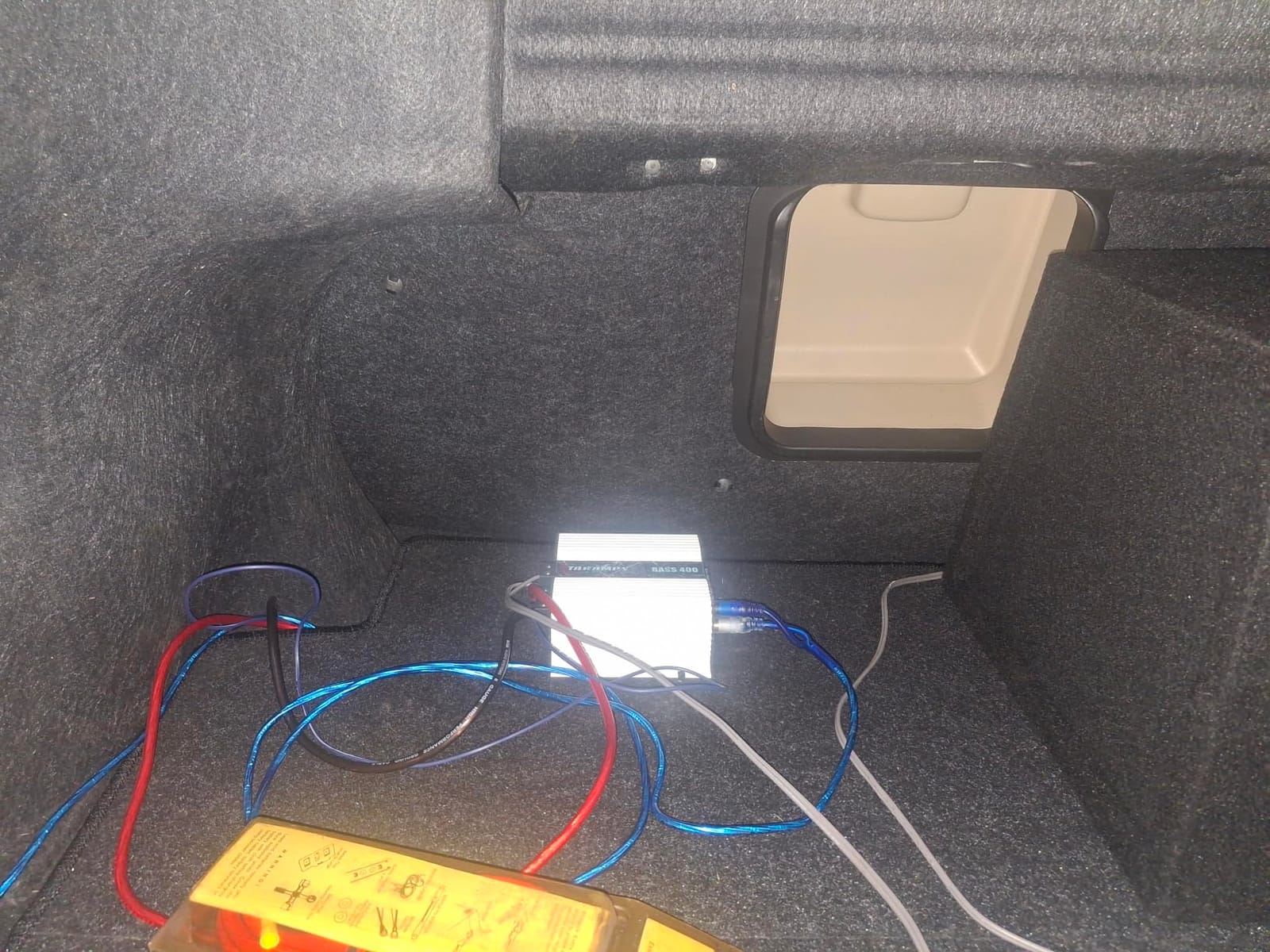
At 620 grams and roughly 6 inches square, the BASS 400 solves the problem that trips up plenty of otherwise good installs: no room. It mounts under a passenger seat, inside a spare tire well, or in a hatchback cavity where a full-size monoblock simply will not go. Owners routinely report driving multiple 10-inch and 12-inch subwoofers with it.
Despite the size, output measures close to the rated 400 watts RMS at 2 ohms, and third-party dyno testing has broadly corroborated the claim. It runs cool in extended use with no clipping or overheating reported, and the aluminum housing supports that.
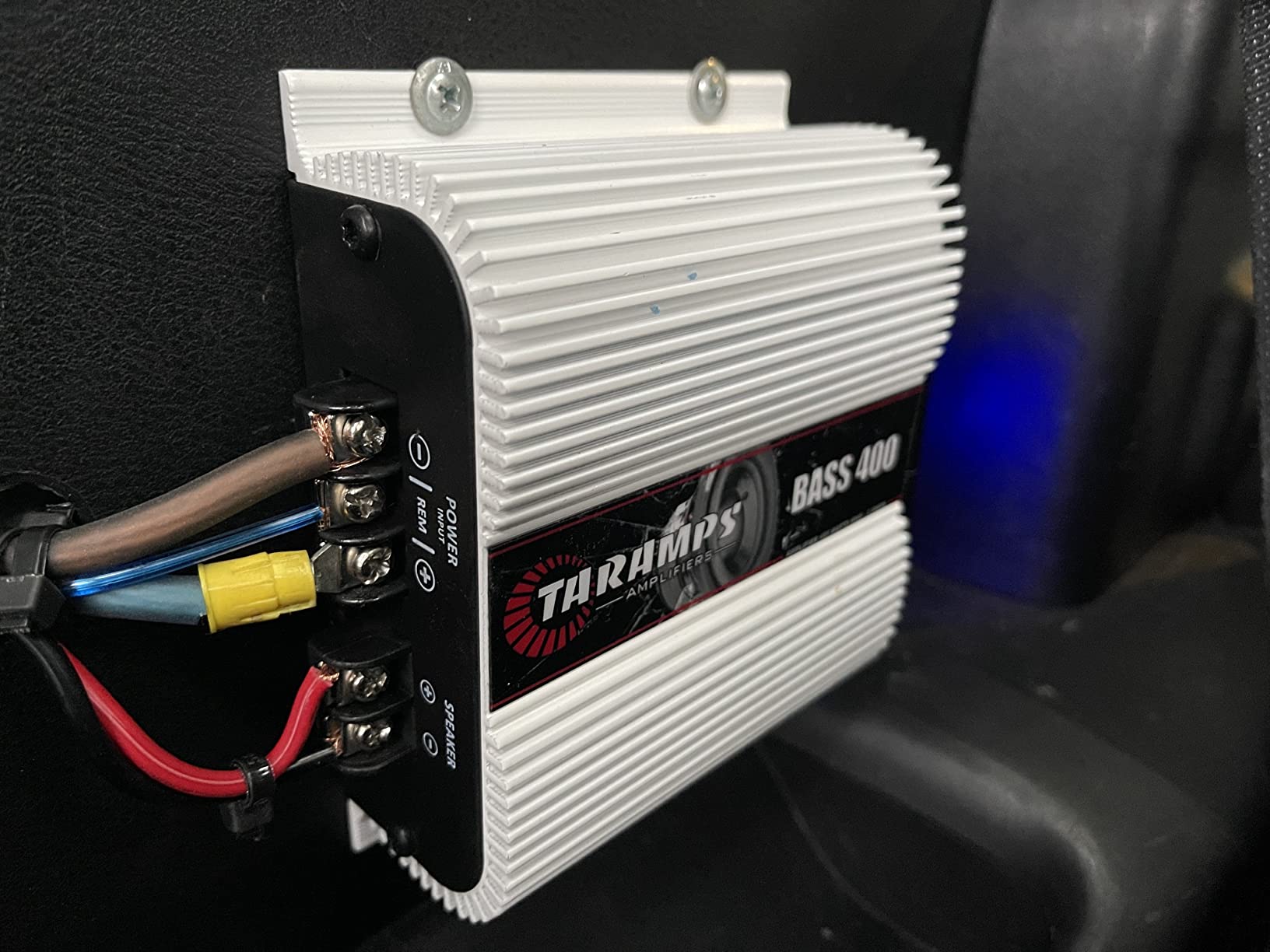
Control features are better than the size suggests. You get an 8Hz to 250Hz operating range, a variable low-pass filter, and a parametric bass boost from 35Hz to 55Hz with up to 12 dB of lift, which lets you target the boost at the frequency your subwoofer and enclosure actually produce rather than a fixed wide shelf.
High-level and RCA inputs with automatic high-level turn-on mean it works with a factory radio without a line output converter, and thermal plus short-circuit protection covers the basics.
Best fit for small cars and simple systems
This is the amplifier for a shallow mount subwoofer in a compact car, a spare-tire-well install, or a first system where the subwoofer is rated at 400 watts RMS or below. The automatic turn-on also makes it one of the easiest options to wire into a factory system.
If you want to add a second subwoofer later, choose it carefully. Two 400 watt drivers wired in parallel present 1 ohm, which this amplifier is not rated to sustain. Check the final load before you commit to a second subwoofer.
Where it falls short
The 12 dB per octave low-pass slope is the biggest technical compromise. Some higher frequencies bleed through to the subwoofer, and the Kenwood in this list offers 24 dB per octave for noticeably cleaner output if your system is built for quality over convenience.
Terminal blocks and knobs are also described as cheap and easy to strip, and there is no onboard fuse, so fusing must be handled in the power wire itself. For anything larger than 400 watts RMS, step up a tier rather than pushing this one.
8. Pioneer GM-A6704 – Best Four Channel Amp for Subs Plus Front Speakers
Pioneer GM-A6704 1000W Max Class AB Bridgeable 4-Channel Car Amplifier
4-channel Class A/B
60W RMS x 4 at 4 ohm
190W RMS x 2 bridged
Variable HPF and LPF
4.9 lbs
Pros
- One amplifier can run a bridged subwoofer pair and front door speakers
- variable high-pass and low-pass filters for system tuning
- runs cool without overheating
- clean low-distortion output
- long track record of reliability
Cons
- Bridged output of 190W RMS x 2 is modest for a serious subwoofer
- 60W RMS per channel is limited
- Class A/B topology produces more heat than Class D
- requires 4-gauge or heavier power wire
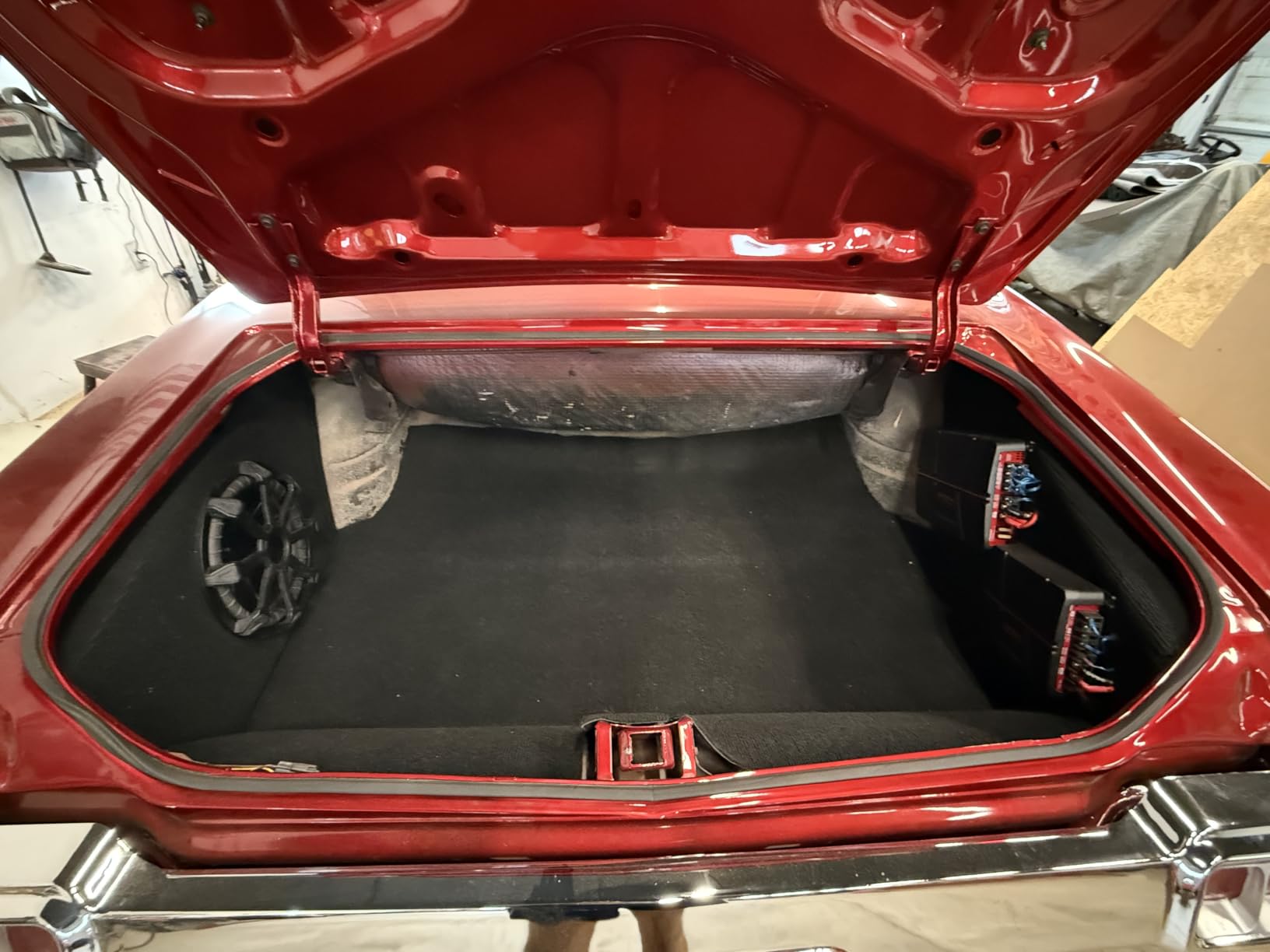
Most builds here pair a subwoofer amplifier with nothing else. The GM-A6704 answers a different question: what if one amplifier has to power a subwoofer and the front speakers too? Four channels of Class A/B amplification, 60 watts RMS per channel at 4 ohms, and bridgeable pairs give you that flexibility in a single box.
At 4.4 stars from 990 reviews with 69 percent five-star ratings, this is a well-proven entry-level amplifier, and the feedback pattern is consistent: clean output, straightforward installation, and long-term reliability. Reviewers with units running for years report no drama, which is the kind of track record most enthusiasts actually care about.

Variable high-pass and low-pass filters are the practical benefit. You can set the high-pass on the channels driving door speakers to keep them out of the deep bass the subwoofer handles, and the low-pass on the bridged pair to keep the subwoofer from being asked to play midrange.
Class A/B topology is a deliberate choice here. It is less efficient and warmer than Class D, but reviewers consistently describe the output as low-distortion with natural bass and detailed highs, and the unit runs cool in normal use at 4.9 pounds and 8.5 by 14 by 2.38 inches.
When a four-channel amp is the smarter buy
Choose the GM-A6704 for a first system build where the budget covers one amplifier rather than two, or to add bass to an existing system where the front speakers currently have no amplification. It is also a good match for a pair of modest door speakers plus a single small subwoofer.
Buyers upgrading a factory system get a lot of value here. Sixty watts per channel transforms thin, quiet door speakers, and the bridged pair handles a small subwoofer in the same install.
Why it is not a dedicated subwoofer answer
Bridged output of 190 watts RMS per channel is the hard limit. No matter how good the amplifier is, that is modest power for anything beyond a 10-inch or small 12-inch subwoofer, and it is well short of what the monoblocks on this list deliver.
Two further cautions. Class A/B efficiency means a heavier current draw and more heat than a Class D equivalent, so the amplifier needs 4-gauge or heavier power wire and a properly sized fuse. And gain setting on this type of amplifier is critical, so set gains with a meter or a distortion detector before touching any EQ.
9. Audiobank P1601 – Best Budget Monoblock for Moderate Bass
Audiobank P1601 Monoblock Car Audio Amplifier – Class AB MOSFET, 1600W Max / 800W RMS Power, Remote Subwoofer Level Control
Class AB MOSFET monoblock
800W RMS rated output
1600W maximum
Remote sub level control
Surface mount
Pros
- Very low cost for 800W RMS of rated monoblock power
- Class AB topology is more forgiving of imperfect gain staging
- remote subwoofer level control included
- some owners report more than two years of trouble-free operation
Cons
- Runs hot and some units enter thermal protection after 30 to 40 minutes of sustained output
- undersized for 500W plus per subwoofer loads
- lowest average rating in the roundup at 4.1 stars
- limited documentation with no published dimensions
The P1601 is the cheapest route to a real monoblock in this roundup, and at moderate listening levels it delivers. It is rated at 800 watts RMS with a 1600 watt maximum figure, and owners driving multiple 10-inch and 12-inch subwoofers report strong, clean bass without the amplifier cutting out.
Class AB topology has a practical upside for first-time installers. It tends to be more tolerant of imperfect gain staging than many budget Class D designs, which means a slightly optimistic gain setting is less likely to produce immediate audible damage.
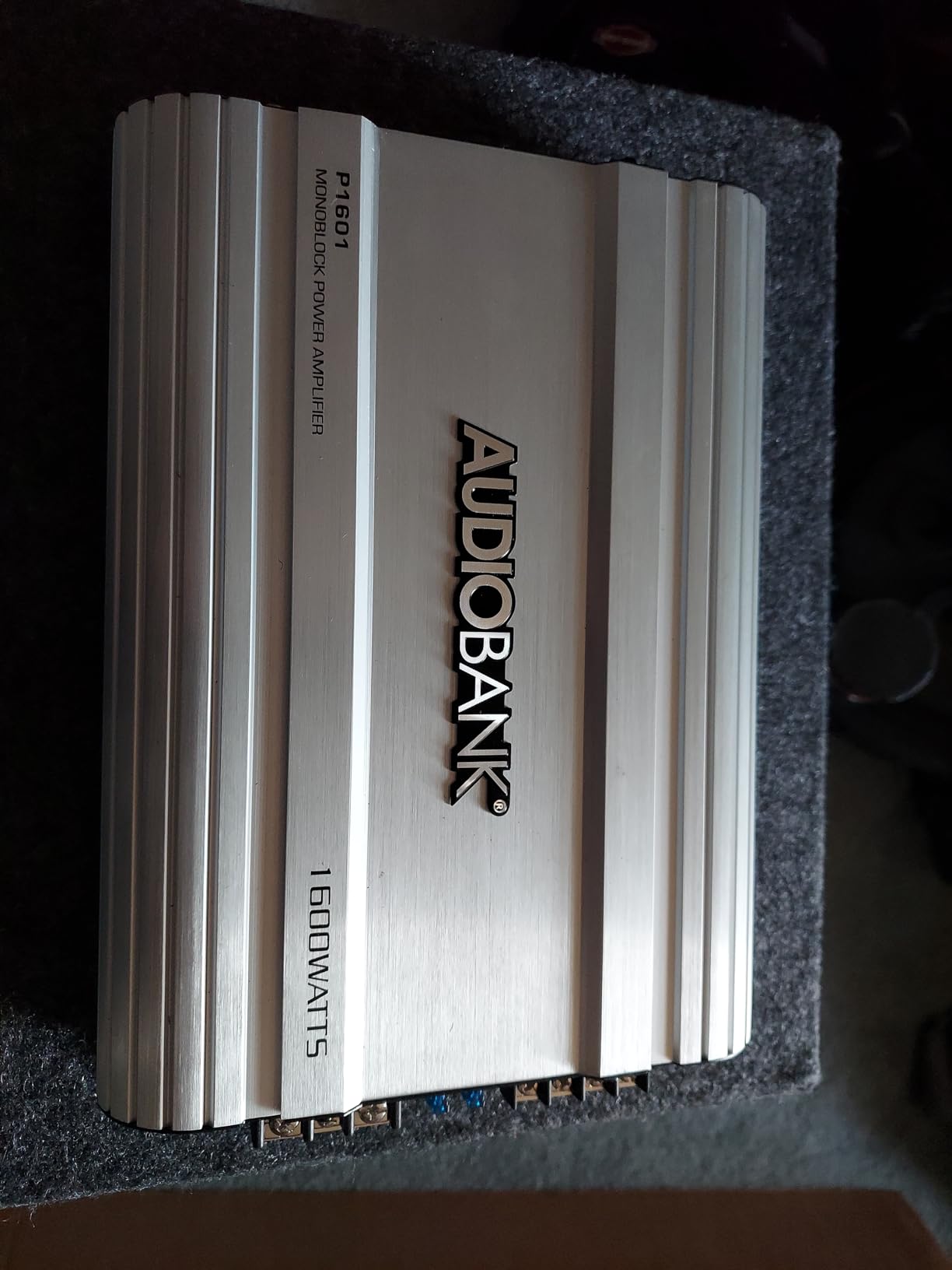
The remote subwoofer level control is included, and the terminals and settings are described as sturdy and easy to read. At 4.1 stars from 516 reviews, 63 percent of buyers are handing over five stars, and some report two-plus years of trouble-free operation with no overheating or protection trips.
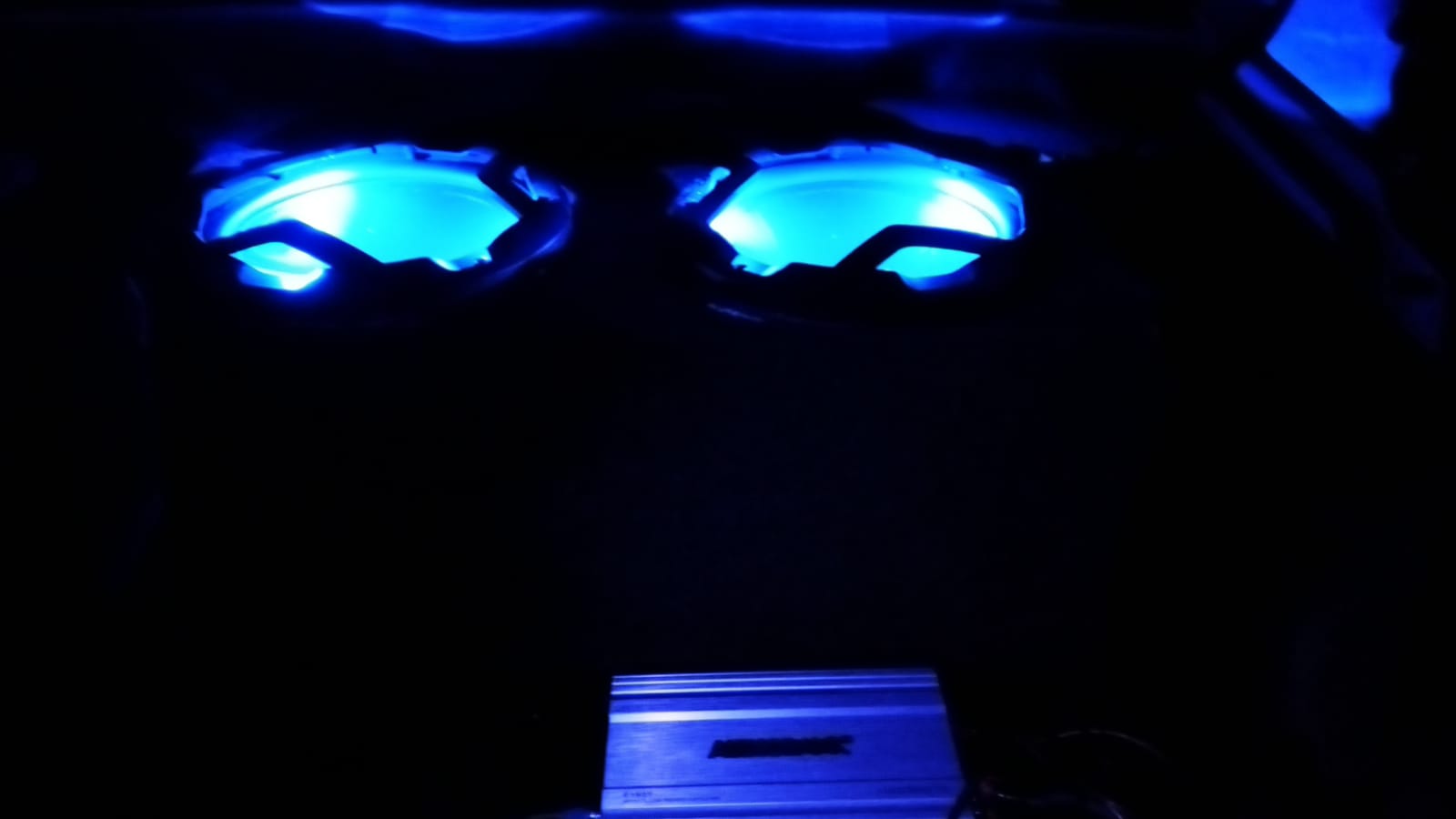
Heat is the defining problem, though. The 11 percent of one-star reviews concentrate on amplifiers entering thermal protection after 30 to 40 minutes of sustained high output, then shutting down to cool before resuming. That behaviour is inherent to a Class AB design of this size pushed hard.
Reasonable uses for the P1601
It suits a modest daily-driver bass setup, a single subwoofer rated well below 500 watts RMS, or a build where the amplifier will spend most of its life at moderate volume. Under those conditions the thermal complaints largely disappear and the value is genuine.
It is also a reasonable second amplifier once a system outgrows one, provided the two amplifiers share the same final load and gain structure.
When to spend more instead
If your subwoofer needs 500 watts RMS or more per driver, this amplifier is undersized and you will be asking it to operate continuously in the range that triggers its protection circuit. A Class D monoblock such as the AUDIOZERONE ZE1000.1 or the Kenwood KAC-9106D is a better long-term purchase.
It also carries the lowest average rating in the roundup, and the documentation is thin, with no published dimensions or weight. Measure carefully before ordering, and plan for airflow around the chassis.
10. Taramps TS1200X4 – Best Four Channel Amp for Two Subwoofers and Speakers
Taramps TS 1200 Watt Amp 4 Channel Amplifier Car Audio, Full Range Crossover Fixed RCA/Wire Input – Multichannel Class D, 2 Ohm Car Amplifier Kit Profesional Installation Recommended
4-channel Class D amp
300W RMS x 4 at 2 ohm
600W RMS x 2 bridged
High-level inputs
HPF, LPF and Full modes
Pros
- Bridging lets a channel pair drive a subwoofer at 600W RMS
- high-level speaker inputs with automatic turn-on for factory radios
- HPF
- LPF and Full crossover modes give real tuning flexibility
- Class D efficiency keeps heat manageable
- reinforced terminals
Cons
- 12 percent one-star rating hints at occasional early failures
- fixed RCA and wire input options with no adapter
- only 300W RMS per channel at 2 ohm for large subwoofers
- manufacturer recommends professional installation
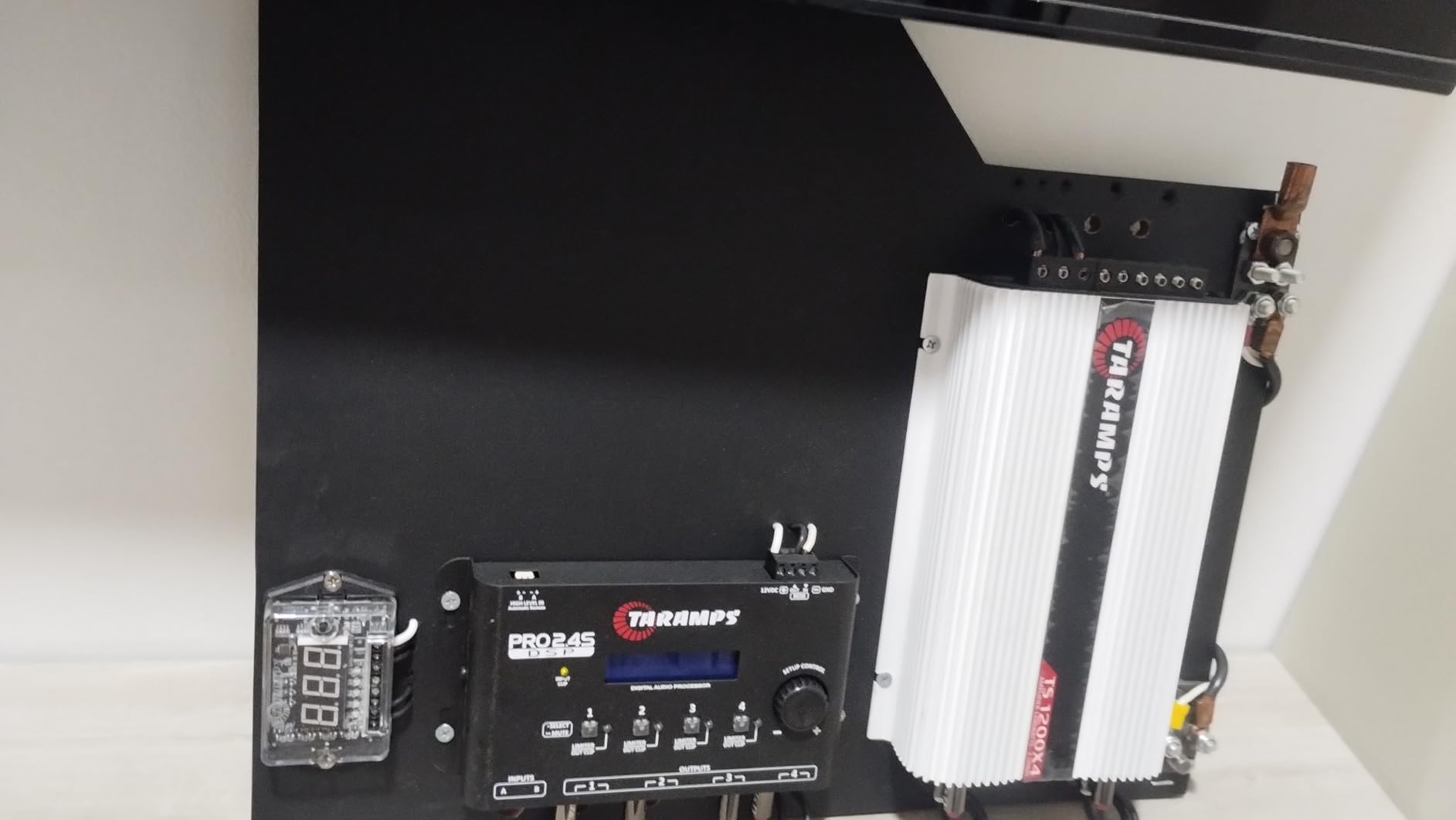
The TS1200X4 is the pick when you need one amplifier for two subwoofers plus speakers, or for a system where the subwoofer is not the only thing being powered. It delivers 300 watts RMS per channel at 2 ohms across four channels, or 600 watts RMS per pair when bridged at 4 ohms, all from a 1340 gram Class D chassis.
At 4.3 stars from 704 reviews with 77 percent five-star ratings, the feedback leans positive. Reviewers value the combination of bridging flexibility, factory-radio-ready high-level inputs, and three crossover modes at a price that keeps the whole build reasonable.
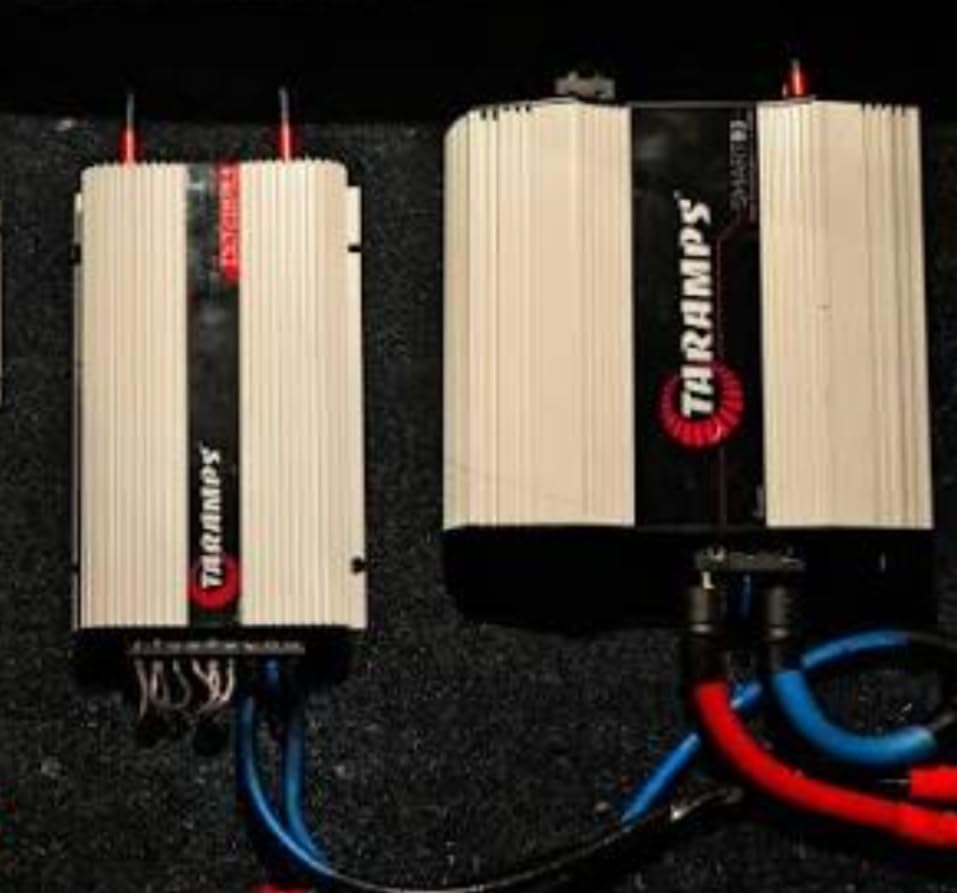
HPF, LPF and Full modes matter more than they sound. You can run one channel pair in high-pass for door speakers, another pair in low-pass bridged for a subwoofer, and the filters are genuinely variable rather than a single fixed corner. High-level inputs with automatic turn-on mean a factory stereo can drive the whole amplifier without a converter.
Class D efficiency is the quiet advantage. Where a Class A/B four-channel like the Pioneer generates meaningful heat, this one stays manageable in a cramped install, and the reinforced terminals are a sensible touch for a multi-speaker system.
Where this amplifier fits
Choose it for a compact build with two modest subwoofers, or for a system that needs one box to handle door speakers and a small subwoofer. It suits new installs on a factory radio as well as upgrades on an aftermarket head unit, thanks to both input types.
Running two small subwoofers in parallel on a bridged pair is the configuration that gets the most from it, provided each subwoofer is rated near 300 watts RMS.
Why it is not our primary pick
At 300 watts RMS per channel at 2 ohms, this cannot feed a high-power 12-inch subwoofer, let alone a 15-inch. A single monoblock with more output is a better answer for serious bass, and the four-channel layout only wins when you genuinely need the extra channels.
There is also a 12 percent one-star share, the second highest in the roundup, pointing to occasional early failures. The input options are fixed, with no adapter supplied for other signal sources, and the manufacturer itself recommends professional installation for the best results.
How to Choose a Car Amplifier for a Subwoofer in 2026
Pick the amplifier after the subwoofer, never before. The repeatable procedure that car audio regulars on forums like r/CarAV and the Car Audio Forum use is identical: choose the subwoofer, identify its voice coil configuration, calculate the final impedance, then confirm the amplifier is rated for that load. Every other decision follows from those four steps.
Match RMS power, not peak power
RMS is continuous power the amplifier delivers over time. Peak power is a short burst figure that most manufacturers inflate heavily, and several amplifiers in this roundup headline a maximum number that their continuous output never approaches. Ignore the peak figure entirely.
As a rule, the amplifier’s RMS at your final impedance should match the subwoofer’s RMS rating, or sit modestly above it for headroom. A larger amplifier run well below its capability delivers low distortion, and low distortion is what prevents voice coil damage. A smaller amplifier is asked to deliver more current than it can sustain, which produces clipping and heat.
Understand impedance and why 2 ohm runs cleaner
Impedance is the electrical load in ohms. Running a 1-ohm load means the amplifier must push twice the current it would at 2 ohms for the same wattage, and four times the current at 4 ohms. More current means more heat, and the amplifier has less margin before it clips or shuts down.
This is why going higher on the ohms sounds cleaner, a point that comes up constantly in community discussions: buyers routinely recommend stepping up to 2 ohms and accepting slightly less output for a quieter, more controlled result. Where an amplifier is stable at both 1 and 2 ohms, and the subwoofer is rated for either, choose 2 ohms unless you need the extra output for competition.
Calculate your final load before you buy. A single dual voice coil subwoofer with 2-ohm voice coils wired in series presents 4 ohms, and wired in parallel presents 1 ohm. Two identical subwoofers in series give double the impedance of one; two in parallel give half. If the number you calculate is below your amplifier’s minimum stable impedance, the amplifier will overheat or enter protection mode.
Decide between a monoblock and a multi-channel amp
A monoblock is the correct answer for any dedicated subwoofer, which is why nine of the ten amplifiers here are single-channel. Multi-channel amplifiers make sense only when you need one box to power both the subwoofer and the front speakers, as with the Pioneer GM-A6704 and the Taramps TS1200X4.
Bridging a four-channel amplifier to drive a subwoofer is possible, but bridged multi-channel amplifiers are often only rated at 4 ohms in bridge mode, deliver modest power, and run warm. It is the most common reason subwoofer amplifiers end up in protect mode, and it is why we would rather see a proper monoblock in the trunk.
Class D or Class AB
Class D amplifiers are more efficient, run cooler, and are lighter for the output they deliver, which is why they dominate the subwoofer market. Class AB designs produce a warmer sound signature that some listeners prefer and are often more forgiving of imperfect gain staging.
The trade-off is heat and current draw. The Class A/B amplifiers in this roundup, including the BOSS R1100M and the Audiobank P1601, need more airflow and heavier power wiring, and the Audiobank shows exactly how a Class AB design behaves when asked for sustained high output in a small chassis.
Factory systems and the bass rolloff problem
If your head unit has no RCA outputs, you need an amplifier with speaker-level inputs, and every pick in this roundup except the Rockford Fosgate R2-1200X1 lists them. A signal-sensing turn-on, found on the Kenwood and both Taramps models, removes the need to run a separate turn-on wire.
One recurring complaint deserves attention. Many factory head units apply their own low-pass filter, so bass disappears as you turn the volume up even though the subwoofer is still playing. The fix is the same regardless of amplifier: use a line output converter with a summing input or a digital signal processor with proper bass management, so the low-pass lives in one place.
Filters, remote control and installation hardware
A variable low-pass filter sets the highest frequency the subwoofer plays. Start at 80 to 100Hz for a sealed enclosure and around 70 to 80Hz for a ported one, then adjust by ear. A 24 dB per octave slope, as on the Kenwood, filters more sharply than a 12 dB per octave slope and generally produces a cleaner result.
A subsonic or infrasonic filter, found on the Rockford R2-1200X1, rolls off frequencies below the enclosure’s tuning so the subwoofer is not asked to move air it cannot move cleanly. A remote subwoofer level control lets you trim bass from the driver’s seat, and it is included with the BOSS, Rockford R2-1200X1 and Audiobank amplifiers.
Finally, budget the electrical side. Match power wire gauge to current draw and run length, fuse the power wire within a short distance of the battery, keep the ground cable as short as possible, and upgrade the Big 3 cables if you are running a high-current amplifier. Undersized wiring causes voltage drop and amplifier shutdown on bass hits, which installers report far more often than they report a bad amplifier.
How to Set Gain, Low-Pass Filter, Subsonic and Phase on a Sub Amp
Setting a subwoofer amplifier correctly takes about fifteen minutes with a multimeter, and doing it properly is the difference between clean bass and a blown voice coil. Do these steps in order, and do not skip ahead to the EQ.
Set the low-pass filter before anything else. Turn it to its least restrictive position, then set gain with the filter wide open so you are not tuning against a corner that will move later.
Disconnect the subwoofer speaker wire from the amplifier. With no load connected, the amp cannot clip correctly and the reading will be meaningless.
Turn all settings to minimum, including bass boost and any subsonic filter, and set input sensitivity to its lowest position if the amplifier has that control.
Set the gain so the multimeter reads 40 percent of full deflection on a 1kHz test tone at 40Hz, using the AC volts setting. Some manufacturers publish a target of 30 to 40 percent, and on the Rockford R2-1200X1 the C.L.E.A.N. circuit can indicate when you are at the right point.
Reconnect the subwoofer and set the low-pass filter to 80 to 100Hz, then lower it until the subwoofer stops overlapping audibly with your door speakers.
Set the subsonic filter to just below your enclosure’s tuning frequency, typically 15 to 20Hz for a sealed box and around 20 to 25Hz for a tuned port.
Set phase by playing a familiar low-frequency passage and switching between 0 and 180 degrees. The setting that gives more bass at the driver’s seat is correct, and it differs from car to car.
Only now raise bass boost, if at all. Boost adds gain before the amplifier stage, so it clips the amplifier first; prefer EQ from a head unit or a digital signal processor instead.
If the amplifier goes into protection mode during any of this, check the final impedance first, then the fuse, then the power and ground connections. If a mid-range four-channel amplifier shuts down while driving a bridged subwoofer, the likely cause is a bridged impedance the amplifier was never rated for.
Frequently Asked Questions
Should amp RMS match subwoofer RMS?
Match them closely, with the amplifier rating at or slightly above the subwoofer RMS figure at your final impedance. A larger amplifier run below its capability stays clean and protects the voice coil, while a smaller one clips and runs hot. Ignore peak power ratings entirely when comparing.
How many watts do I need for a subwoofer?
For a single 12-inch subwoofer on a factory stereo, 400 to 800 watts RMS is a realistic range. With an aftermarket head unit, 600 to 1000 watts RMS gives the subwoofer control without strain. Dual 12-inch setups usually start around 1200 watts RMS, and competition builds run well beyond that.
Why is impedance mismatch bad for a subwoofer system?
A load below the amplifier’s minimum stable impedance forces it to push more current than it was designed for. The result is clipping, rising heat, and eventually thermal shutdown or amplifier failure. Always calculate the final impedance of the voice coils and confirm the amplifier is rated for that exact load.
Is a 1 ohm or 2 ohm subwoofer amplifier better?
Running at 2 ohms is generally cleaner because the amplifier supplies less current for the same power, leaving more headroom before clipping. A 1-ohm load delivers more output but works the amplifier harder, so reserve it for competition builds or subs that genuinely need the extra current.
Do my ohms need to match my subs and amps?
The load your wiring presents must be at or above the amplifier’s minimum stable impedance, and the amplifier’s RMS rating at that impedance should match your subwoofer. A dual voice coil subwoofer with 2-ohm voice coils presents 4 ohms in series and 1 ohm in parallel, so always work out the final load first.
Can I run a subwoofer off a 4 channel amplifier?
You can, by bridging a channel pair, but bridged multi-channel amplifiers are often rated only at 4 ohms in bridge mode and deliver modest power, typically well under 300 watts RMS per pair. They also run warm and are a common cause of protection-mode shutdowns. A dedicated monoblock is the safer choice.
How do I set the gain on a car amplifier?
Disconnect the speaker wire, set all filters wide open, and feed a 1kHz test tone at 40Hz. Turn the gain up until your multimeter reads about 40 percent of full deflection on the AC range, then leave it there. Reconnect the subwoofer and set the low-pass filter to 80 to 100Hz afterwards.
How do I add a subwoofer to a factory stereo with no RCA outputs?
Use an amplifier with speaker-level high-level inputs and a signal-sensing auto turn-on, which several picks in this roundup include. If your factory head unit also applies its own low-pass filter, adding a line output converter with a summing input or a digital signal processor stops bass disappearing as volume rises.
Final Verdict on the Best Car Amplifiers for Subwoofers in 2026
After weighing all ten, the BOSS Audio Systems R1100M takes the top spot for most people. It is the best documented monoblock here, it accepts both RCA and speaker-level inputs, it includes a remote subwoofer level control, and a 6-year warranty is unusual at this level. Its Class A/B design does draw more current, but for a single subwoofer on a factory system that trade is worth making.
For cleaner power and a bigger ceiling, the Rockford Fosgate R1200-1D delivers genuine CEA-2006 rated output with Class D efficiency, and the AUDIOZERONE ZE1000.1 gives you measured-accurate 1000 watts RMS at 1 ohm for a fraction of the cost. If tuning accuracy matters most, the R2-1200X1 with its C.L.E.A.N. calibration and infrasonic filter is the one to beat.
Whatever you choose, start from your subwoofer’s RMS rating and its final impedance, set the gain with a meter before you touch any EQ, and give the amplifier the power wire and airflow it needs. If you are still comparing the speakers, our broader car amplifier guide covers the multi-channel side of the system.