
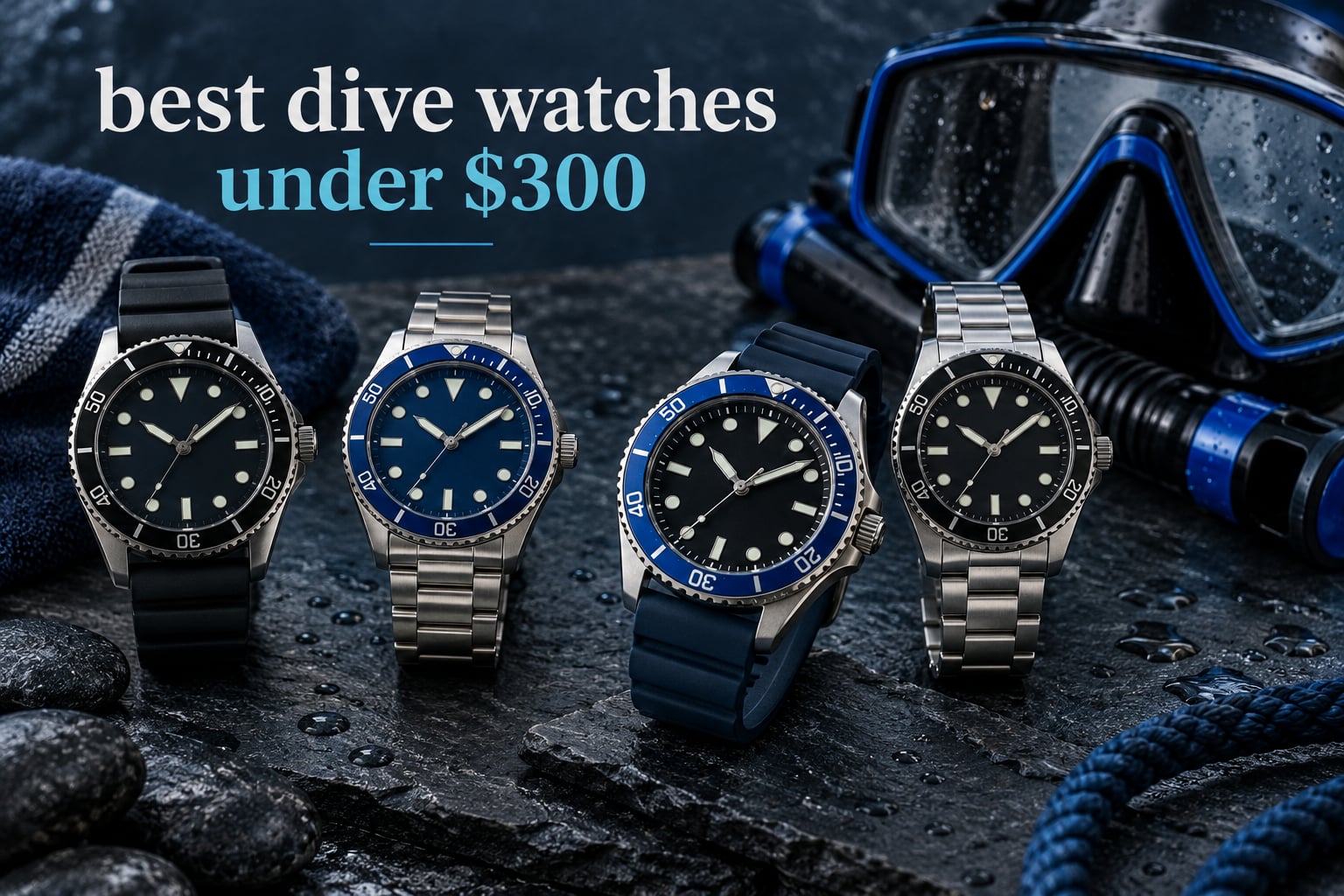
Dive watch prices keep drifting upward, and that is the frustration we hear most from people buying their first mechanical watch. Steel, sapphire and movements all move in one direction, and what was an easy automatic purchase a few years ago now sits much closer to the top of the budget. So this roundup does one thing: it works through everything available under the cap and keeps the watches that hold up after the novelty wears off.
Our verdict up front so nobody has to scroll. The Casio MDV106-1A is the best overall dive watch under 300 dollars in 2026. It is not the most impressive watch here. It simply has one of the highest ratings on this list, by far the largest volume of verified owner reviews, a 200m rating with a screw-down crown and caseback, and a battery that runs about three years, so most owners never think about it again.
What follows is 12 picks rather than 3. We covered quartz, solar and automatic movements plus one dive computer, because a buyer who wants a low-maintenance tool should not be pushed into a mechanical watch to stay inside a roundup. We looked at how each case sits on the wrist, how the bezel behaves cold and wet, how fast the lume dies out, and which bracelets survived daily wear. Prices move constantly, so each card carries a check button for the current figure. Last updated for 2026.
If you want the wider field, our picks for dive watches for everyday wear and our guide to titanium dive watches for men cover what this one does not, namely lighter metal cases and watches built purely for daily rotation.
Table of Contents
Top 3 Best Dive Watches Under 300 Dollars (October 2026)
Before the long list, the short one. These three cover the most common ways people buy a budget diver: the watch you never think about, the cheapest serious automatic, and the one to pick if you want day and date on the dial.

Casio MDV106-1A
- 200m water resistance
- Screw-down crown and caseback
- 3-year battery
- Resin band

Invicta Pro Diver 8926OB
- Seiko NH35A automatic
- 40mm steel case
- 120-click bezel
- Solid steel bracelet
Orient Mako II
- In-house F69 automatic
- Hacking and hand-winding
- 200m water resistance
- 41.5mm case
All 12 Dive Watches Under 300 Dollars in 2026 at a Glance
Use this to narrow the field before reading the write-ups. Every watch here is an analog diver with a rotating timing bezel except the Cressi, which is a digital dive computer and earns its place for a different reason.
| Product | Specifications | Action |
|---|---|---|
| Casio MDV106-1A |
|
Check Latest Price |
| Invicta Pro Diver 8926OB |
|
Check Latest Price |
| Orient Mako II |
|
Check Latest Price |
 Orient Mako 3 Orient Mako 3 |
|
Check Latest Price |
 Orient AA02 Diver Orient AA02 Diver |
|
Check Latest Price |
 Invicta Pro Diver Quartz Invicta Pro Diver Quartz |
|
Check Latest Price |
 ADDIESDIVE 41mm ADDIESDIVE 41mm |
|
Check Latest Price |
 RATIO FreeDiver RATIO FreeDiver |
|
Check Latest Price |
 NORTH EDGE Solar NORTH EDGE Solar |
|
Check Latest Price |
 Casio MTP-VD01D Casio MTP-VD01D |
|
Check Latest Price |
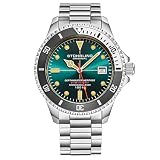 Stuhrling Depthmaster Stuhrling Depthmaster |
|
Check Latest Price |
 CRESSI Leonardo 2.0 CRESSI Leonardo 2.0 |
|
Check Latest Price |
1. Casio MDV106-1A – Best Overall Dive Watch Under 300 Dollars
Casio Men’s MDV106-1AV 200M Black Dive Watch (MDV106-1A)
200m WR
Screw-down crown and caseback
3-year battery
Stainless steel case
Pros
- Very high rating with an enormous owner base
- 200m rating suits swimming and recreational diving
- Screw-down crown and screw-down caseback
- Three-year battery life
- Anti-reverse bezel
Cons
- Resin band feels basic next to steel
- No lume on the bezel insert
- Two-hand layout with date only
This is the watch we recommend to someone who asked the plain question: which dive watch under 300 dollars should I buy. The MDV106 has been in production since the early 2010s and the current version carries more than 32,000 owner reviews at a 4.7 average, a volume of long-term data nothing else on this list can approach.
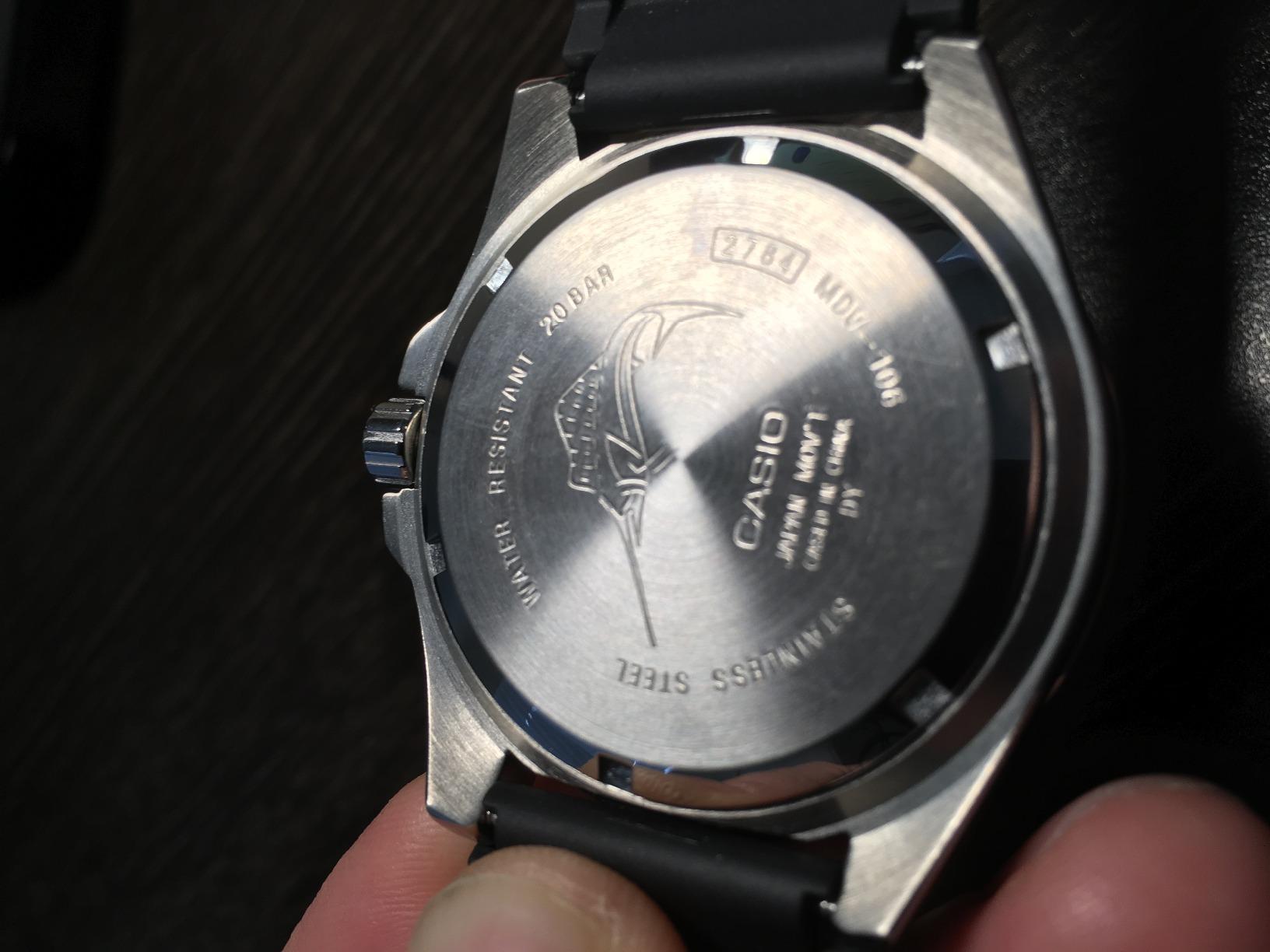
Specs: 200m water resistance, stainless steel case, mineral crystal, black resin band, luminous hands and hour markers, sweep second hand, date at 3 o’clock, anti-reverse bezel, screw-down crown and caseback, three-year battery life. Why buy: every compromise here is cosmetic. Accuracy is quartz, the crystal is mineral, the band is resin, and none of that touches the part that matters, which is whether it keeps working when you swim in it.
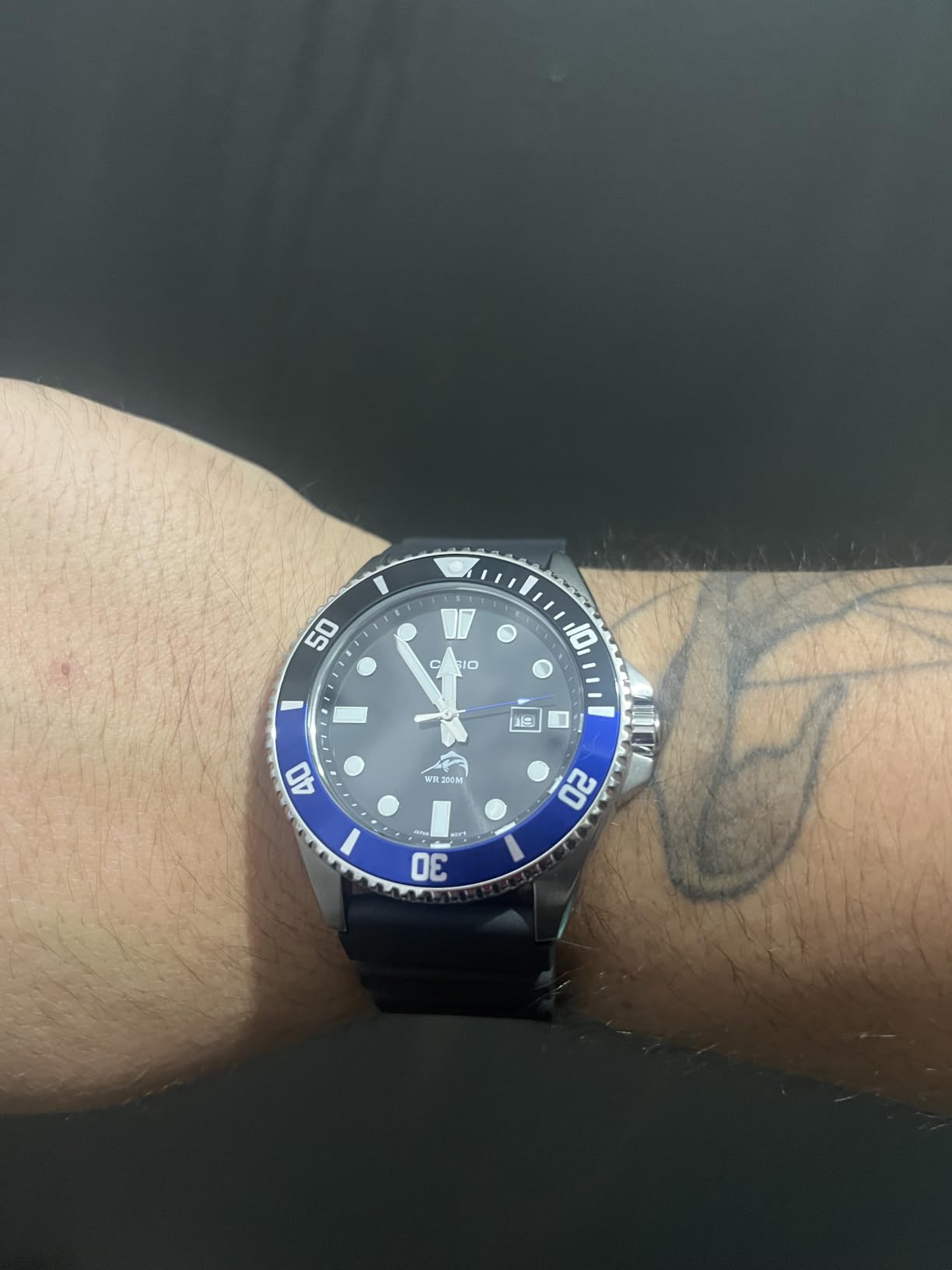
Where it beats more expensive competition is in the boring places. The screw-down crown and caseback are the two components most likely to leak, and both are properly sealed. The resin band weighs down to 3.25 ounces with the watch, so it disappears on the wrist in a way a 155g steel watch never will, and it does not hold water the way steel does.
What you give up is visible. The mineral crystal scratches sooner than sapphire, the lume is on the hands and hour markers only with no pip on the bezel insert, and the display is two hands plus a date, with no day and no chronograph.
How it wears and how to change the strap
At 3.25 ounces this is the watch you forget you are wearing, which for a daily diver is the feature rather than an accident. The first adjustment almost every owner makes is swapping the resin band for a NATO or rubber strap, a two-minute job that transforms the look.
Who should skip it
Skip it if you want sapphire, because you will be paying more for the watch rather than saving. Skip it if the feel of a mechanical movement is the whole point of the purchase, and skip it for serious saturation diving, since 200m is a recreational and surface-sports rating rather than a professional one.
2. Invicta Pro Diver 8926OB – Best Value Automatic Under 300 Dollars
Invicta Men’s Pro Diver Collection Coin-Edge Automatic Watch
40mm steel case
Seiko NH35A automatic
120-click bezel
155g
Pros
- Genuine Seiko NH35A automatic with hacking and hand-winding
- Often keeps time within 15 seconds a day
- Solid steel case and bracelet with real heft
- Tight 120-click unidirectional bezel
- Exhibition caseback shows the movement
Cons
- Very weak lume in the dark
- Mineral crystal scratches easily
- Crown is fiddly to thread
- No wetsuit extension on the clasp
The 8926OB is the most common answer to this question on watch forums, and the reason is arithmetic rather than romance. You get a genuine Seiko NH35A Japanese automatic with hacking and hand-winding on a solid steel bracelet, in a 40mm case, and there is very little else under this ceiling that does that.
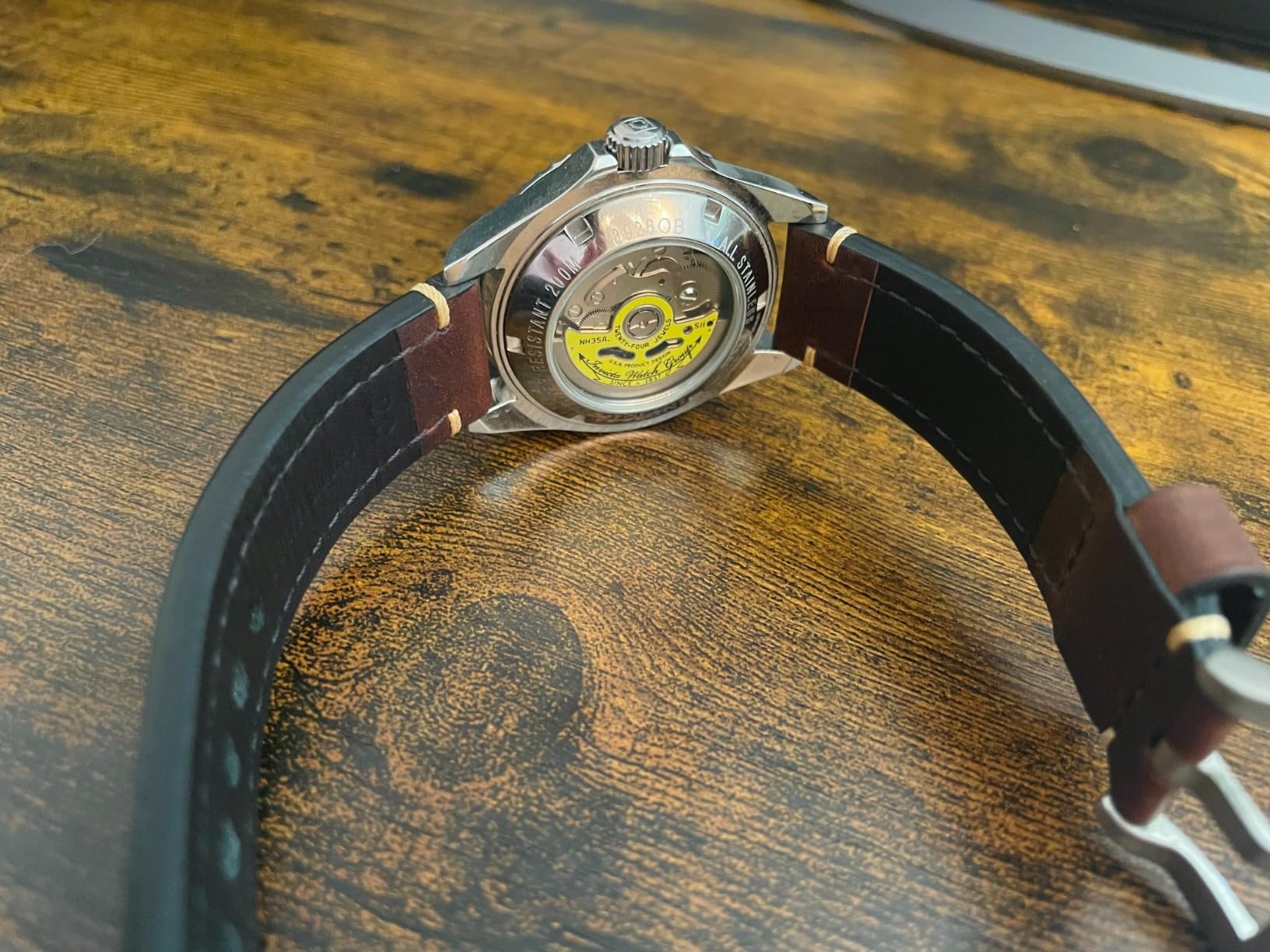
Specs: 40mm stainless steel case, 14.1mm thick, 155g, Seiko NH35A Japanese automatic with 24 jewels, exhibition caseback, unidirectional bezel, luminous hands, fold-over clasp, three-year limited manufacturer warranty. Why buy: the NH35A is the movement almost every modified budget diver is built around, and owners regularly report drift inside 15 seconds a day.
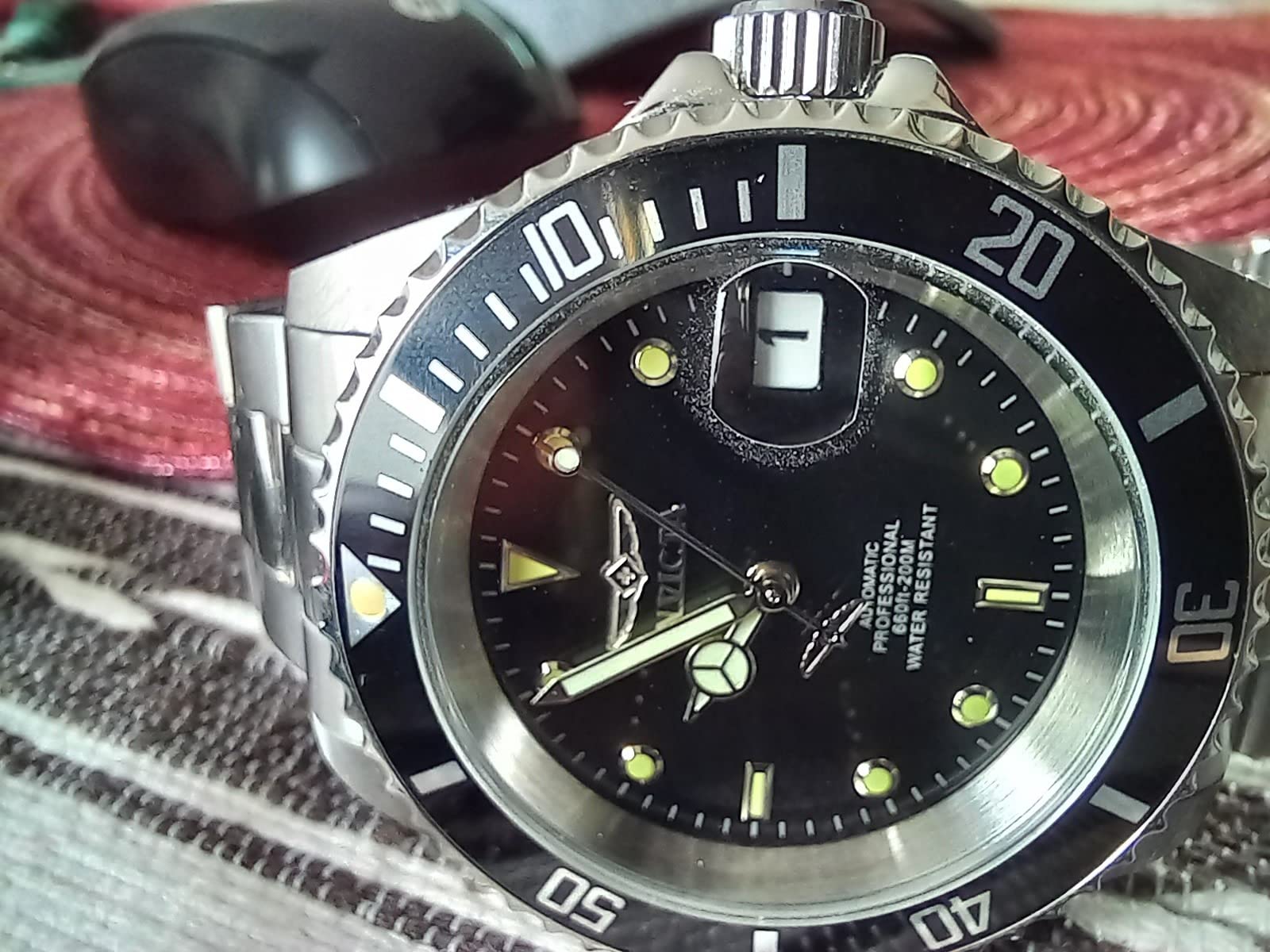
The case justifies the price. At 40mm and 155g it has the density that makes cheap watches feel cheap, and the bracelet holds together better than most at this level. The bezel is the real pleasure: 120 clicks, tight, and it does not slip when your fingers are wet, which is exactly the failure that ruins cheaper homage divers.
Be honest about the compromises. The lume is weak and reviewers say so repeatedly, so this is not a watch you can read at depth in the dark. The mineral crystal marks up over a few years. The crown is a real screw-down but it is small and fiddly, and the clasp has no wetsuit extension.
Why the movement matters more than the branding
Brand baggage is the biggest hesitation we see around Invicta, and the practical answer is to judge the movement instead of the dial. The NH35A here is a Seiko design, serviceable and well documented, and the exhibition caseback lets you confirm the calibre rather than trusting a listing. Long-term reports are mostly about the movement staying steady, with a few owners noting drift creeping up over several years.
Who should skip it
Skip it if legibility in darkness matters, because that is the weakest point here. Skip it if your wrist is under about 6 inches and you dislike presence, since 40mm and 155g is a full watch. And screw the crown fully down before heavy water exposure, since a few owners report moisture ingress when they do not.
3. Orient Mako II – Best for Day and Date on a Budget
ORIENT Men’s ‘Mako II’ Japanese Automatic Stainless Steel Diving Watch
41.5mm case
F69 automatic
120-click bezel
200m WR
Pros
- In-house Orient F69 automatic with hacking and hand-winding
- Accuracy typically within 3 to 5 seconds a day
- Numbered dial and narrow bezel look modern
- Smooth case edges and a solid bracelet
- Arrives with the time already set
Cons
- Small stiff crown
- Stiff bezel that is hard to grip when wet
- Hollow end links loosen and become noisy
- Mineral crystal rather than sapphire
- Weak lume and no lume on the seconds hand
Orient is where most people start shopping budget automatics, and the Mako II is why the name has momentum. The F69 is an in-house Japanese automatic with hacking and hand-winding, and at 41.5mm with a narrow bezel the watch looks more modern than the retro divers it competes with.
Specs: 41.5mm case diameter excluding the crown, 22mm lug width, 200m water resistance, Japanese automatic with hand winding and hacking, 120-click unidirectional bezel, screw-down crown, mineral crystal, day and date display. Why buy: measured accuracy is the headline, with owners typically seeing three to five seconds a day on a movement that is regulated and serviceable rather than a generic shelf part.
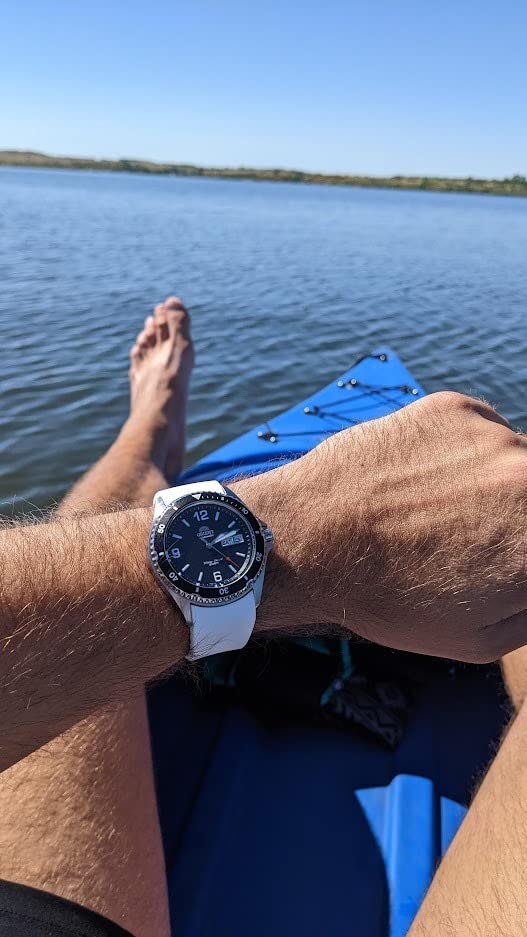
Two details separate this from the first Mako. Hacking stops the seconds hand when you set the time, which makes setting a watch far less frustrating, and hand-winding lets you start it before you put it on. Case edges are smooth rather than sharp, and it arrives ready to wear.
The complaints are consistent enough to plan around. The crown is small and stiff. The bezel is stiff and slippery with wet hands, which is the one thing a dive watch should not be. The hollow end links loosen and get noisy within a couple of years, the crystal is mineral, and the lume is weaker than Seiko’s with nothing on the seconds hand.
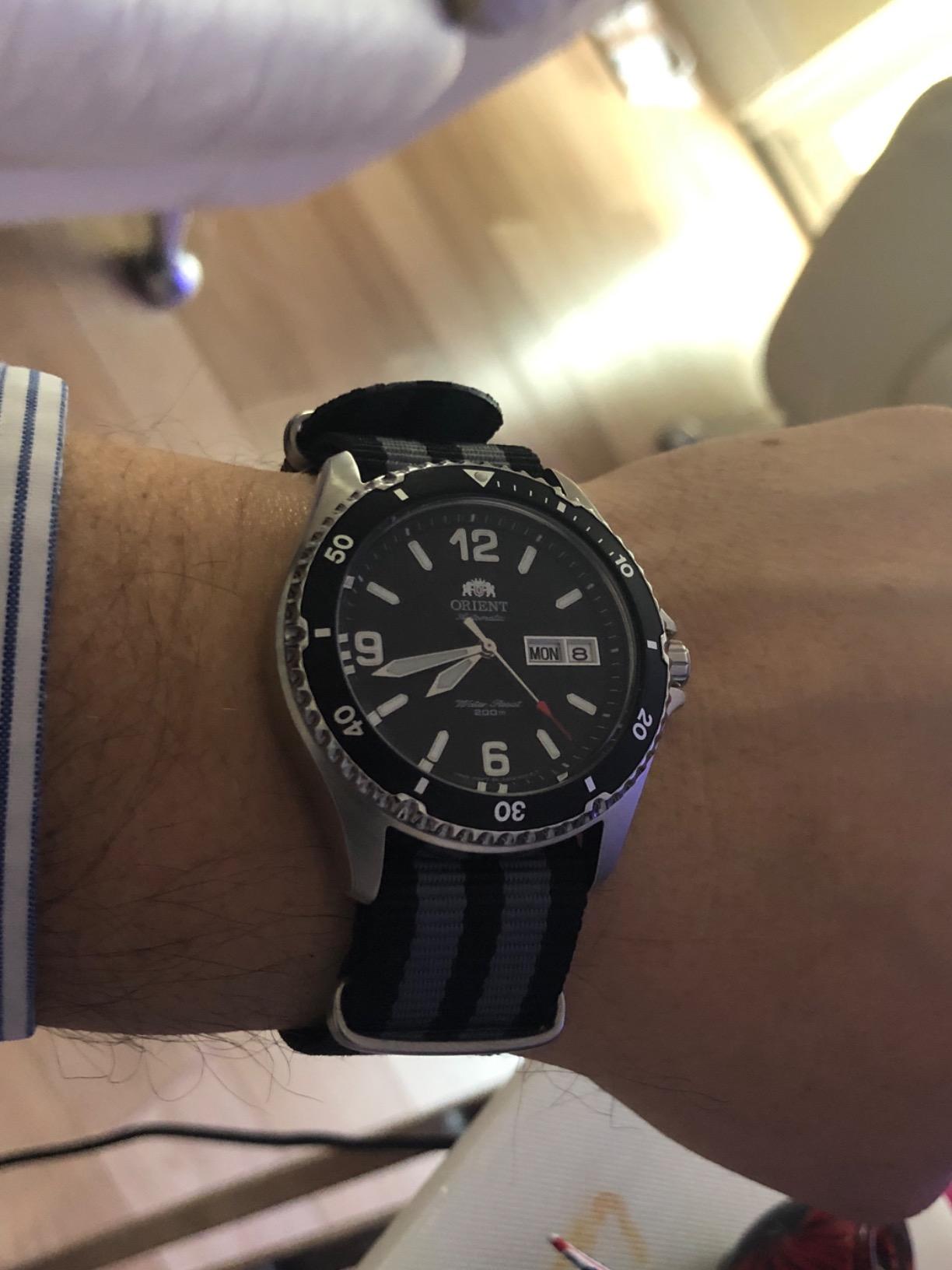
What day and date changes in practice
The day wheel removes the small daily annoyance of setting a date after a weekend and lets you skip the watch on days you do not need a full display. At 22mm the lugs are wide enough for the whole aftermarket strap market, so a NATO or rally strap swaps on in minutes, which matters because the first two upgrades most owners make are a strap and a bracelet.
Who should skip it
Skip it if you scratch anything you own, because the mineral crystal records it. Skip it if you dive in gloves, since the stiff bezel is hard to grip wet. And if you have a small wrist, note that 41.5mm with 22mm lugs is a large combination.
4. Orient Mako 3 – Best Sapphire Crystal Under 300 Dollars
Orient Mako-3″ Japanese Automatic/Hand-Winding 200m Diver Style Watch, Matte Blue, RA-AA0818L19B
Sapphire crystal
F6922 automatic
41.8mm case
200m WR
Pros
- In-house F6922 automatic with 40-hour power reserve
- Hacking and hand-winding
- Sapphire crystal where rivals use mineral
- Owners measure within a second a day
- 22mm bracelet gives real heft
Cons
- Bracelet lacks solid end links and feels cheap
- Flat sapphire rather than domed
- Some variants assembled outside Japan
- Lume is good but not exceptional
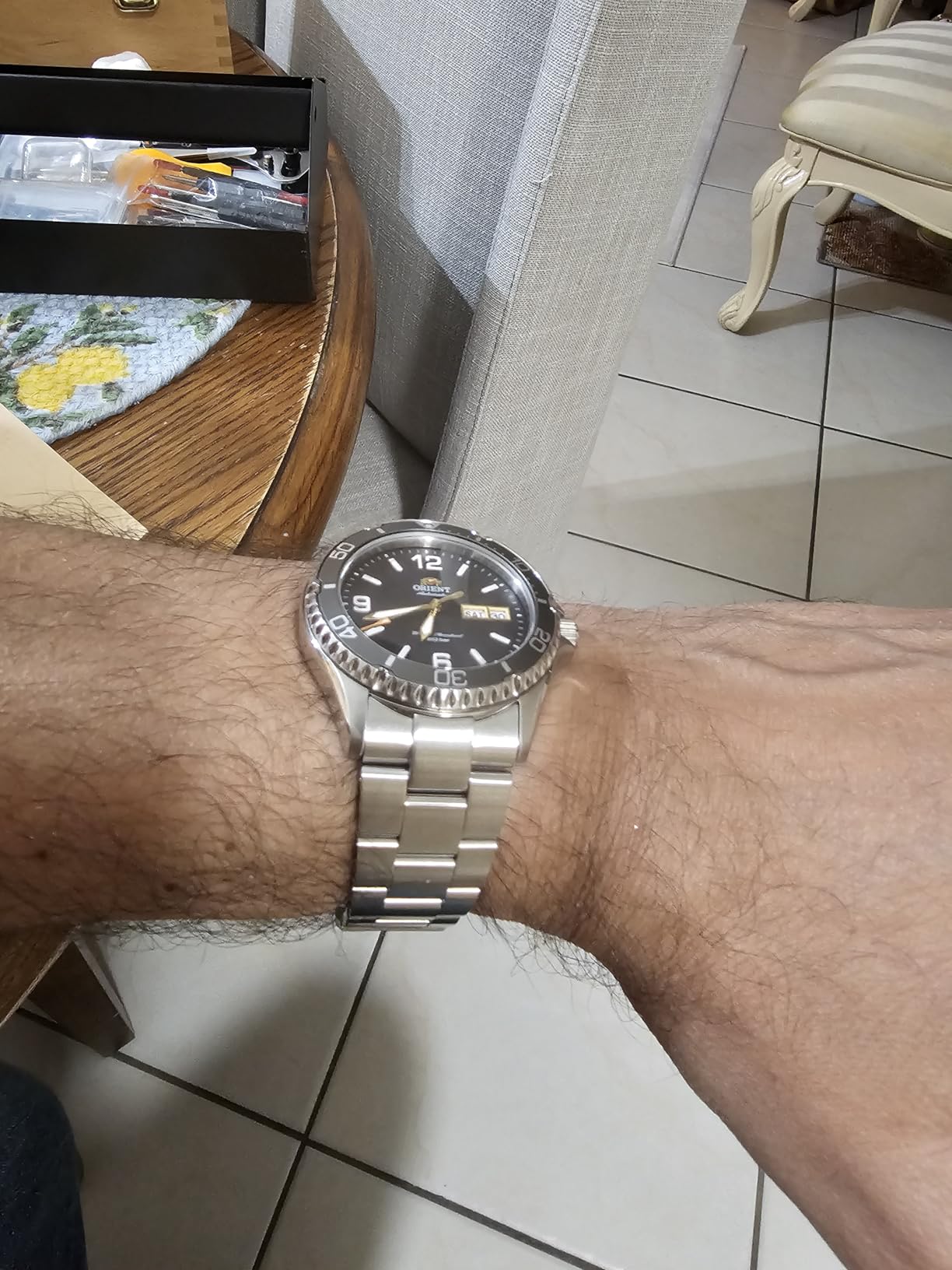
The Mako 3 is the reason many collectors think a sapphire crystal and an in-house automatic are affordable inside a budget. It is the only watch here pairing a Japanese in-house movement with sapphire, and at the top of this band it still fits, though only just, so it is the first watch to check when this category shifts upward.
Specs: in-house Orient F6922 automatic with hacking, hand winding and a 40-hour power reserve, sapphire crystal, 41.8mm case diameter, 47mm lug-to-lug, 22mm lug width, 200m water resistance, sunburst dial options including ivory, gray, matte red and matte blue. Why buy: the F6922 is a more substantial movement than the NH35A-based automatics most of this list uses, and sapphire changes the ownership experience rather than the spec sheet.
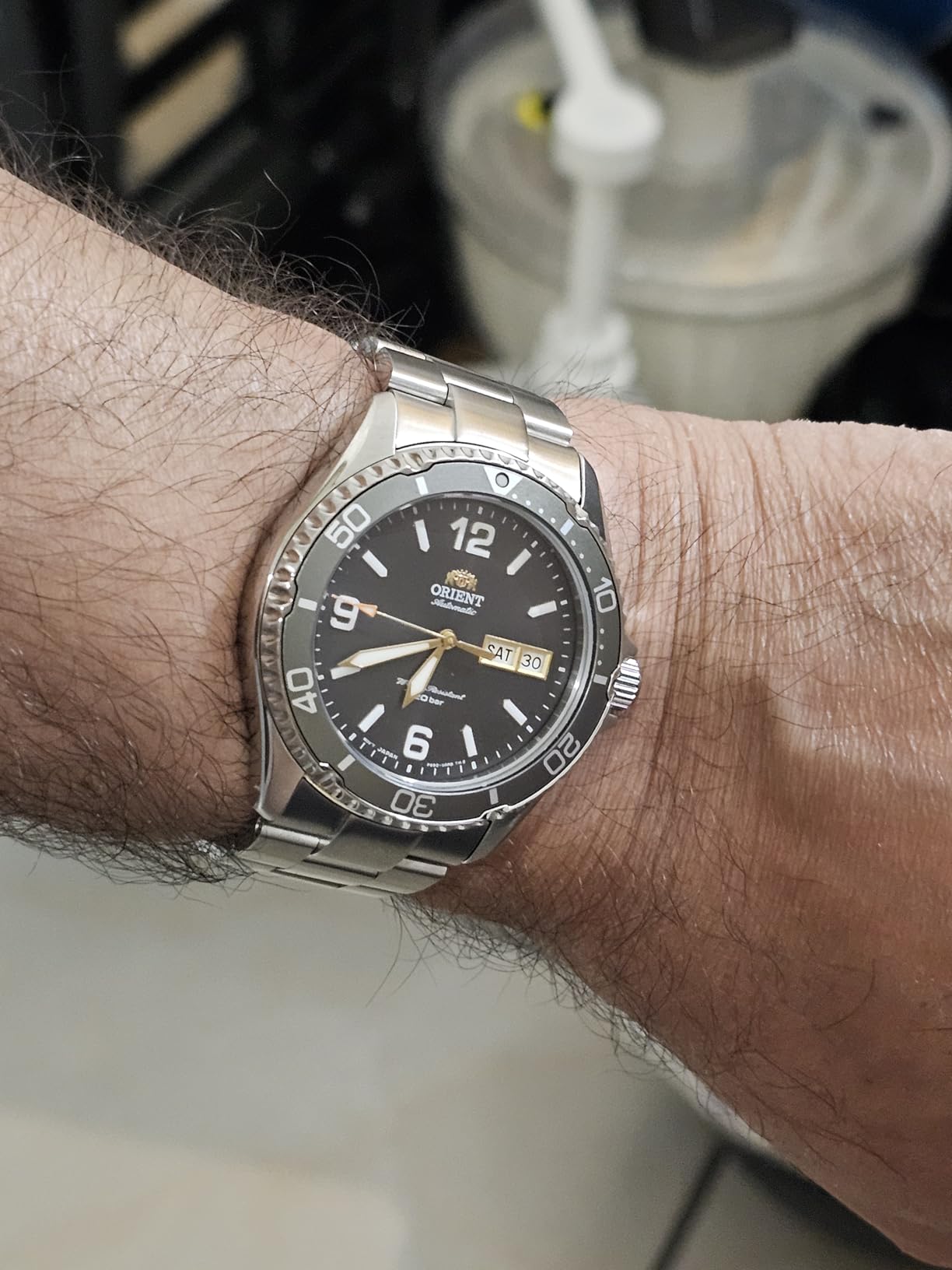
Accuracy is the other argument. Owners measuring these report running within a second a day, and the sunburst dial looks considerably better in person than the photos suggest. The 22mm bracelet is wider than the Mako II, which gives real heft on the wrist and more presence than a 20mm strap does. The bezel is crisp with no play.
Nearly all the criticism lands on the bracelet. It lacks solid end links and can feel cheap next to a watch this well finished, the sapphire is flat rather than domed so it catches reflections, and some variants are assembled outside Japan. Lume is good rather than exceptional.
Whether sapphire is worth the compromise
Sapphire is worth it if you keep watches for years, and the trade-off here is the bracelet, so read the two as a package. Ten years on, a sapphire watch looks like it, where a mineral-crystal watch shows every scuff you gave it in year one. If your wrist runs small, the 47mm lug-to-lug matters more than the 41.8mm diameter, because that is the figure that decides whether a watch looks proportional.
Who should skip it
Skip it if bracelet feel is non-negotiable, since that is the watch’s real weakness and you will notice it daily. Skip it if you need a smaller case given that lug-to-lug, and if you are starting your first mechanical watch, the movements in picks 2 and 3 are more forgiving of beginner mistakes.
5. Orient AA02 Diver – Brightest Lume and Dial in the Roundup
Orient Men’s Japanese Automatic / Hand-Winding Stainless Steel 200 Meter Diving Watch Model: FAA02004B9
200m WR
41.5mm case
Hand-winding and hacking
Sunburst dial
Pros
- In-house Japanese automatic accurate to a few seconds a day
- Vibrant sunburst dial with strong daytime legibility
- Very bright lume that outshines most rivals
- Hand-winding and hacking at this price
- Smooth case edges and good finish
Cons
- Small hard-to-grip crown
- Mineral crystal scratches
- Bezel is stiff and slippery when wet
- Hollow end links rattle
- 22mm bracelet looks chunky on smaller wrists
When reviewers list shortcomings, lume and dial legibility rarely come up for the AA02 Diver. The luminous hands and markers are bright enough that owners describe them as outshining far costlier watches, and the sunburst blue or black dial is among the better finishes in this roundup at any price.
Specs: Japanese in-house automatic with hand winding and hacking, 41.5mm stainless steel case, 200m water resistance, mineral crystal, 120-click unidirectional bezel, date display on the dial, stainless steel bracelet. Why buy: if your priority list reads legibility first, this is the watch. Everything else here compromises somewhere, and this one compromises in the crown and the crystal rather than the two things you actually read.
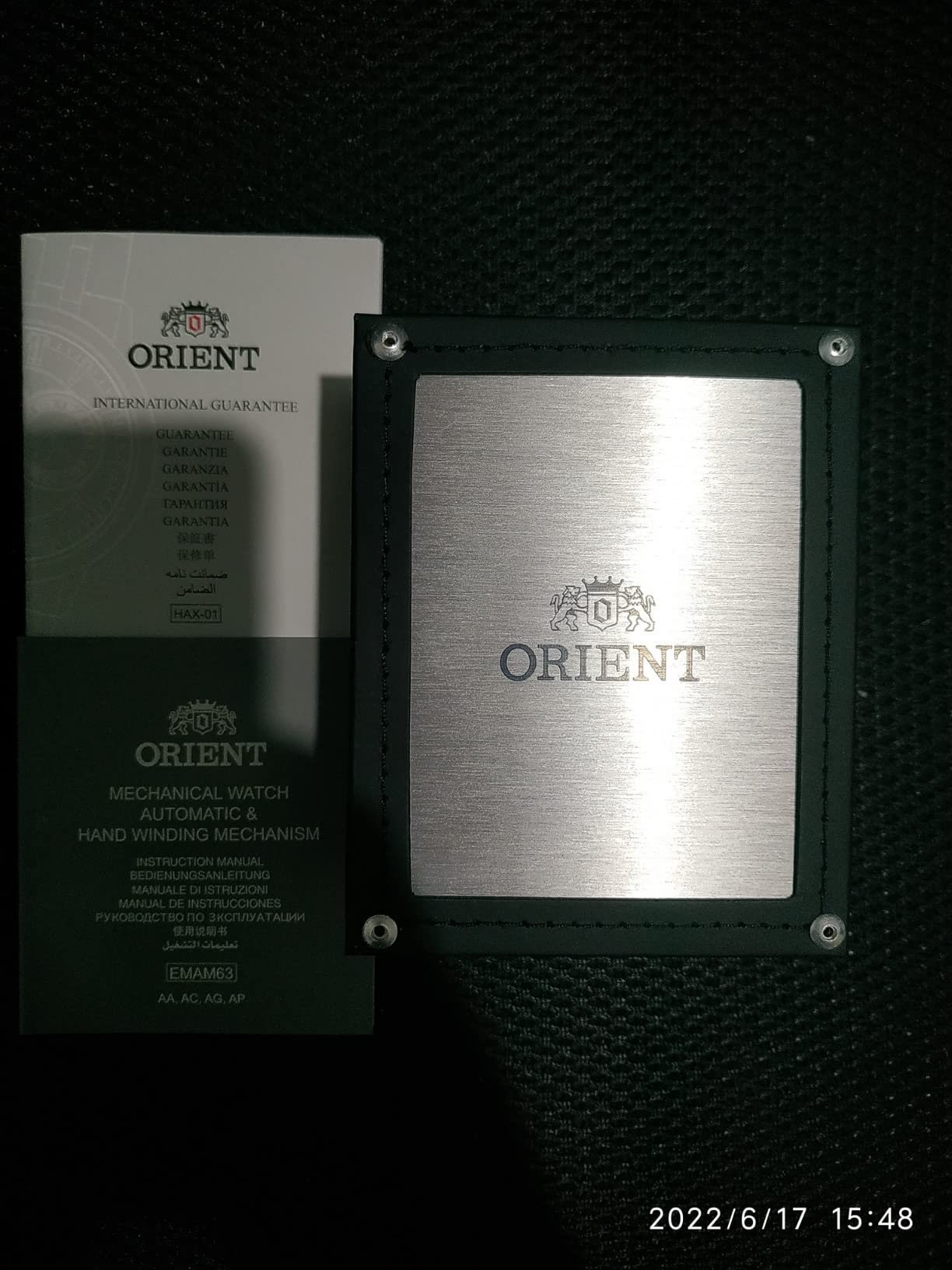
The movement is a proper in-house Japanese automatic and owners report gaining only a few seconds a day, putting it alongside the Mako II for accuracy. Hand winding and hacking are genuinely useful at this price, and finishing is a step above where most automatics in this bracket sit, with smooth case edges rather than harsh transitions.
The weak point is the crown. It is small and hard to grip when winding or when screwing it down on the beach, the bezel is stiff and slippery when wet, the end links are hollow and can rattle, and the crystal is mineral. At 22mm the bracelet reads chunky on anything under about 6.5 inches.

Daylight legibility against night legibility
Most dive watch buying happens in daylight and is judged in the sun, and that is where the sunburst dial earns its place. Under direct light the finish shifts, the applied markers have real presence, and the contrast against the bezel is clean enough to read while moving. At night the lume carries it further than the other Orient here, which matters if you read time in a dark room or swim at dusk.
Who should skip it
Skip it if you have a small wrist and dislike large bracelets, since 41.5mm and 22mm is a wide package. Skip it if you scratch watches, and skip it if you need a bezel you can operate with gloves, where the stiff action works against you.
6. Invicta Pro Diver Quartz 30018 – Best Thin Quartz Diver for Daily Wear
Invicta Men’s Pro Diver Quartz Watch, Silver, 30018
43mm case
12mm thick
Japanese PC32 quartz
170g
Pros
- Japanese quartz accuracy at a fraction of automatic cost
- All stainless steel build with plating accents
- Screw-down crown and screw-down caseback
- Light 12mm profile for daily wear
- Over 20000 reviews at a 4.7 average
Cons
- Lume is modest and fades quickly
- 100m rating is for surface water only
- Bracelet pins are very hard to remove without a pin tool
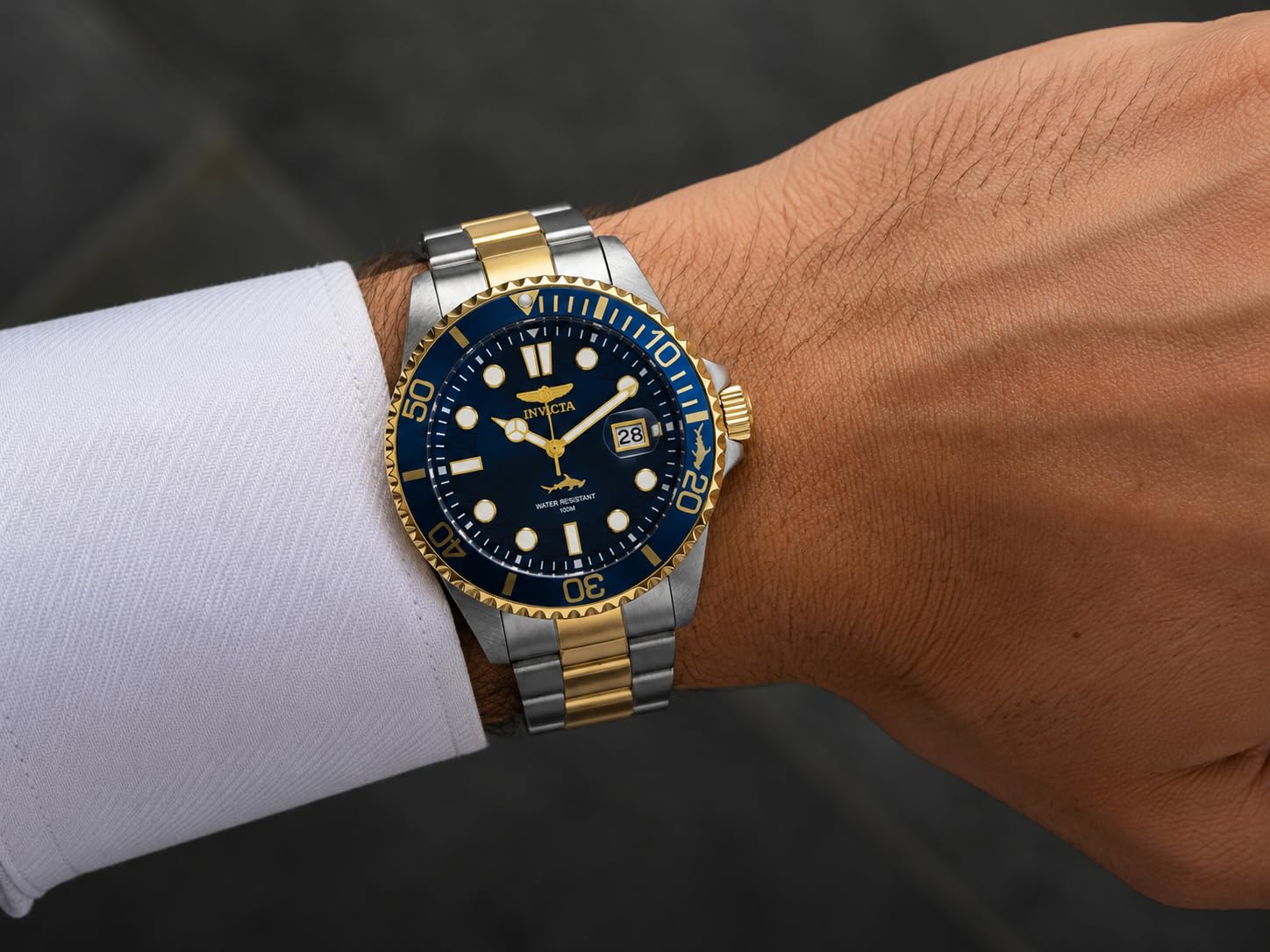
This is the pick for anyone who wants a dive watch but not a mechanical one. The Japanese PC32 quartz keeps time to a standard an automatic cannot approach, and the whole watch is built around being a low-profile tool you can wear in an office on Friday and in the water on Saturday.
Specs: 43mm stainless steel case, 12mm thick, 170g, Japanese PC32 quartz with an SR626SW battery included, screw-down crown, unidirectional stainless steel bezel with a black top ring, adjustable steel bracelet with fold-over safety clasp, Flame Fusion crystal. Why buy: 12mm thin, which is the difference between a watch that slips under a shirt cuff and one that does not. Reviewers also note it arrives set very close to atomic time.
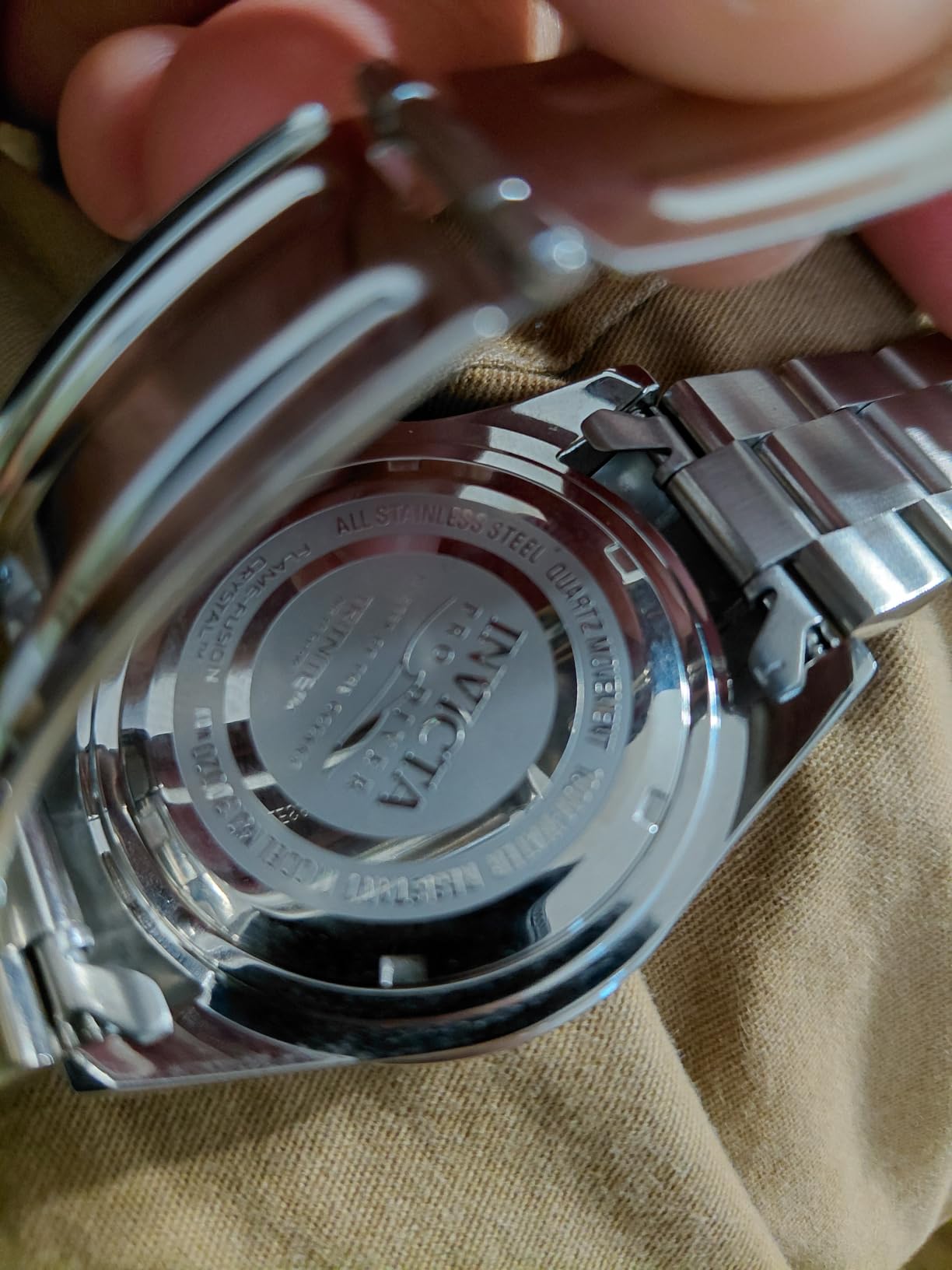
Held in the hand it looks more expensive than it is. The all-steel build, the plating accents on the bezel ring, the fold-over safety clasp and the way the case sits flat against the wrist all read as more considered than the number suggests. Reviewers consistently mention it holding up well in pools and showers, which is exactly what 100m is rated for.
The honesty: 100m covers recreational surfing, swimming, snorkelling, sailing and water sports, and the manufacturer is explicit that it is not suitable for diving. The lume is modest and fades relatively quickly, and the bracelet pins are very hard to remove without a proper pin tool, so budget for a watchmaker if you need it resized.
Quartz accuracy against the mechanical options
The accuracy argument is not close. Japanese quartz holds time to within seconds a month while an automatic in this class drifts by seconds a day, and a battery swap every few years is less work than winding or regulating anything mechanical. What quartz gives up is the reason people buy automatics at all, which is the small ritual of a sweeping seconds hand. If that matters, take pick 2, 3 or 4 instead.
Who should skip it
Skip it if you dive, because the manufacturer does not rate it for that. Skip it if your wrist is under about 6 inches, since 43mm is a wide case even at 12mm, and skip it if plating details bother you, because the accent ring is a style choice rather than a functional one.
7. ADDIESDIVE 41mm – Most Complete Spec Sheet for the Money
ADDIESDIVE Quartz Divers Watch for Men Diver 200 M Black Dial Luminous Stainless Steel Strap
200m WR
41mm case
20mm lug width
316L steel
Pros
- Highest average rating in the roundup at 4.8
- Screw-in crown and screw-down caseback with a real 200m rating
- Compact 41mm case suits small to medium wrists
- 20mm lugs give a wide aftermarket strap choice
- Japanese quartz movement needs no winding
Cons
- Lume dims relatively quickly after charging
- Screw-down crown threading feels rough and imprecise
- Noisy loose buckle clasp
- May look petite on very large wrists
There is a category of watch people argue about, and this is the argument in miniature. The ADDIESDIVE 41mm is a Submariner-styled homage, so the design is not original, and it arrives with the usual debate about whether that matters when the spec sheet is this complete.
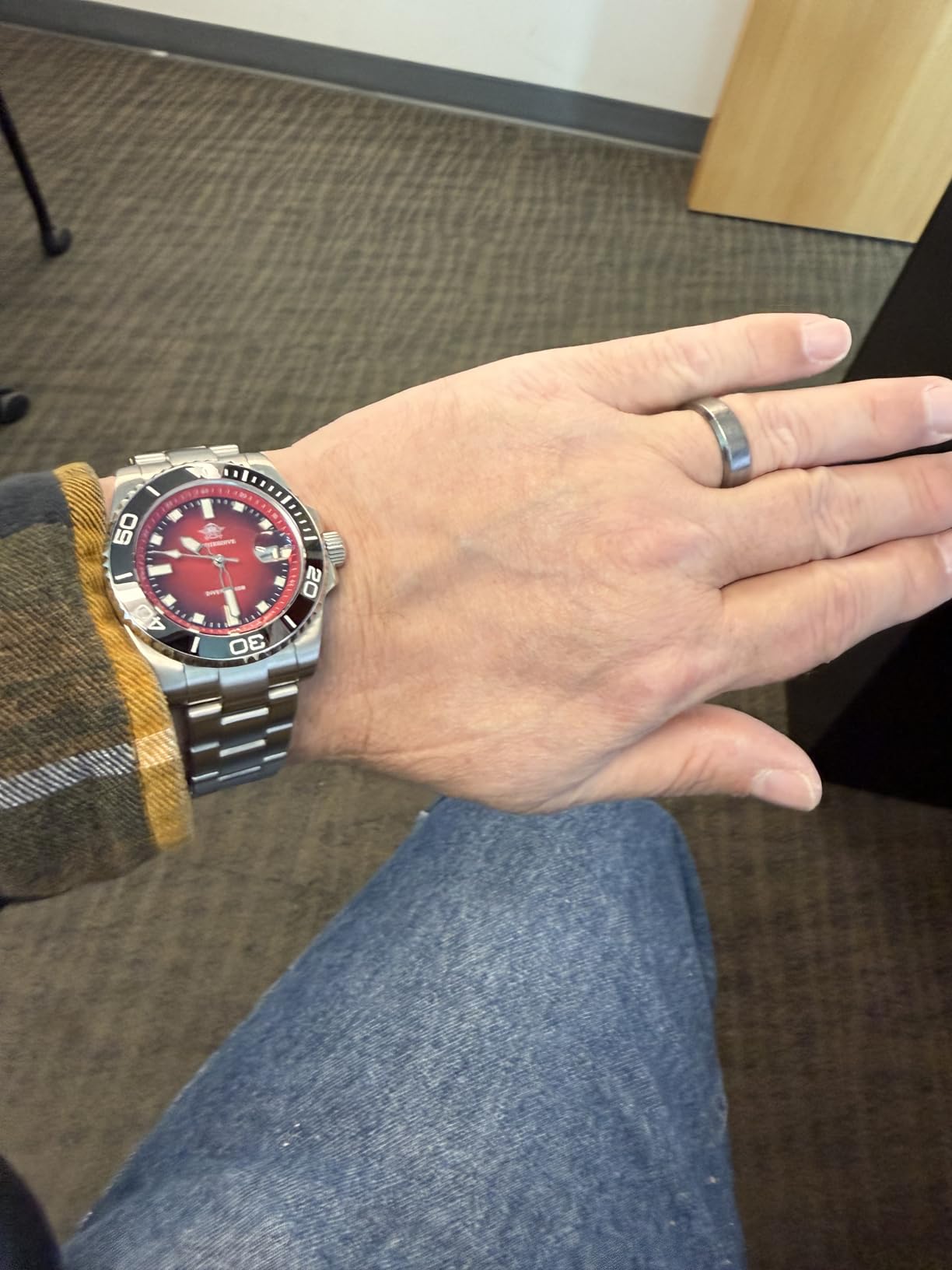
Specs: 41mm case diameter, 48mm lug-to-lug, 13mm thick, 20mm lug width, 163g, 316L stainless steel case and bracelet, 200m and 20 ATM water resistance, Japanese quartz with an LR44 battery, unidirectional rotating bezel, screw-in crown, mineral crystal with a protruding date magnifier, luminous hands and hour markers. Why buy: a screw-in crown, a screw-down caseback and a stated 200m rating on a steel bracelet is not a cheap watch pretending to be a dive watch. It has the actual components.
Where the spec sheet is honest is in the dimensions. A 41mm case with 20mm lugs is a genuinely small-to-medium package, and at 48mm lug-to-lug it sits flatter than most watches of this size. The 20mm lug width unlocks the entire aftermarket strap market, and the mineral crystal is described as clear with no distortion, which is a real improvement over many cheap divers.
Where owners push back is mechanical. The screw-down crown threads imprecisely, so it takes practice to tighten properly, the buckle clasp is noisy and loose and is the weakest part of the watch, and the lume dims fairly quickly after charging. On a very large wrist a 41mm case reads as petite rather than modest.
Whether a homage is worth buying
Our view is that the question is about originality versus specification, and those are not the same axis. If you want a design nobody else has, a homage is the wrong purchase and no spec sheet will change that. If you want a steel dive watch with a working screw-down crown well below the price of the design it imitates, the argument mostly dissolves. Owners of these typically report better satisfaction than expected, particularly in the less obvious dial and bezel colourways.
Who should skip it
Skip it if design originality is part of the appeal, skip it on a very large wrist, and note that the brand carries no meaningful reputation, so judge the case, movement and clasp on their own merits. If you are buying a gift, expect the homage conversation to dominate the discussion rather than the watch.
8. RATIO FreeDiver – Best Microbrand Sapphire Automatic
RATIO FreeDiver Sapphire Crystal Diver Watch Japanese Automatic Dive Watch 200m Water Resistant Diving Watch (Orange)
Sapphire crystal
Japanese automatic
40mm case
20mm lugs
Pros
- Sapphire crystal where most rivals use mineral
- Japanese automatic often close to chronometer accuracy out of the box
- Applied markers and finishing look far more expensive than the price
- Very bright lume that stays readable through the night
- Screw-down crown with plenty of thread
Cons
- Bracelet tapers thin toward the clasp
- 40mm may feel small on a large wrist
- Thick case bumps into things on smaller wrists
- Crown is hard to pull to the date position
- Bezel is very stiff and needs breaking in
The microbrand route gets you closer to serious watch territory for less money than the big names, and the FreeDiver is the clearest example here. You get a sapphire crystal, a well-regulated Japanese automatic and applied dial markers, which is a combination that is hard to find on an established-brand diver at this level.
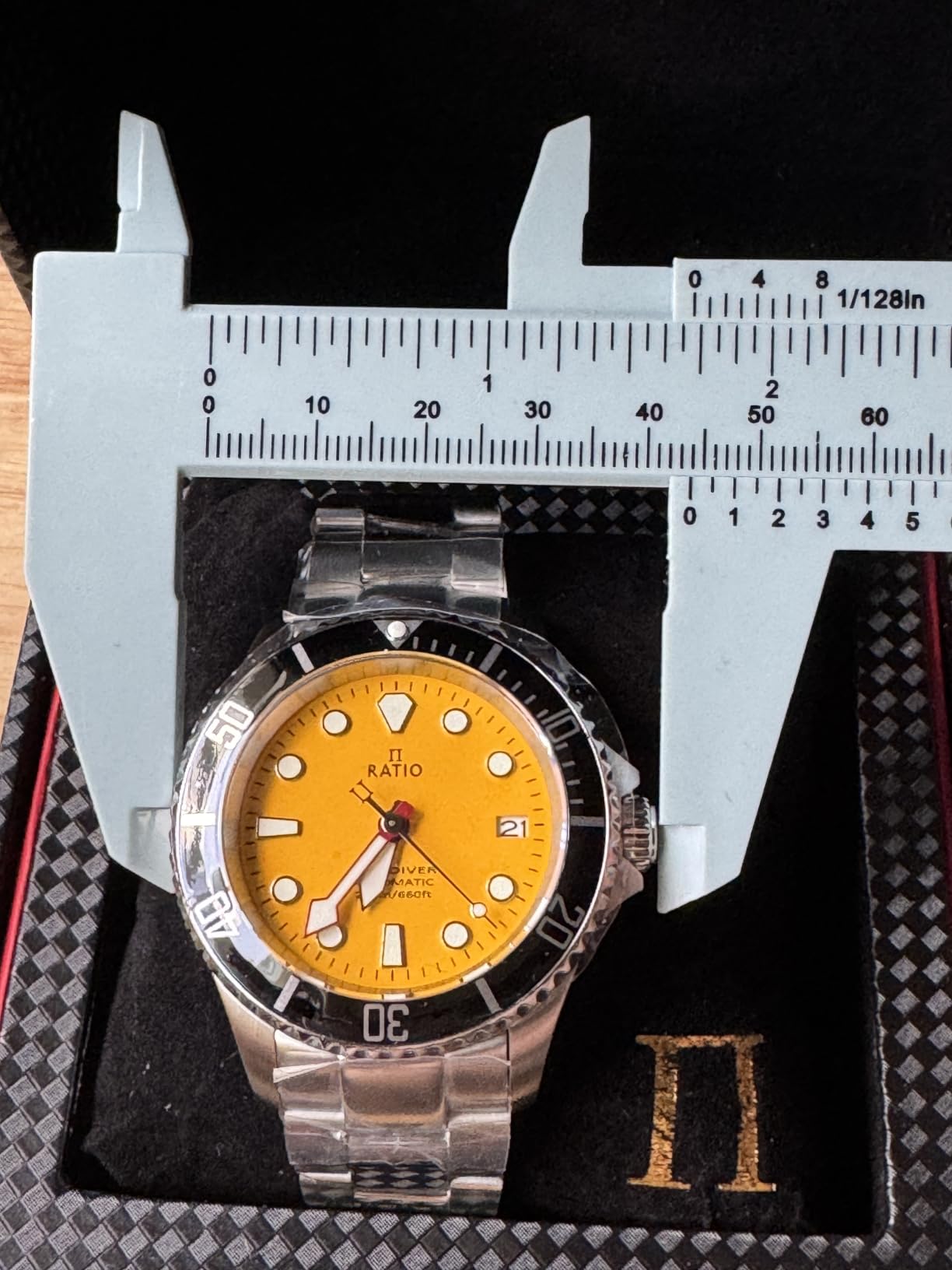
Specs: Japanese automatic, sapphire crystal, 200m water resistance, 40mm case, 20mm lug width, stainless steel case and bracelet, rotating bezel with luminous markers, multiple dial colour options. Why buy: the sapphire is the spec that normally doubles the price, and owners verify the movement on timegraphers, with many units running close to chronometer standard out of the box, which is unusual at this budget.
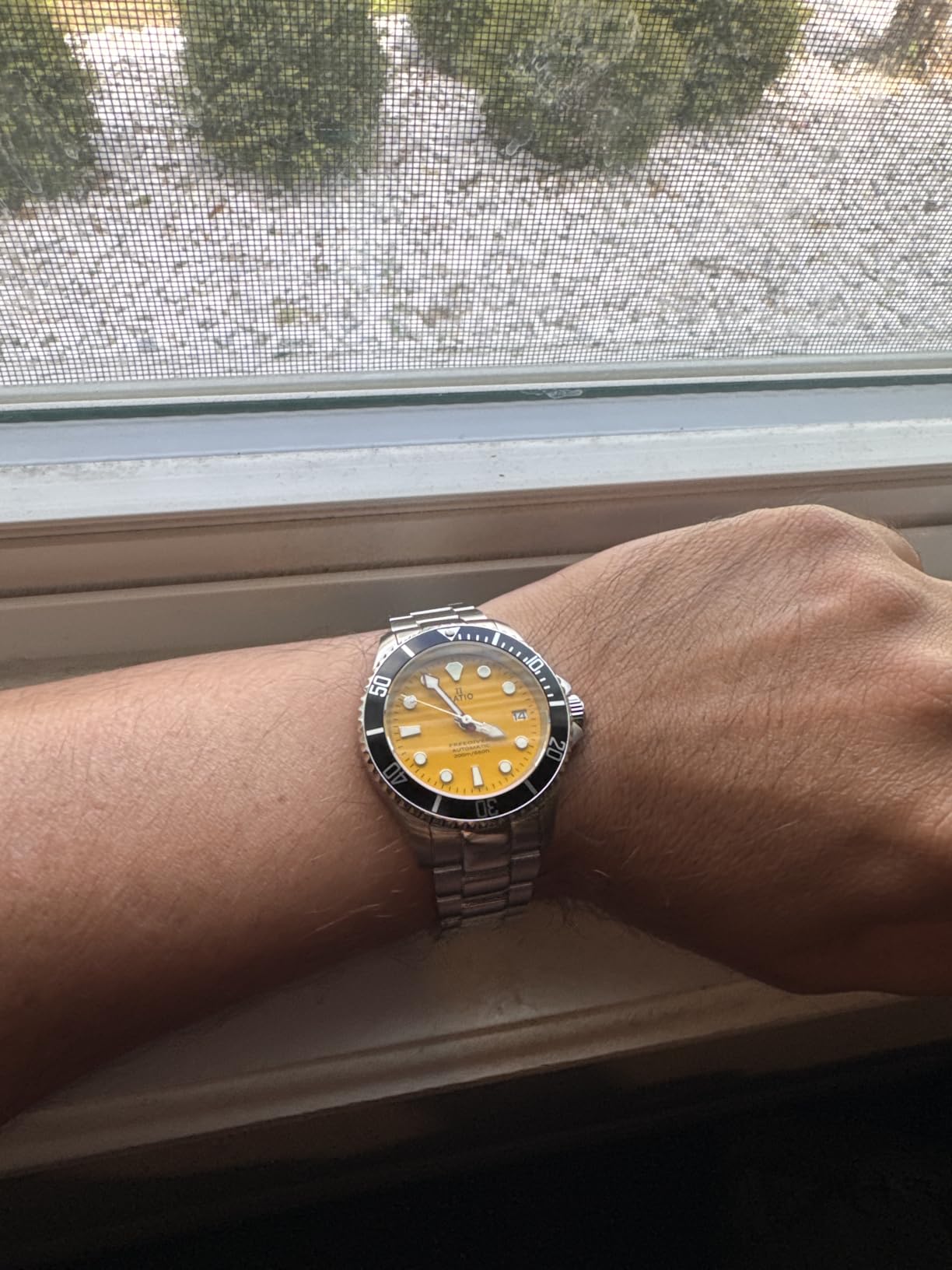
Reviewers frequently compare this favourably against more expensive Seiko divers. The lume is another standout, staying readable through the night rather than fading in twenty minutes, and the 20mm lug width makes strap changes simple and cheap. The screw-down crown has plenty of thread, which is exactly what the watch in the previous section lacks.
The bracelet is the weak link and the shape of it matters. It tapers thin toward the clasp, which makes the watch look less substantial from the side. At 40mm it can read small on a larger wrist while still being thick enough to bump into things on a smaller one. The crown is hard to pull to set the date and the bezel is very stiff until broken in.
What microbrand buying actually changes
Buying from a small brand changes where your money goes and where your risk sits. More of it goes into the case, crystal and finishing, which is why this watch looks the way it does for what it costs. The risk is thinner, because a small operation has less long-term data behind it. That is the trade we would make at this budget, and it is helped by the movement being a serviceable Japanese automatic rather than a proprietary calibre.
Who should skip it
Skip it if bracelet quality is what you notice most, skip it if you want a domed or curved sapphire, since this one is flat, and skip it if a large case suits you better, because 40mm at this thickness is a smaller footprint than the diameter suggests.
9. NORTH EDGE Solar 300M – Best Solar Diver and the Biggest Case
NORTH EDGE Triton-TI Titanium Solar Dive Watch, 300M, Blue
300m WR
Solar quartz
45.8mm case
24mm strap
Pros
- Solar power means far less battery swapping than standard quartz
- Very impressive lume that stays readable all night
- Screw-down crown and smooth bezel with clear clicks
- 300m rating covers swimming snorkelling and diving
- Titanium version weighs about 92g
- Arrives with the time already set
Cons
- Very tall and chunky at roughly 16mm thick
- Not suitable for smaller wrists
- Basic silicone strap with no micro-adjust
- No date display
- Full charge takes around 41 hours of direct sun
Solar is the middle path between quartz and mechanical, and this is the clearest example of why people like it. A solar quartz movement charges in daylight and runs for months, so you get quartz accuracy and low maintenance without planning battery changes.
Specs: solar powered quartz, 300m and 1000ft water resistance for swimming, snorkelling and diving, screw-down crown, rotating bezel with clear clicks, luminous hands and markers, mineral glass crystal, 45.8mm case diameter, 51.4mm lug-to-lug, adjustable 24mm silicone strap fitting wrists up to 230mm. Why buy: the rating. A stated 300m with a screw-down crown puts this in a different class from most of this list, and the solar movement means you are not managing a battery.
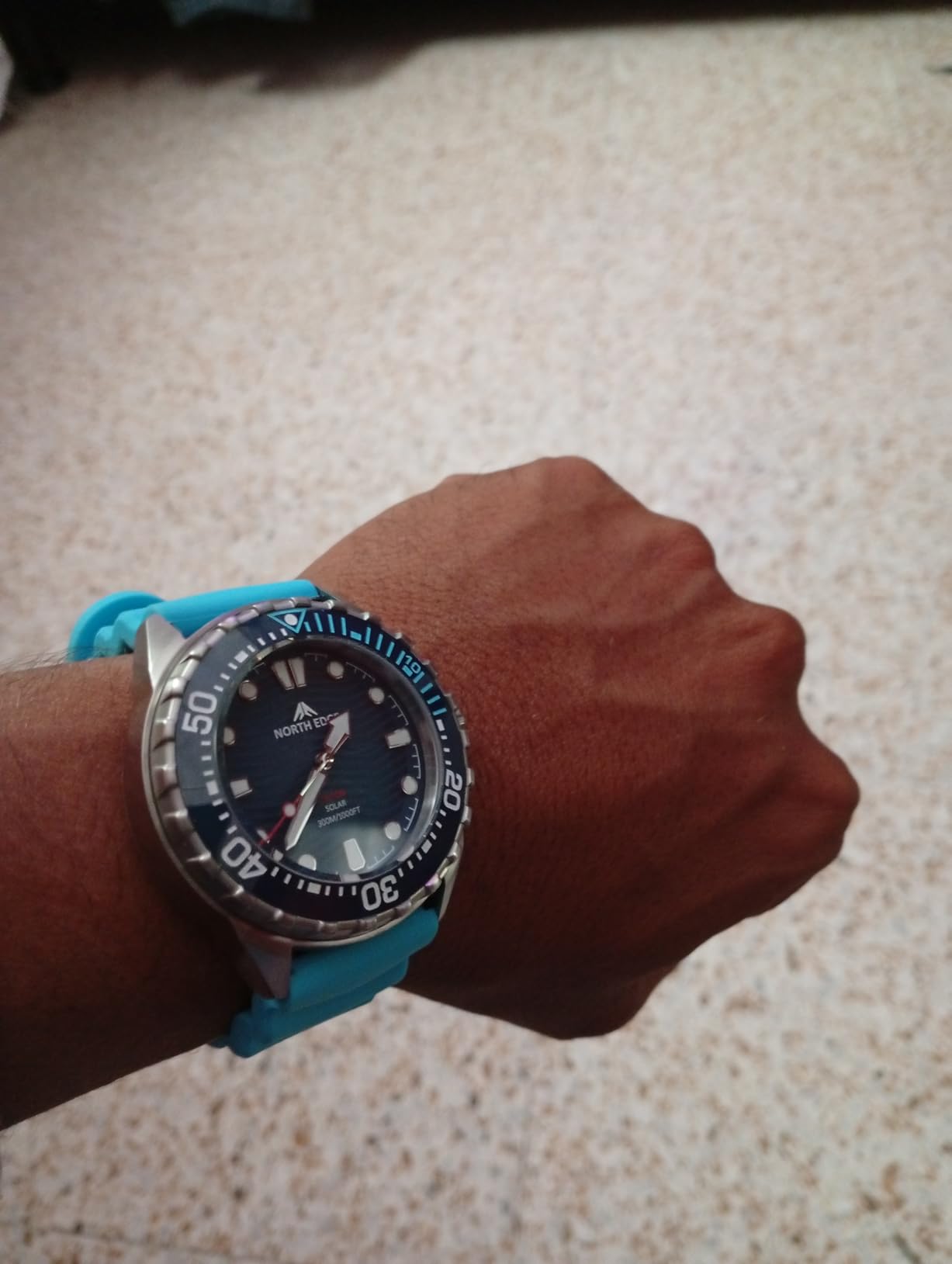
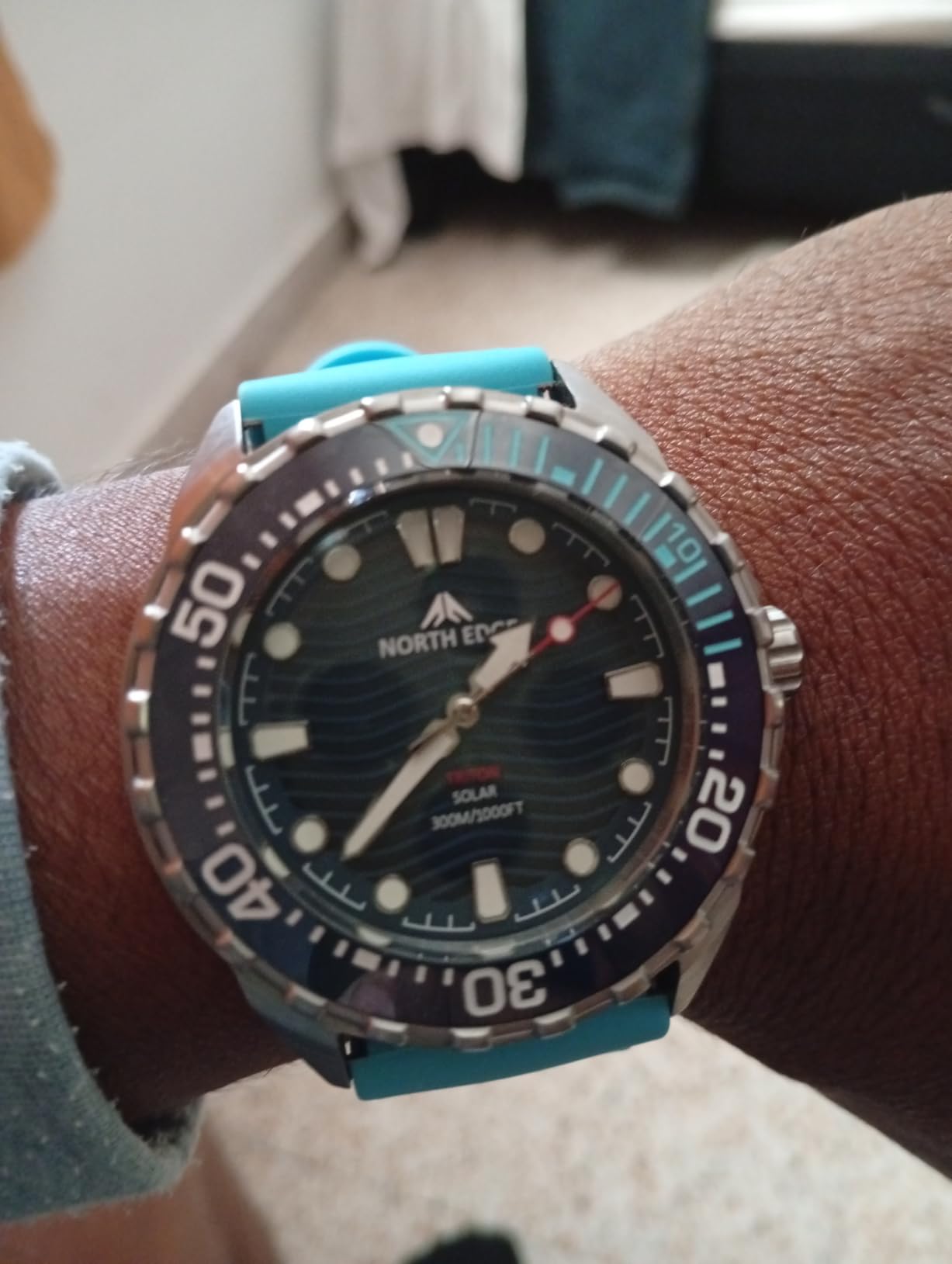
Owners compare it favourably with similarly sized Seiko and Citizen solar divers on lume and finish. The lume is genuinely strong and stays readable all night, the bezel is smooth with clear clicks, and the dial is clean and uncluttered with a subtle wave pattern and a red-tipped second hand. A titanium version at about 92g changes the feel of a watch this size completely.
Size is the whole argument against it. At 45.8mm and 51.4mm lug-to-lug with roughly 16mm of thickness, reviewers split, with most loving the substantial case and a minority finding it impossible to wear daily. There is no date, the silicone strap is basic with no micro-adjust, and a full charge needs about 41 hours of direct summer sun, so it is not a watch you can leave in a drawer for a year.
Solar against quartz and automatic in daily use
The maintenance comparison is what makes solar worth considering. Standard quartz needs a battery roughly every three years, which is already little, and an automatic needs winding and servicing on a schedule while a solar watch needs neither. The trade is light, because the dial on a solar watch tends to be cleaner and you will never see the movement.
Who should skip it
Skip it if your wrist is under about 7 inches, because 45.8mm and 51.4mm lug-to-lug will overhang, skip it if you need a date, and skip it if you want something that goes under a shirt cuff, because this watch announces itself before anything else does.
10. Casio MTP-VD01D – Best Dressed-Down Diver Look on a Budget
Casio MTP-VD01D-2BV | Diver-Style Analog Watch | Blue Sunburst Dial | Stainless Steel Band | Date Display | 50M Water Resistant | 3-Year Battery | Men’s
50m WR
48 by 42mm case
Mineral glass
Quartz
Pros
- Blue sunburst dial shifts from navy to bright blue with the light
- Full stainless steel case and bracelet feel more expensive than the price
- Large luminous numerals read at a glance
- Lightweight and comfortable with a quick-adjust clasp
- Quartz accuracy within 20 seconds a month
Cons
- Only 50m water resistant
- so not for swimming
- Bezel is decorative and does not rotate
- Crown is not screw-down
- Lume on the hands only and fades quickly
- 48mm case is large for smaller wrists
We include this one with a clear caveat, because it is not a dive watch in any functional sense. It is a diver-styled steel watch that looks the part, reads clearly and sits at the lowest outlay of anything here, and for pool decks, travel and casual summer wear that is a good outcome.
Specs: case dimensions 48 by 42 by 10.7mm, stainless steel case and band with fold-over clasp, blue sunburst dial with large luminous Arabic numerals, date display, 3-hand analog, quartz accuracy within 20 seconds a month, SR626SW battery with about a three-year life, mineral glass crystal, 50m water resistance. Why buy: the sunburst dial. It shifts from deep navy to bright blue as the light moves, which is more visual interest than most entry divers manage.
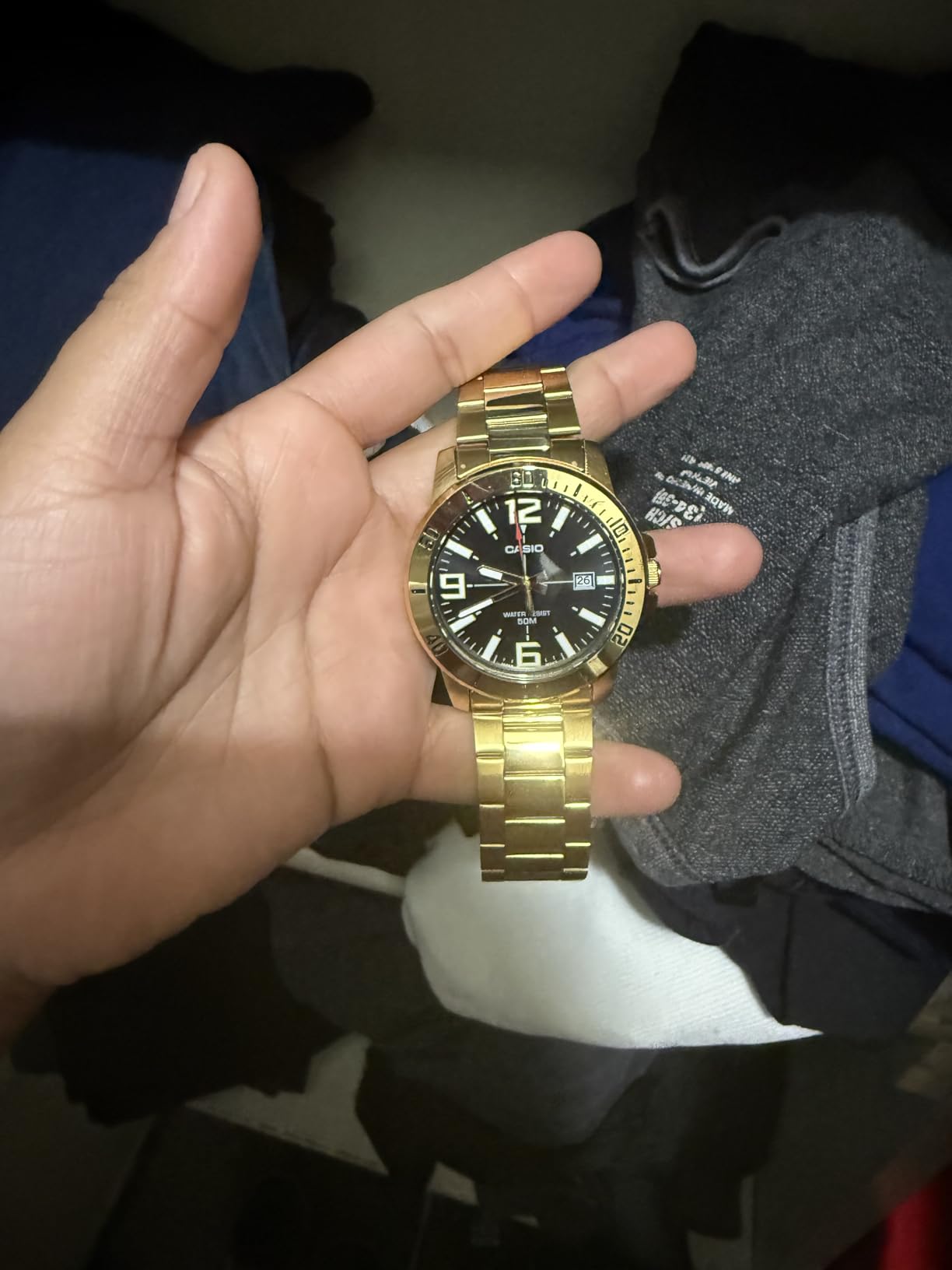
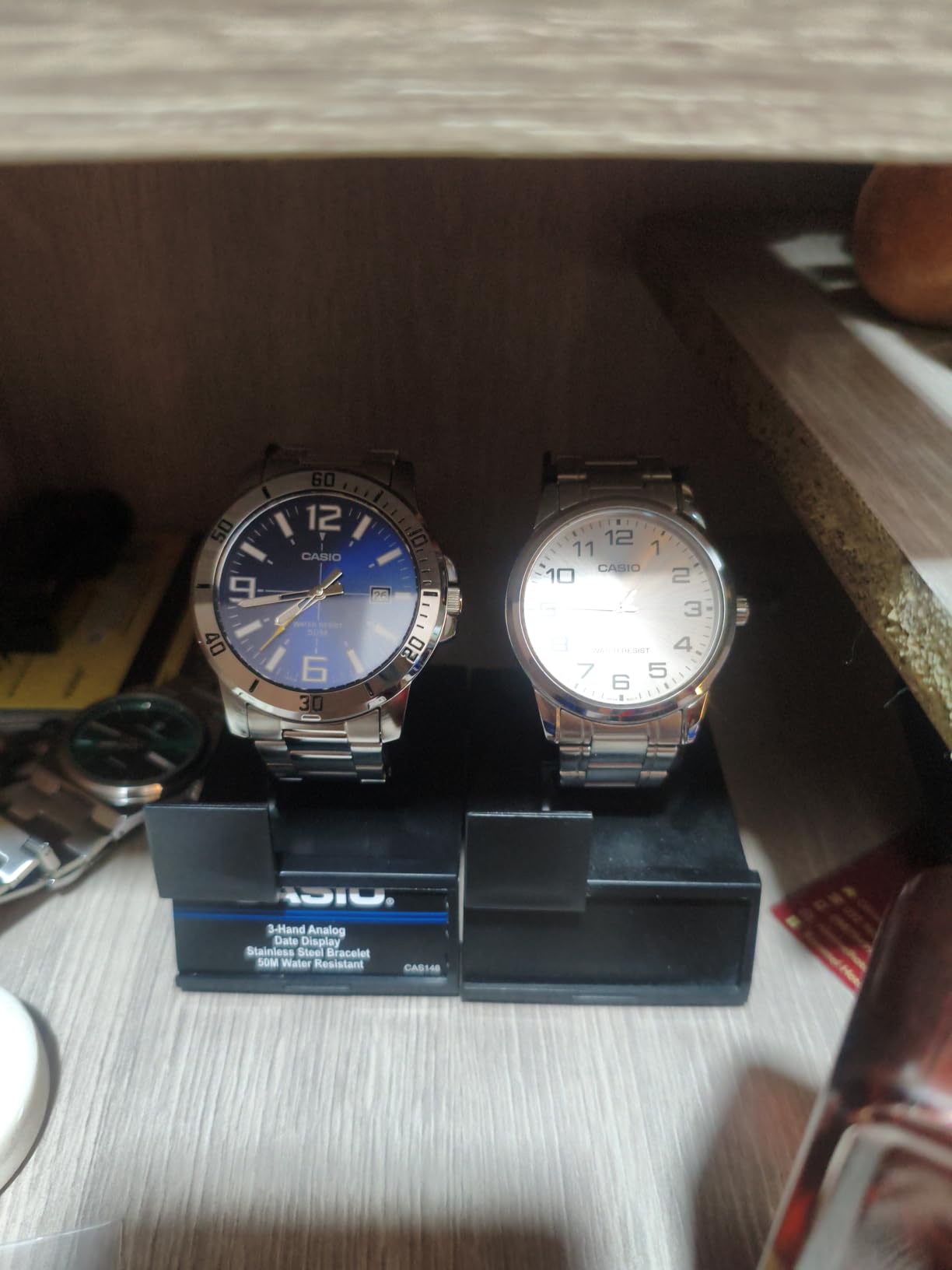
The large Arabic numerals are the practical feature. They are readable at a glance in daylight, which matters more than lume performance for a watch worn in the sun, and the quick-adjust clasp means you can size it without a tool, a convenience most steel-bracelet watches in this list do not offer. Buyers consistently describe the full steel case and bracelet as feeling more expensive than the price suggests.
The caveats are not small. A 50m rating means everyday splashes and hand washing, not swimming, the bezel does not rotate so it is decorative, and the crown is not screw-down. The lume is on the hands only, not the indices, and it fades quickly. At 48 by 42mm the case is large, particularly for smaller wrists.
Why it belongs in a dive watch roundup anyway
Because the line between a dive watch and a dive-styled watch is exactly what buyers need help with. This watch sits right on it: the rotating-bezel silhouette, steel construction and diver layout, without the water resistance, rotating bezel or screw-down crown that make the silhouette functional. Put it next to the ADDIESDIVE 41mm, which has a 200m rating and a screw-in crown for a similar outlay, and the difference between style and substance becomes obvious in about five seconds.
Who should skip it
Skip it if you swim with it on, skip it if you want a rotating bezel, and skip it on a small wrist, because a 48mm case does not shrink regardless of the 10.7mm profile.
11. Stuhrling Depthmaster Heritage Diver – Swiss Quartz in a Steel Case
Stuhrling Original Depthmaster Heritage Diver Men’s Watch 42mm Stainless Steel, Swiss Quartz Dive Watch for Men, Teal Dial, 100M Water Resistant, Rugged Outdoor Watch for Swimming & Daily Use
42mm 316L steel
Swiss Ronda 515 quartz
100m WR
Pros
- Swiss-made Ronda 515 quartz movement with dependable accuracy
- Durable 316L stainless steel case
- Unidirectional bezel and 100m rating for swimming
- Clean legible dial with a practical date window
- Good value for a Swiss-movement diver
Cons
- 100m rating is for swimming and surface water
- Quartz movement has none of the appeal of an automatic
- Styling less refined than competing budget divers
The distinguishing spec here is the Ronda 515, a Swiss-made quartz movement, sitting in a 316L stainless steel case with a 100m rating. That combination is genuinely unusual at this price, and it is the whole reason this watch is here rather than a Casio or an Invicta.
Specs: 42mm 316L stainless steel case, Swiss-made Ronda 515 quartz, unidirectional rotating bezel, 100m and 330ft water resistance for swimming and water exposure, date display on a clean dial, available in teal and black. Why buy: if movement provenance matters to you, this is the only watch in the roundup with a Swiss calibre, and the 100m rating plus rotating bezel make it a functional swim watch rather than a decorative one.
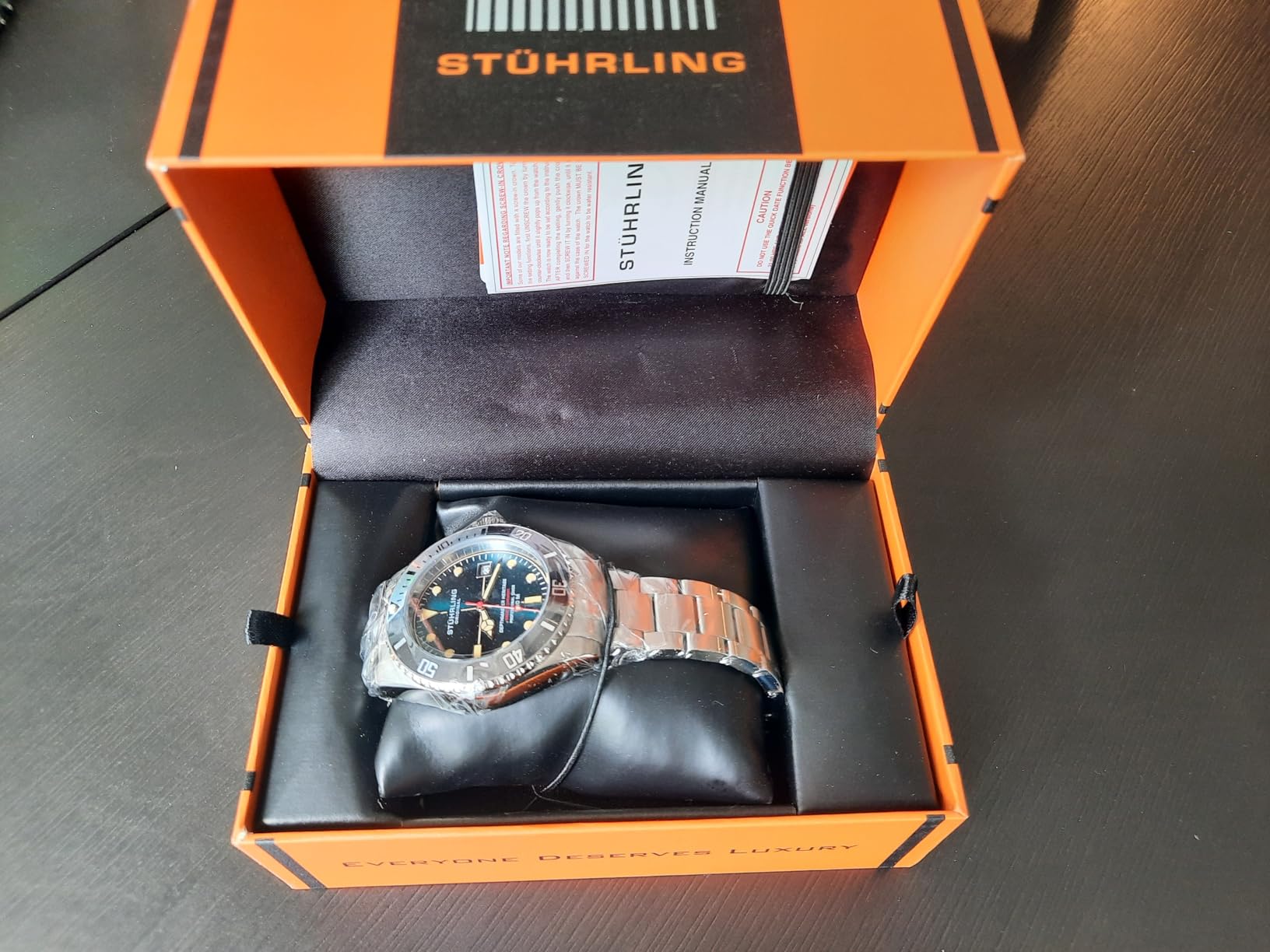
The 100m rating covers swimming, showers and surface water exposure, a step above the purely decorative diver-styled watches. The rotating bezel gives you something functional to do with it, the 316L case is the same steel grade used across the better watches here rather than a lighter alloy, and the dial is clean with a practical date window and no clutter.
Two honest limitations. The 100m rating is not a diving rating, and a Swiss quartz movement, while dependable, has none of the appeal of an automatic if a mechanical watch is the goal. Reviewers also find the styling less refined than competing budget divers, and this has the smallest owner review base in the roundup, so the long-term picture is less well documented.
Swiss quartz against Japanese quartz
Both are quartz, so both give you the same accuracy class and the same battery maintenance, and neither changes how you read the time. The difference is manufacturing provenance and regulation, and for some buyers that is enough on its own. The more useful comparison is against the automatics here, since an automatic gives movement interest while quartz gives accuracy and no winding, and that decision is the one that matters.
Who should skip it
Skip it if you dive, skip it if you want an automatic or a solar movement, and skip it if a thin profile matters, because 42mm in steel is a substantial watch on the wrist.
12. CRESSI Leonardo 2.0 – Best Dive Computer in the Roundup
CRESSI Leonardo 2.0 Scuba Dive Watch, Air Nitrox Gauge, Black/Blue
100m WR
Air Nitrox and gauge modes
2 inch display
Single button
Pros
- Large high-contrast display that is easy to read underwater
- Simple single-button interface that is quick to learn
- Algorithm accuracy matches more expensive computers
- User-replaceable battery and automatic activation on water entry
- Works as a primary or backup recreational computer
Cons
- Very large and bulky for everyday wear
- Single-button interface takes time to master
- No wireless sync and some units fail to connect
- Weak backlight compared with premium computers
- Loose silicone strap on smaller wrists
This is the odd one out and it earns its place. A dive computer is not a dive watch, but if you are spending money in this range on underwater timing, a computer does something no watch on this list can, and this is the budget option for it.
Specs: dive computer supporting Air, Nitrox and Gauge modes, single-button interface, 2 inch 320×240 display, pressure-based gauge depth sensor, analog-digital display, visual and audible critical alerts including ascent rate warnings, USB and infrared data transfer for dive logs, 100m water resistance with an IPX7 rating, user-replaceable lithium manganese dioxide battery with up to 70 hours of life, silicone strap, two-year limited warranty. Why buy: if you dive recreationally, this tracks depth, time, nitrogen loading and ascent rate, and it alerts you. A bezel and a 200m rating cannot do any of that.
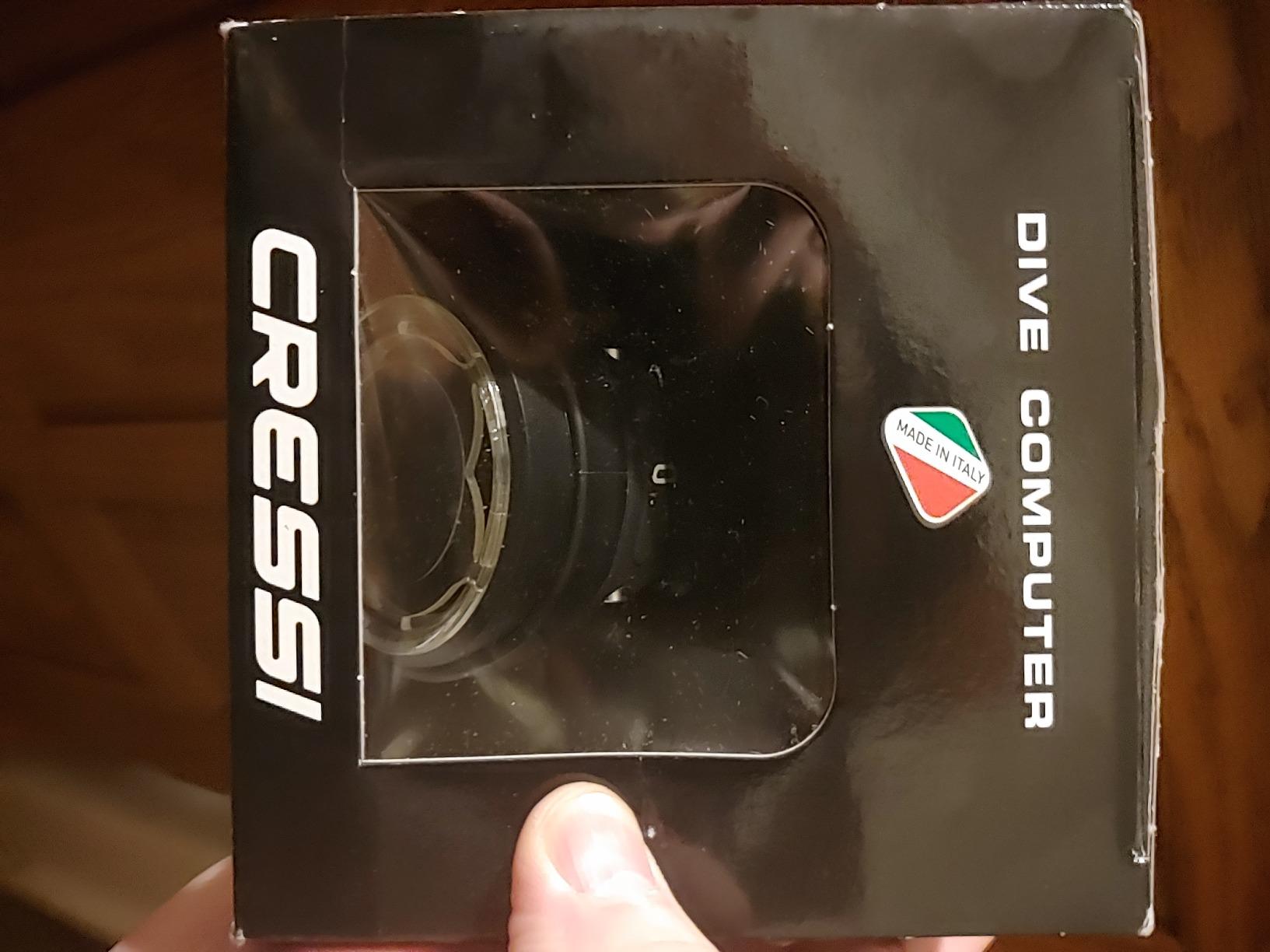
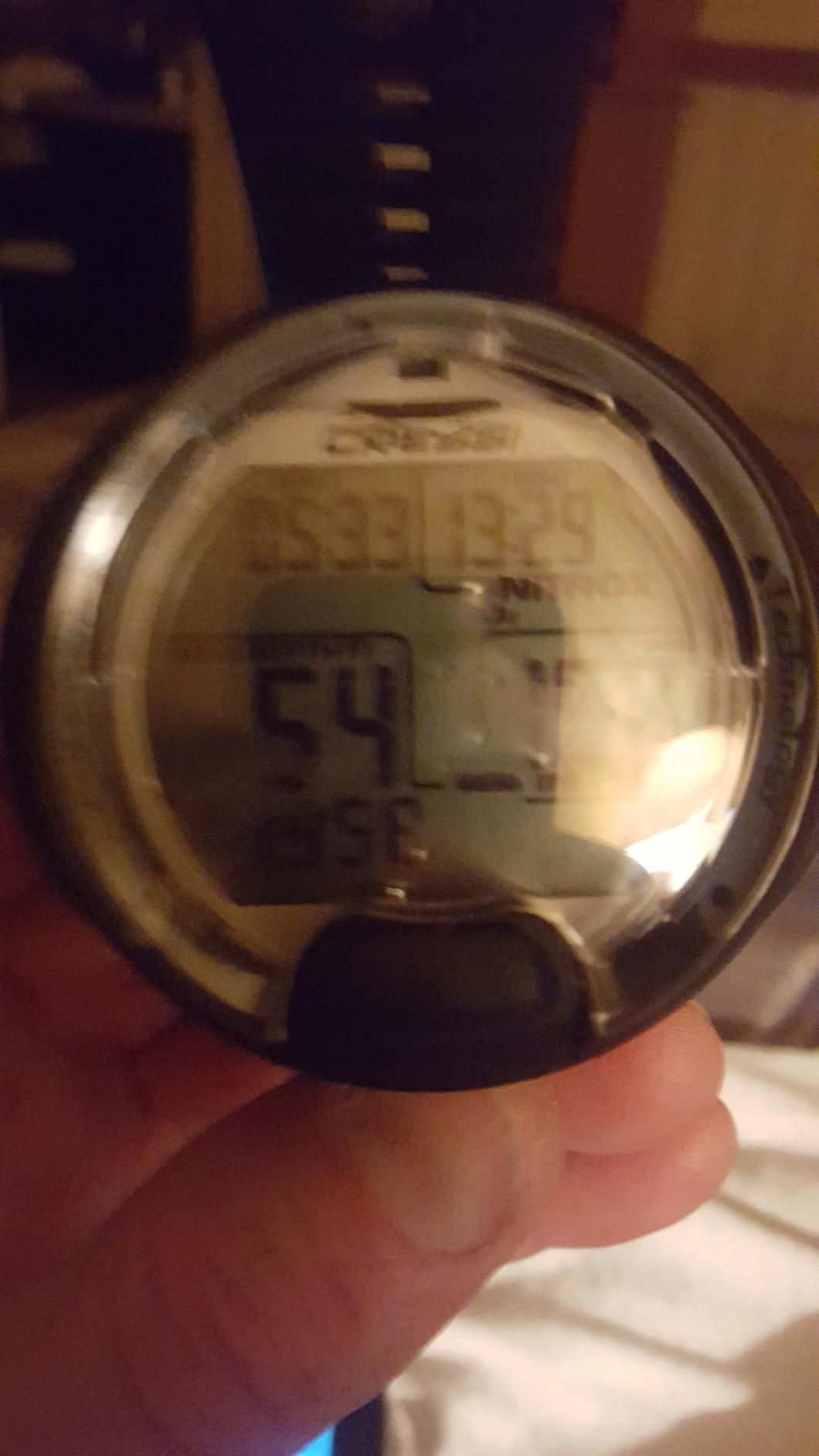
The display is the strongest part. A large high-contrast screen is easy to read underwater, which is the single most important characteristic of a dive computer, and the algorithm is accurate enough that reviewers compare it to computers costing considerably more. Single-button control also means fewer ways to fumble a critical action with cold hands.
The weaknesses are about durability and convenience. At 200g it is very large and bulky, which makes it awkward as an everyday watch and is why most owners use it as a primary or backup dive-only device. There is no Bluetooth or wireless sync, only USB and infrared, and some owners report units that will not connect at all. The backlight is weak next to premium computers.
Whether a dive computer makes the watch redundant
For actual scuba diving a computer is more informative than any watch, and serious divers usually run one as their primary timing instrument. Owning both is about redundancy, because a computer can fail, run flat or get forgotten on a boat deck, and a simple watch with a bezel is the backup that depends on no menu. Use this in the water and a watch from this list on the surface and every day after, while weighing the reports of displays failing after a battery change.
Who should skip it
Skip it if you do not dive, because 200g of plastic on the wrist has no purpose on land. Skip it if you need something you can wear to work, and skip it if you want wireless app syncing, which this does not offer.
How to Choose a Budget Dive Watch: The Specs That Decide It
Spec sheets at this budget are full of numbers that do not tell you whether a watch is good. These are the ones that do, in roughly the order we would weigh them.
1. Water resistance, and what the number covers. A 200m rating means the watch is built for swimming, snorkelling and surface water sports, and the Orient models here are explicit that they are not rated for diving. A 300m rating covers diving. A 50m rating covers splashes and rain, which is all the Casio MTP-VD01D offers, and no amount of styling changes that.
2. Whether the 200m claim is ISO 6425 certified. ISO 6425 is the international standard for dive watches and tests far more than depth, covering legibility in low light, unidirectional bezel operation, magnetic and shock resistance, and condensation. A watch that meets it should carry the divers mark on the dial. A watch that only says 200m on the box may simply be depth tested, so check the dial before you buy.
3. Bezel action. The bezel should rotate only counter-clockwise so it cannot be moved by accident underwater. Click count tells you how finely it indexes, and 120 clicks gives one per minute, finer than 60. The bigger issue is grip, because a stiff or slippery bezel is useless with wet or gloved hands, and that is a documented weakness of both Orient models here.
4. Movement type, honestly. Quartz is the most accurate, needs the least attention and costs the least, and for most buyers of a budget diver it is the correct answer. Solar gives quartz accuracy with less maintenance, at the price of a larger, plainer case. Automatic is the interesting choice. Our guide to automatic watches under this budget covers the movement side in more depth.
5. Crystal type. Sapphire resists scratches, and that is the reason to choose the Orient Mako 3 or the RATIO FreeDiver over otherwise similar watches. Mineral and Hardlex scratch, visibly, which is why so many owners end up with cloudy crystals. Flame Fusion, on the Invicta quartz, sits in between. Anti-reflective coating matters more than buyers expect, because a glare-free dial is a legibility tool rather than a luxury detail.
6. Case diameter and lug-to-lug together. Diameter is what listings show and lug-to-lug is what decides whether a watch looks right on your wrist. A 41mm case with 48mm lug-to-lug wears noticeably larger than a 41mm case with 43mm. As a rough guide, a wrist around 6 inches looks best at 38 to 40mm, 6.5 inches suits 40 to 42mm, and 7 inches or more handles 42mm and up without looking wrong.
7. Lume, and where it is applied. Check whether the lume covers the indices, the hands and the bezel pip, or only some of them. Budget lume fades faster than spec sheets suggest, and owners of the Invicta 8926OB report brightness that barely shows. The Orient AA02 and the NORTH EDGE are the two bright picks here.
8. Strap and bracelet. Standard 20mm and 22mm lug widths give you the whole aftermarket strap market, and a NATO or rubber strap is the first upgrade most owners make. Hollow end links are the most common disappointment at this budget because they loosen and rattle, and fixed spring bars rather than quick release make swapping harder. We cover the everyday side of this in our dive watches for everyday wear guide.
One more thing nobody at this price range discusses: what this budget does not buy. Above it you start seeing in-house movements with longer power reserves, domed sapphire, solid end links, better finishing on the case flanks and eventually real ISO 6425 certification. Our dive watches under 500 dollars roundup covers that tier, and our automatic dive watches under 1000 dollars covers the step beyond it.
Frequently Asked Questions
What is the best value for money dive watch?
The Casio MDV106-1A is the best value dive watch under 300 dollars. It carries a 4.7 average across more than 32,000 owner reviews, a 200m water resistance rating, a screw-down crown and caseback, luminous hands and markers, and a battery that lasts about three years. Nothing else at this price combines that rating, that volume of long-term owner data and that little maintenance.
What are the best diver watches under 300 dollars?
Our top picks are the Casio MDV106-1A for reliability and low maintenance, the Invicta Pro Diver 8926OB for the cheapest route into a genuine Seiko NH35A automatic, the Orient Mako II for a well-regulated in-house movement with day and date, the Orient Mako 3 for a sapphire crystal, and the ADDIESDIVE 41mm for a full 200m spec sheet with screw-in crown and steel bracelet.
What is the best affordable sapphire crystal watch?
Among the dive watches in this roundup, the Orient Mako 3 pairs a sapphire crystal with an in-house Japanese F6922 automatic and 200m water resistance, which is the strongest combination under this ceiling. The RATIO FreeDiver also uses sapphire, adds a well-regulated Japanese automatic and 20mm lugs, and costs less, though its tapering bracelet is the weakest part. Both avoid the scratch problems that affect mineral and Hardlex crystals over time.
How do I know if a dive watch is ISO certified?
ISO 6425 certified dive watches carry a divers symbol on the dial that looks like a circle with a line and the number 1 inside it, usually printed between the 4 and 8 o’clock markers or near 12. The standard tests far more than depth, including low-light legibility, unidirectional bezel operation, magnetic resistance, shock resistance and condensation. A stated 200m rating with no dial mark means depth tested only, so the claim is unverified.
What dive watches do Navy Seals wear?
Military and professional units typically use rugged dive watches with strong legibility, high water resistance and unidirectional bezels from specialist brands rather than budget fashion divers. Those watches cost considerably more than this price range, and the reason is the same one that separates the good picks here: sealed screw-down cases, sapphire or Hardlex crystals, serviceable movements and full depth testing. None of the watches in this roundup would replace a military-issue instrument.
Conclusion: The Best Dive Watches Under 300 Dollars in 2026
The best dive watches under 300 dollars in 2026 are not as close together as the marketing suggests, because each of these fails in a different place. Our overall pick is the Casio MDV106-1A, the only one where the compromises are cosmetic rather than structural. Buy the Invicta 8926OB for the cheapest route to a mechanical movement, the Orient Mako II for accuracy and day and date, the Orient Mako 3 for sapphire, the ADDIESDIVE 41mm for a complete 200m spec sheet, and the NORTH EDGE solar if you dive.
Check the dimensions first, because a watch that is too large on your wrist is the mistake you cannot fix later, then decide whether you are buying a tool or a first mechanical watch, since that answer changes which of these twelve is right for you. Prices shift constantly, so use the check button on each card to confirm current figures before you decide.