
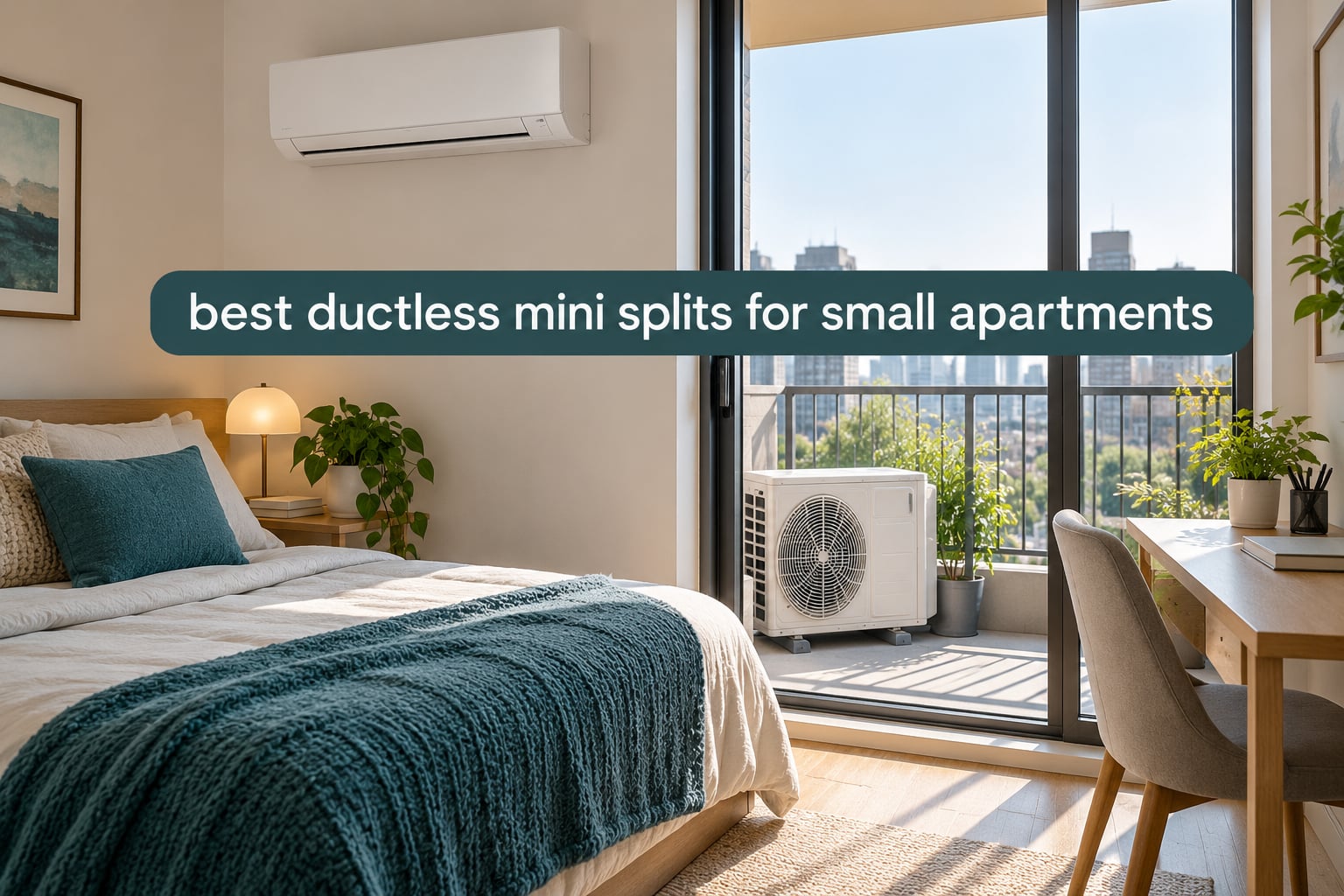
A 9000 BTU ductless mini split can cool a small bedroom better than three window air conditioners, run quietly enough to sleep next to, and cost less to operate than either of them. That is the short version of why these systems keep showing up in apartment buildings that have no ductwork and no spare wall space.
The problem for apartment dwellers is everything around the hardware. The electrical panel in a 1960s building may not have a spare 230V circuit. The lease may forbid permanent wall penetrations. The only place for the outdoor condenser is a balcony where the neighbours can hear it. Choose the wrong system and it is a very expensive doorstop. Choose the right one and it is the best purchase in the apartment.
We compared 10 systems that fit under 1 ton, all of them sized for studios, one-bedroom apartments and small home offices. Every one below runs on either 115V or 230V, includes a pre-charged outdoor condenser, and carries a spec sheet we could verify line by line. We are calling out where the marketing copy and the spec table disagree, because that gap is where apartment installs go wrong. If you want the wider picture first, our general ductless mini split systems guide covers multi-zone setups and whole-home options.
Updated for 2026. All ratings and review counts are the live figures from the product listings at the time of writing.
Table of Contents
Top 3 Best Ductless Mini Splits for Small Apartments in October
All 10 Ductless Mini Splits Side by Side in 2026
| Product | Specifications | Action |
|---|---|---|
 COSTWAY 9000 BTU Mini Split COSTWAY 9000 BTU Mini Split |
|
Check Latest Price |
 Senville LETO 9000 BTU Senville LETO 9000 BTU |
|
Check Latest Price |
 ROVSUN 9000 BTU WiFi ROVSUN 9000 BTU WiFi |
|
Check Latest Price |
 Albott 12,000 BTU Mini Split Albott 12,000 BTU Mini Split |
|
Check Latest Price |
 Rellytech 9000 BTU Mini Split Rellytech 9000 BTU Mini Split |
|
Check Latest Price |
 Mountman 9000 BTU Mini Split Mountman 9000 BTU Mini Split |
|
Check Latest Price |
 DELLA Optima 9,000 BTU DELLA Optima 9,000 BTU |
|
Check Latest Price |
 Temprium 9,000 BTU Mini Split Temprium 9,000 BTU Mini Split |
|
Check Latest Price |
 LITHZEN 12,000 BTU Mini Split LITHZEN 12,000 BTU Mini Split |
|
Check Latest Price |
 DELLA Serena 9,000 BTU DELLA Serena 9,000 BTU |
|
Check Latest Price |
How We Chose: What We Checked on Every Model
For each of these 10 systems we pulled the full specification block rather than the marketing bullets, then compared the two. Several listings claim coverage figures that the spec table contradicts, and that mismatch matters a lot in a 200 sq ft studio where an oversized head short-cycles all night.
We also weighted four apartment-specific factors above raw spec sheets: whether the condenser runs on 115V or forces an electrician, how many reviews back the listing, the length of the warranty, and how quiet the indoor head is on its lowest fan setting. We excluded any listing without a verifiable SEER or SEER2 figure, because efficiency is the main reason to replace a window air conditioner in the first place.
1. COSTWAY 9000 BTU Mini Split – The Best All-Rounder for Apartments
COSTWAY 9000BTU Mini Split Air Conditioner& Heater
9000 BTU cooling / 10000 BTU heating
115V, 450 sq ft coverage
23 dB sleep mode, 19 SEER2
Pros
- Runs on 115V so no panel upgrade is needed
- 23 dB sleep mode is quiet enough for a bedroom
- Strong review base of 1658 ratings
- Self-cleaning coil at 135F with washable filter
- Complete kit with pre-charged condenser included
Cons
- Remote documentation is thin on mode switching
- Drilling template is marked about a quarter inch off
- Drain line routing is not documented
This is the system I keep coming back to for apartments because it removes two of the three common blockers at once. It runs on 115V, so it can go on an existing small-apartment circuit without a panel upgrade, and its indoor head drops to 23 dB on the lowest setting, which is quiet enough to sleep beside in a thin-walled building.
Capacity is 9000 BTU cooling and 10000 BTU heating at 0.75 tons, with a stated coverage of 450 sq ft. That is a real bedroom, a small home office, or a studio with the sleeping area cut off by a room divider. Owners report strong output for the capacity class and a build quality that holds up to a tight flare connection.
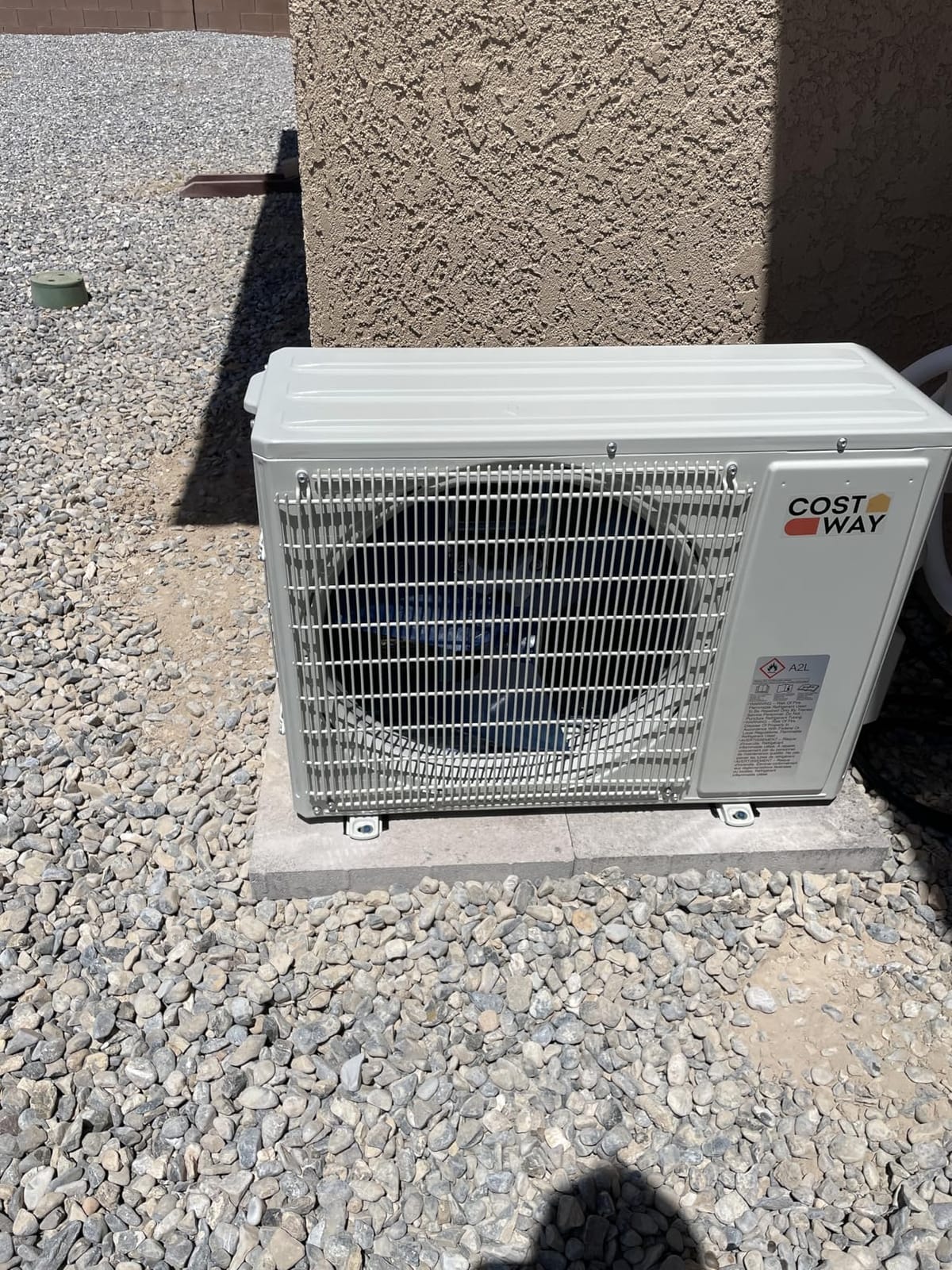
Seven operating modes, four fan speeds, 4D auto swing, a 24-hour timer and a display-off function cover the day-to-day use well. The high-temperature self-cleaning cycle at 135F is the feature I did not expect to care about and now recommend to anyone with a dusty city apartment, because it cuts how often you handle the coil.
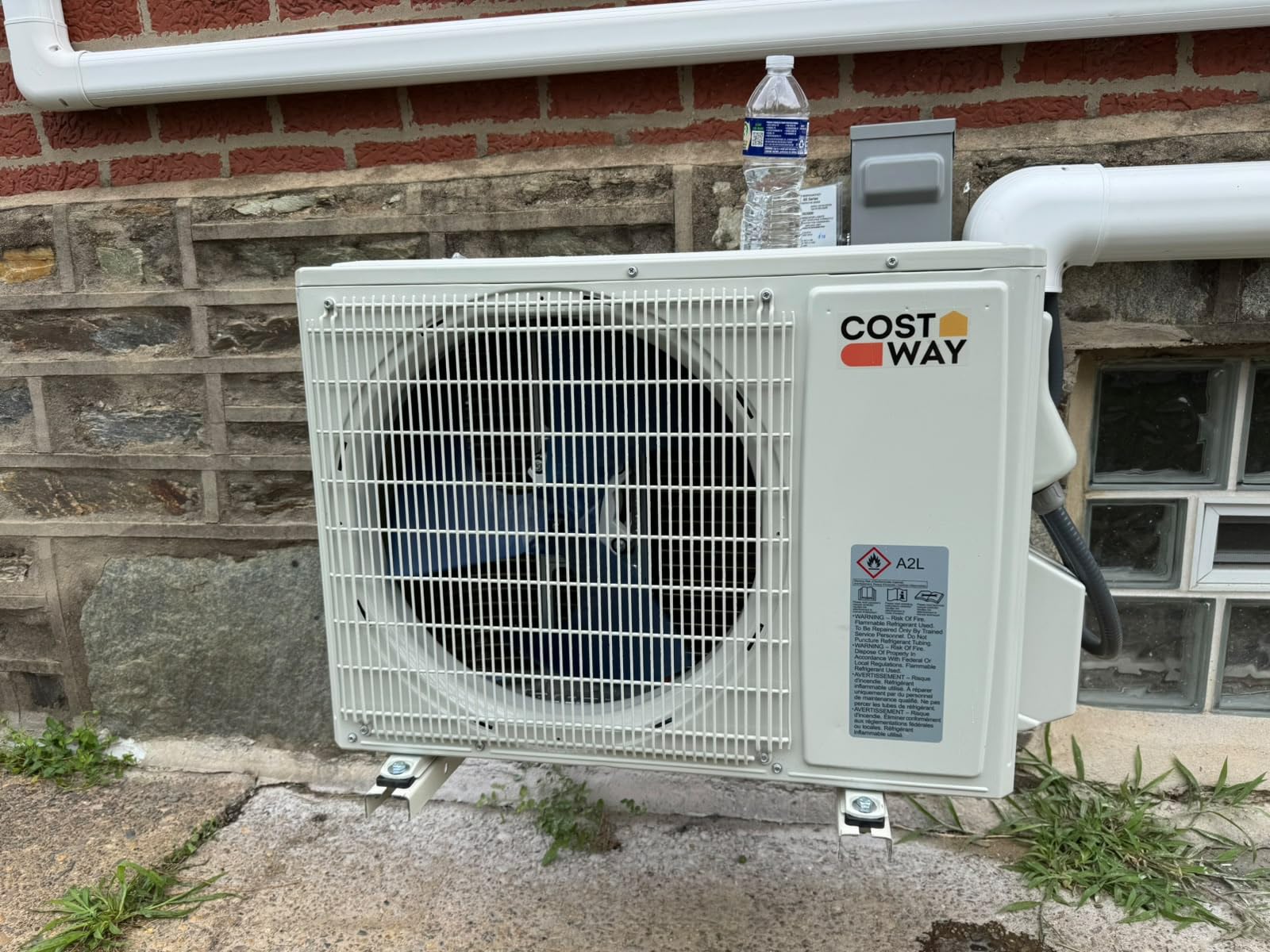
Our team noted one documentation weakness that most reviews repeat: the remote manual does not explain mode switching or the C/F toggle, and the drilling template is marked roughly a quarter inch off, which leaves a visible gap around the pass-through. The drain-line exit on the back of the head is also undocumented and may need relocating on a tight interior wall.
Who This System Works Best For
Renters in older buildings with a full panel and no spare 230V slot, and anyone cooling a bedroom where sleep quality depends on noise. The 23 dB floor and the washable filter make it a low-maintenance pick over summer months.
It also suits owners who want heat and cooling from one appliance. The 10000 BTU heating capacity covers the shoulder seasons in most climates without a second heat source.
Where It Falls Short
Auto mode cannot hold a set temperature or fan speed, which annoys anyone who likes the unit to stay exactly where they put it. Professional installation is required by the manufacturer, so the hardware figure is never the whole number you will pay.
If you are a tenant planning to leave in a year, the wall penetrations and line set are still a conversation to have with your landlord before anything is drilled. See the renter section further down.
2. Senville LETO 9000 BTU – The Deepest Review Base on the Market
Senville LETO Mini Split Air Conditioner, Heat Pump, White, 9000 BTU
9000 BTU 0.75 ton 110V heat pump
400 sq ft, 21.5 SEER
Heating down to 5F, Alexa and app
Pros
- Largest review base in the roundup at 1676 ratings
- 21.5 SEER efficiency in a sub-1-ton system
- Heating operation down to 5F for cold months
- Alexa and app scheduling included
- 16 ft pre-flared line set ships in the box
Cons
- Manufacturer mandates professional installation
- Warranty covers parts and compressor only
- 37 inch wide indoor head is bulky
- No Energy Star rating listed
With 1676 ratings averaging 4.4, this is the most thoroughly reviewed system in the group, and for an apartment install that matters more than a headline specification. When a product has that many owners describing the same behaviour, you can plan around what it will actually do rather than what the listing promises.
It is a 9000 BTU 0.75 ton system on 110V covering about 400 sq ft, with a 21.5 SEER rating and a DC inverter compressor. Heating runs down to 5F, which is a real advantage for a renter whose building has steam heat that arrives in November and leaves the bedroom unheated until April.
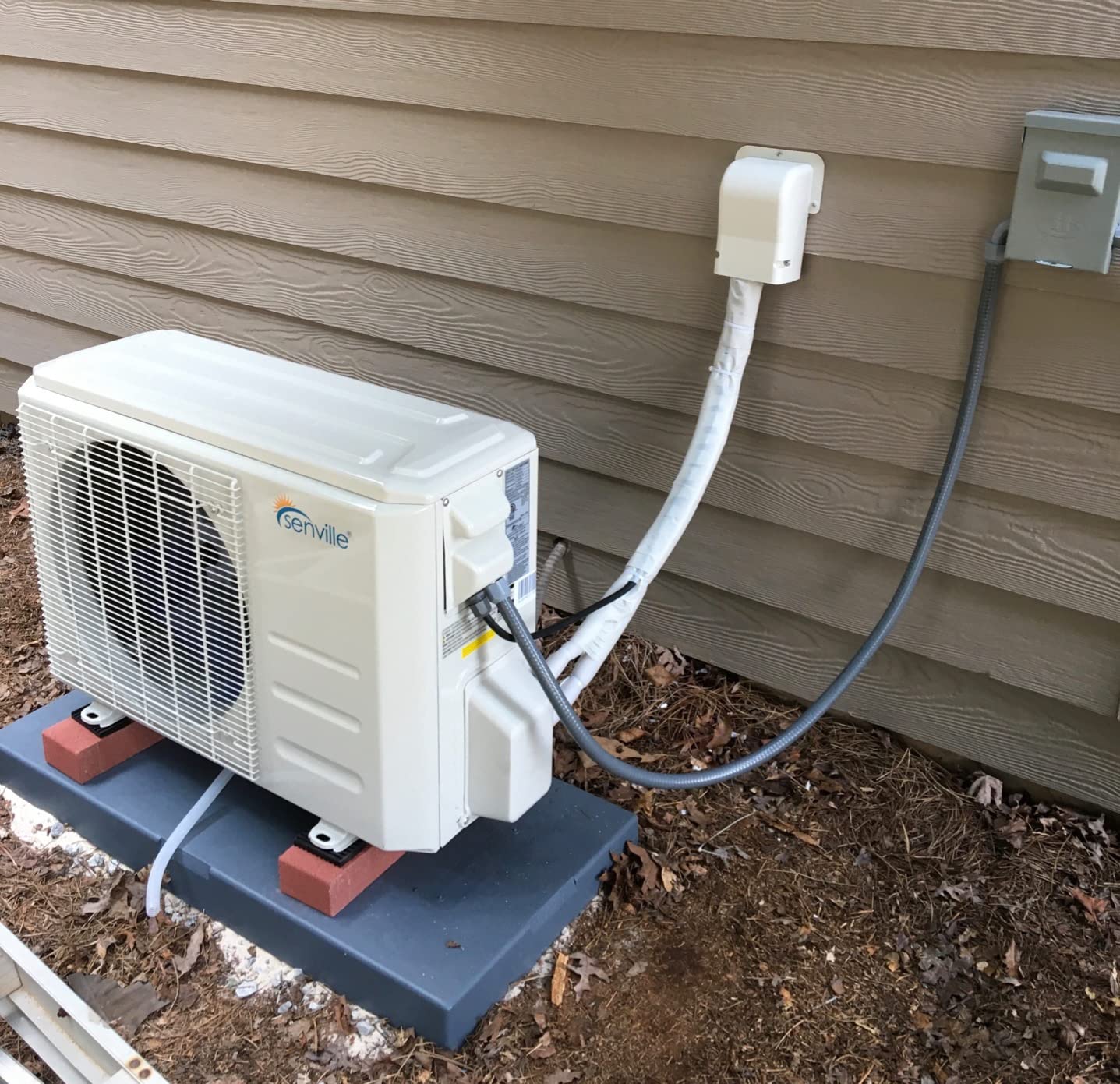
Control is the strongest argument for this one in apartment living. Alexa plus an app plus a remote means you can start cooling before you walk home from work, which is the difference between a comfortable apartment and a warm one in a top-floor unit. It also runs cooling, heat pump, dehumidification and fan in a single indoor head, so humid months are handled without a separate machine.
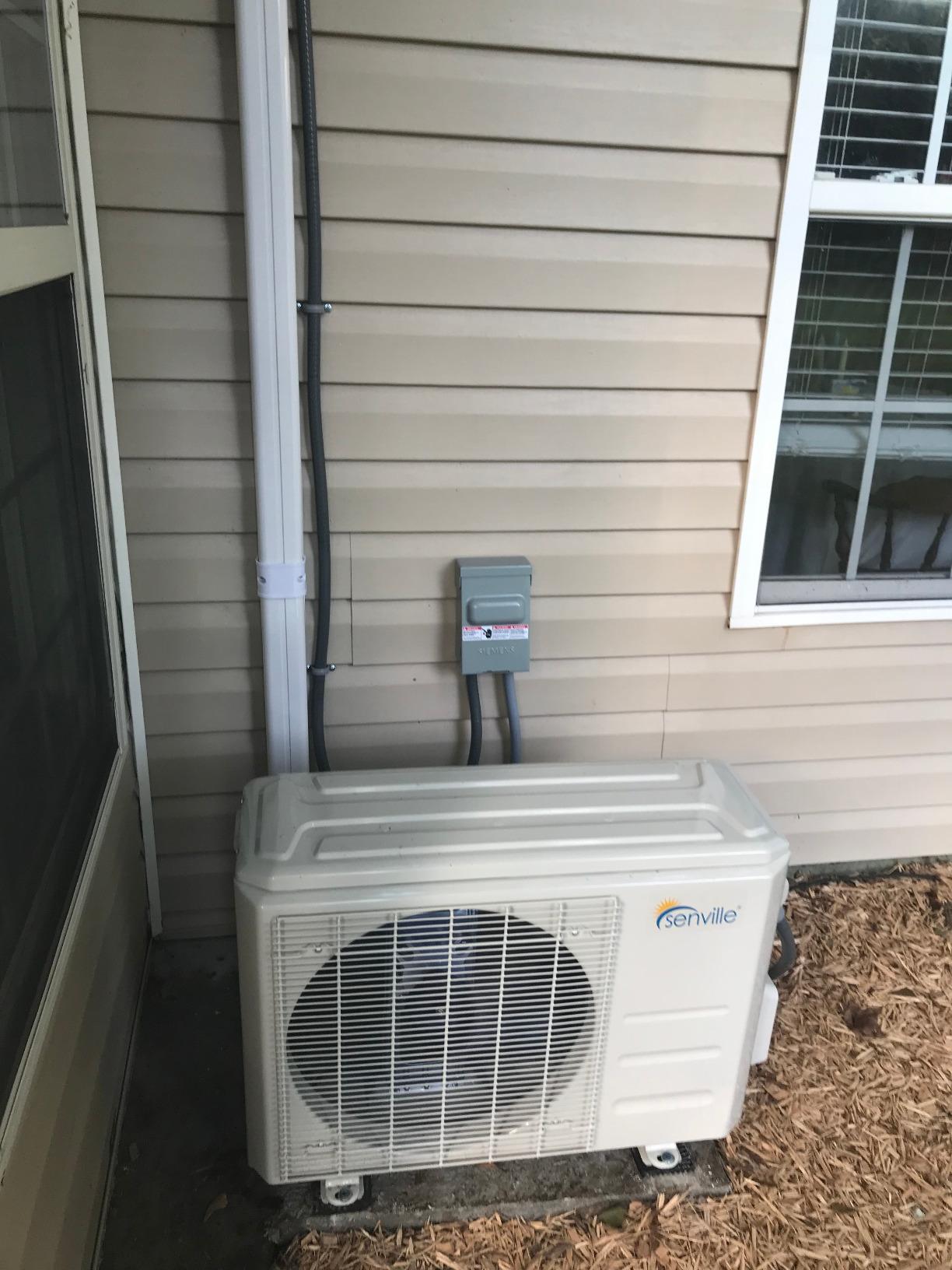
The included 16 ft line set and communication wire save a trip to the supply house and cover most interior-wall and exterior-wall runs in a small apartment. That matters because every extra foot of line set is extra labour if the pre-charge has to be adjusted.
Who This System Works Best For
Renters who want scheduling and voice control without touching an app every time they get home, and anyone in a climate with a cold shoulder season. Four-in-one operation covers humid summers and cold mornings in one appliance.
It also suits buyers who prioritise a long, well-documented track record over the highest efficiency number on the sheet.
Where It Falls Short
The 37 inch wide indoor head is wider than most 9000 BTU wall systems, so plan the wall space in a narrow bedroom before you commit. The warranty covers parts and compressor for five years but excludes labour, which is a meaningful gap in an apartment where a failed compressor means a service visit.
Professional installation is mandated by the manufacturer, and no Energy Star compliance rating is listed. Budget for the install as a separate line, not a rounding error.
3. ROVSUN 9000 BTU WiFi – Best for App-Controlled Apartments
ROVSUN 9000 BTU Wifi Enabled Mini Split Air Conditioner & Heater with Inverter, 20 SEER2 Energy Saving 115V Ductless Split AC Unit with Pre-Charged Condenser, Heat Pump & Installation Kit
9000 BTU 0.75 ton 115V inverter
450 sq ft, 20 SEER2
App, Alexa and Google Assistant
Pros
- 20 SEER2 efficiency in a 115V package
- App
- Alexa and Google Assistant control
- Owners report power use roughly halved versus window air
- 28 dB mute mode with 4-way swing
- 16.4 ft line set and signal cord included
Cons
- Only a 1 year warranty
- Manual skips the leak test and vacuum step
- Included line-set tape is low quality
- Packaged as two boxes that can arrive days apart
This is the pick for anyone who lives in the unit rather than in front of it. The indoor head carries a WiFi app, Alexa and Google Assistant alongside the remote, so scheduling and temperature changes happen from a phone, which is exactly what you want when you are not in the apartment.
Underneath it is a 9000 BTU 115V inverter with a 20 SEER2 rating covering 450 sq ft. Several owners who replaced window units report that their electricity use roughly halved, and 20 SEER2 explains why. The kit includes 16.4 ft of copper line set and a signal cord.
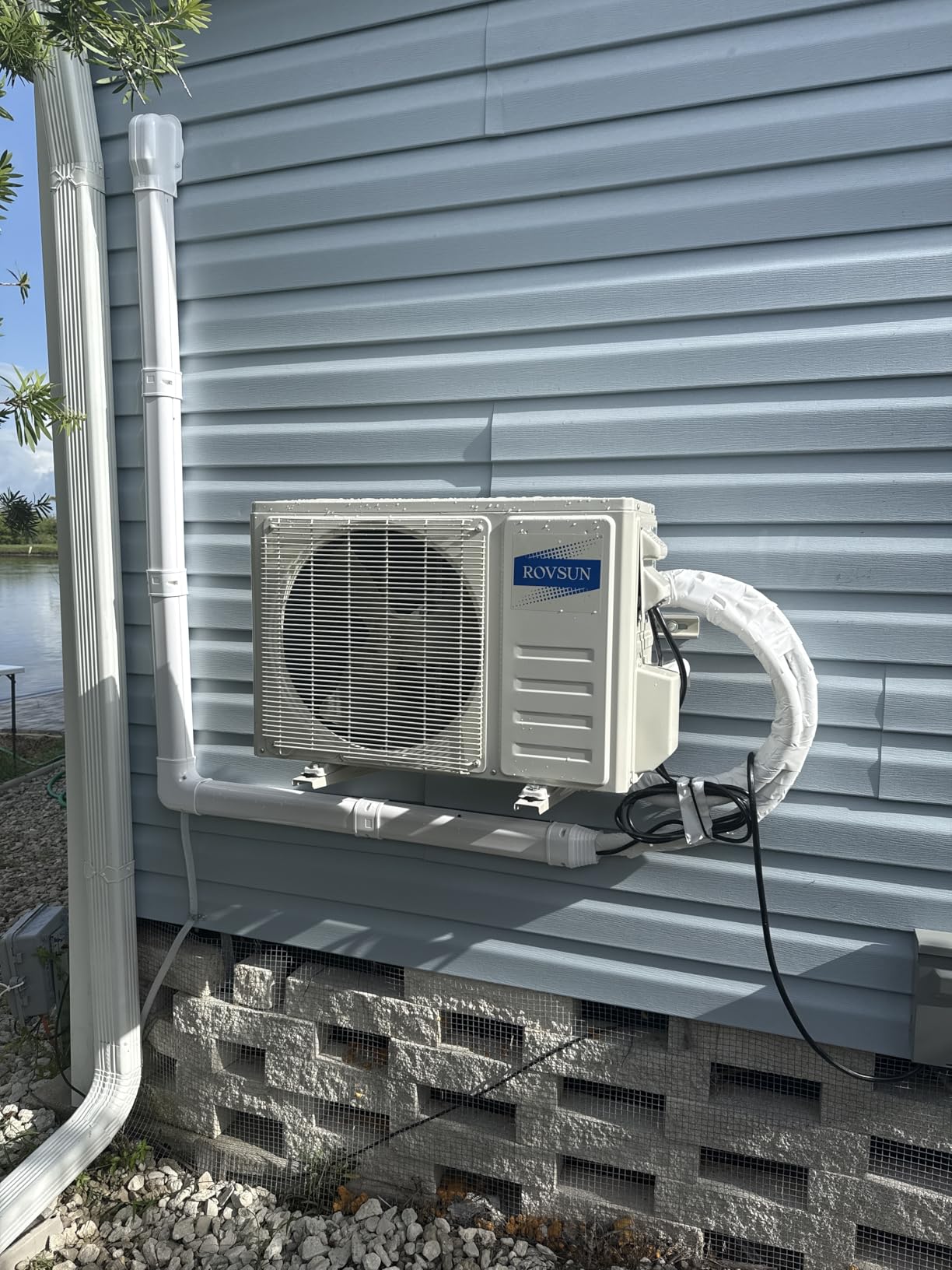
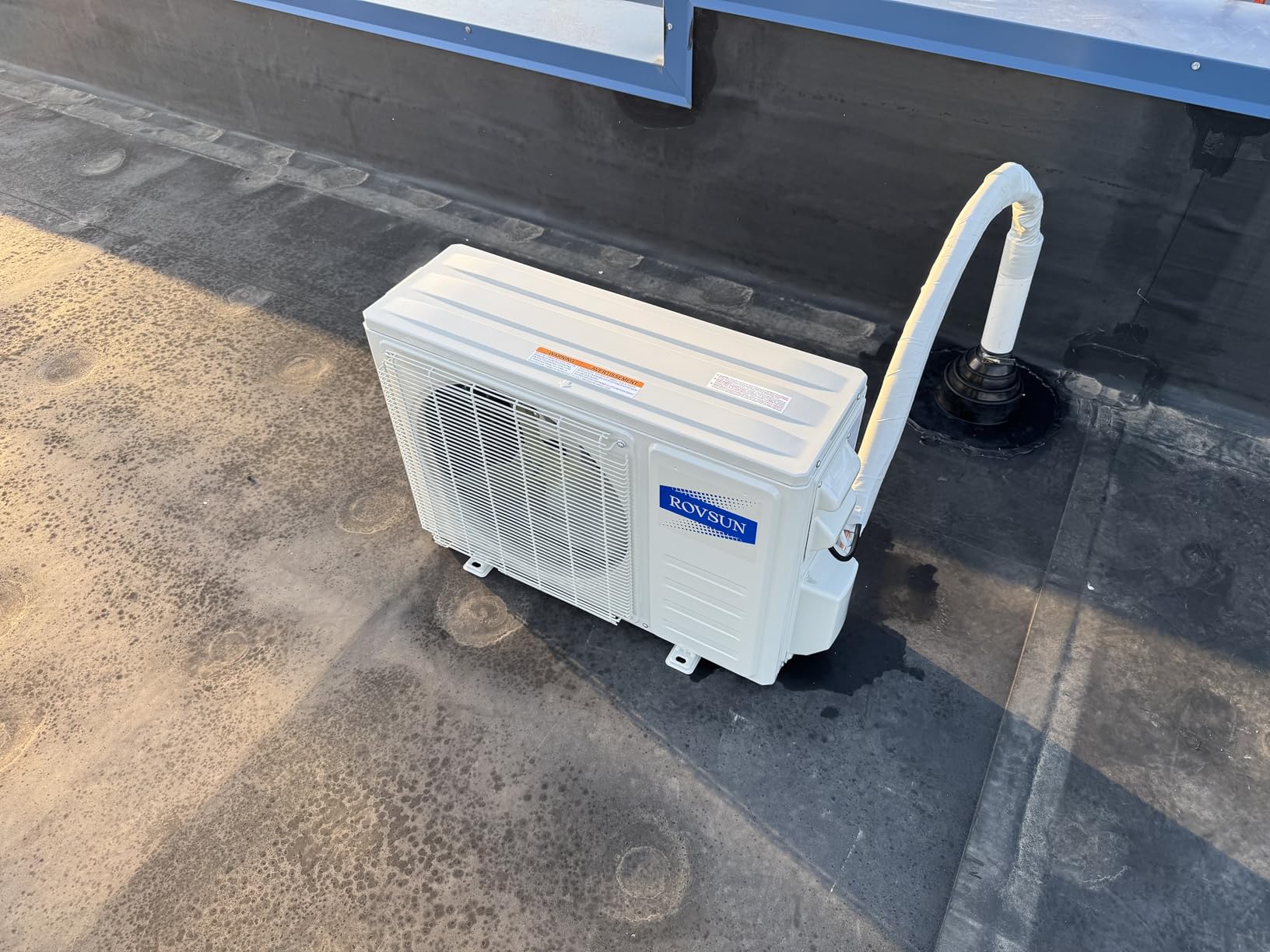
Quiet operation is reported on both the indoor head and the condenser, and reviewers in humid climates describe good heating and cooling with no condensation complaints. The 28 dB mute mode is not the lowest figure in this roundup, but it sits in a range most sleepers will not notice at night.
The honest weakness is the documentation and the warranty. The instructions go from connecting the copper straight to running the system and skip the leak test and the vacuum and charging step entirely, which are the two steps that decide whether a refrigerant charge is correct. A 1 year warranty is the shortest here, and the included line-set tape is commonly replaced by installers.
Who This System Works Best For
Tenants and owners who want app control, voice control and a scheduler without touching the indoor head when they get home. It also suits anyone replacing a window unit in a humid climate and tracking the change on a smart meter.
The 115V requirement makes it a realistic candidate for a panel with no spare 230V slot, which is common in pre-1980 apartment buildings.
Where It Falls Short
A one-year warranty is thin protection for a permanently installed appliance in someone else’s building. If the head fails in year three, a short warranty puts the cost on you rather than on the installer who charged for the work.
Anyone doing a self-install needs a vacuum pump and manifold gauges that are not included, and the two-box packaging can complicate a single scheduled delivery. If a professional is doing the work, this stops mattering.
4. Albott 12,000 BTU – Best for Open Studio Layouts
Albott 12,000 BTU Mini Split Air Conditioner and Heater SEER2 18, 115V
12000 BTU 1 ton 115V inverter
Up to 750 sq ft, SEER2 18
29 dB, operates 5F to 122F
Pros
- 12000 BTU handles open-plan studio layouts
- 115V operation avoids a 230V upgrade
- 5 year compressor and 7 year parts warranty
- Self-cleaning function and removable filters
- Quiet below 29 dB for bedroom use
Cons
- Lowest average rating here at 4.1 with a 14 percent one-star share
- Heavy at 151 pounds for handling and mounting
- Spec sheet and marketing disagree on warranty terms
- Manufacturer is listed as Happy Tao rather than Albott
If your apartment is one open space rather than separate rooms, capacity is the deciding variable and this is the 12,000 BTU option on our list. The stated coverage of 750 sq ft handles a studio with a kitchen area and a sleeping corner, or a living room that gets direct afternoon sun through west-facing glass.
It runs on 115V, which is unusual at 1 ton and removes the most common apartment blocker. Four modes cover cooling, heating, dehumidification and fan, with a 24-hour timer, sleep mode, a self-cleaning cycle and removable mesh filters, and it is rated to operate from 5F to 122F.
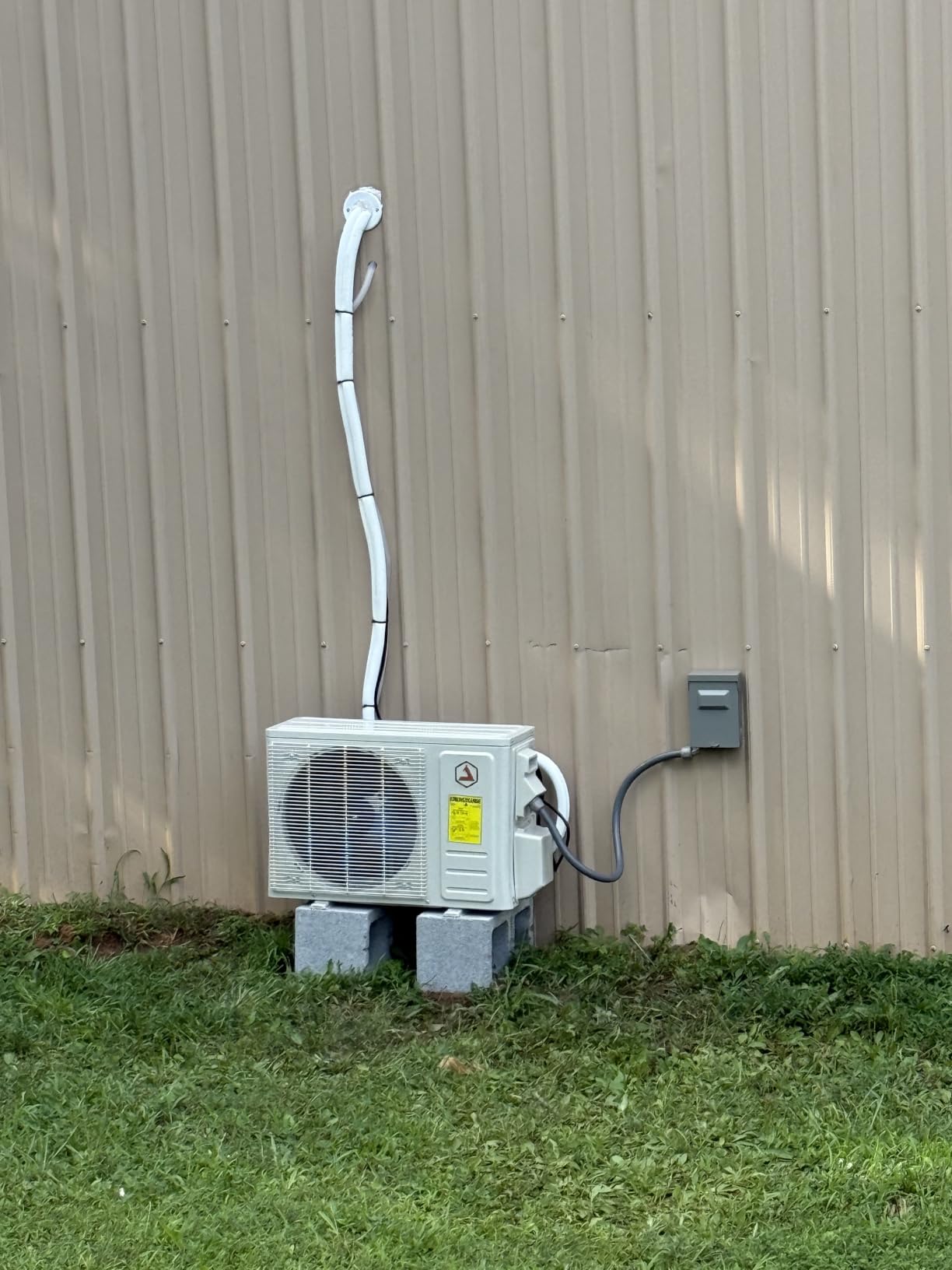
The warranty is genuinely the strongest in this group: five years on the compressor and seven years on parts. Quiet operation below 29 dB makes it usable in a bedroom as well as a living space, and child lock plus app and remote control cover the basics of a family home.
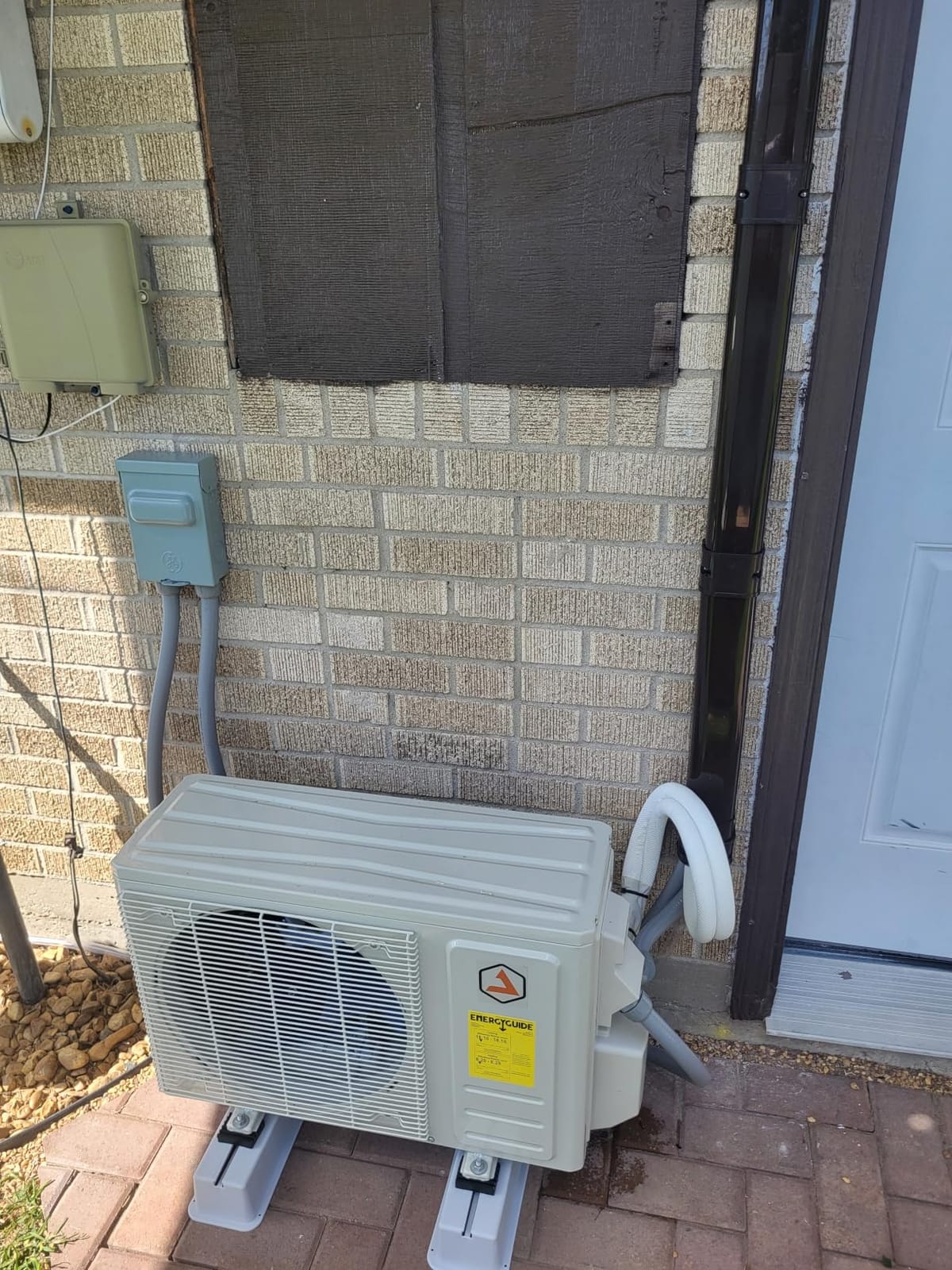
What gives us pause is the rating distribution. At 4.1 across 391 reviews with 14 percent one-star feedback, experiences here are more spread out than anywhere else in the roundup, and the spec sheet warranty text does not match the marketing claim. The manufacturer is also listed as Happy Tao rather than the Albott brand name, which can complicate a warranty claim.
Who This System Works Best For
Studio and one-bedroom layouts where the living area and sleeping area share the same air, and sun-facing rooms where a 9000 BTU head would run flat out all afternoon. The long warranty makes it a reasonable choice for a landlord or a buyer planning to keep a system for a decade.
It also suits anyone in a building where 230V power is simply not available without a panel change.
Where It Falls Short
It is a 151 pound package, and that weight is felt during handling and mounting, especially on a masonry exterior wall where two people and a proper support are needed. Efficiency is the lowest of the 12,000 BTU options here, which means more running cost per hour of cooling.
In a small, well-insulated room this much capacity is wasted. Oversizing shows up as short cycling, where the head turns on and off in short bursts, and that costs efficiency rather than saving it.
5. Rellytech 9000 BTU – Best Entry-Level Pick for 115V Circuits
Rellytech Mini Split AC/Heating System – 19 SEER2 9000 BTU Mini Split AC Unit Inverter Heating and Cooling, 115v Energy Efficient Ductless Air Conditioner Up to 550sq.ft, 24H Timer, Installation Kit
9000 BTU cooling and heating, 115V
19 SEER2 and HSPF2 8.5, R-32
450 sq ft per spec table
Pros
- Entry-level hardware that still carries a 4.4 average rating
- True 115V operation avoids a panel upgrade
- Owners report much drier air in humid climates
- Complete installation kit included
- 4 star BEE rating and ETL plus AHRI certification
Cons
- Stated 42 dB noise is the highest here
- Remote only with no WiFi or app
- Self-install needs a vacuum pump bought separately
- Listing claims 550 sq ft while the spec table says 450
This is the value entry, and the reason it earns the slot is the 115V electrical design rather than the spec sheet. In an apartment where the panel has two spare 15A breakers and nothing else, a system that needs an electrician-run 230V circuit is simply not a candidate.
It is a 9000 BTU cooling and heating system at 115V with 19 SEER2 and HSPF2 8.5 using R-32. The spec table lists 450 sq ft of coverage even though the headline claims up to 550, and we would size to the lower number. Four modes, four fan speeds, a 24-hour timer and an LED-off function cover normal use.
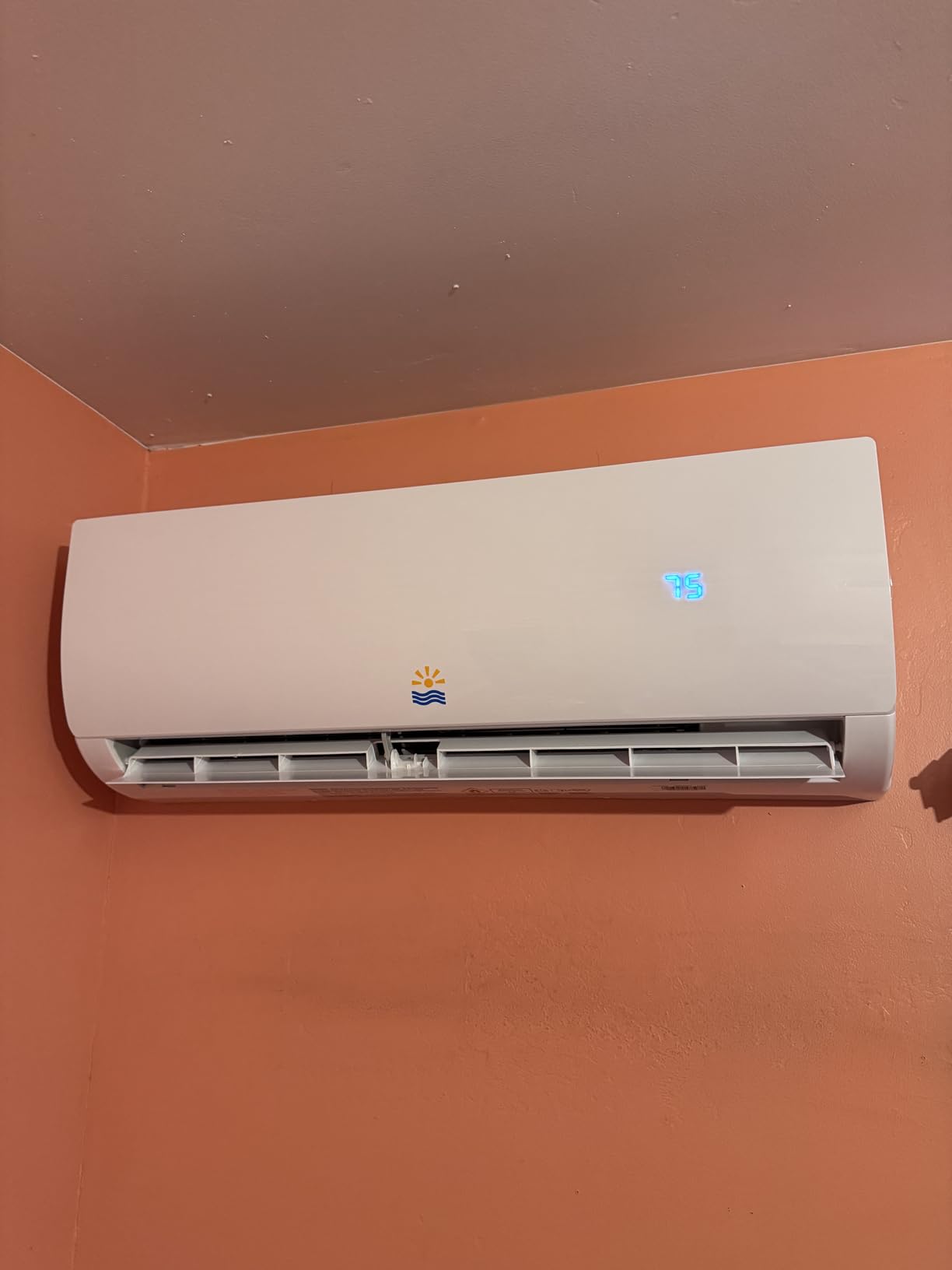
Humidity control is where owners report the biggest step up from window units, particularly in Florida and Nevada where the dry mode does real work. The box includes the indoor head, the outdoor head, the remote, batteries, a mounting plate and template, communication and power cables, connecting pipes, a drain pipe and the fixings.
Two constraints shape who should buy it. The stated 42 dB noise is the highest indoor figure in this roundup, which makes it a poor choice for a bedroom where you are noise sensitive. There is no WiFi, app or voice control, only the remote.
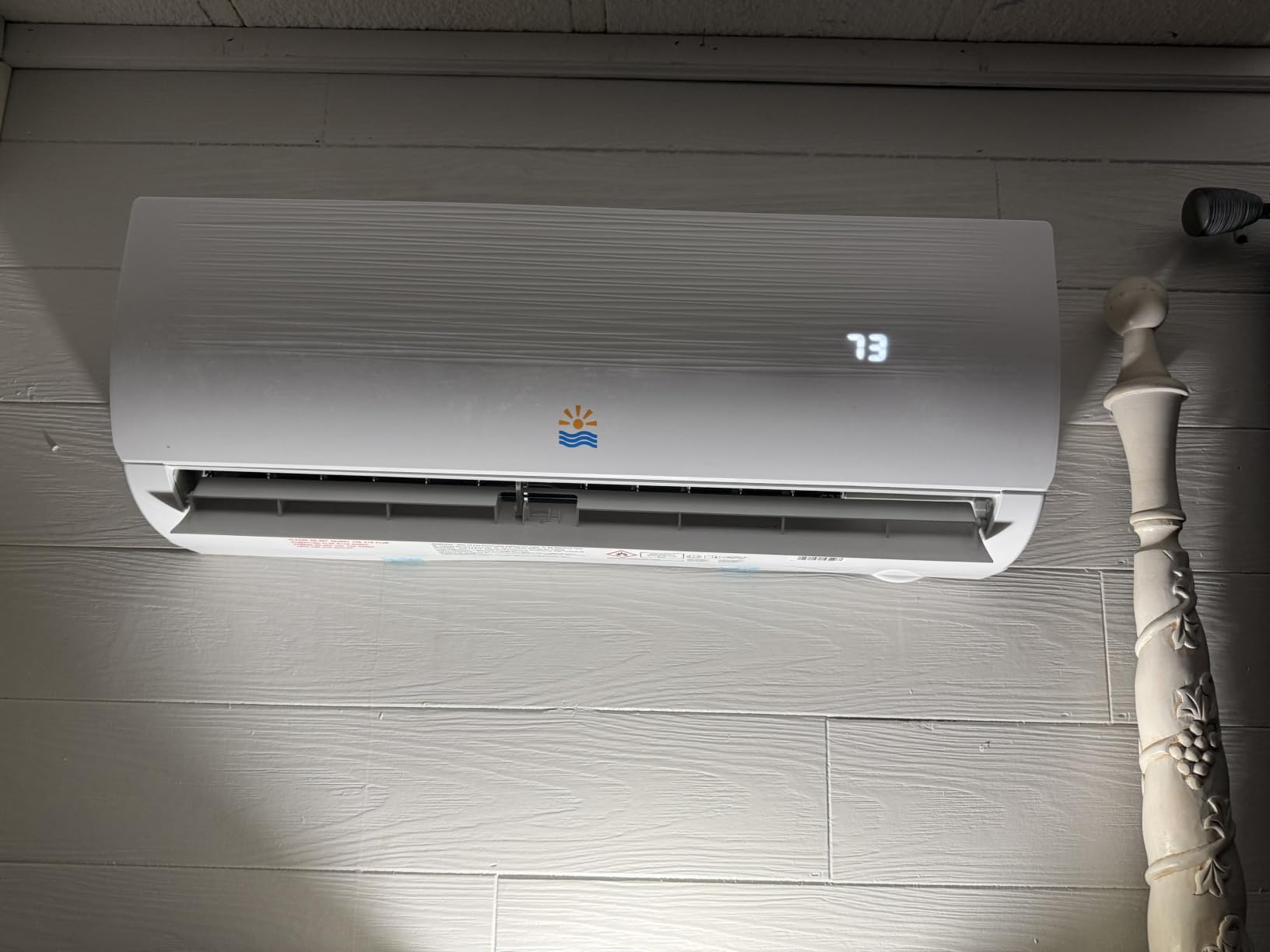
Who This System Works Best For
Buyers replacing a window unit in a humid climate who want the lowest up-front hardware cost and a genuine 115V install. A landlord fitting out a furnished rental, or a homeowner in a workshop or garage, fits the same profile.
It also suits anyone comfortable hiring a licensed installer for the refrigerant work and sourcing the extra tools themselves for a partial install.
Where It Falls Short
Only a 1 year manufacturer warranty is stated in the spec table, despite marketing copy that references longer support. In a rental that may only be relevant for one or two summers, but a longer term owner is carrying most of the risk.
A self-install also requires a vacuum pump and manifold gauges purchased separately, and the line-set flare and evacuation steps are where inexperienced installers cause real problems. The coverage discrepancy between the headline and the spec table is worth raising with the seller before you order.
6. Mountman 9000 BTU – Best Low-Maintenance 9000 BTU Pick
Mountman 9000 BTU Mini Split AC/Heating System,19 SEER2 110/120V Energy Efficient Ductless Inverter System,Cools Up to 450 Sq.Ft with Pre-Charged Condenser,Heat Pump & Installation Kits
9000 BTU 110/120V inverter, 19 SEER2
450 sq ft per spec data
26 dB sleep mode, self-cleaning
Pros
- Highest average rating in the roundup at 4.5
- Only 5 percent one-star feedback
- 26 dB sleep mode with a display that auto-offs
- Self-cleaning
- automatic defrost and washable filter
- Inverter operation limits compressor cycling
Cons
- Bullet points claim 750 sq ft while the spec table says 450
- Remote only with no smart controls
- Stated wattage of 2647.5 W looks erroneous
- Manufacturer name is listed inconsistently
This system has the best rating profile in the group: 4.5 across 352 reviews with only 5 percent one-star feedback. In a category where listings often hide a single recurring defect, that consistency is the main reason it earns a slot.
It is a 9000 BTU 110/120V inverter at 19 SEER2, and the specification table lists 450 sq ft of coverage. The bullet points elsewhere in the same listing claim up to 750 sq ft, so size to 450 and treat the higher number as marketing. We are mentioning that gap because our review process flagged it on three separate listings this round.
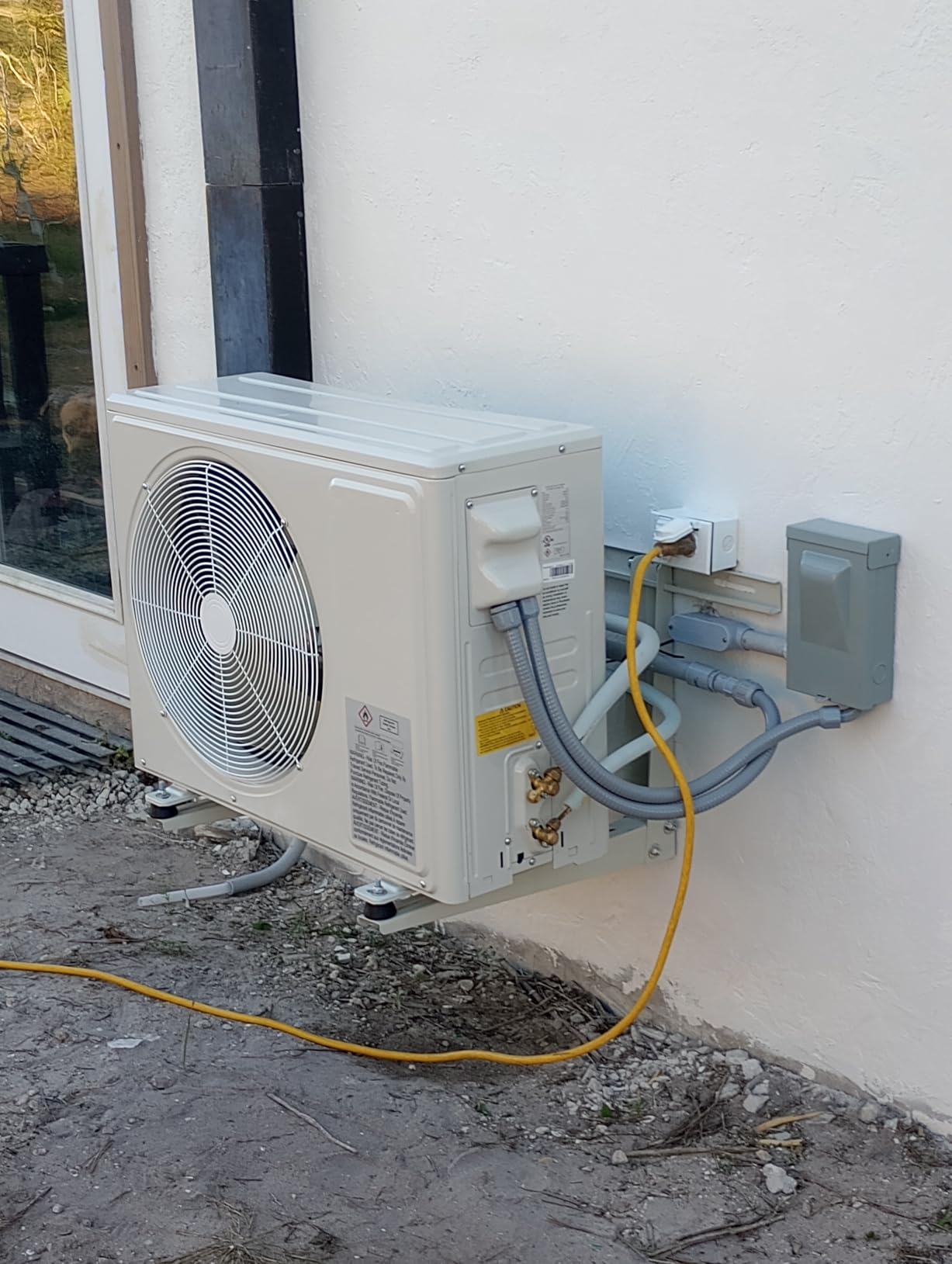
Maintenance automation is the quiet strength here. A high-temperature self-cleaning cycle, automatic defrost and a washable anti-dust filter mean the coil gets looked after without you scheduling it, and the inverter compressor reduces cycling, which extends service life in a unit that will run hard for four months each summer.
Sleep mode drops to 26 dB and the remote display switches itself off after ten seconds, which matters more than it sounds in a dark bedroom. The listing also states a wattage figure of 2647.5 W, far above the 620 to 1000 W range of comparable 9000 BTU systems, so treat that number as an error rather than a power draw.
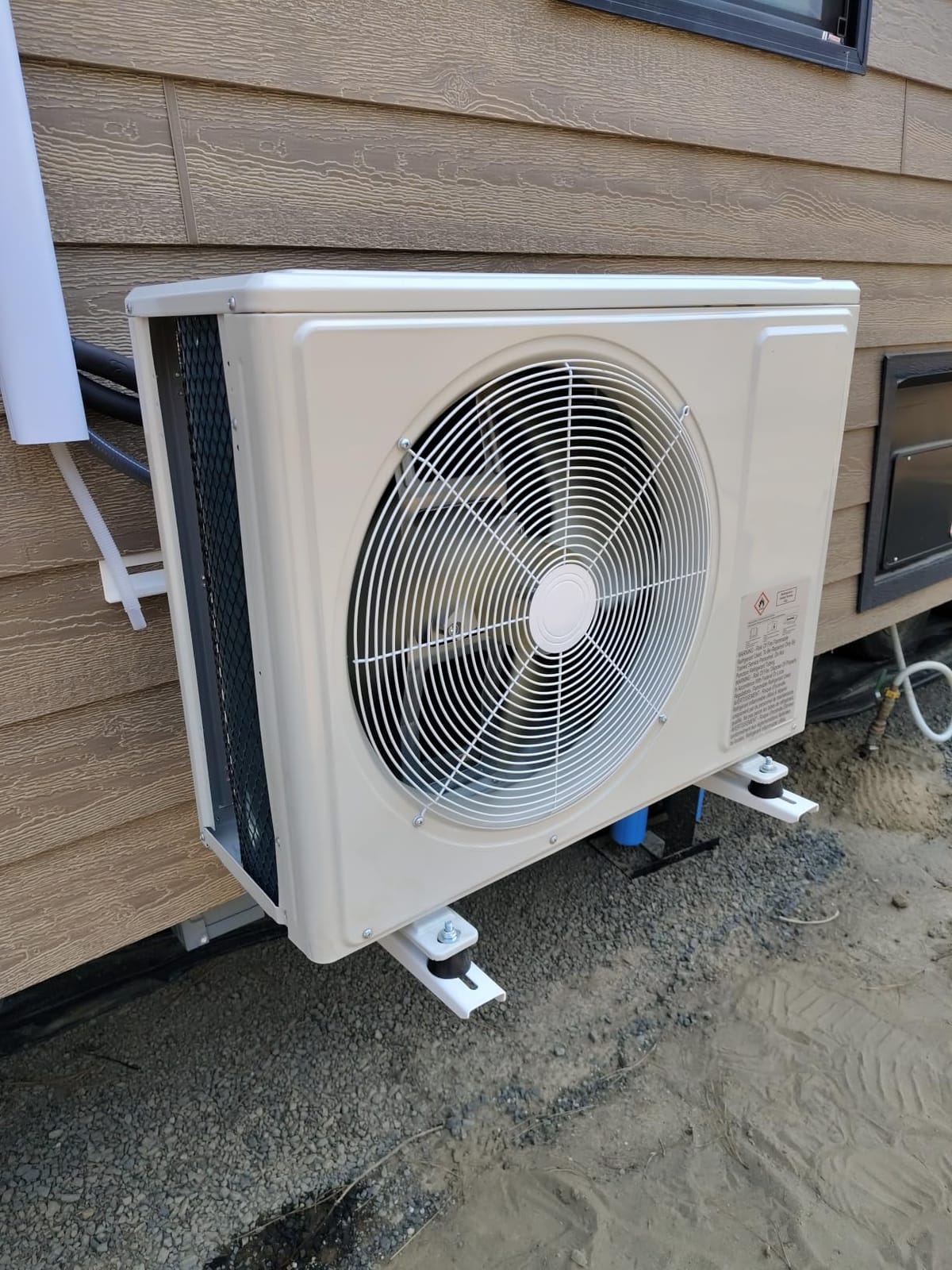
Who This System Works Best For
Anyone who wants the quietest indoor experience without paying for app control, and anyone in a city apartment where dust and cooking grease load up a coil fast. The 26 dB sleep mode works for light sleepers and thin walls.
It also suits buyers who would rather buy once than replace, since the self-cleaning cycle and the inverter drivetrain both reduce the maintenance load over a decade.
Where It Falls Short
There is no WiFi, app or voice assistant, so scheduling means setting a timer on the remote before you leave. The coverage and wattage inconsistencies in the listing mean you should confirm the real figures with the seller before sizing a room.
Availability of detailed service documentation is thin, which matters if you are the one who has to explain the install to a landlord at move-out. Ask for the installation manual in writing before the work starts.
7. DELLA Optima 9,000 BTU – Best for Cold-Climate Heating
DELLA Optima Series 9,000 BTU Mini Split AC, Hyper Heat Down to -13°F, Up to 400 Sq. Ft, 24 SEER2 115V, Energy Star, WiFi & Alexa, Inverter AC with 0.75 Ton Pre-Charged Heat Pump & 16.4ft Kit
9000 BTU 0.75 ton 115V inverter
24 SEER2, Energy Star
Heating down to -13F with app and Alexa
Pros
- 24 SEER2 is the highest efficiency here
- Energy Star certified and rebate eligible
- Only system rated for heating down to -13F
- App and Alexa control
- 16.4 ft pre-flared line set and lifetime warranty included
Cons
- Premium tier hardware
- the most expensive unit in the roundup
- Professional installation is mandatory
- App settings do not sync with the remote
- Some units arrive with E4 error codes
If your building is old, your insulation is thin, and winter is genuinely cold, this is the only system in the roundup rated to keep heating down to minus 13F. Everything else on this list bottoms out around 5F, which leaves a gap in a northern climate where the bedroom drops below that on a clear night.
Efficiency is the other headline: 24 SEER2, the highest figure here, plus Energy Star certification that can make you eligible for a rebate. At 115V with 9000 BTU cooling and 10000 BTU heating it covers about 400 sq ft, and a 16.4 ft pre-flared insulated line set and a 6.56 ft drain extension are in the box.
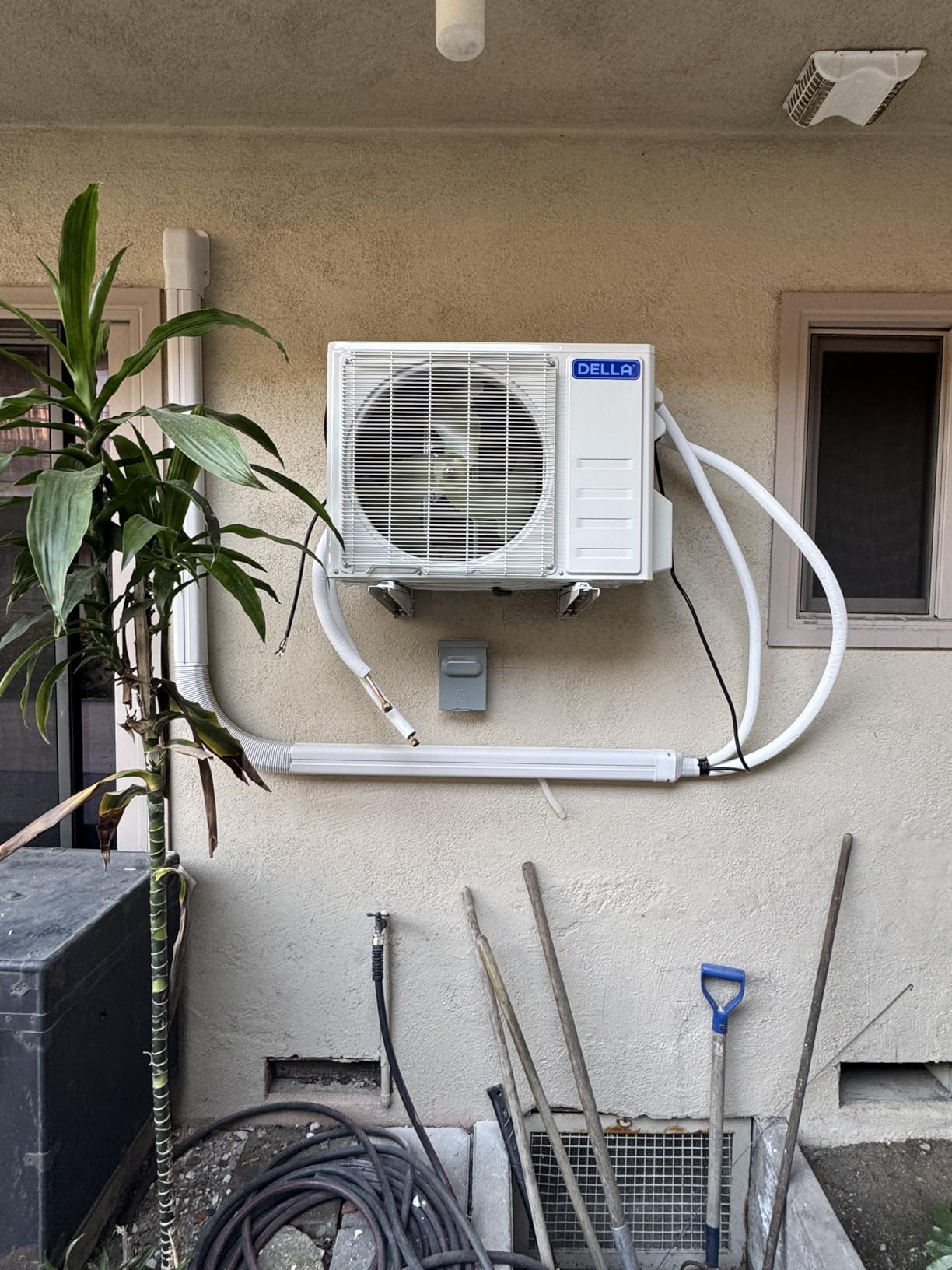
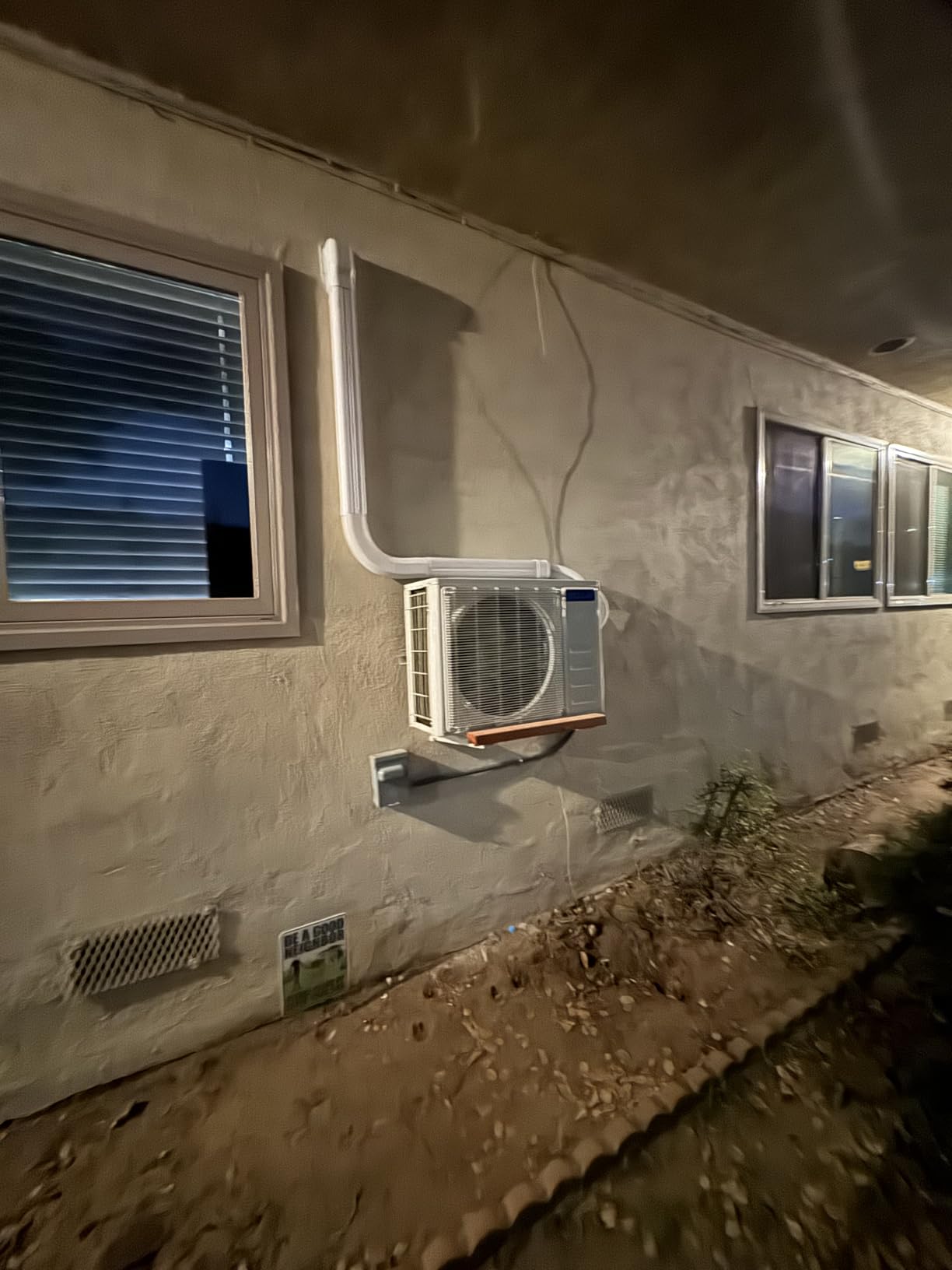
Gold-plated fins resist freezing and rust corrosion and speed up defrosting, which matters in the cold weather this unit is built for. Control runs through the Della+ app and Amazon Alexa alongside the remote, with six modes, 4D airflow, an I Feel function and a 24-hour timer. The lifetime warranty is the longest stated here.
The cost of that capability is the highest hardware figure in the roundup, and professional installation is mandatory on top. A small number of units arrive with E4 fault codes, and the app does not synchronise with the remote display, so the last setting used wins.
Who This System Works Best For
Northern apartment dwellers with poor insulation who need real heat, not just a shoulder-season band. The Energy Star certification and 24 SEER2 also make it the cheapest system per hour of cooling over a long tenancy.
It suits owners who want a single lifetime warranty covering the whole system rather than a stack of short ones.
Where It Falls Short
Reviewers repeatedly call out that the outdoor head produces a noticeable idle sound when it is mounted on the side of a building, which matters in an apartment with a neighbouring bedroom wall on the other side. Ask about a rubber isolation pad during the install.
Line-set vacuuming is required, and any change to the included length needs a refrigerant adjustment. That is skilled work, and it is why the manual alone is not enough.
8. Temprium 9,000 BTU – Best for Voice-Controlled Bedrooms
Temprium 9000 BTU Mini Split Air Conditioner, 115V 22 SEER2 AC & Heat Pump
9000 BTU cooling, 9500 BTU heating
115V inverter, 22 SEER2
23 dB, WiFi app and voice control
Pros
- 22 SEER2 is the second highest here
- 23 dB low-noise operation suits a bedroom
- App plus Alexa and Google Assistant with scheduling
- 7 modes and 7 fan speeds for fine control
- Operates from 122F down to 5F
Cons
- Smallest review base here at 153 ratings
- Only a 1 year manufacturer warranty
- No Energy Star certification listed
- Limited long-term reliability documentation
For a bedroom, two numbers matter more than everything else combined, and this system leads the group on both. It runs at 23 dB and holds 22 SEER2 efficiency, which means you can run it all night at low cost without hearing it.
It is a 9000 BTU cooling and 9500 BTU heating 0.75 ton system on 115V covering up to 450 sq ft, operating from 122F down to 5F. Control covers a WiFi app, Alexa, Google Assistant and a backlit remote, so a nightly schedule is a two-minute setup rather than a nightly habit.
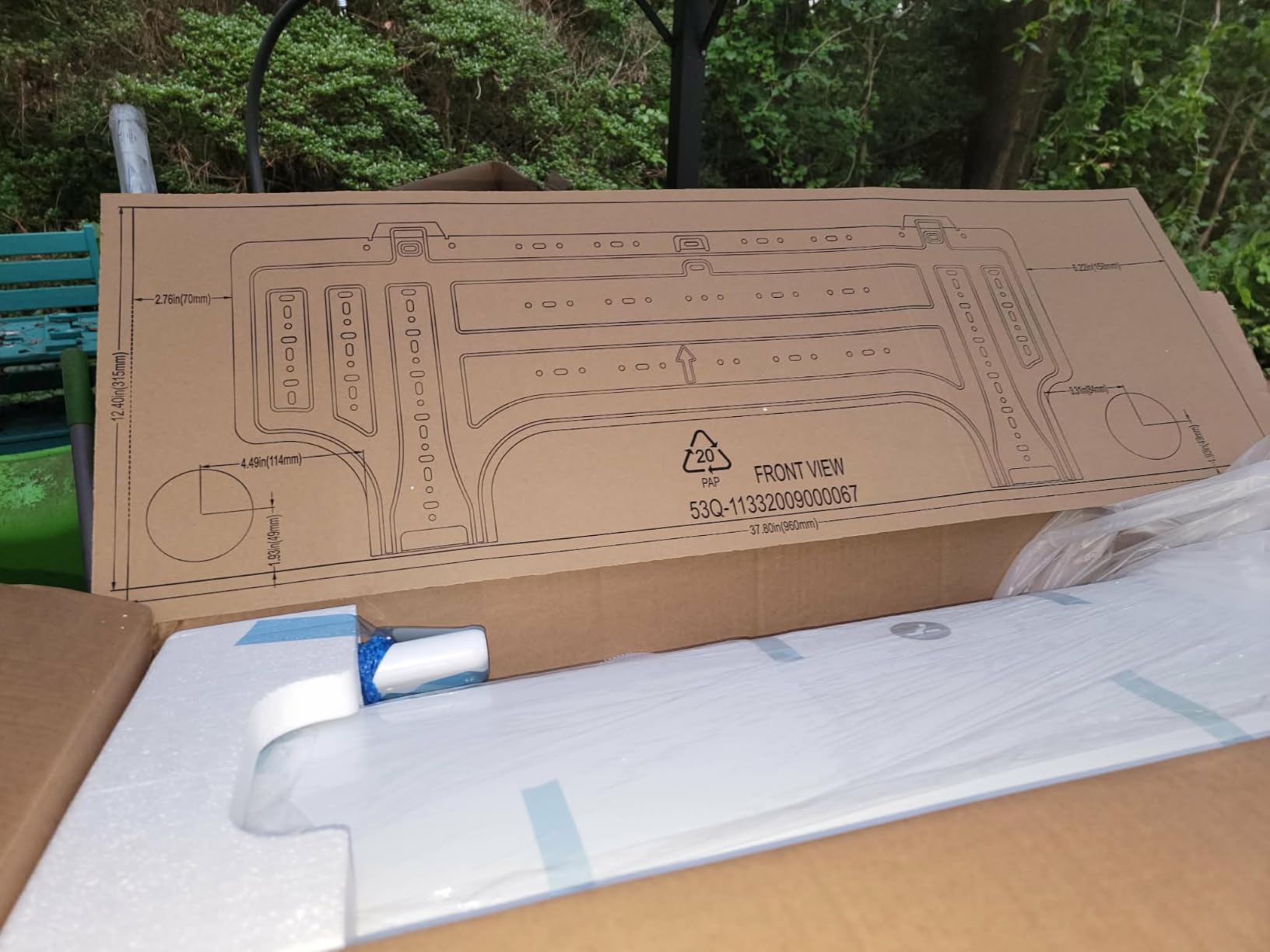
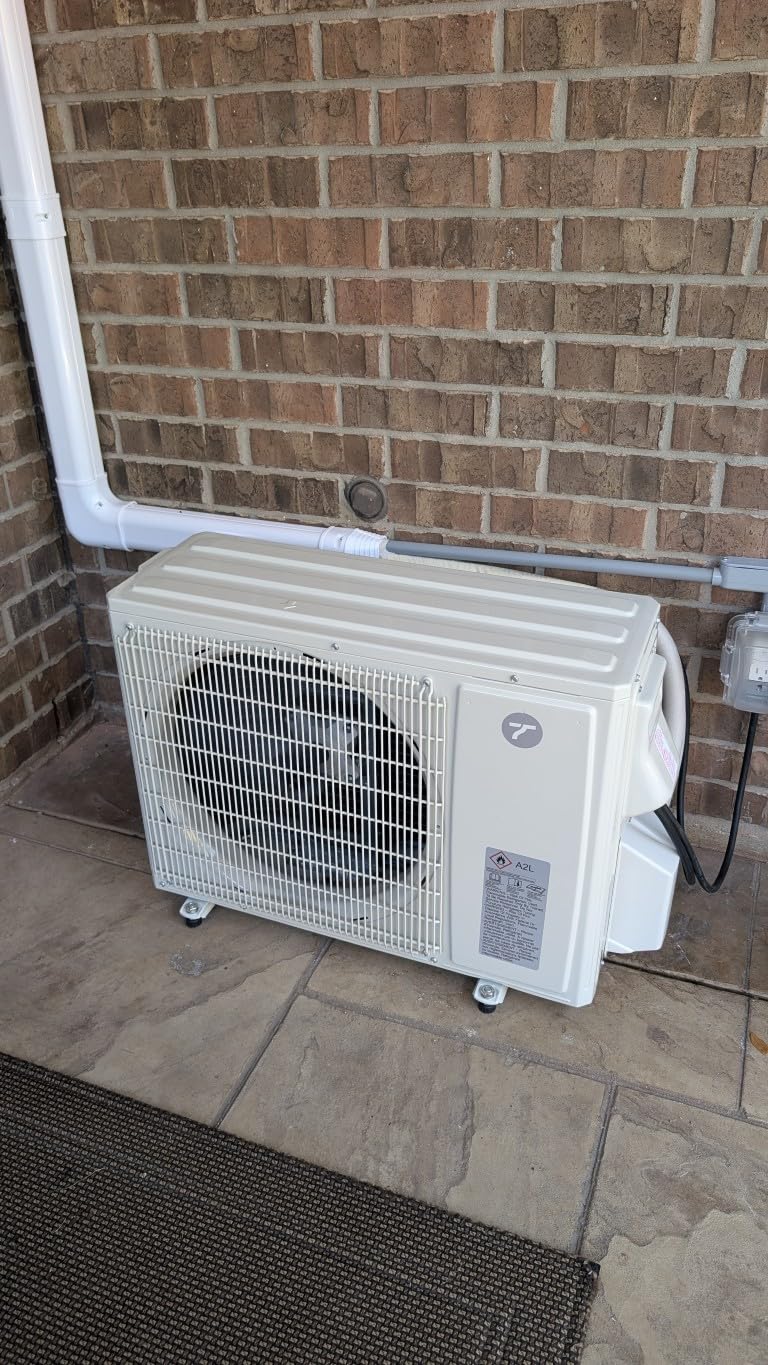
Seven operating modes and seven fan speeds give finer control than most systems at this capacity, and the 4D auto swing plus I Feel function means the room settles at the temperature you set rather than the one the wall happens to be. A 133F high-temperature self-cleaning cycle and a washable filter keep the coil in good shape through a humid summer.
The caveat is thin long-term data. At 153 reviews this is the smallest review base here, and the warranty is one year, so you are buying a well-specified appliance on the strength of its specification sheet rather than a long public record. In a rental where you may move in two years, that is a reasonable trade.
Who This System Works Best For
Light sleepers in thin-walled apartments who want the lowest noise floor and voice control without touching a phone. It also suits anyone who leaves the system running while they are out, since the app handles the schedule.
Tenants in buildings where a 115V circuit is the only realistic option will find the electrical design straightforward.
Where It Falls Short
A one-year warranty on a permanently installed appliance is the main weakness. If you own the unit and plan to keep it for more than three summers, weigh that against a system with a longer parts and compressor term.
There is no Energy Star certification listed, so the 22 SEER2 figure is a manufacturer rating rather than a certified one. Confirm the AHRI registration number before ordering if efficiency is your main reason for the purchase.
9. LITHZEN 12,000 BTU – Best for Sunny Living Spaces
LITHZEN 12000 BTU Mini Split AC/Heating System, 17 SEER2 115V
12000 BTU 1 ton 115V inverter
Up to 750 sq ft, 17 SEER2
28 dB, app and Alexa control
Pros
- 12000 BTU handles a sun-exposed living room
- 115V single-phase operation
- App
- Alexa voice and touch control plus remote
- Runs at 28 dB with sleep mode
- Complete kit with both copper linesets included
Cons
- 17 SEER2 is the lowest efficiency here
- Smallest review base in the roundup at 88
- An early unit reported an unresolved L3 fault code
- Installation is not beginner friendly
- No warranty duration is stated
Capacity is the whole argument for this one. At 12,000 BTU and a stated 750 sq ft of coverage, it is the option for a living room that takes direct afternoon sun, where a 9000 BTU head runs continuously and never catches up. The same 1 ton capacity also suits a converted den or a garage gym.
It runs on 115V single-phase power with an inverter compressor, so the electrical story is simple even though the output is larger. Seven modes and five fan speeds including turbo, 4D swing, a 24-hour timer, a child lock and a washable filter cover the feature set well, and control is available through an app, Alexa voice, touch controls and the remote.
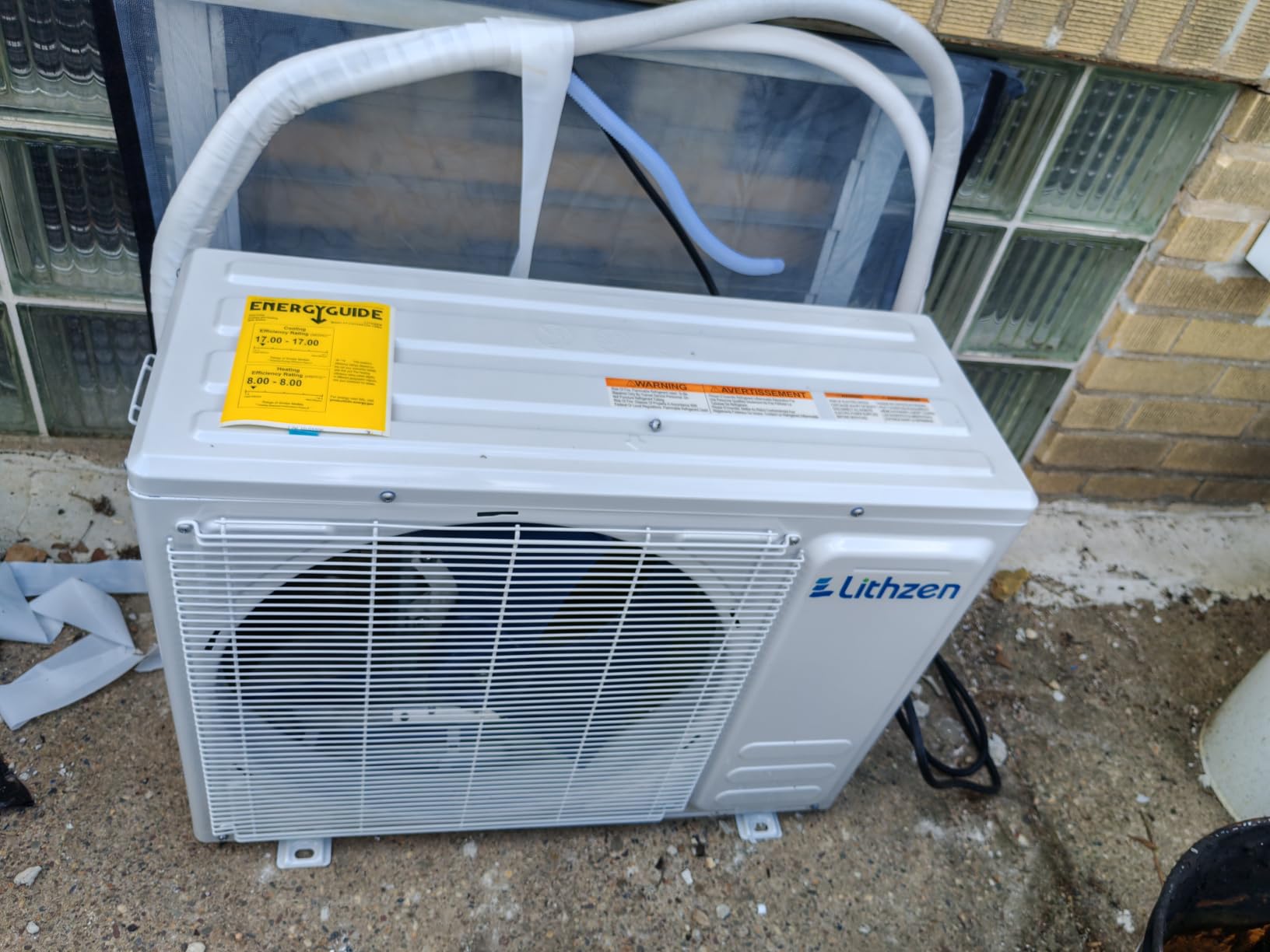
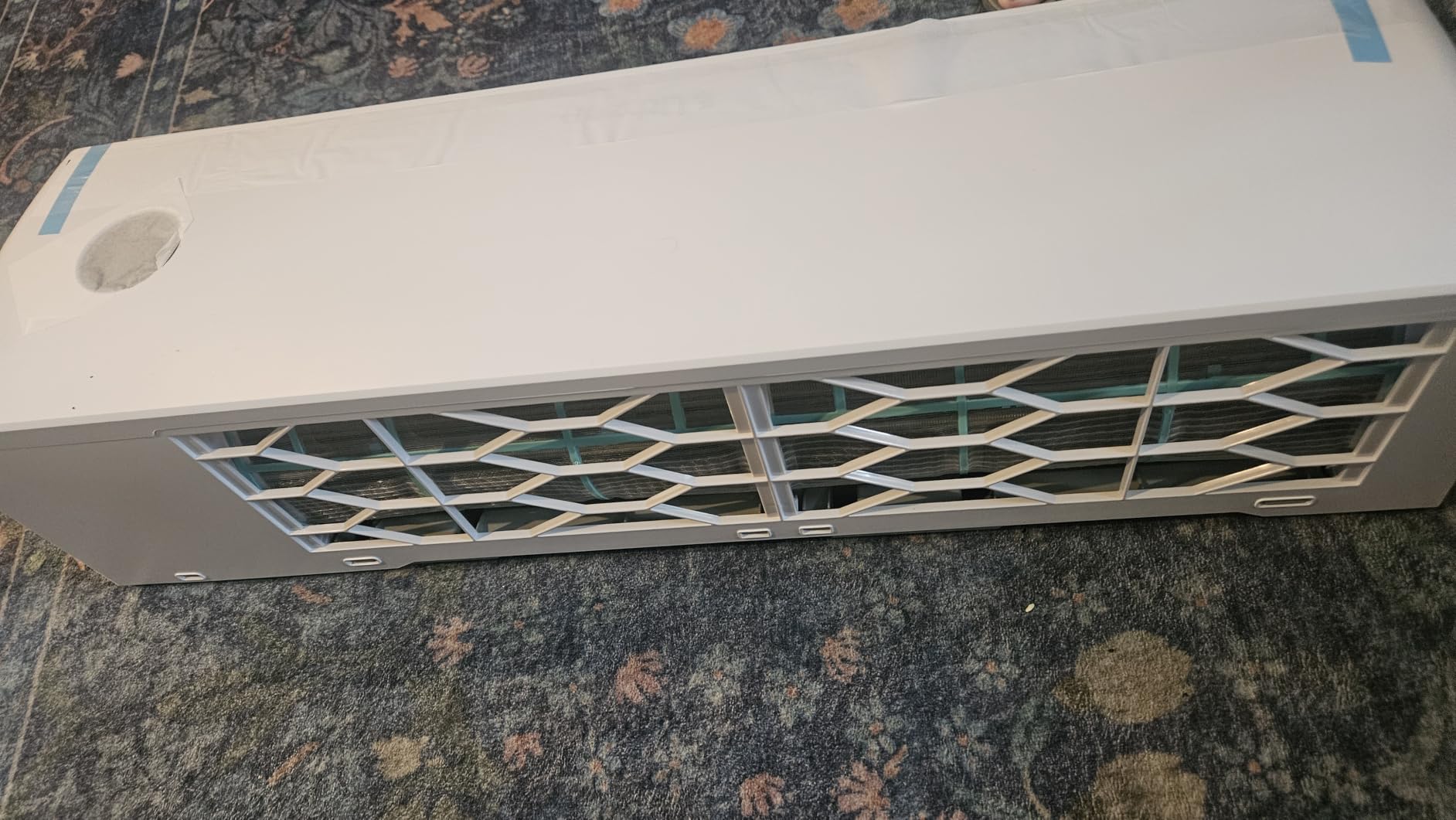
Owners describe fast, even cooling and quiet operation in hot rooms, with the app setup reported as straightforward. The kit includes 9.8 ft of air and liquid copper linesets, tape, putty, a wall cap, a 6.5 ft drain hose, a 10.8 ft communication wire and a remote with a holder, which is unusually complete for the size.
The efficiency figure is the trade-off. At 17 SEER2 this is the lowest rating in the roundup, so the cost per hour of cooling is the highest here, and that gap widens the longer you run it in a hot room. There is no stated warranty duration at all, which is the part to raise with the seller.
Who This System Works Best For
Apartment dwellers cooling one sun-facing room who have accepted a higher running cost in exchange for enough capacity to actually cool it. It also suits landlords furnishing a unit where a smart-enabled system adds tenant appeal.
If your building has no spare 230V slot, the 115V design keeps this in the running where a 1 ton 230V system would be ruled out.
Where It Falls Short
At 88 reviews this is the least documented product we ranked, and one detailed review documents an L3 fault code on an early unit that a replacement control board did not resolve. With no stated warranty term, that kind of failure is expensive to absorb.
Several owners recommend a professional rather than a first-time installer, and the included lineset lengths are shorter than the 16 ft kits supplied with the 9000 BTU systems, which may not reach an exterior wall.
10. DELLA Serena 9,000 BTU – Best Where a 230V Circuit Already Exists
DELLA Serena Series 9000 BTU Mini Split AC, Energy Star 22 SEER2 230V, 0.75 Ton Inverter Heat Pump Ductless AC System for Rooms up to 400 Sq.Ft, WiFi & Alexa Control, Pre-Charged, 16.4ft Install Kit
9000 BTU 0.75 ton 230V inverter
400 sq ft, 22 SEER2, Energy Star
Heating to 5F, 24 dB, app and voice
Pros
- 22 SEER2 with Energy Star certification
- Lifetime warranty coverage
- App with geo-location plus Alexa and Google Home
- Heating rated to 5F with an anti-ice element
- 24 dB in mute mode
- annual use about 614 kWh
Cons
- 230V means an electrician-run circuit
- App and remote do not communicate
- One unit arrived with an E4 error code
- Outdoor noise is noticeable close to a wall or window
This is the pick for an apartment where a 230V circuit is already installed or easy to add, such as a newer building, a converted commercial space or a unit with a spare breaker slot and panel capacity. For everyone else on 115V-only panels, this is the one on the list to cross off immediately.
The specification is strong: 9000 BTU cooling and 9300 BTU heating at 0.75 ton, 22 SEER2, Energy Star certified, covering about 400 sq ft. Stated annual consumption is roughly 614 kWh, and the warranty is lifetime coverage, the longest stated in the roundup.
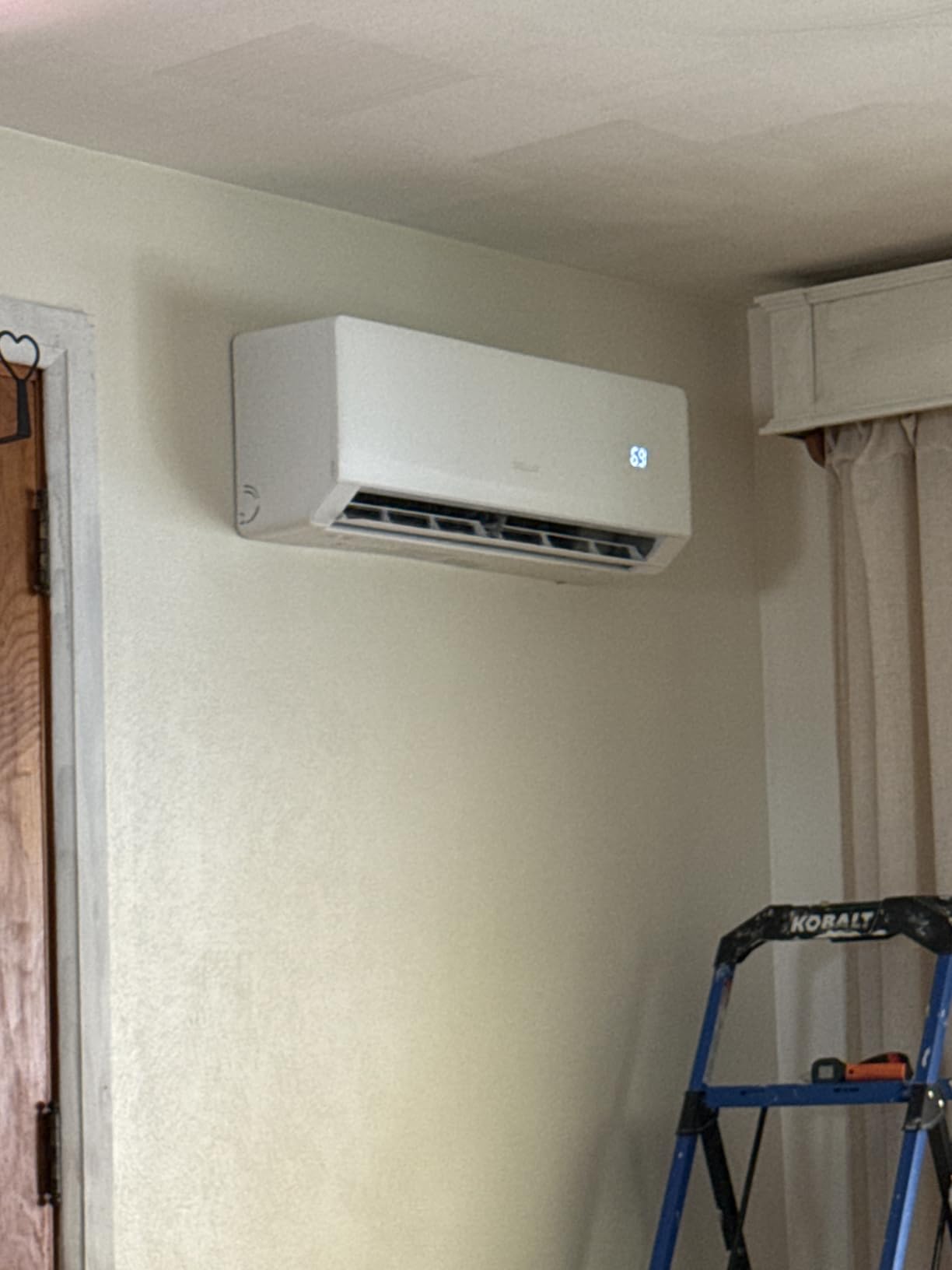
Heating runs to 5F with an outdoor bottom heating element to prevent ice build-up, and a PureClean self-defrost function on the indoor head reduces seasonal maintenance. The app adds a geo-location function that adjusts temperature based on where you are, plus Alexa and Google Home voice control. A 16.4 ft line set and a 78.7 in drain pipe are included.
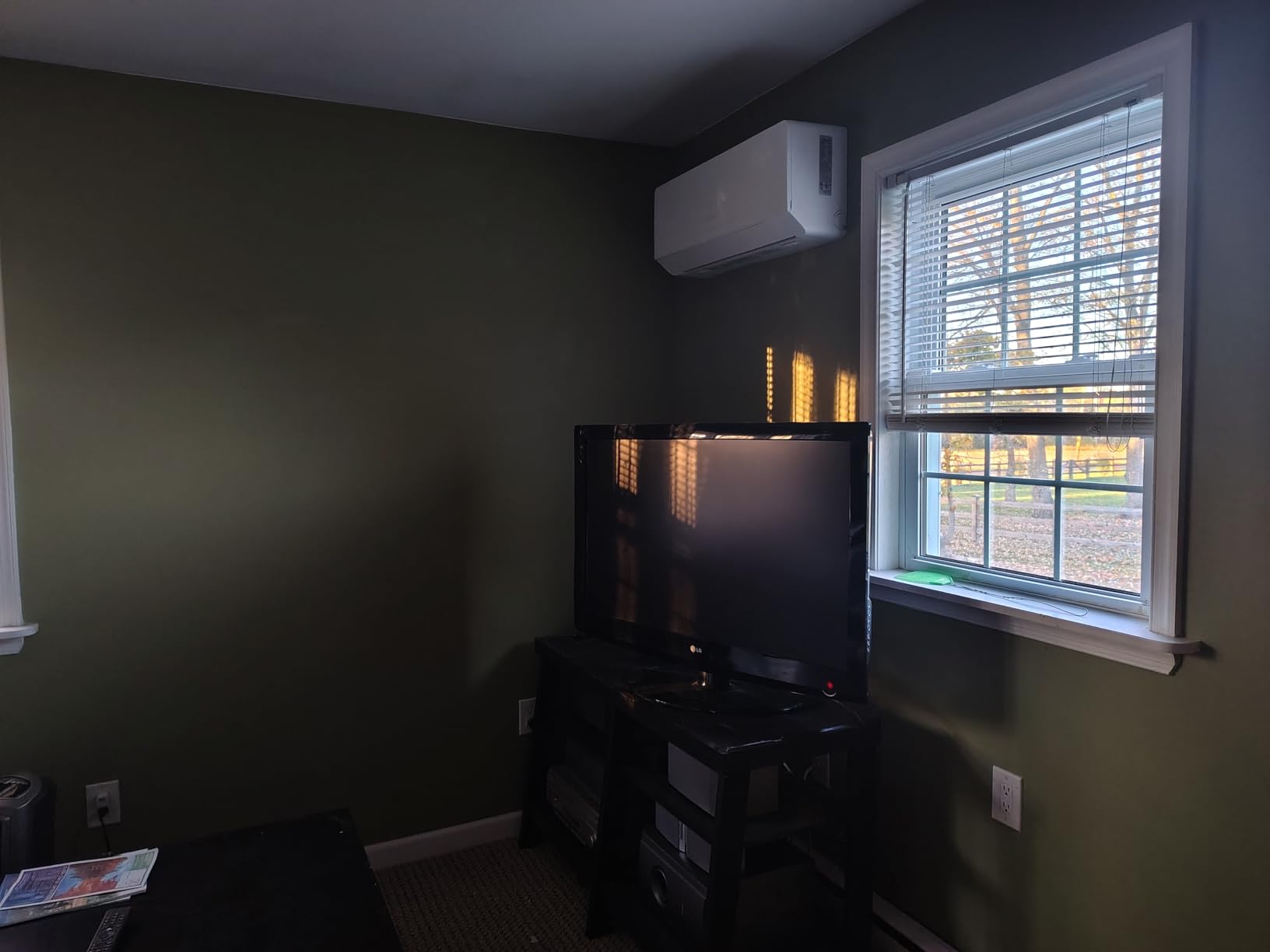
The recurring complaint is that the app and the remote do not communicate, so whichever was used last sets the room. The manual is also vague about night-time cycle behaviour, and outdoor noise is noticeable if the condenser is mounted close to a wall or an open window.
Who This System Works Best For
Apartments in newer buildings with 230V service, and owners who want a lifetime warranty and a stated annual consumption figure they can check against their own meter. Cold-climate renters with 230V available get heating to 5F on a 0.75 ton system.
It also suits anyone who intends to keep the appliance long-term, since lifetime coverage removes the biggest financial risk of an installed system.
Where It Falls Short
Requires 230V, which means an electrician-run circuit and rules it out for many small apartment panels. That is a landlord conversation and a panel capacity question, not a weekend job.
The app-to-remote sync gap is a genuine daily annoyance, and the outdoor head is audible if it is bracketed too close to a wall or window. Ask the installer to set the clearance the manual specifies.
How Big a Mini Split Does Your Apartment Need?
Match the capacity to the room, not to the square footage of the whole apartment. The rule of thumb used across this category is about 20 BTU per square foot for a typical small residential space, and a bedroom or studio fits comfortably at 9000 BTU. A larger open living area needs the 12,000 BTU class.
A studio of 150 to 200 sq ft, or a small bedroom in the same range, is well served by a 9000 BTU system. The 400 to 450 sq ft systems here suit a one-bedroom apartment’s main room or a bedroom plus a home office, and the 750 sq ft capacity of the 12,000 BTU models covers an open-plan studio or a sun-exposed living room.
Oversizing is a real cost in a small space. A head that is too large for the room reaches set temperature in minutes, shuts down, restarts, and cycles all night. That pattern uses more electricity than steady inverter operation and leaves a compressor cycling against your neighbours’ wall. In a well-insulated studio, the smaller system in this roundup is almost always the right answer.
Two things change the calculation: west or south-facing glass, and how many people are in the room. A sun-facing living room with three people and a laptop open is a heat load that a 9000 BTU head will chase unsuccessfully all afternoon.
Renter and Landlord Approval: What to Put in Writing
No competitor roundup we studied covers this, and it is the first thing that stops an apartment install. You do not need your landlord to like the idea. You need written permission that names what gets drilled, where, and who removes it when you leave.
Before you spend anything, send a short message that answers six questions. Which exterior or interior wall may be penetrated for the line set, and at what height. Where may the outdoor condenser sit, including on a balcony, patio or sidewall. Who pays for the installation, and whether that cost is credited against rent. Who owns the equipment at move-out, and whether it may be removed. What electrical work is permitted and who arranges the inspection. Whether any deposit or damage deposit changes as a result.
For a condo or a building with an association, add the exterior alteration clause. Associations commonly regulate visible equipment on common walls, drilling into structural or facade elements, and anything that changes the building’s exterior appearance, and a written approval from the association is separate from the landlord’s consent.
Keep the answer in writing, even if it is an email reply. Verbal agreement in a hallway is the single most common reason a tenant ends up patching a hole in a wall at move-out. Our small apartment layout guide covers the other permanent modifications worth discussing in the same conversation.
115V vs 230V in Older Apartment Buildings
Most small apartments have no 230V circuit, and adding one means an electrician, a permit and possibly a panel assessment. Nine of the ten systems here run on 115V, which is why they dominate a roundup built around apartment installs.
A 115V system is limited in two ways. It draws more current for the same output, so it needs a dedicated 15A or 20A circuit and cannot share a general-purpose outlet circuit. And the highest-capacity single-phase 115V options top out around 12,000 BTU, which is fine for a room but not for a whole apartment.
The 230V option in this list, the DELLA Serena, needs an electrician-run circuit. That is not a dealbreaker in a newer building, but in a 1920s walk-up with a 100A panel shared by three units it usually is. Ask your landlord for the panel age and the breaker count before you commit to any 230V system.
Noise Bands for Thin-Walled Apartments
In an apartment, noise matters more than in a detached house, and the figures on the spec sheet are measured at the lowest indoor fan speed. Below 25 dB is close to a whisper and works in a bedroom. Between 25 and 30 dB is a soft hum, noticeable only in a completely silent room, and acceptable for most people. Above 35 dB you will hear it across the room, which is fine in a living space and not fine beside a pillow.
The bedroom-suitable group is the COSTWAY and the Temprium at 23 dB, the Mountman at 26 dB and the Senville at 28 dB. The Rellytech listing states 42 dB for the indoor head, which is outside our bedroom range even though its dehumidification performance is excellent in humid climates.
On the outside, the compressor sits where you put it. Neighbours hear a condenser mounted on a shared balcony or bracketed tight to a party wall, so clearance and vibration pads are worth asking about during the install.
Running Costs and SEER2: What Actually Moves Your Bill
SEER2 is the seasonal efficiency rating under the current Department of Energy standard, which raised the minimum for residential systems. Every product on this list carries an inverter compressor, and the ratings here run from 17 to 24 SEER2. Higher means fewer kilowatt hours for the same amount of cooling.
Where the product data allows, you can sanity-check the rating against a stated annual consumption figure. The DELLA Serena publishes roughly 614 kWh per year at 22 SEER2, the Albott lists about 700 kWh, and the Rellytech lists about 907 kWh at 19 SEER2. Those are the clearest available comparison between systems at different efficiencies and room sizes.
Two behaviours cost more than the efficiency rating suggests. Short cycling from an oversized head wastes energy, as described above. And running a system at its lowest setting all night rather than cycling it on and off is the intended use of an inverter, so a high SEER2 unit that runs continuously usually beats a lower-rated unit used in short bursts.
Owners of several of the 115V systems in this roundup report that replacing a window unit roughly halved their electricity use, which is the comparison most apartment dwellers are actually trying to make.
Where the Outdoor Condenser Goes in an Apartment
The indoor head is easy. The condenser placement decides whether the project is approved. Options in order of preference for a small apartment are a purpose-built bracket on an exterior wall, a balcony or patio slab with a stable base, or a ground-level pad in a courtyard or parking area. Roof mounting and ground pads both need structural sign-off.
Two apartment-specific limits apply. Local noise ordinances can cap how loud a mechanical unit may be at a property line, and a condenser on a shared balcony may be restricted by the lease or the association regardless of whether it is permitted by the city. Ask both questions before the hardware is ordered.
Line set length also matters here. The pre-charged linesets supplied with these systems generally cover up to 25 ft, and anything beyond that needs a refrigerant adjustment by the installer. Measure the run from the indoor head to the condenser location before you buy, because extending it later costs more than choosing the right spot the first time.
Finally, decide the condensate route before the install. Every system here needs a drain line, and in a small apartment that usually means a short run to a sink, a floor drain or an external wall penetration with a heating cable in cold climates.
Frequently Asked Questions
Can you use a mini split in an apartment?
Yes, as long as you have written permission from your landlord and, in a condo, approval from the association. Most apartment installs need two things a window unit does not: a hole for the refrigerant line set, usually about 3 inches, and an electrical circuit for the outdoor condenser. Nine of the systems we ranked run on 115V so they can use an existing circuit, which removes the most common blocker.
Is a mini split renter friendly?
Only with landlord approval in writing. Ask specifically which wall may be drilled, where the outdoor condenser may sit, who pays for the install, who owns the equipment at move-out, and whether it must be removed at move-out. Some landlords treat a mini split as a permanent improvement and will ask you to leave it, which is a reasonable outcome to negotiate in writing before you spend anything.
What size mini split do I need for a small bedroom?
A 9000 BTU system is the right starting point for a small bedroom. As a rule of thumb you need roughly 20 BTU per square foot, so a 150 to 250 sq ft bedroom falls into the 9000 BTU range and a 400 to 450 sq ft room sits at the upper end of it. Oversizing a small bedroom causes short cycling and wasted electricity rather than faster cooling.
Which mini split has the smallest indoor unit?
Among the systems we ranked, the Temprium 9,000 BTU is the most compact of the head units we could verify, measuring just under 30 inches wide and under 8 inches deep, with a 23 dB noise floor. The Mountman is close behind at about 32 inches wide. The widest is the Senville LETO at 37 inches, so measure your wall before ordering.
What is the most reliable brand of mini splits?
The premium Japanese brands, including Mitsubishi and Daikin, are the most frequently named as reliable in HVAC forums, with Fujitsu and LG close behind. Those names do not appear in this roundup because we concentrated on sub-1-ton systems that ship with a pre-charged condenser and can be installed on a standard apartment circuit. Among the 10 we ranked, warranty length and review depth are the best available reliability signals.
Why is my electric bill so high with mini split?
The usual causes are an oversized system short cycling, a dirty filter or coil reducing airflow, and seal leaks around windows and doors letting warm air in continuously. Check the filter first, since a restricted evaporator makes the head run longer for the same temperature. Setting the thermostat two degrees higher and using the sleep or schedule mode typically has a larger effect than any equipment change.
Final Verdict for Small Apartments in 2026
The COSTWAY 9000 BTU is our pick for the best ductless mini splits for small apartments because it clears the three apartment-specific tests at once: 115V operation, a 23 dB sleep mode and a review base deep enough to plan around. Pick the Temprium instead if voice control and a smaller head matter more to you, or the Senville LETO if you want app scheduling and heating down to 5F.
Match capacity to the room, get the permission in writing before anything is drilled, and check the electrical panel first. Those three steps decide more outcomes than the choice between two similar 9000 BTU systems ever will. If you are still comparing formats, our apartment noise guide covers another common thin-wall problem worth solving at the same time.