

Short answer: the Dr. Infrared DR-975 is the best electric garage heater for workshops overall, the Comfort Zone CZ220BK is the best value for a small or mid-size bay, and the InoKraft 7500W is the top-rated pick because it ships with a plug instead of a bare whip. All three are 240V fan-forced machines that mount to a ceiling or wall, and all three put out real heat with no burner, no flue and no carbon monoxide. We spent 2026‘s cold months going through ten electric shop heaters on output, amperage, thermostat behaviour, certification and the things buyers complain about after the first winter.
Why bother heating a workshop at all? Because cold costs more than the heater does. Wood glue will not cure properly, finishes dry slowly, lumber picks up moisture and checks, and thin steel seizes in your hands. A working heater is the cheapest productivity upgrade a shop can make, and an electric unit is the cleanest way to get one: nothing to fuel, nothing to vent, nothing to alarm.
There is a catch. Electric heat is a poor match for a large uninsulated building, and the electrical work is often the real project. We cover both honestly below, including where a heat pump or a gas unit is the smarter call. If you want the full fuel-by-fuel picture, read our general garage heater roundup first, then come back here for the electric-only shortlist. Shop owners weighing fuel logistics will also want our propane roundup and our natural gas roundup side by side with this list.
Table of Contents
Top 3 Picks for Best Electric Garage Heaters for Workshops in October

Dr. Infrared DR-975 7500W
- 7500W or 4700W selectable
- 25590 BTU
- Remote thermostat 50-85 F
- 5 adjustable louvers

Comfort Zone CZ220BK 5000W
- 5000W 17065 BTU
- Covers up to 1000 sq ft
- Ceiling mount ETL listed
- Dual knob thermostat to 95 F

InoKraft 7500W Plug-In
- 7500W 240V fan-forced
- NEMA 14-50P plug included
- Digital thermostat 40-99 F
- 65 dB operation
All 10 Best Electric Garage Heaters Compared in 2026
Every heater below is listed with the spec that actually decides the purchase: how many watts it puts out, how many amps it pulls, and how it gets mounted. Coverage figures are manufacturer claims and they vary widely, so treat them as a rough guide rather than a promise.
| Product | Specifications | Action |
|---|---|---|
| Dr. Infrared DR-975 7500W |
|
Check Latest Price |
| Comfort Zone CZ220BK 5000W |
|
Check Latest Price |
 Dr. Infrared DR218 1500W Dr. Infrared DR218 1500W |
|
Check Latest Price |
 TEMPWARE 7500W Digital TEMPWARE 7500W Digital |
|
Check Latest Price |
| InoKraft 7500W Plug-In |
|
Check Latest Price |
 TEMPWARE 5000W ECO TEMPWARE 5000W ECO |
|
Check Latest Price |
 DuraHeat EUH5000 5000W DuraHeat EUH5000 5000W |
|
Check Latest Price |
 ROVSUN 7500W App Control ROVSUN 7500W App Control |
|
Check Latest Price |
 CTSC 10000W High Output CTSC 10000W High Output |
|
Check Latest Price |
 VEVOR 7500W Digital VEVOR 7500W Digital |
|
Check Latest Price |
1. Dr. Infrared DR-975 7500W Hardwired Shop Heater – Best Overall
DR. INFRARED HEATER NEW Upgraded DR-975 7500-Watt 240-Volt Hardwired Shop Garage Electric Heater, Wall/Ceiling Mounted with Remote Controlled Thermostat White
7500W or 4700W selectable
25590 BTU at full output
31.25 A at 240V
800 sq ft claimed coverage
Pros
- Switchable 7500W and 4700W output so you can match heat to the season
- Remote controlled thermostat covering 50-85 F
- Five adjustable louvers plus a mounting bracket for wall or ceiling
- UL and CUL listed with overheat protection and a timer
- 26 lb steel cabinet with a fully enclosed motor
Cons
- Hardwired only and no power cord ships in the box
- 31.25 A draw needs a dedicated 240V branch circuit
- Remote batteries are the only part owners replace regularly
This is the unit we kept coming back to. With more than 4,000 reviews averaging 4.3 stars, it carries the deepest review history in the roundup, and that matters more than any spec sheet when you are about to drill into a joist and hang something from it. The 69% five-star share tells you the returns are rare.
What stood out in real-world feedback is the switchable output. Most 7,500W heaters are single-speed, so in a mild October you either run them or you freeze. The DR-975 lets you drop to 4,700W, which cuts the amperage and the bill without losing all the heat. Owners also credit the remote thermostat for actually holding temperature rather than drifting.
It is not a digital unit. There is no screen and no app, and the thermostat range is 50 to 85 F, which is narrow if you want to hold a garage at 68 F on a mild day. If a wide, precise range matters to you, the InoKraft or the TEMPWARE 7500W handle that better.
The install is the real story here. It draws 31.25 A, so it needs its own 240V branch circuit on 8 AWG copper, and no cord is included. If your garage subpanel does not already have a spare 40 A slot, the electrical work costs more than the heater. Budget for a licensed electrician and do not try to piggyback it on an existing outlet.
What you get for the money
Buyers repeatedly mention the five louvers and the mounting bracket as the features that make the difference day to day. Being able to aim one lobe at a workbench and another at a vehicle means you stop heating the empty middle of a two-car bay where heat just goes to the rafters.
The 26 lb cabinet and fully enclosed motor are the other talking points. Heavy steel and a sealed motor are exactly what you want in a space with temperature swings, sawdust in the air and a heater that will sit through five or six heating seasons.
Where it falls short
The narrow thermostat range is the honest drawback. If you want to cool down a shop that has overheated from sun gain through a south-facing door, there is no set point below 50 F, so you switch it off and lose the fan circulation too.
Second, this is a bare hardwired box. Every 240V heater in this roundup except the InoKraft and the DuraHeat is the same way, but it is worth repeating: the wiring is a separate project with its own cost and its own permit rules. Shoppers looking for the shortest path from box to running should look at the InoKraft instead.
2. Comfort Zone CZ220BK 5000W Ceiling Mount Heater – Best Value
Comfort Zone Hard-Wired Ceiling Mount Garage Electric Space Heater, Fan-Forced, 5,000 watt, 240 volt, Overheat Protection, Thermal Cut-Out Switch, Ideal for Workshop & Garage, ETL Compliant, CZ220BK
5000W fan-forced
17065 BTU output
20.9 A at 240V
Claimed coverage to 1000 sq ft
Pros
- ETL listed and rated 4.4 across more than 3500 reviews
- Heavy-gauge steel body that tolerates poorly insulated spaces
- Ceiling mount frees the floor for vehicles and benches
- Louvers and adjustable mounting angle aim the heat
- Simple dual knob thermostat with quick on and off
Cons
- No remote and no digital display on the thermostat
- 5000W is roughly two thirds the output of the 7500W models here
- Hardwired 20.9 A draw needs its own 240V branch circuit
This is the pick for a single-bay garage, a basement shop or a small workroom where 5,000W is genuinely enough. It ranks at number four in its Amazon heating accessories category and carries 3,550 reviews at 4.4, which is close to the deepest review history in this roundup. Buyers consistently call it the value option and then say it does more than they expected.
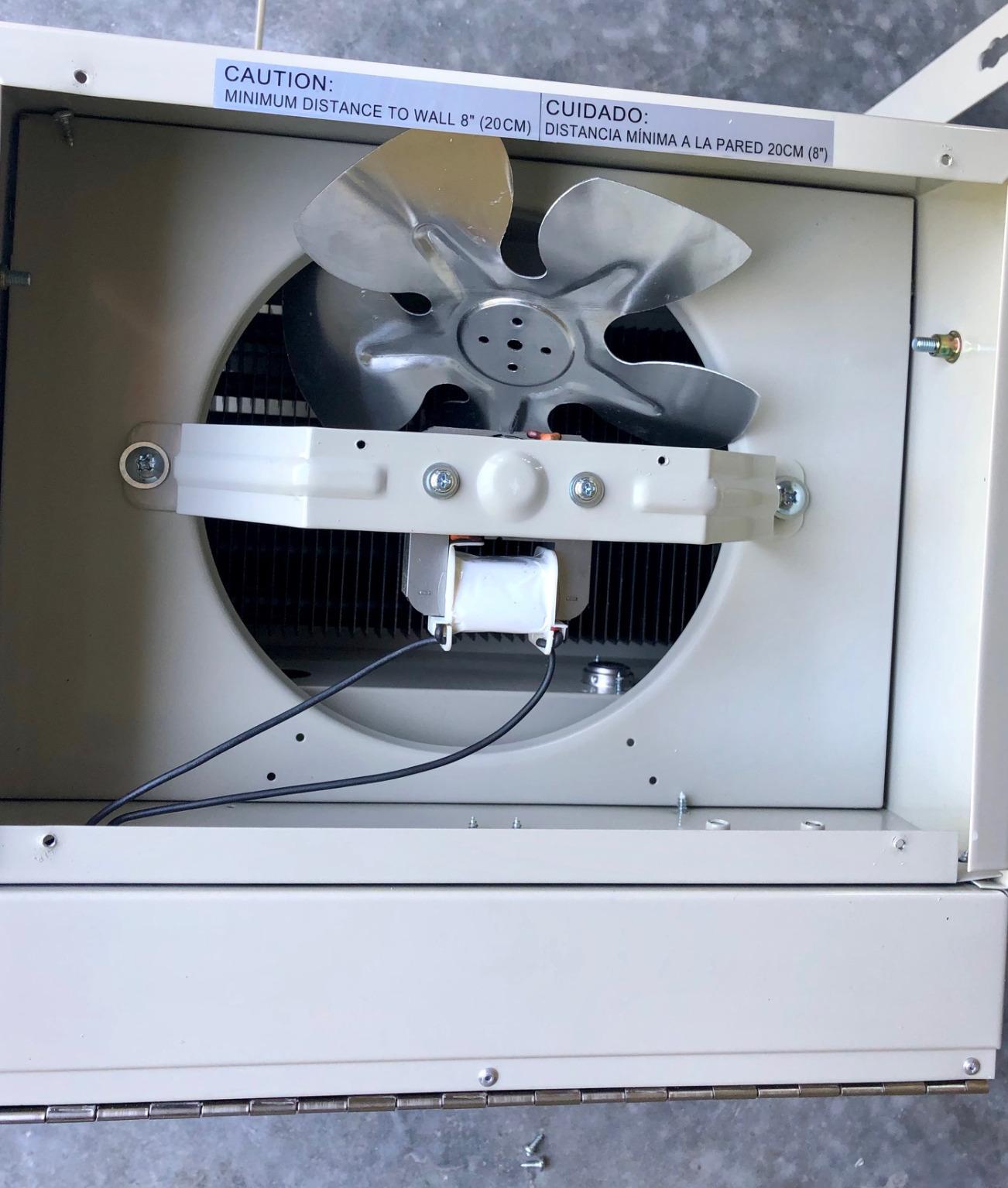
Build quality comes up first in almost every review. The heavy-gauge steel body is the point: in a drafty garage with big swings, thin sheet metal warps and cracks around element mounts. This one is built to survive that, and the integrated temperature sensor shuts the whole unit down quickly if it ever overheats.
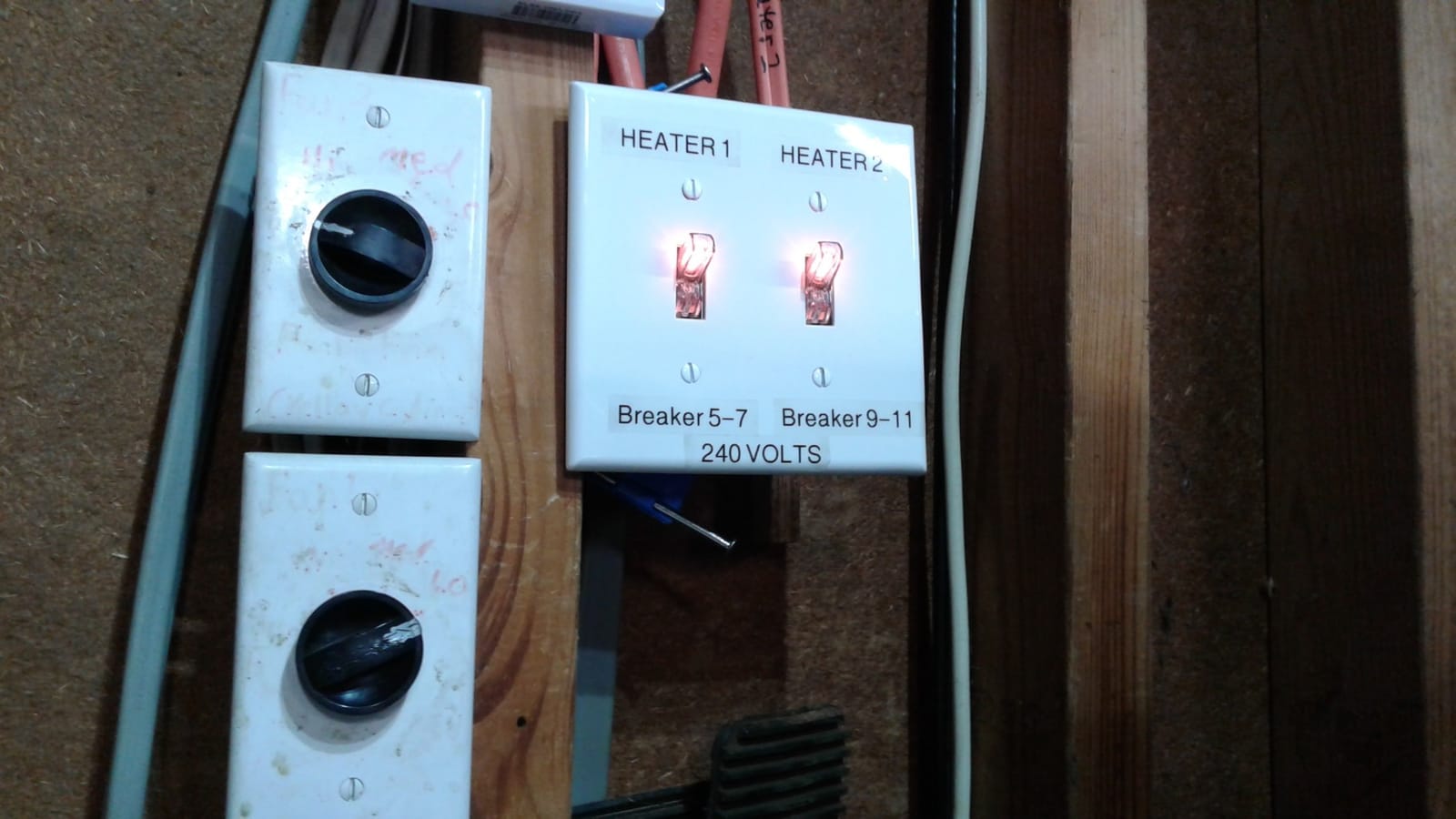
The 1,000 square foot coverage claim is generous for a 5,000W machine, and the real limit is your insulation, not the label. In a well-insulated single bay with a decent door, it holds temperature. In a bare two-car space in deep winter, you will be running it constantly and still watching the thermostat hunt.
The thermostat is the compromise. Two mechanical knobs, one for power and speed, one for temperature up to 95 F. There is no remote, no display and no timer, so if you like to start the heat an hour before you walk out to the shop, this is not the unit for that habit.
Why it suits a workshop
Ceiling mounting is the underrated part. In a workshop the floor belongs to the table saw, the mill and the stacks of MDF, and a wall-hung or ceiling-hung unit gives all of it back. The adjustable mounting angle lets you point the louvers down toward a bench instead of across the floor.
At 20.9 A, this is also among the easiest 240V heaters here to wire. A 30 A branch circuit covers it with room to spare, and 8 AWG copper is standard. If your garage already has a subpanel with a spare slot, this is a straightforward install.
Where it falls short
Manual controls lose points in a category where seven of the other nine ship a remote. There is no scheduling, so the heat runs all night and all weekend unless you remember to shut it off at the dial. On a thermostat with no clock, that is a real running-cost leak in a cold season.
Second, if your shop is 1,200 square feet or larger, 5,000W will not keep up and you will end up undersized. In that case step up to a 7,500W or 10,000W model rather than trying to make this one stretch.
3. Dr. Infrared DR218 1500W 120V Plug-In Heater – Best for 120V Outlets
DR. INFRARED HEATER DR218-1500W Greenhouse Garage Workshop Infrared Heater, 1500-watt
1500W infrared output
120V plug-in power
12.5 A draw
150 sq ft claimed coverage
Pros
- Plugs into a standard household outlet with no electrician and no new circuit
- Only pick here that works without any 240V work
- Lightweight at 11.5 lb so you can move it between greenhouse garage and shop
- Built-in thermostat cycles the fan instead of running it constantly
- IPX4 splash resistance suits damp spaces
Cons
- 1500W and 150 sq ft is small for deep-cold whole-space heating
- Radiant design warms objects more than the air so warmth stays near the unit
- Some owners report thermostat wiring burning out after a year or two
- Single heat setting with no real low and high difference
Everything else in this roundup assumes you have 240V available. This one does not, and for a rental shop, an older detached garage with a single 15 A circuit, or a hobbyist who wants heat this month rather than after an electrical project, that changes the whole decision. Plug it in, turn it on, and it works.
Reviewers report the most convincing results in spot-heating rather than whole-space heating. Several verified owners describe lifting a one-car garage from 36 F to 65 F overnight, and another held an insulated 20 by 25 shop above freezing through a cold snap. Those are honest results for 1,500W, because the win is mostly from moving warm air rather than from raw output.
It is also the only infrared unit here, and that distinction matters in a woodshop. A radiant element warms you and your workbench without pushing a lot of air around, which means it stirs up far less sawdust than a fan-forced machine. Shop forums have long recommended radiant or quartz benchwork heaters for exactly this reason.
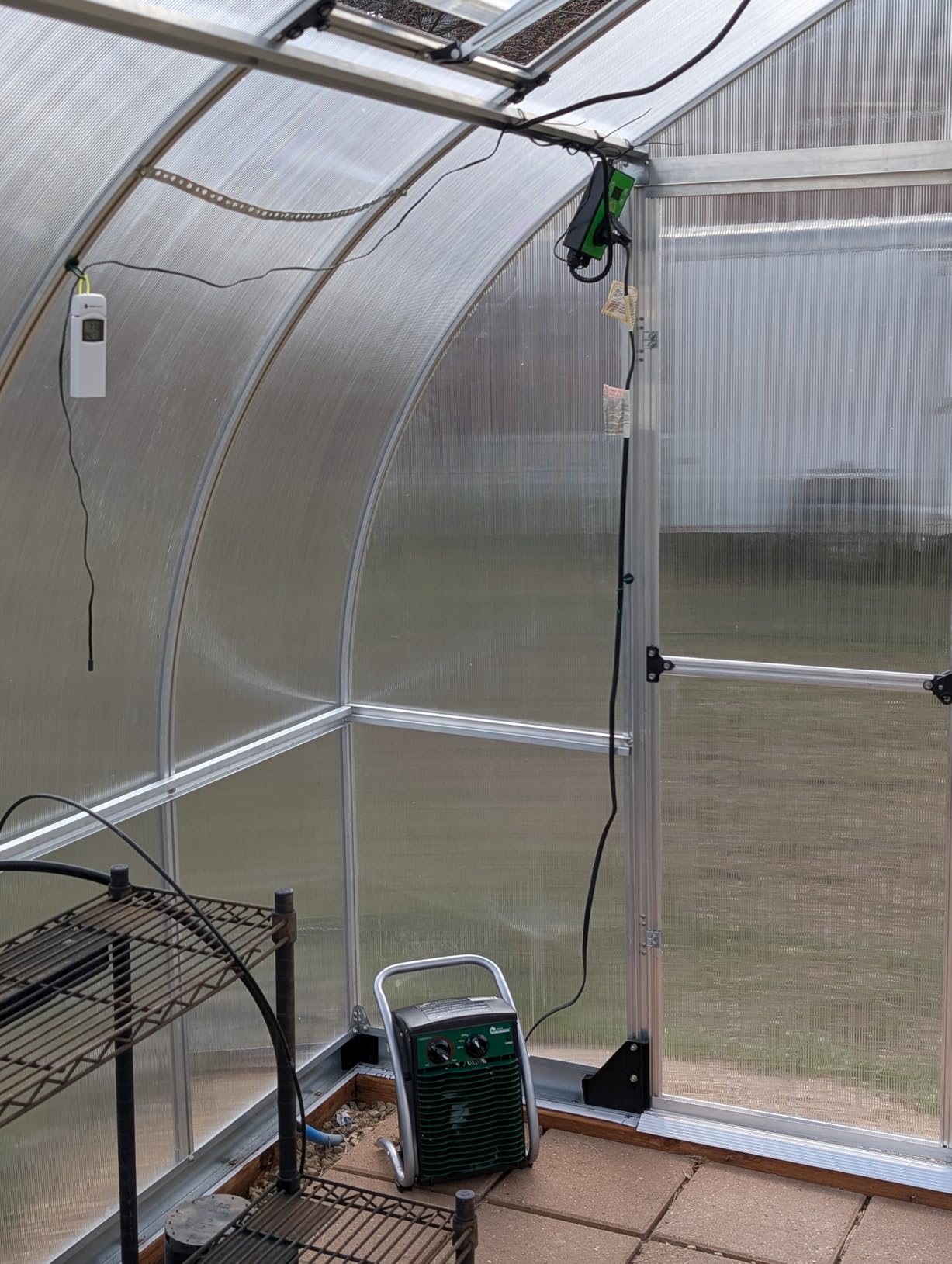
The catch is scale. This is a 150 square foot heater by its own rating. If you try to heat a 500 square foot shop in Northern California where winter nights sit in the high 40s, a 1,500W radiant unit will not get you there, and no setting changes that. Treat it as bench and personal heat, or as a garage topper for a mild climate.
When this is the right tool
Reach for it when the electrical work is the blocker, not the weather. A 120V circuit you already have is worth more than any spec upgrade, and the 12.5 A draw is safe on an ordinary household outlet with nothing else demanding it.
It is also the right pick for a greenhouse, a mudroom or a small finishing area where damp is a factor, since the IPX4 housing tolerates splashing. The 11.5 lb weight means one person can carry it between spaces on a cold morning, which no ceiling-mounted unit in this list allows.
Where it falls short
Durability is the honest concern. A recurring theme in reviews is internal thermostat wiring burning out and the unit failing within a year or two, though the manufacturer has replaced at least some of these at no charge. If you are buying it to run all winter every day, buy it knowing you may be replacing it sooner than a 240V unit.
Second, radiant heat does not travel. You feel it on your hands and face, and the far end of the garage stays exactly as cold. If you need the whole bay usable, this is the wrong heater and no amount of repositioning fixes that.
4. TEMPWARE 7500W Digital Ceiling Heater – Best for Large Shops
TEMPWARE 7500W Electric Garage Heater, 240V Hardwired Heater, 2026 Upgraded
7500W 25590 BTU output
Adjustable 5000W to 7500W
31.25 A at 240V
Claimed coverage to 1250 sq ft
Pros
- 25590 BTU with power adjustable from 5000W to 7500W
- Largest stated coverage of the 7500W units at 1250 sq ft
- Digital thermostat across a wide 45-95 F range
- Remote control plus on-unit touch panel and 12 hour timer
- ECO mode trims output to hold set temperature
Cons
- Hardwired with no power cord so an electrician is required
- 31.25 A draw needs a dedicated 240V branch circuit
- Smaller review base than the established picks at 414 ratings
This is the most capable 7,500W heater in the list on paper, and for a genuinely large shop it is the one to look at first. Output runs 5,000W to 7,500W with 25,590 BTU at the top setting, and the manufacturer rates it for 1,250 square feet, the biggest claim among the 7,500W models here.
The adjustable power range is more useful than it sounds. Running at 5,000W on a shoulder-season day saves real money and reduces how hard you drive the element, and it means one unit covers a 900 square foot spring and a 1,200 square foot January. The 4.4 rating from 414 reviews, with 73% at five stars, is a strong early signal even though the sample is smaller than the older picks.
Control is where this one pulls ahead of the Dr. Infrared. A digital thermostat from 45 to 85 F, a remote, a touch panel on the unit and a 12-hour timer mean you can warm the shop before you drive out and shut it down at the end of the day. ECO mode uses the temperature sensor to trim output rather than slamming the element fully on and off.
As with most hardwired units, the ceiling is the install. A multi-angle mounting bracket is included, but the whip connection means a dedicated 240V circuit and an electrician, same as the rest of the 7,500W class.
Why the wide thermostat range matters
A 45 to 85 F set point is the practical difference between a heater you tolerate and one you leave on. Shops run cold in the morning and warm up fast once the sun hits the door, and a narrow dial forces you into a rough setting and live with the swing.
Combined with the timer, that range lets you do the sensible thing: bring the shop to working temperature on a schedule, then hold. Owners who moved from a manual dial report the change in fuel bill is the first thing they noticed, not the heat itself.
Where it falls short
The review base is thin by comparison with the Dr. Infrared or the Comfort Zone. A 4.4 from 414 ratings tells you current owners are happy, but it does not tell you how the element and the fan motor hold up across eight seasons the way a 3,500-review listing does.
Second, the 1,250 square foot figure is a manufacturer claim and depends entirely on insulation. In an uninsulated shop the practical number is much lower, and at 31.25 A you will feel that on the electrical bill faster than on the thermometer.
5. InoKraft 7500W Heater with NEMA 14-50P Plug – Top Rated
InoKraft 7500W Electric Garage Heater, 240V with NEMA 14-50P Plug
7500W fan-forced output
31.25 A at 240V
NEMA 14-50P plug and 8.2 ft cord
65 dB operating level
Pros
- Highest rating in the roundup at 4.6 stars with 82 percent of reviews at five stars
- Plug and 8.2 ft power cord included so no bare whip to terminate
- Digital thermostat spanning a wide 40-99 F range with 1-24 hour timer
- Quiet 65 dB operation and a fan delay function
- Five angle adjustments plus flexible louvers for wall or ceiling mounting
Cons
- A 31.25 A NEMA 14-50 outlet still has to be installed or confirmed
- 750 sq ft rated coverage is smaller than some competing claims
- Professional installation is still recommended
This is the highest-rated heater in the roundup, at 4.6 stars from 286 reviews, and the most practical one to install. The included NEMA 14-50P plug and 8.2 ft cord is the headline: you are not terminating eight conductors inside a junction box, you are plugging into a receptacle.
That distinction is bigger than it sounds. The other seven 7,500W units in this list all require a hardwired run, and hardwiring is where most DIY installs go wrong, and where the cost sits. If your garage already has a 50 A range-style outlet, this is the shortest path from delivery to warm shop in the entire roundup.
Owners also single out the 65 dB operating level and the automatic fan delay, which lets the fan keep circulating after the element stops so the residual heat in the cabinet actually reaches the room instead of baking inside the housing. The thermostat range of 40 to 99 F is the widest here, which lets you set a real comfort target in a cold shop.
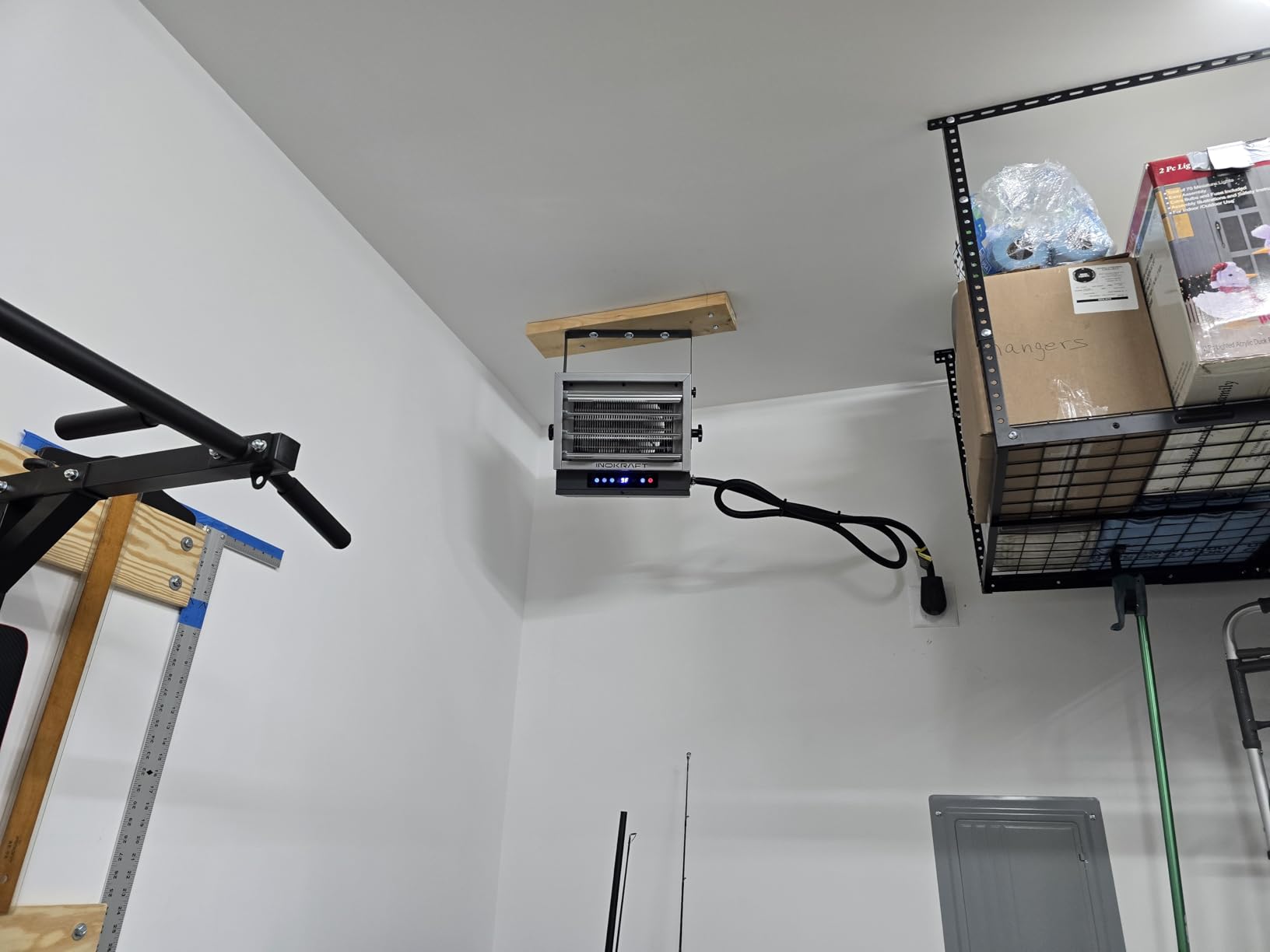
Be realistic about the plug, though. A NEMA 14-50P is a 50 A receptacle on a 50 A circuit, and if you have only a NEMA 6-30R from a 30 A circuit, an adapter does not exist that makes this legal and safe. Confirm your outlet before you buy, or budget to have one installed.
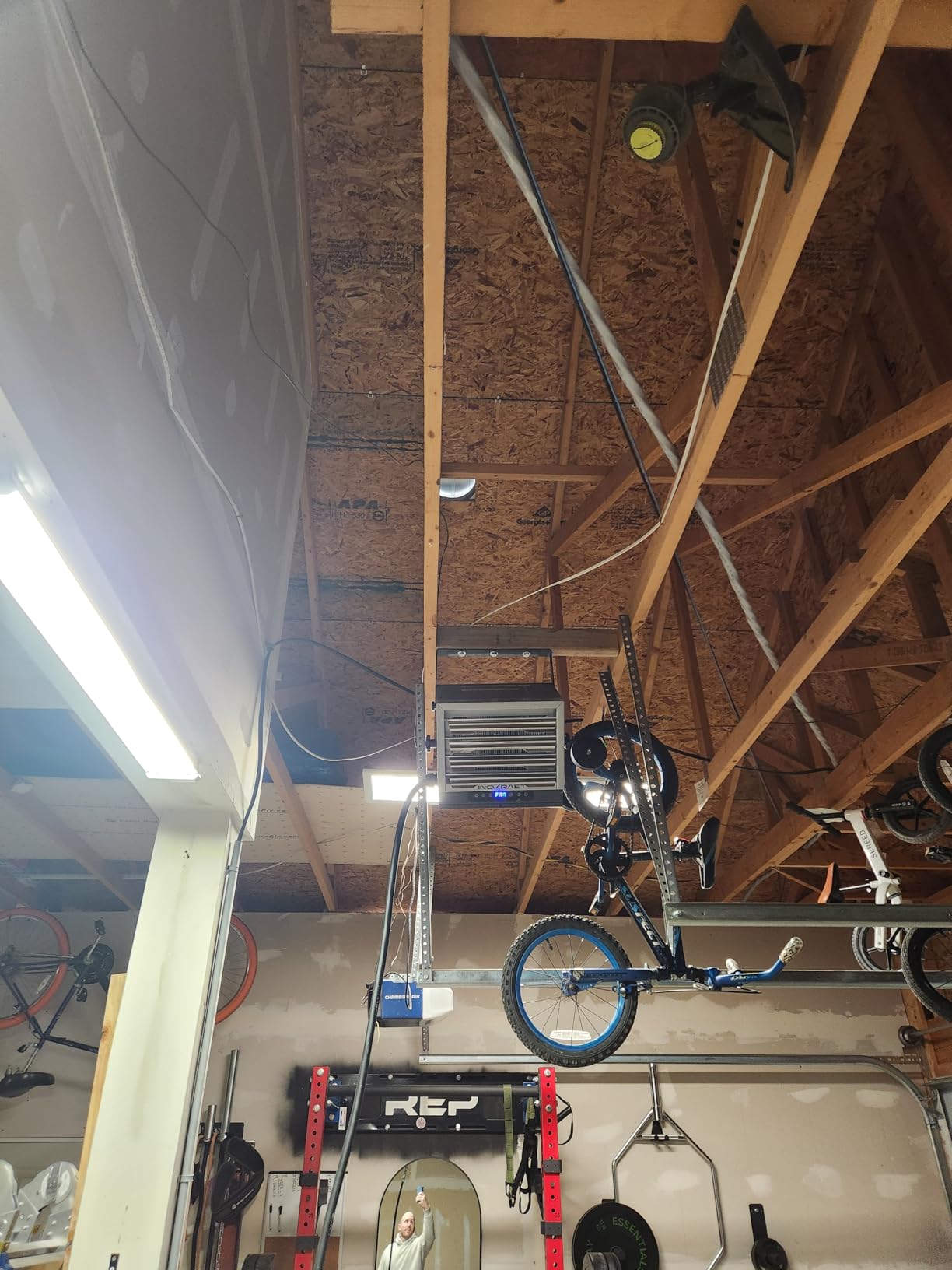
Best fit for a working shop
Ceiling or wall mounting with five angle adjustments means you can get the unit out of the way of a vehicle lift and aim the louvers at the bench where the work happens. The fan delay and ECO mode together are what keep the operating cost sane in a space that loses heat every time the door opens.
For anyone who plans to add smart control later, the panel is digital and the timer runs to 24 hours, which is more scheduling headroom than most of the hardwired competition offers. It is a good middle ground between a bare metal box and a full app-connected unit.
Where it falls short
Coverage is rated at 750 square feet, which is modest beside the 1,000 and 1,250 square foot claims of the TEMPWARE and Comfort Zone units. Those figures are not directly comparable, so treat all of them as marketing and size on your own insulation instead.
Second, at 286 reviews this has the thinnest history among the strong performers. It is a newer design doing exactly what an older design does well, and we would not fault the choice, but the long-run record does not exist yet.
6. TEMPWARE 5000W Shop Heater with ECO Mode – Best for Mid-Size Shops
TEMPWARE Garage Heater Electric 240V, 5000-Watt Hardwired Ceiling Mount Shop Heater with ECO Mode, 240-Volt Hardwired with Full-Function Remote and 12-Hour Timer, Ideal for Workshop
5000W 17060 BTU output
Three power settings 3000/4000/5000W
20.83 A at 240V
592 sq ft claimed coverage
Pros
- Remote control and digital features at a 5000W output level
- Three selectable power levels let you match heat to conditions
- ECO mode plus a 1-12 hour timer reduce idle runtime
- Lower 20.83 A draw is friendlier to wire than 31.25 A models
- ETL certified heavy-duty steel body
Cons
- Smallest coverage of the hardwired units here at 592 sq ft
- Hardwired with no power cord so an electrician is required
- Most polarized rating spread in the roundup with 11 percent at three stars
This unit does something the manual-thermostat boxes do not: it gives you remote control and a timer at a 5,000W output level. For a 600 square foot shop that is already warm by the time you arrive, paying up for 7,500W capacity you would rarely use makes no sense, and this is the smarter spend.
Three power settings, 3,000W, 4,000W and 5,000W, let you run a lower step on a shoulder season and still have real heat. The 45 to 85 F thermostat, ECO mode and the 1 to 12 hour timer together mean the heater can hold a target overnight without you touching it, which is where most of the wasted runtime in a shop actually goes.
Installation is the friendliest of the hardwired group at 20.83 A. That draws inside a 30 A branch circuit with margin, so if you are pulling a new circuit anyway this is the least demanding one on the list alongside the Comfort Zone.
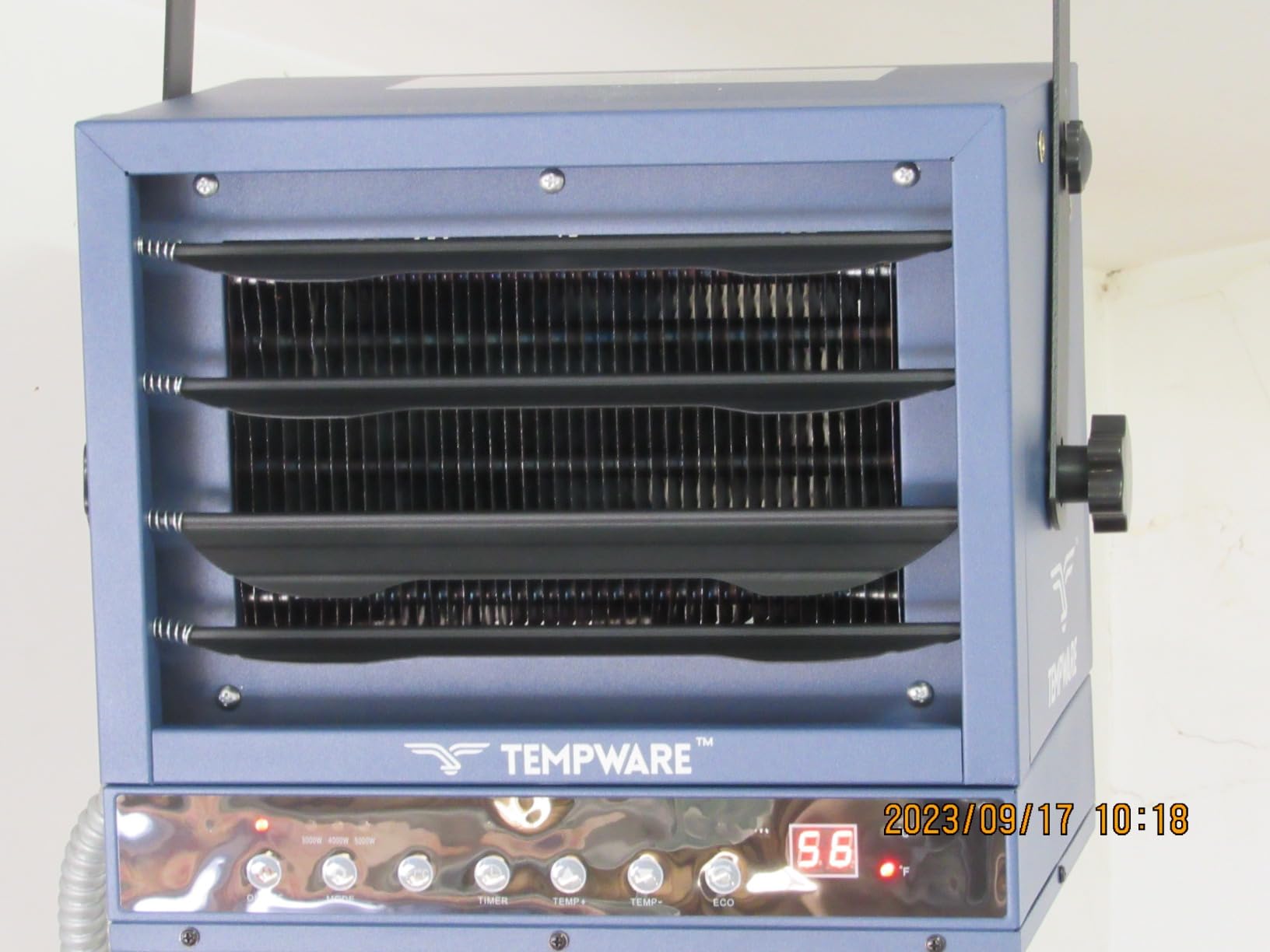
The 4.2 rating from 281 reviews deserves an honest note. The spread is the widest in this roundup, with 64% five-star but 11% at three stars, which usually signals an expectation mismatch rather than a manufacturing fault. Owners who wanted a bigger shop tend to be the ones marking it down.
Where the value is
Louvers plus a variable mounting angle mean you can direct the output where the work is. In a 600 square foot shop with a bench along one wall, aiming the heat at the bench instead of the middle of the floor is worth more than any additional wattage.
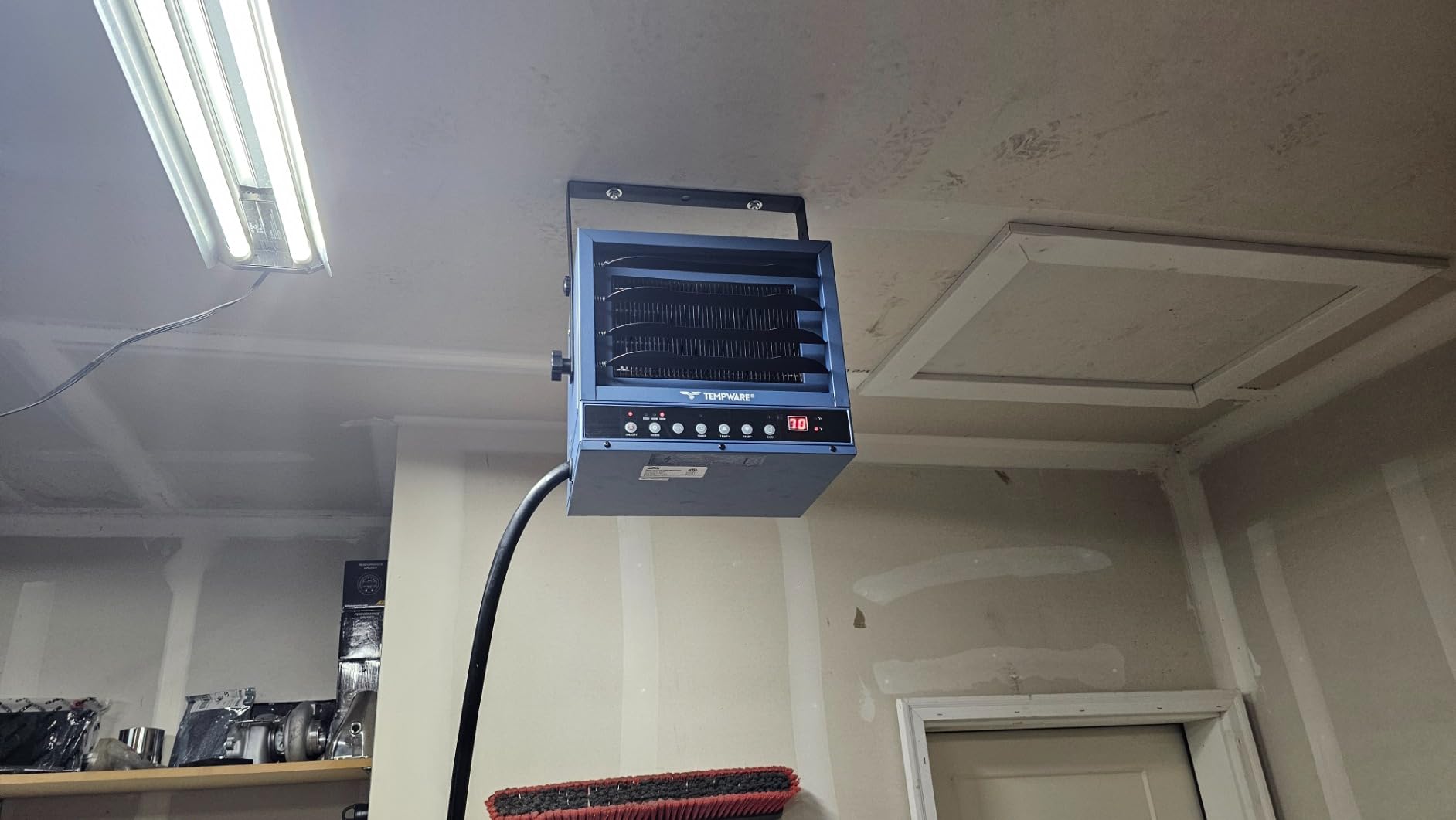
The built-in overheat sensor shuts the unit down automatically, and the steel body is ETL certified, which is the same construction language you would look for on a commercial unit. For a shop that also sprays finish or handles solvents, having no open flame or burner in the space is a genuine safety argument.
Where it falls short
Coverage is the honest limit. 592 square feet is the smallest claim among the hardwired units here, and the 17,060 BTU output confirms it. Use it in a mid-size shop with decent insulation, and if your bay is bigger, spend the difference on a 7,500W model instead.
Second, the polarized reviews mean a few buyers had units that did not meet their expectation. That is a small sample on its own, but it is a reason to check the warranty terms before buying rather than assuming a one-year parts policy is automatic.
7. DuraHeat EUH5000 5000W Forced Air Heater – Simplest Unit That Works
Dura Heat EUH5000 Electric Forced Air Heater 16,400 Btu, Yellow
5000W 16400 BTU output
30 A at 240V
NEMA 6-30P plug
700 sq ft claimed coverage
Pros
- Simplest design in the roundup with a thermostat and two speeds
- Lightest cabinet at 9.8 lb with a ceiling and wall bracket included
- Overheat sensor under the element cuts out quickly
- Nothing gets dangerously hot because air is forced across the coil
- Reliable way to take the chill off a cold garage
Cons
- Listing photos show a 20A plug while the unit ships with a 30A NEMA 6-30
- Nameplate reads 4800W at 240V rather than the advertised 5000W
- Lowest rated unit here at 4.0 with 11 percent of reviews at one star
This is the analog end of the category and there is nothing wrong with that. A 5,000W forced air cabinet, a mechanical thermostat and two speeds, with a ceiling and wall bracket in the box at 9.8 lb. Nothing to learn, nothing to program, and a coil element that has been made in this shape for decades.
The 700 square foot rating and 16,400 BTU output put it squarely in single-bay territory, and owner feedback is consistent: it takes the chill off a cold garage and keeps pipes from freezing. Expectation-setting matters here, because reviewers repeatedly make the point that an electric unit of this size produces a fraction of what a small gas furnace does. Judge it as comfort and freeze protection, not as whole-space winter heat.
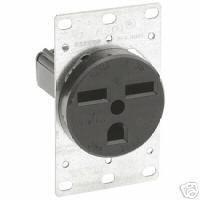
One detail to know before you buy. The listing images show a 20 amp plug, but the unit actually ships with a 30 A NEMA 6-30 connector. That mismatch is well documented and has left more than one owner rewiring an outlet. Check what receptacle you actually have before the box arrives.
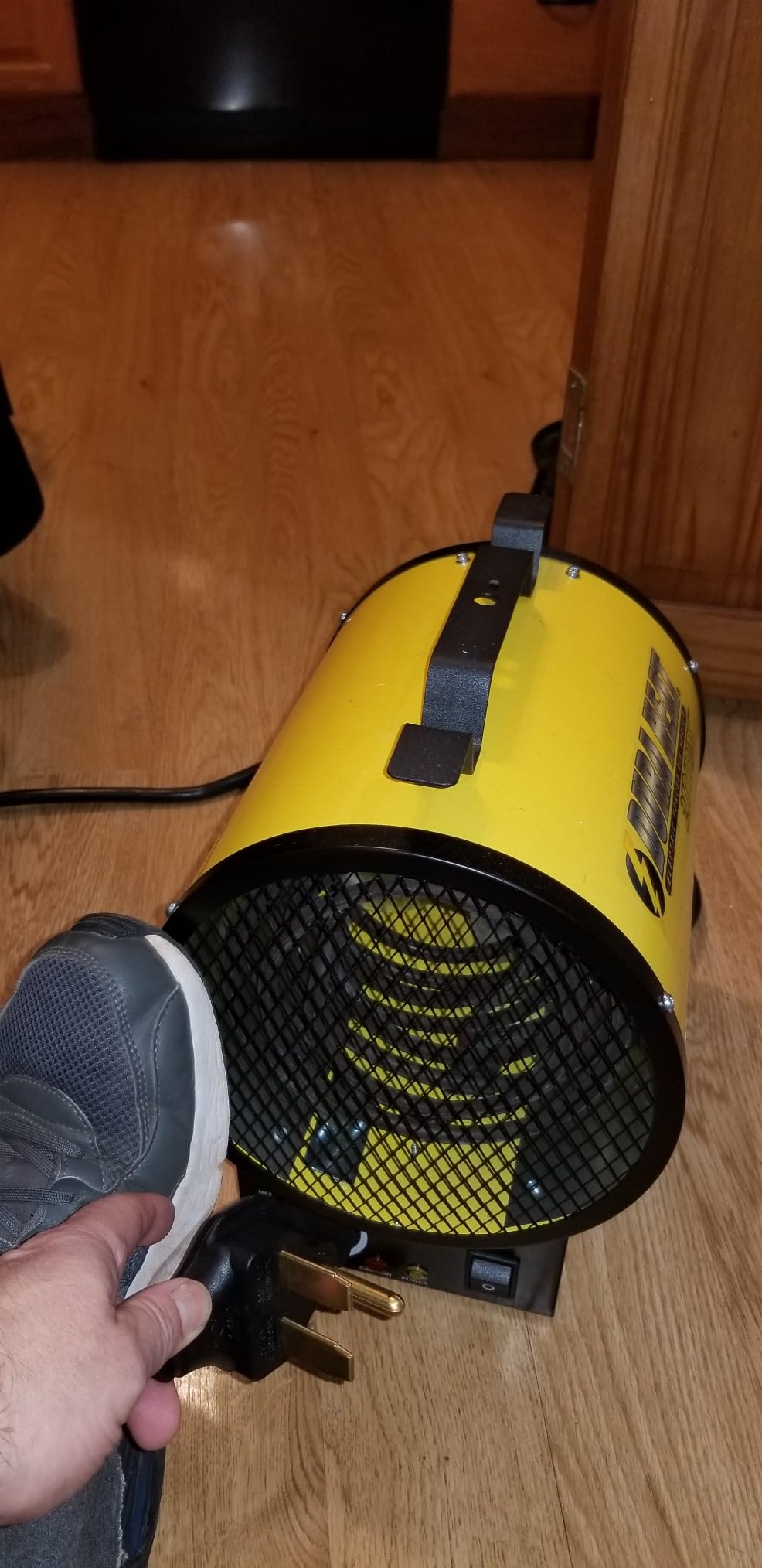
At 4.0 stars from 149 reviews, it is the lowest-rated pick here, and the distribution is top-heavy at 59% five-star against 11% one-star. The one-star reviews cluster around units arriving with a defective fan motor, missing hardware, or dead on arrival, which reads as quality control variance rather than a design fault. It also carries a 1-year manufacturer-defects warranty, so a dead-on-arrival failure is worth raising with the seller immediately.
Why some shops still buy analog
There is real value in a unit with a mechanical thermostat. No firmware, no app, no electronics to fail in a cold damp shop, and a repair shop can replace the thermostat for a few dollars. For a unit you plan to run hard every winter, simplicity has a lifespan argument.
Forced air across a coil also means the housing never gets dangerously hot to the touch, which is worth something in a shop full of lumber, clamps and solvent cans. The steel cabinet and the under-element overheat sensor are both simple, proven parts.
Where it falls short
The plug mismatch is the practical trap and the first thing to resolve. If your garage has a NEMA 6-30R on a 30 A circuit you are fine; if you only have a 20 A outlet, this unit cannot be used there and you need a receptacle change.
Second, the nameplate reads 4,800W rather than the advertised 5,000W. That is a rounding issue rather than a real loss, but it is also a signal that the listing copy is not tightly controlled, and the one-star quality complaints follow the same pattern.
8. ROVSUN 7500W Heater with App Control – Best for App Control
ROVSUN 7500W Electric Garage Heater with Remote & APP Control, Digital Fan-Forced Ceiling Mount Heater with Thermostat, 12H Timer & Overheat Protection, 240V Hardwired for Workshop Factory
7500W 25000 BTU output
31 A at 240V
Coverage to 1200 sq ft
Hardwired 8 AWG connection
Pros
- The only heater in the roundup with smartphone app control on top of remote and panel
- App scheduling with a 12 hour timer helps cut waste in unoccupied shops
- 25000 BTU covering up to 1200 sq ft
- Three directional outlet settings at 0 20 and 40 degrees
- ETL certified steel frame with overheat protection
Cons
- Smallest review base in the roundup at 46 ratings
- 31 A draw and an 8 AWG hardwired connection need an electrician
- App control depends on phone and network availability
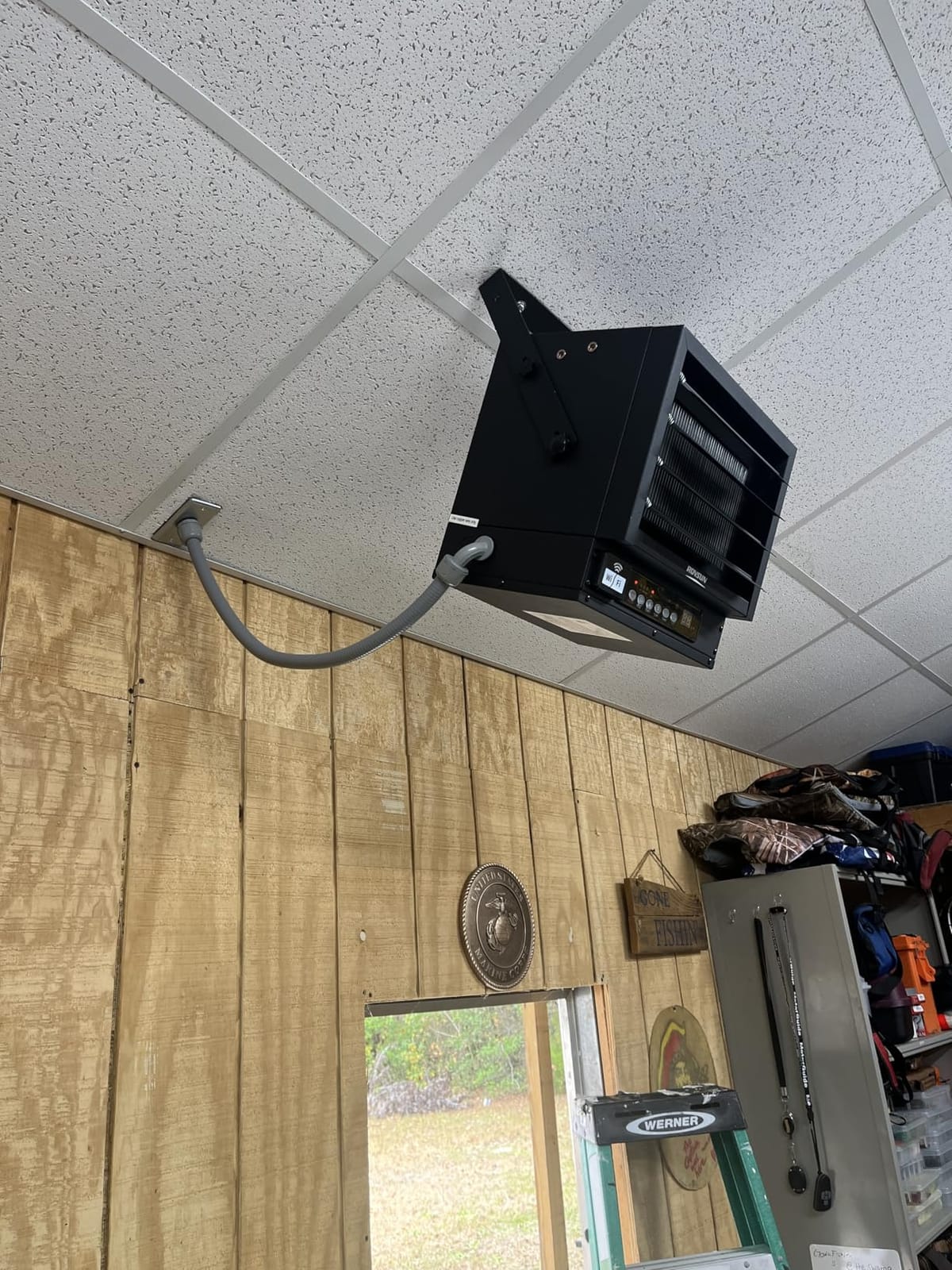
Smart control has been showing up across the shopping results for this category all year, and this is the pick that takes it seriously. You get three control paths: the panel on the unit, a handheld remote, and a phone app that can adjust the set temperature and set a 12-hour timer from anywhere.
That last part is the real use case. A workshop heater you can schedule means the shop is warm at 7 am without anyone driving out at 6 am, and it means the unit is not burning electricity in an empty building over a long weekend. Owners who came from a manual dial tend to cite the running cost, not the convenience, as the reason they would buy it again.
Output is strong: 25,000 BTU covering up to 1,200 square feet, with three directional outlet positions at 0, 20 and 40 degrees. That angle control is useful in a bay with an awkward ceiling, where a single fixed blast either misses the bench or blows dust across it.
Be honest about the sample size. 46 reviews at 4.3 stars is a promising score, not a validated one, and nothing in that data speaks to how the fan motor or the element looks after five seasons. Treat it as the modern pick with an open long-term record rather than a proven workhorse.
What app control actually changes
The scheduling is the feature that pays. A 12-hour timer you set from your phone means the heater follows your work week instead of your memory, and in a space that loses heat the moment the door opens that discipline is worth real money over a winter.
It also helps with freeze protection. A unit you can start remotely after a cold snap hits, before you drive to the shop, is a different tool from one you can only switch on at the dial. For an unheated building with plumbing in it, that is often the reason to buy one at all.
Where it falls short
Forty-six ratings is the smallest base in the roundup, and everything positive here is recent sentiment rather than a durability track record. If you intend to run this daily for many seasons, a model with thousands of reviews is the safer bet.
Second, it is a hardwired unit at 31 A on an 8 AWG connection with no cord included. App control does not reduce the installation work one bit, and the app itself depends on your phone and a working network connection.
9. CTSC 10000W High-Output Ceiling Heater – Best for Maximum Heat
CTSC 10000W Garage Heater Electric, 240V Fan-Forced Ceiling Mount Heater
10000W 34130 BTU output
42 A at 240V
Coverage to 1000 sq ft
58 dB operating level
Pros
- Highest output in the roundup at 10000W and 34130 BTU
- Pre-wired for an external wall thermostat like a home furnace
- Quietest unit here at 58 dB which matters in an occupied shop
- Four heat settings including a fan-only mode for summer circulation
- UL certified SPCC cold-rolled steel with overheat protection
Cons
- Highest rated draw in the list at 42 A and the most demanding circuit
- Hardwired with no cord and the maker recommends professional installation
- An 11 kg cabinet is a two-person overhead lift
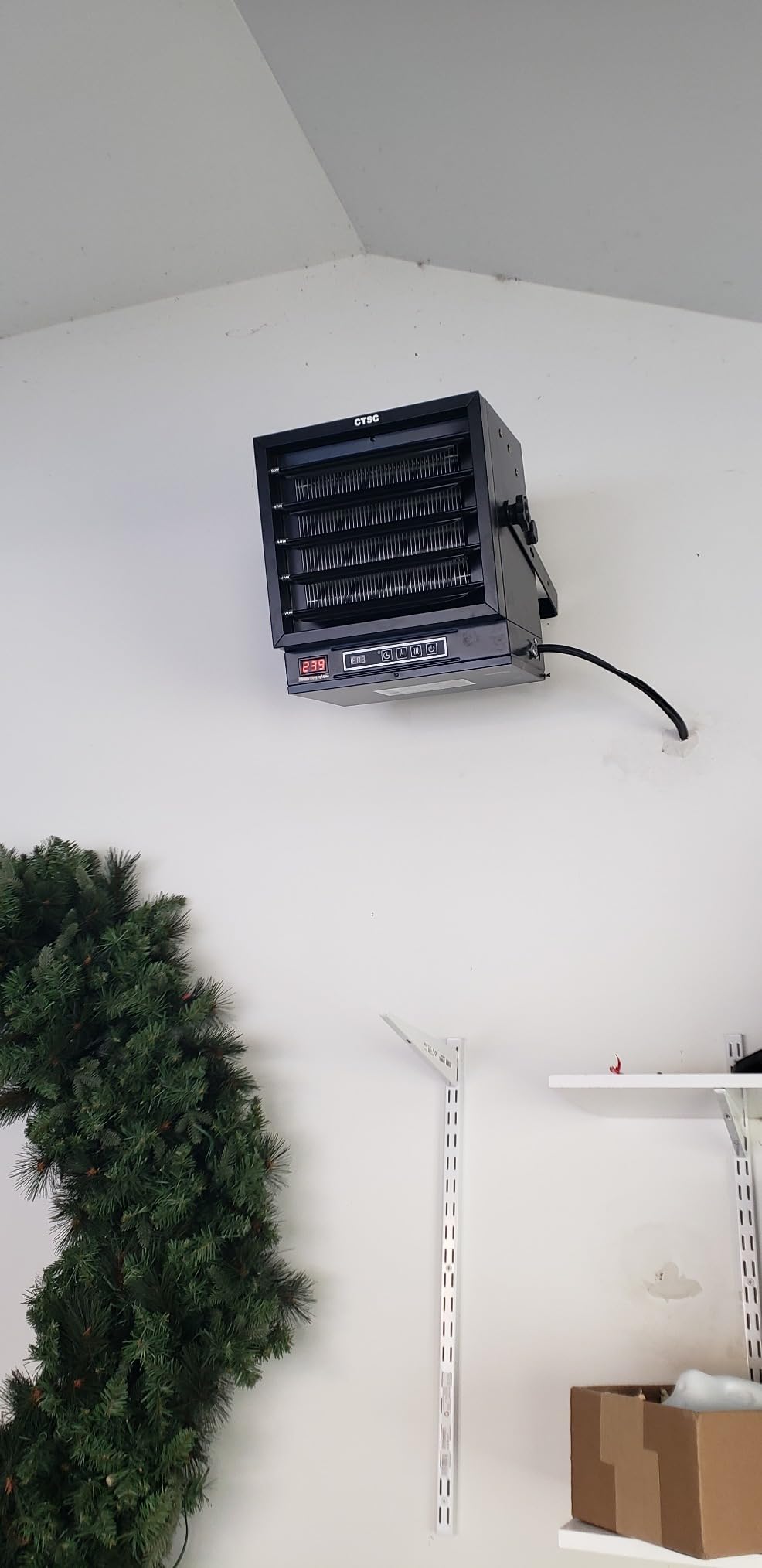
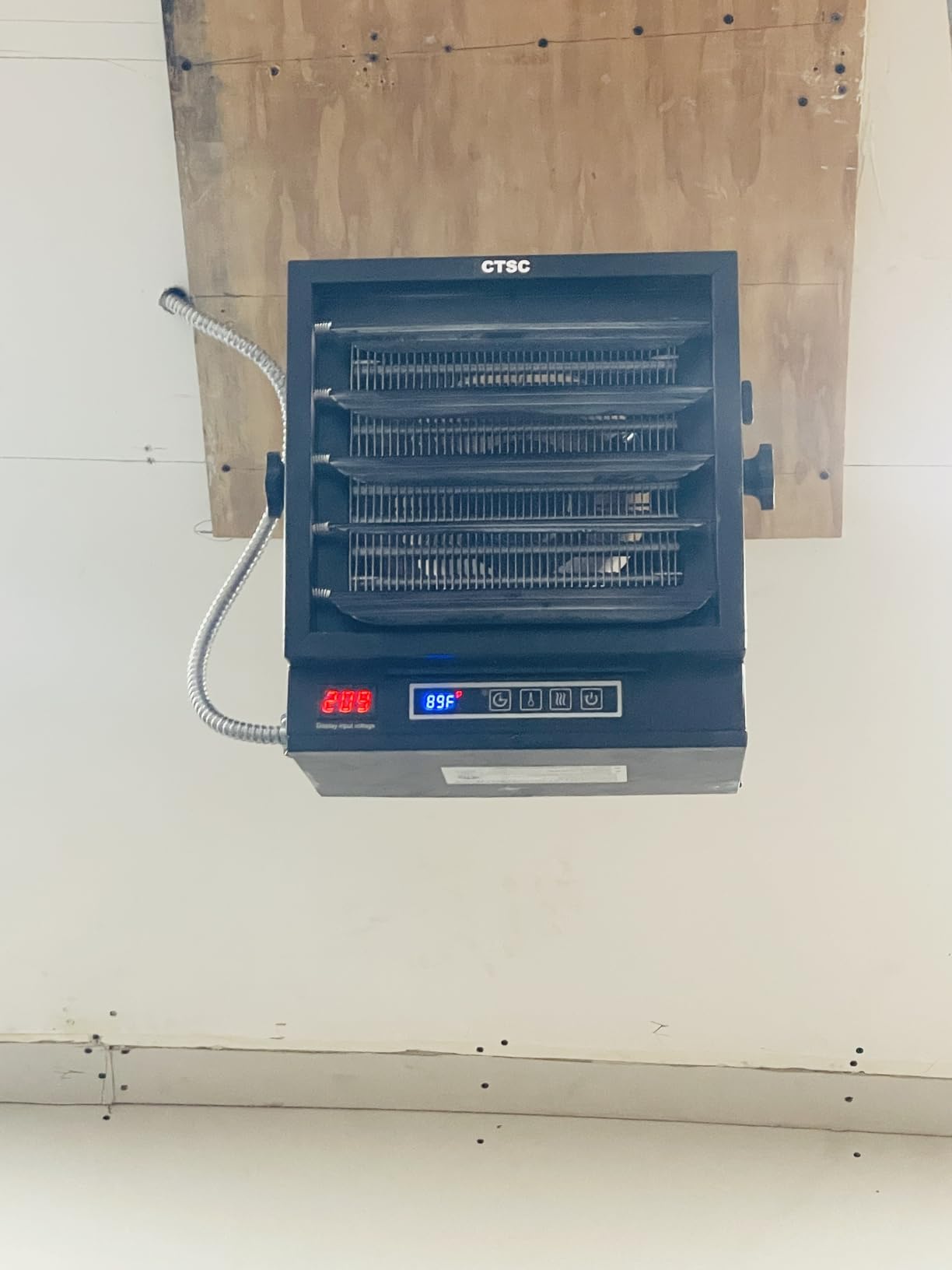
When one heater is not optional, this is the most heat you can get from a single 240V unit in this roundup: 10,000W and 34,130 BTU. That is enough to push heat into a large, drafty, poorly insulated bay or a warehouse where anything smaller would run continuously and never catch up.
Two details make it stand out. First, it is pre-wired for an external wall thermostat, so you can set temperature from a wall control the way you would in a house instead of walking to the unit. For a shop where the heater is mounted somewhere inconvenient, that is a genuine quality-of-life gain. Second, the 58 dB operating level is the lowest published figure in this roundup, and if you work in the same space as the heater, that is measurable.
Four heat settings give you real control: 10,000W high, 5,000W low, an AUTO position with ECO logic, and fan-only for circulating air in summer without heat. The AUTO mode defaults to a 77 F set point and drops to full power below 70 F ambient, which is a sensible default for a garage rather than something you have to tune.
The cost of that output is the electrical work. At 42 A this is the most demanding draw in the list, and it needs a substantial 240V branch circuit on its own. On a 100 review base at 4.2 stars it is a capable unit with a modest history, and the install is the part to plan for.
When 10,000W is justified
Uninsulated spaces, high ceilings and big open floors are where this unit earns its place. Electric heat works by making up for heat loss continuously, so the worse the envelope, the more output you need to hold a workable temperature rather than merely taking the edge off.
The fan-only mode is a small bonus that gets overlooked. In a summer shop you can move air without generating heat, which matters more than it sounds when you are sanding and the goal is dust control and comfort rather than temperature.
Where it falls short
42 A is the honest drawback. Depending on what your panel and subpanel can do, the electrical portion of this install can cost several times what the heater does, and it is the reason many buyers settle for a 7,500W unit instead.
Second, 100 reviews is a light base for the highest-output unit here, and it carries a 1-year limited warranty like most of the category. If you do not genuinely need the output, the money is better spent on insulation or on a second smaller unit you can zone independently.
10. VEVOR 7500W Digital Wall and Ceiling Heater – Compact Option
VEVOR Electric Garage Heater, 7500 Watt Digital Fan Forced Wall Ceiling Mount Shop Heater, Remote Control, Overheat Protection, Hardwired Heater with 9 Hour Timer, ETL Listed
7500W 25600 BTU output
31.25 A at 240V
732 sq ft claimed coverage
20.2 lb cabinet
Pros
- Heats a two-car garage or shop effectively per verified reviews
- Remote control plus a 9 hour timer for scheduling around work hours
- ETL certified SPCC cold-rolled steel shell
- Multi-angle mounting with flexible louvers for wall or ceiling
- Automatic fan delay improves heat transfer and cuts waste
Cons
- Thermostat accuracy is the most cited weakness in reviews
- Hardwired 240V needing a breaker rated above 32A
- Small review base of 84 ratings
The VEVOR sits in the crowded middle of the 7,500W class and does the basics competently: 25,600 BTU across 732 square feet, digital temperature control, a remote, a 9-hour timer and an ETL certified SPCC cold-rolled steel shell. It ranks in the Amazon top hundred of its heater category, and verified buyers report it heating a two-car garage effectively.
Mounting flexibility is genuinely good. Multi-angle adjustment at install time plus flexible louvers afterwards means you can correct the aim after the first cold night, which is when you learn where the draft actually is. The automatic fan delay does the same job in a different way by pushing residual heat out of the cabinet instead of letting it cook.
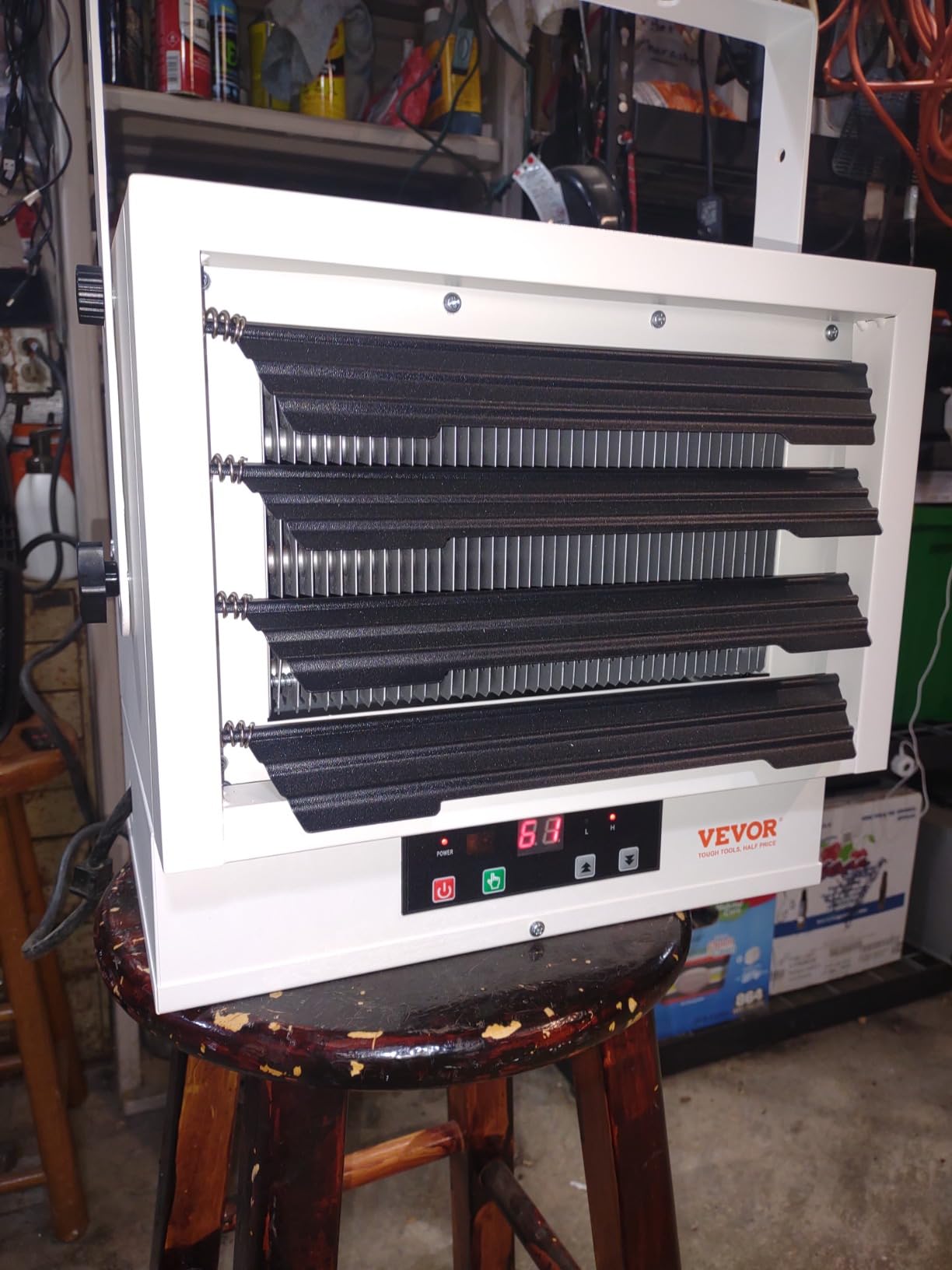
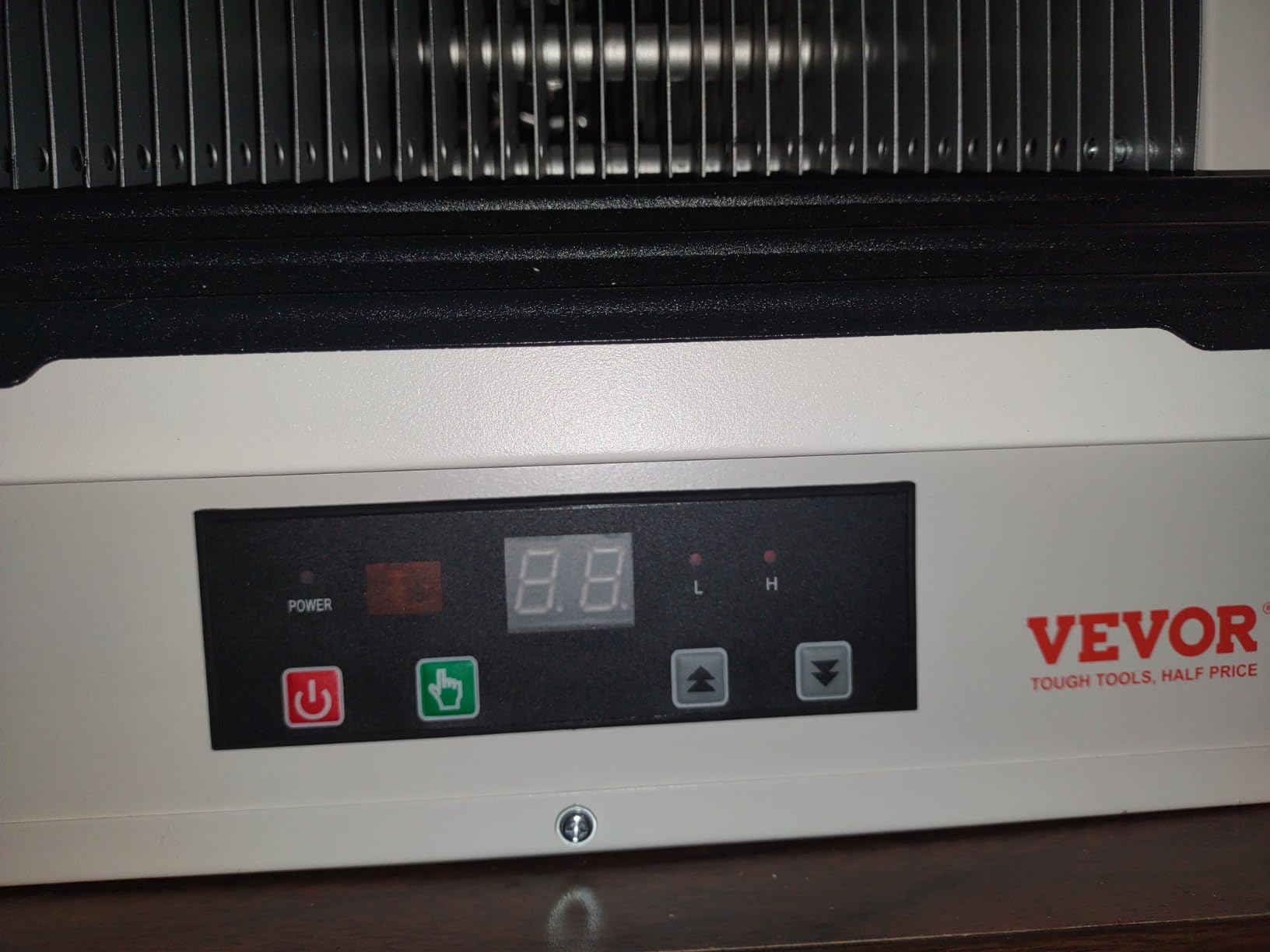
Thermostat accuracy is the weakness reviewers name most, and it is worth taking seriously. One detailed verified review reports the unit cycling 4 to 6 F above its set point and losing its setting after a power outage, which matters if you are relying on it for freeze protection while you are away. The claimed control band is about 2 F, so real-world variance is wider than the spec.
At 4.2 stars from 84 ratings it is a reasonable buy rather than a standout, and there is some disagreement among buyers about whether the fan moves enough air. Most report it does, but it is the one thing to listen to when the unit is running.
What works well
The steel shell and the automatic fan delay are the details that survive daily use. A fan delay is an efficiency feature with a real effect, because a fan-forced heater wastes a surprising amount of the energy it generated if it stops the instant the element does.
At 20.2 lb and roughly 13 by 13 inches, it is easier to handle onto a ladder than the 26 lb Dr. Infrared, which matters more than it sounds when you are mounting overhead alone.
Where it falls short
The thermostat is the problem. A unit that runs 4 to 6 F above its set point and forgets its setting after a power cut is a poor choice for unattended freeze protection, and that is a common reason people buy a workshop heater in the first place.
Second, 84 ratings is a thin base. If you want a proven long-term record and a thermostat you can trust, the Dr. Infrared and the InoKraft are the safer choices at the same wattage.
How to Size an Electric Garage Heater for a Workshop
Start with the wattage math, because everything else depends on it. One watt equals about 3.412 BTU per hour, so a 7,500W heater delivers roughly 25,590 BTU per hour. Once you have BTU, a useful rule for a reasonably insulated single-bay garage is about 5,000 BTU per 100 square feet of heated area.
Measure the space. Multiply length by width. A 24 by 24 bay is 576 square feet; a 28 by 32 bay is 896 square feet. Ignore the ceiling height for sizing and worry about it later for mounting clearance.
Check the insulation honestly. Foam-insulated walls and a sealed door can need 5,000W for a 600 square foot bay. Bare stud walls with a thin steel door can need twice that for the same floor area.
Pick the wattage tier. Roughly 3,000 to 5,000W covers a single bay up to about 700 square feet. 7,500W covers a mid-size shop or a two-car garage. 10,000W is for a large or uninsulated space where you need to recover fast.
Verify the circuit before you buy. Check your amperage against the draw on the nameplate and confirm a dedicated 240V branch circuit exists.
Confirm clearance. Manufacturers generally call for 8 feet of clearance to combustible material below the unit, which rules out a 7 or 8 foot ceiling without a permit and a plan.
Decide hardwired or plug-in. A plug means far less install work but caps you at whatever amperage your receptacle provides.
Set a thermostat you can live with. A narrow 50 to 85 F range is awkward in a shop that warms up fast. A wide range with a timer costs a little more up front and much less in wasted runtime.
Hardwired 240V or 120V plug-in
Almost every capable workshop heater is a 240V hardwired unit, and the reason is physics. A 5,000W heater on 240V draws about 20.9 A. The same heater on 120V would draw more than 41 A, which no normal household circuit provides. If you want real heat in a real shop, 240V is not optional.
What 240V actually involves: a dedicated branch circuit, copper conductors sized for the load, a breaker matched to the unit, and in most places a permit and inspection for a new circuit in a garage. Running that circuit to a detached building is the expensive part, and it is where most of the money goes on a whole-project basis. Forum users worry about this more than anything else, and the worry is justified.
120V plug-in buys you the freedom to skip all of that, at the price of output. The 1,500W unit in this list is the honest expression of that trade: it is a bench heater and a mild-climate garage topper, nothing more.
Breaker size and electrical requirements
The rule is simple: the breaker must be at least 125 percent of the heater’s rated draw, and the circuit must be dedicated to that heater alone. The amperages on this list make the range obvious.
1,500W at 120V draws 12.5 A, so an ordinary 20 A household receptacle is fine.
5,000W at 240V draws about 20.8 to 20.9 A, which fits a 30 A branch circuit.
5,000W models rated at 30 A on the nameplate, including the DuraHeat, need a 30 A circuit with a matching receptacle.
7,500W at 240V draws 31.25 A and needs a 40 A circuit, which is why several manufacturers specify a breaker above 32 A.
10,000W at 240V draws about 42 A, which needs a 50 A circuit and is the most demanding install in this roundup.
Receptacle type follows the breaker. 30 A circuits typically use a NEMA 6-30R, and 50 A circuits use a NEMA 14-50R, which is the same style of outlet a clothes dryer uses. If your garage has a dryer-style outlet already, the InoKraft can go straight into it.
What running a heater actually costs
Running cost is watts times hours times your electricity rate, and a watt is one thousandth of a kilowatt. A 7,500W heater running flat out for one hour uses 7.5 kWh. Over an 8-hour workday that is 60 kWh a day, and a 30-day month at full output is 1,800 kWh. At a typical residential rate that works out to a few dollars an hour, which is why owners are often more surprised by the total than by the hourly figure.
The lever that matters is not the wattage, it is the duty cycle. A well-insulated shop that reaches temperature and holds it runs the element perhaps a third of the time, which cuts those numbers dramatically. An uninsulated shop runs it continuously and there is no thermostat setting that fixes that. This is why owners report such large monthly bill increases with a small heater in a big uninsulated space: small heaters in large spaces do not cycle off, they just fail to win.
Insulation is the cheapest efficiency upgrade available. Weather-stripping the door, insulating the ceiling and sealing gaps around the header typically costs less than one electrician visit and reduces runtime far more than any feature on a heater. Buy insulation before you buy a bigger heater.
Fan-forced versus radiant in a woodshop
Fan-forced units pull room air across a steel element and blow it back. That is why they can heat an entire room, and also why they move everything suspended in that air. In a shop with wood dust, that means the fine dust gets redistributed across every surface you just cleaned.
Radiant or infrared units heat an element that glows, and you warm yourself and the workpiece in front of it without much air movement. That makes them the better choice at a bench, for finish work, and anywhere you are sanding and want dust to stay where it fell. The limitation is that radiant heat does not travel, so it will never heat a whole bay. The 1,500W unit in this list is the only radiant model here.
For a mixed shop, the practical answer is a fan-forced unit mounted high with the louvers aimed down at the work area, plus a radiant unit for the bench. That is also the recommendation that shows up repeatedly on the advanced DIY forums, where overhead radiant or quartz benchwork heaters get recommended specifically because they warm hands without filling the room with dust-laden air.
Certification and safety
Look for ETL or UL listing and treat anything without it as a deal breaker. Both mean an independent lab has tested the unit for electrical safety and fire risk. In this list, the Dr. Infrared DR-975 is UL and CUL listed, the CTSC is UL certified, and the Comfort Zone, TEMPWARE 5000W, ROVSUN and VEVOR are ETL listed or ETL compliant.
Overheat protection matters just as much. A high-limit cutout or thermal sensor that kills the element before it can damage the cabinet is what lets a heater sit unattended through a cold snap, and every unit in this roundup has some form of it. The Dr. Infrared DR218 and the InoKraft also carry automatic shut-off functions in addition to their thermostat cutouts.
One extra note for shops using paint, solvents or finishes: an electric heater has no burner and no combustion, which removes the ignition source question that comes with propane or natural gas units. That is a real advantage in a finishing area, and it is one reason electric wins in woodworking shops even when it costs more to run.
When something other than an electric heater makes more sense
Electric heat is a poor match for three situations, and it is worth naming them. A large uninsulated building needs more watts than a single circuit can deliver. A building you need to heat from October through March at 60 F inside needs either a heat pump or a combustion heater. And an attached garage shares air with a living space, where a combustion heater raises carbon monoxide questions an electric unit simply does not.
A mini-split heat pump is the alternative shop owners keep raising, and for good reason: it heats and cools, it dehumidifies, and once installed it costs less per hour to run than resistance heat. For frequent use in an insulated space, it is usually the better long-term answer. If you want the fuel-by-fuel comparison, our roundups on garage heaters for winter and on propane workshop heaters cover the combustion side in detail.
Frequently Asked Questions
What is the best electric heater for a large workshop?
For a large workshop the CTSC 10000W unit delivers the most heat from a single 240V circuit at 34,130 BTU, and it runs at 58 dB with a pre-wired hookup for an external wall thermostat. The TEMPWARE 7500W is the better choice if 10,000W and a 42 A circuit are more than you need, since it offers adjustable 5,000W to 7,500W output and a digital thermostat.
What size circuit breaker do I need for a 7500 watt garage heater?
A 7,500W heater at 240V draws 31.25 A, so it needs a dedicated 40 A branch circuit. The breaker must be at least 125 percent of the unit’s rated draw, and several manufacturers specify a breaker rated above 32 A. The circuit must serve the heater alone, and the work generally needs a permit and inspection.
How many sq ft will a 7500 watt garage heater heat?
A 7,500W heater produces about 25,590 BTU per hour and manufacturers rate it for roughly 730 to 1,250 square feet depending on the model. That figure assumes good insulation, a sealed door and moderate climate. In a bare stud-walled or uninsulated garage, treat the real number as a fraction of the claim and expect the element to run continuously.
How many Btus do I need to heat a 24×24 garage?
A 24 by 24 garage is 576 square feet, and a common rule of thumb is about 5,000 BTU per 100 square feet, which puts you near 28,800 BTU per hour or roughly 8,500W. In a well-insulated bay a 7,500W unit at 25,590 BTU is usually enough. In an uninsulated bay, add insulation before adding wattage.
What is the most economical way to heat a workshop?
Insulation first, then control. Weather-stripping the garage door, insulating the ceiling and sealing gaps around the header usually costs less than one electrician visit and cuts runtime far more than a larger heater does. After that, a wide-range digital thermostat with a timer and an ECO mode keeps the element from cycling wastefully, and heating only the zone you are working in beats heating the whole bay.
Which Electric Garage Heater Should You Buy?
The best electric garage heaters for workshops in 2026 come down to one honest question: what does your electrical setup already allow you to do. If you have a spare 240V slot, buy the Dr. Infrared DR-975, the most proven hardwired heater here, with switchable 7,500W and 4,700W output and a remote thermostat. If your bay is smaller and you want proven value, the Comfort Zone CZ220BK does the job for less. If you want the shortest path from box to warm shop, the InoKraft 7500W plugs straight into a 50 A outlet.
Whatever you choose, verify the circuit and the clearance before the box arrives, and spend the money on insulation before you spend it on more wattage. Those two steps decide whether the heater works well or whether you end up with a very expensive space heater.