
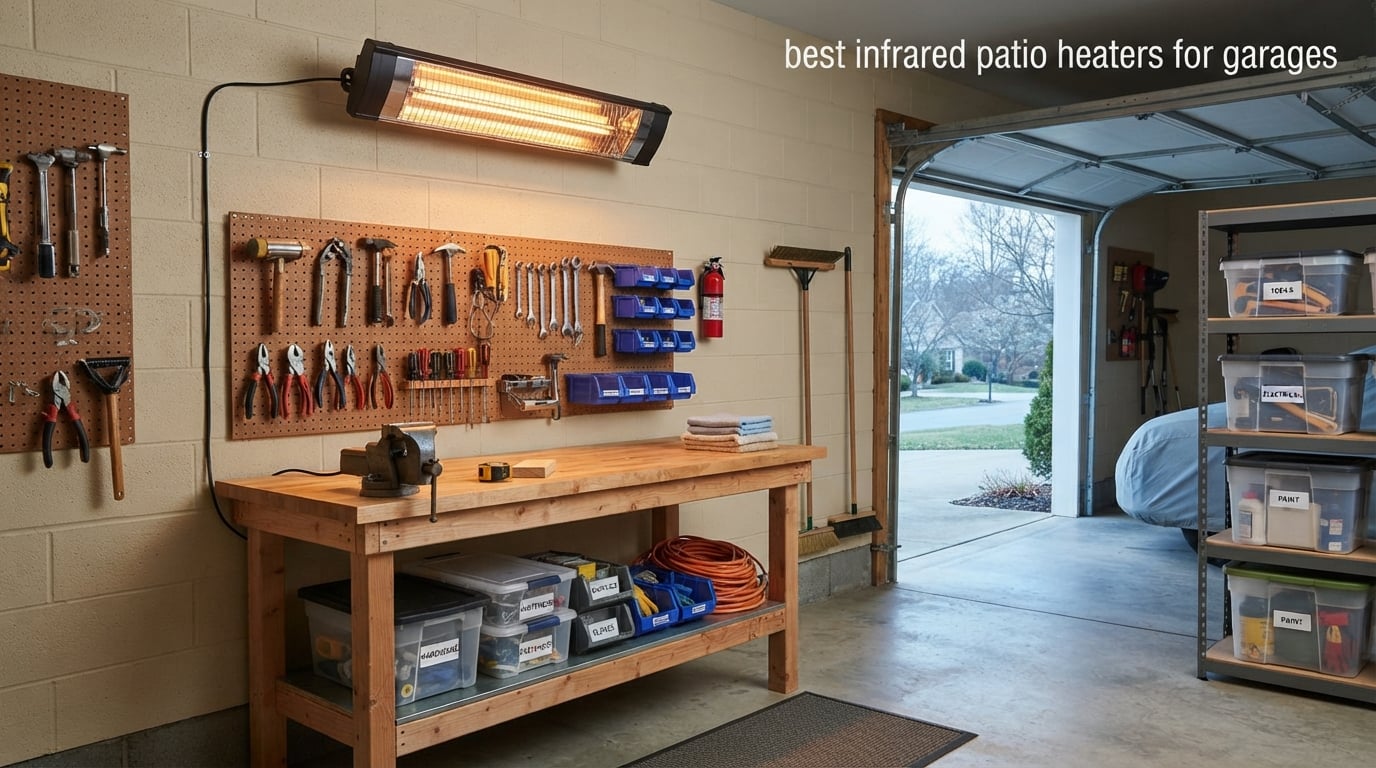
An infrared patio heater is an electric radiant heater: electrical current heats a quartz or carbon element behind a reflector, and the reflector throws infrared energy in a cone in front of the unit so that people and nearby surfaces warm directly instead of the air being heated first. That single design fact is why an outdoor-rated patio heater is legitimate garage equipment, and why the best infrared patio heaters for garages come from the patio aisle rather than the garage aisle.
Our team pulled ten of the most-reviewed electric infrared heaters sold for patios and covered outdoor spaces, then judged each one on the only question that matters in a garage: does it put usable heat where you are standing. We compared mounting geometry, wattage, voltage, weather rating, safety kit and the honest owner complaints that show up years into service, not just week one. Everything below reflects the spec data and owner feedback we could verify, including the places where these units disappoint.
If you want the wider picture first, our electric patio heater roundup covers the outdoor side, and our space heater picks for gaming rooms and garages covers the indoor plug-in end of the market. This page is specifically about radiant heat in a garage, updated for 2026.
Table of Contents
Top 3 Best Infrared Patio Heaters for Garages in October

DR. INFRARED HEATER 1500W
- IP55 rated for indoor and outdoor use
- Wall and ceiling bracket included
- 900W 1200W and 1500W settings
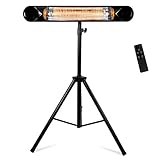
Briza 1500W
- Tripod stand and mounting hardware both included
- IP55 all-weather rating
- Remote with 1 to 9 hour timer
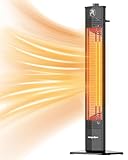
Encyclpo 1500W Tower
- IPX5 waterproof carbon fiber elements
- Silent fanless operation
- Only 7.5 pounds
All 10 Best Infrared Patio Heaters for Garages in 2026
| Product | Specifications | Action |
|---|---|---|
| DR. INFRARED HEATER 1500W |
|
Check Latest Price |
| Briza 1500W |
|
Check Latest Price |
 SereneLife 57 inch Tower SereneLife 57 inch Tower |
|
Check Latest Price |
| Encyclpo 36 inch Tower |
|
Check Latest Price |
 Paraheeter 1500W Paraheeter 1500W |
|
Check Latest Price |
 SereneLife Wall Mount SereneLife Wall Mount |
|
Check Latest Price |
 VAGKRI with 12H Timer VAGKRI with 12H Timer |
|
Check Latest Price |
 Sundate WiFi 1500W Sundate WiFi 1500W |
|
Check Latest Price |
 VAGKRI 42 inch Tower VAGKRI 42 inch Tower |
|
Check Latest Price |
 SereneLife Adjustable Stand SereneLife Adjustable Stand |
|
Check Latest Price |
1. DR. INFRARED HEATER 1500W – The Best Overall Infrared Patio Heater for a Garage
DR. INFRARED HEATER Portable Infrared Indoor and Outdoor Space Heater for Patio, Garage, Commercial & Residential With Remote Control, Without Thermostat, Black
1500W on 120V
IP55 indoor and outdoor
900W 1200W and 1500W settings
8 pounds
Pros
- Largest verified review base in this group at over 6000 ratings
- IP55 sealing holds up against dust and damp
- Wall and ceiling bracket included so one unit covers two mounting jobs
- Three power settings let you drop to 900W for a warm bench zone
Cons
- Heat falls off fast outside the direct line of sight
- Bracket hole spacing is fixed with no drilling template
- Must be restarted from the remote after a power cut
I have had one of these on the wall of a workbench bay for the better part of two winters, and the thing that keeps it in service is the combination of mounting hardware in the box and the IP55 sealing. You get the wall bracket and the ceiling bracket, the 120V cord plugs into a standard outlet, and there is no conversion kit or electrician in the middle of the job.
The heat is instant. The element reaches working temperature in seconds and the mirror aluminium reflector rated at 90 percent reflectivity throws a tight, bright band at whatever is directly in front of it. At 900W I can work at a bench all evening without feeling the chill, and stepping up to 1500W when I am thawing something in the sink is a genuinely different experience.
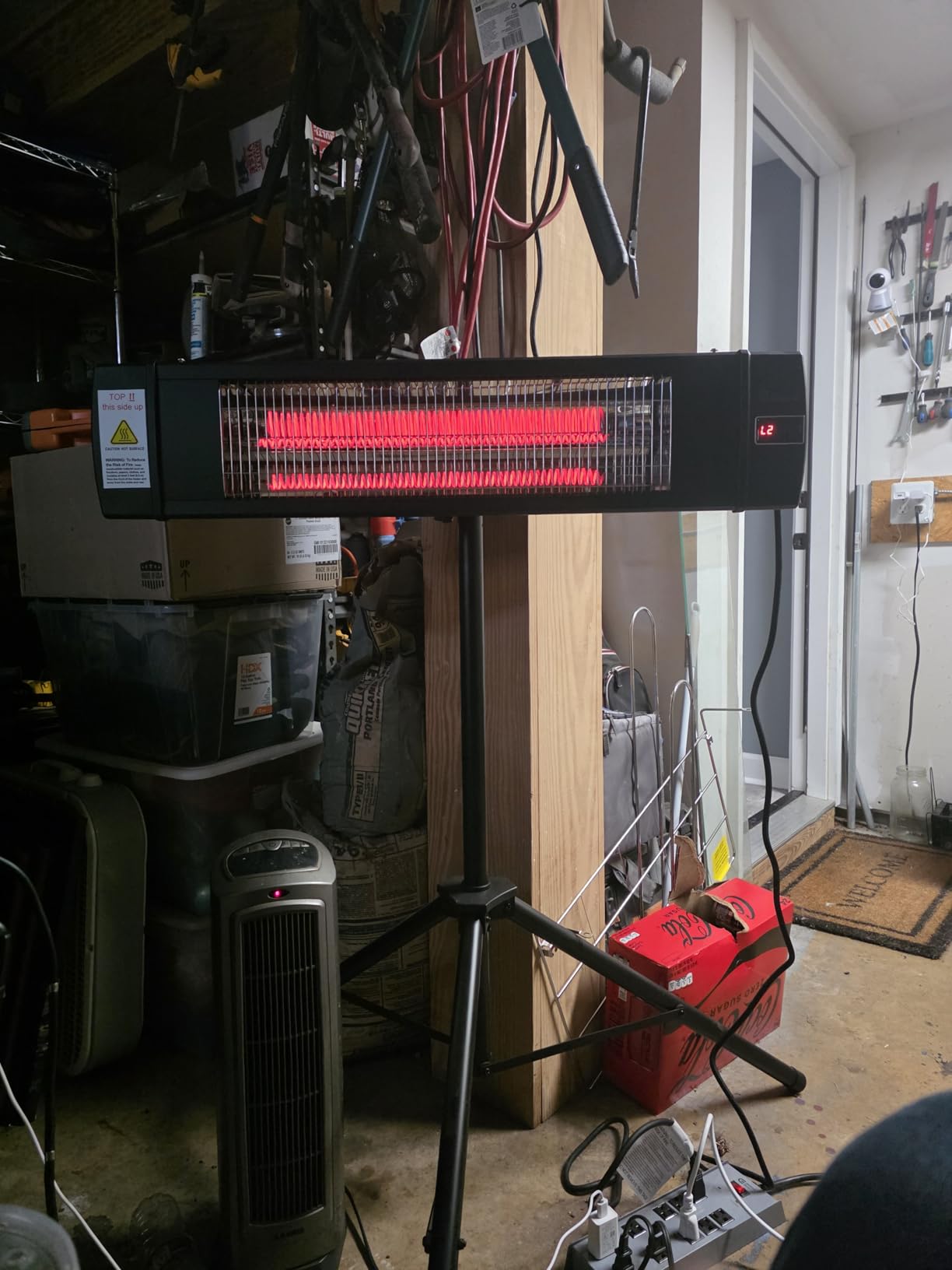
Reviewers report long service lives. Owners describe two to four years of continuous seasonal use without the element degrading, and the distribution of ratings is unusually healthy for a category where most listings sit in the low fours with almost no feedback. That review volume is the reason this is the pick I trust most in the group.
The complaints are consistent and all fixable in your head before you buy. Heat falls off quickly outside the cone, so this is a zone heater and not a room heater. The bracket hole spacing is fixed, so measure twice and use a level. On the lower settings, PWM regulation can make LED lamps on a shared circuit flicker, which is cosmetic. And the unit does not restore its last setting after a power cut, so if your garage loses power mid-project you restart it from the remote.
Check the outlet before you buy
It draws 12.5 amps at full power, which is the number that matters. A 20-ampere circuit handles it, but you should keep the heater on a circuit of its own if you plan to run a welder, a compressor or an extra heater on the same run. Older detached garages frequently have a single 15-ampere circuit, and 15 amps is not enough for this heater at 1500W.
Wall mount or ceiling mount
In a bay with eight-foot ceilings, wall mounting on an adjacent stud at roughly bench-to-shoulder height aims the cone horizontally at your torso, which is the most efficient use of radiant heat. Ceiling mounting throws the cone down and out, which works well over a work area where nothing is stored high but wastes energy if the ceiling is tall and the bracket angles downward.
2. Briza 1500W – The Best Value Pick with the Most Mounting Options
Briza Infrared Electric Patio Heater – Indoor/Outdoor Heater – Portable Wall/Garage Heater – 1500W – use with Stand – Mount to Ceiling/Wall)
1500W on 120V
IP55 all-weather rating
Tripod stand plus wall and ceiling hardware
Three heat levels with remote timer
Pros
- Only heater here that ships with both a tripod stand and fixed-mount hardware
- IP55 rating for real outdoor exposure
- Remote handles power
- level and a 1 to 9 hour timer
- Silent with no hot air blowing across the bench
Cons
- Tripod extends to 6 feet which is too tall to aim down while seated
- About 5 degrees of ambient gain reported in a garage
- Heavier than expected once the stand is assembled
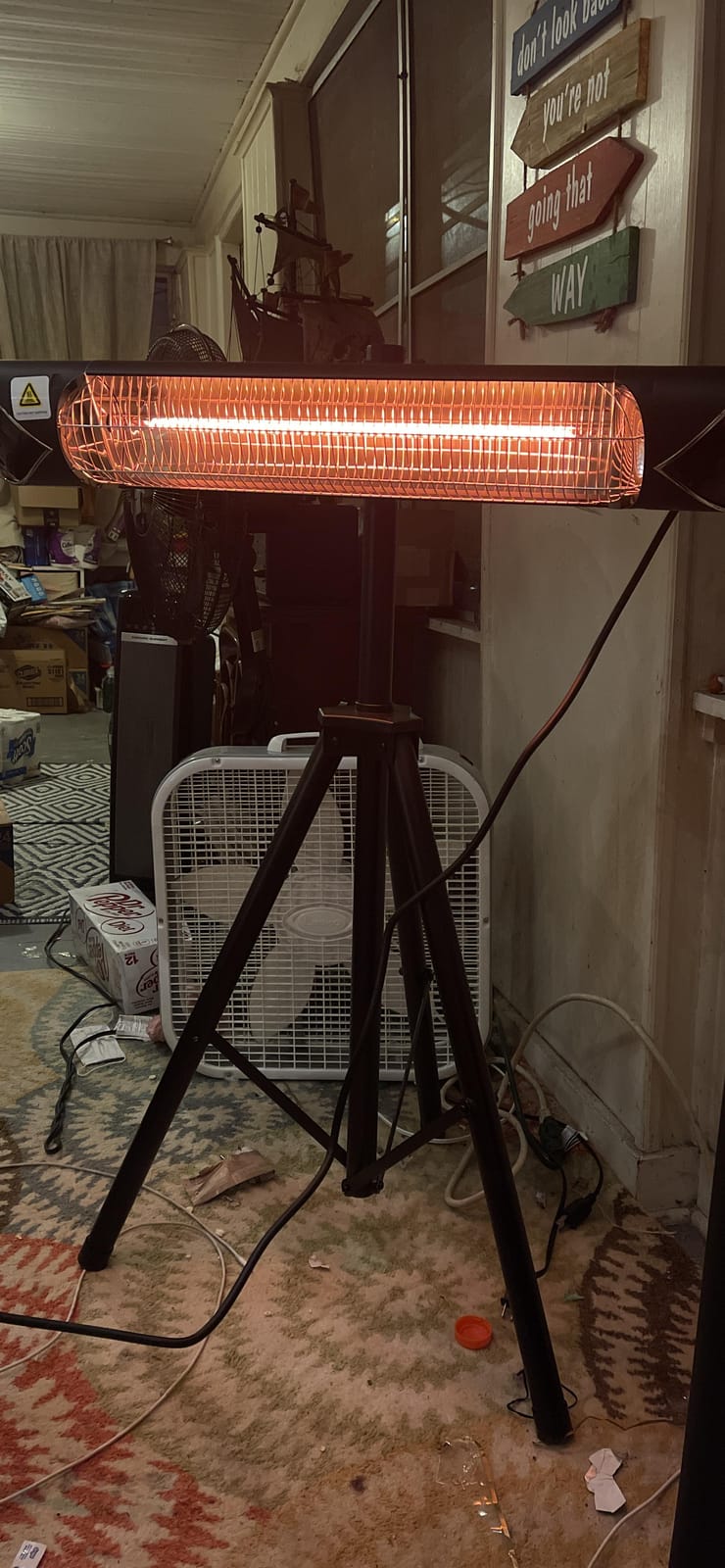
The Briza is the one in this group I keep recommending to people who are undecided about mounting, because it is the only one that arrives with the tripod stand in the box alongside the wall and ceiling hardware. You can start on the stand this winter, find that the bench spot works better fixed, and then use the same heater on the covered patio in the summer.
Assembly takes about five minutes and the remote runs everything: power, three heat levels at 900W, 1200W and 1500W, and a timer you can set anywhere from one to nine hours. The tip-over sensor is built in, so if the dog walks into the stand in a trailer or a busy garage the unit cuts out on its own.
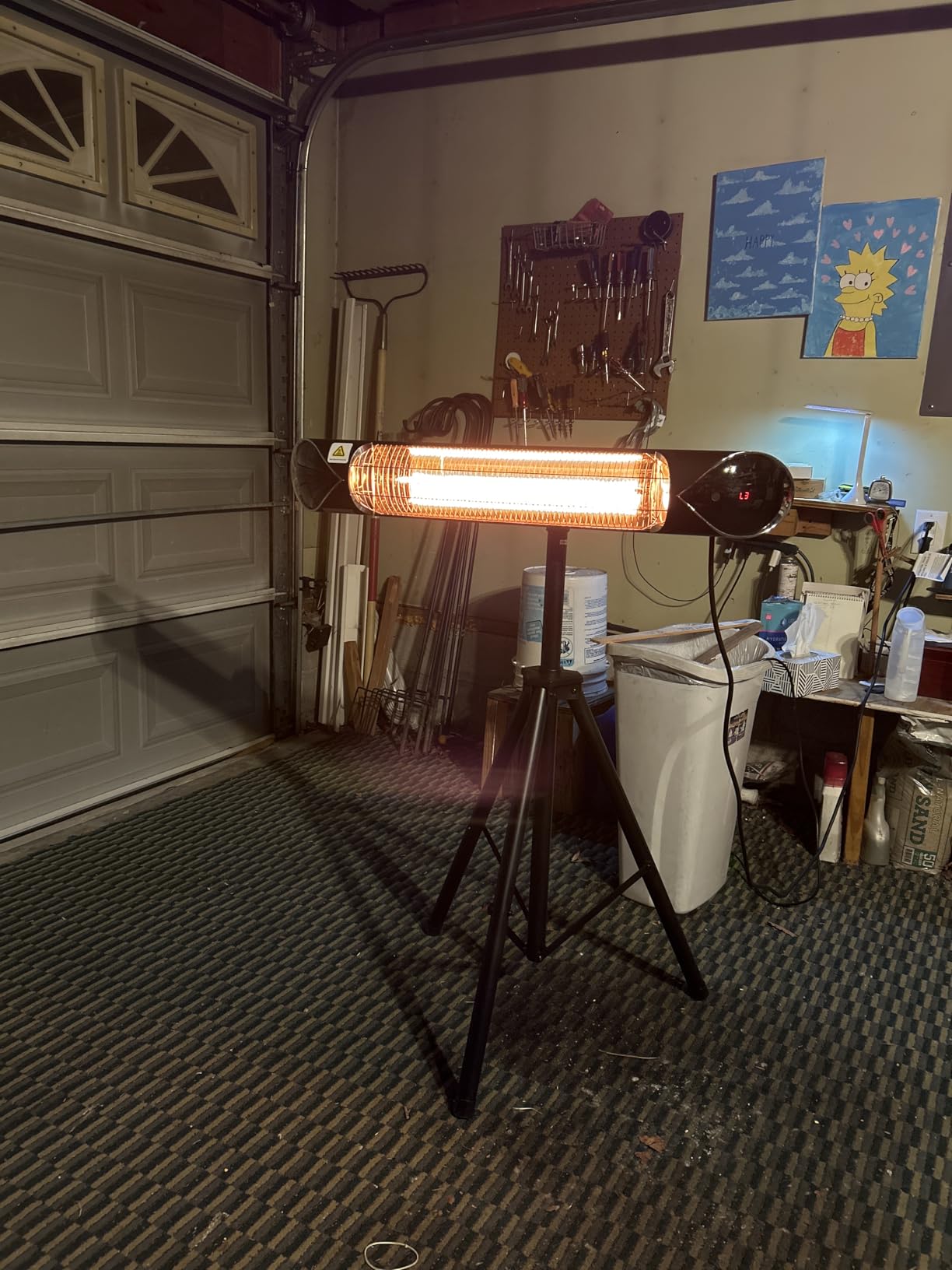
Owners use it in genuinely rough conditions, including shipping-container work spaces and through snow, and the IP55 rating is doing real work there rather than sitting on a spec sheet as decoration. The 84-inch cord gives you room to place it away from a trailer outlet.
The standing complaint is the one every radiant heater attracts: it warms you, not the room. People expecting to raise garage air temperature report being disappointed. The tripod is also tall, at six feet when extended, so seated aiming is awkward, and once the stand is bolted together the whole assembly is heavier than the bare heater suggests.
Best for a garage you use in more than one place
If your garage heat doubles as patio or deck heat, the value calculation here is straightforward. One heater, three mounting methods, no need to buy a second unit for the outdoor side of the house. The timer also means you can warm a space before you walk out to it rather than sitting through the cold first few minutes.
What the 800 to 1000 sq ft figure actually means
The listing states coverage of 800 to 1000 square feet indoors and about 100 square feet outdoors, and those two numbers are describing different things rather than a discrepancy. Indoors, the useful area is the warm zone around the cone. Outdoors, wind strips away the little warmed air the unit produces, so only the immediate radius counts.
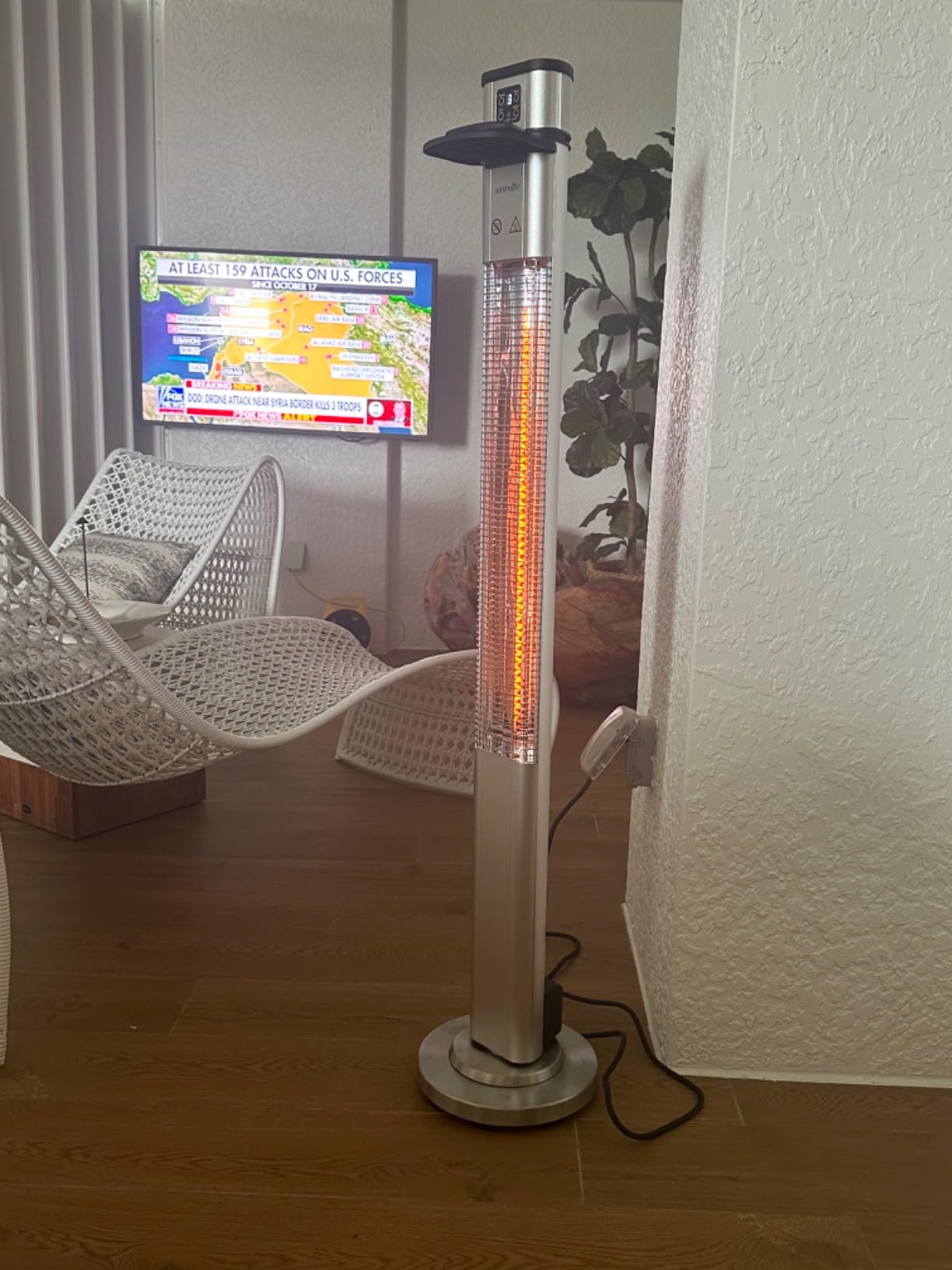
3. SereneLife 57 Inch Tower – Best for a Large Freestanding Footprint
SereneLife Infrared Patio Heater, 1500W Electric Standing with Remote Control, IP44 Approved, Odorless, Three Power Settings, Indoor/Outdoor for Restaurant, Backyard, Garage, Decks
1500W on 120V
57 inch tower with 25 sq ft range
IP24 rating and ETL certified
Tip-over, overheat and mesh guard
Pros
- Tall tower covers a noticeably wider seating area than a wall unit
- ETL certified with 88 percent efficiency carbon fiber elements
- Aluminium alloy frame and stainless base cover resist corrosion
- Tip-over switch
- overheat protection and mesh guard as standard
Cons
- 25 sq ft rated coverage is small for a garage
- IP24 is the weakest weather rating among these heaters
- 21.6 pounds makes repositioning a chore
This is the freestanding option that makes the most sense when you want a heat source in the middle of a bay rather than fixed to a wall, and the 57-inch height is doing useful work there. The radiant band throws further because the element sits high, covering a seating or working area without you standing directly over the base.
The build is the more convincing part. An aluminium alloy frame, a stainless steel base cover and a mesh guard across the front, with a 360-degree tip-over switch and overheat protection all included. It is ETL certified and the carbon fiber element is rated at 88 percent efficiency, which is a certification mark worth more than a marketing line in this category.
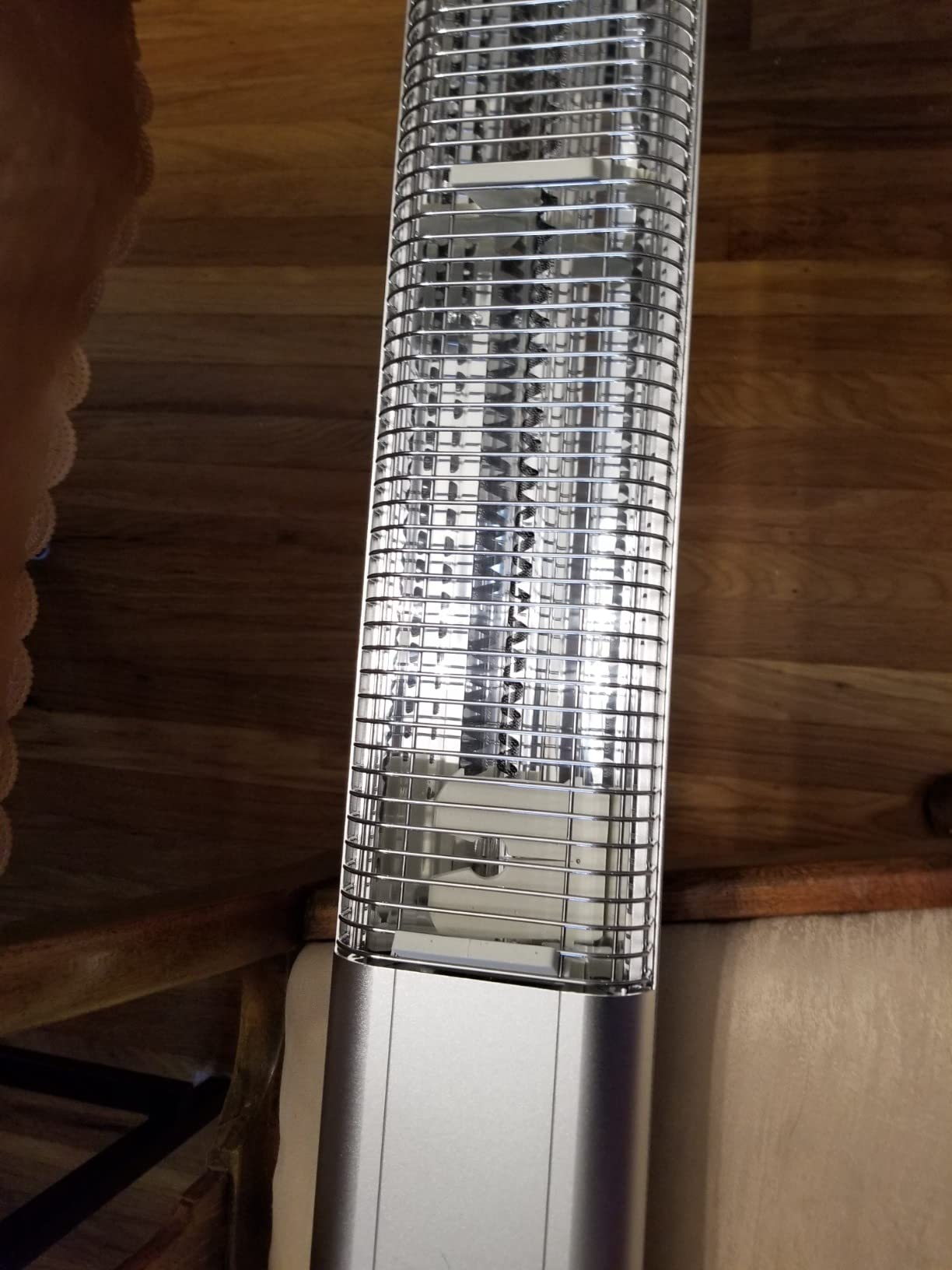
Owners like the fast odorless warmth and the three power settings with remote. It is noticeably quieter than anything with a fan, which matters if the garage is also your workspace or a converted studio.
Two things hold it back. The 25 square foot rated coverage is honest but small, so you are warming a corner and not a bay. And the IP24 rating is the weakest on this list, which is a meaningful downgrade in a damp garage or anywhere water sits on the floor. At 21.6 pounds it is also not a heater you drag across the floor every time you rearrange the space.
Choose this if floor space matters more than reach
A wall-mounted unit keeps the floor clear, which in a one-car garage with a workbench and a parts shelving run can be the difference between a usable workspace and a cramped one. The tower gives up that floor space in exchange for standing heat in the middle of the room.
Where the IP24 rating bites
IP24 means protected against solid objects over one millimetre and against water splashing from any direction. That is fine under a covered patio roof. In a garage with a bare concrete floor, a hose-down habit, or a roof leak, an IP55 or IP65 chassis is the one you want, and only two of these ten reach that level.
4. Encyclpo 36 Inch Tower – The Budget Pick
Encyclpo Patio Heater for Outdoor Use,1500W Infrared, 36 in Portable Tower Heater, 3 Levels, IPX5 Waterproof, Tip-Over&Overheat Protection for Garage, Indoor, Large Room, Backyard, Home
1500W on 120V
IPX5 waterproof carbon fiber element
Only 7.5 pounds
600W, 900W and 1500W levels
Pros
- One of the lightest heaters here at 7.5 pounds so you can carry it between work areas
- IPX5 waterproofing on a slim frame
- Completely silent with no fan noise or wind noise
- Tip-over and overheat protection both trigger reliably
Cons
- Tip-over sensor is so sensitive that a light touch shuts the unit off
- No remote so controls are on the unit
- Short cord and the manual advises against extension cords
The Encyclpo is the one I keep in the back of the garage for jobs that are not at the bench. At 7.5 pounds it is light enough to carry one-handed to a car on the driveway, a drain at the back of the lot, or the far corner of an uninsulated shed, and it heats up within about a second of switching on.
Two high-efficiency carbon fiber heating wires do the work, with three levels at 600W, 900W and 1500W and a stated operating range from 40 to 140 degrees Fahrenheit. There is no fan, so there is no fan noise, no wind noise and no odor. If your garage doubles as a recording space or a quiet office, that silence is worth real money.
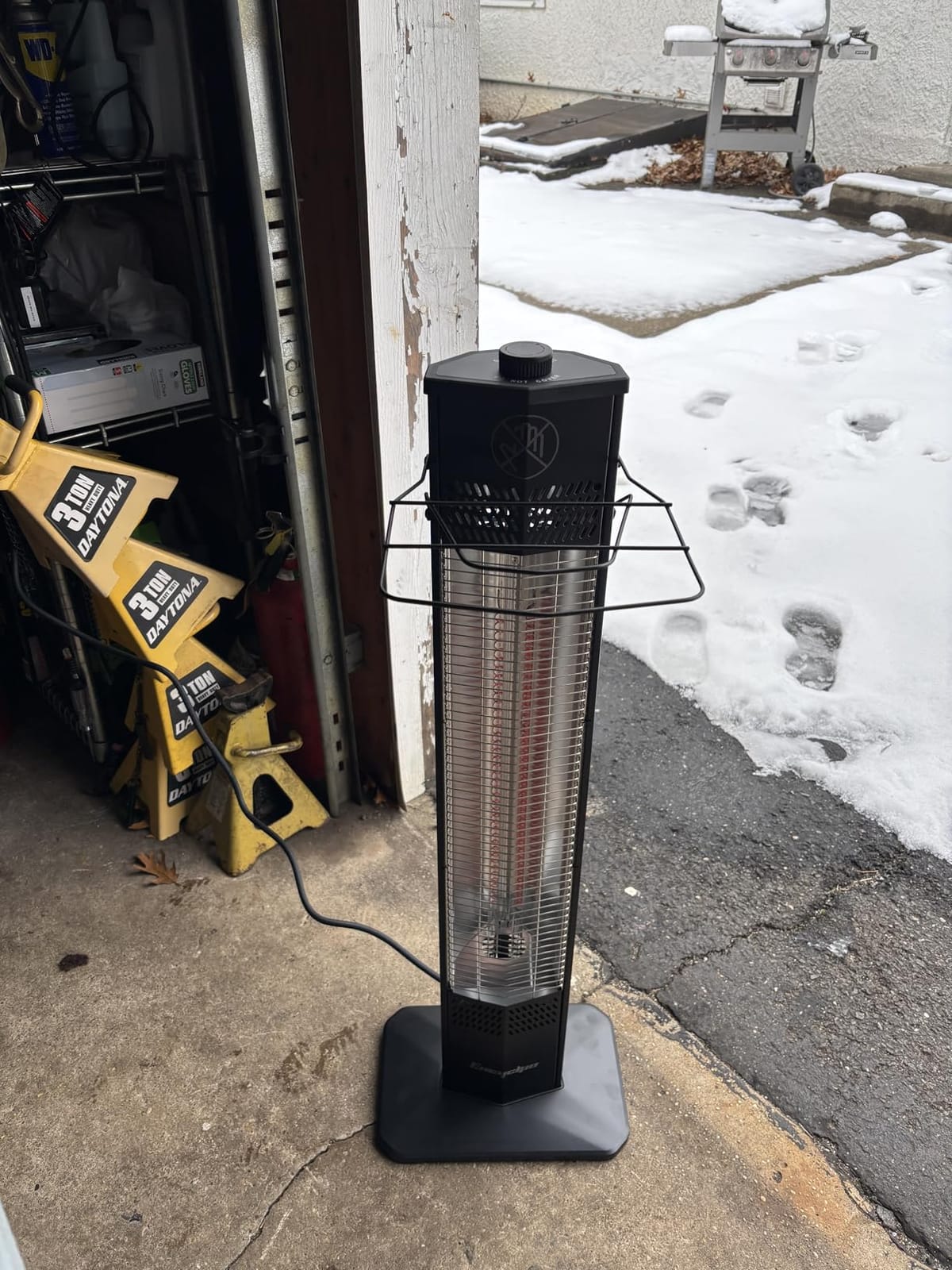
It is also the most honest value in the group. IPX5 waterproofing, dual safety cutoffs and a slim 36-inch body with a stable base, all in a package that undercuts the branded units without giving up the safety features that actually matter in a garage.
Plan around two things. The tip-over sensor is extremely sensitive, and a brush with a broom or the edge of a workbench is enough to stop it, which is irritating rather than dangerous. And the controls are on the unit, with no remote and a relatively short cord, so it belongs next to an outlet rather than across the bay.
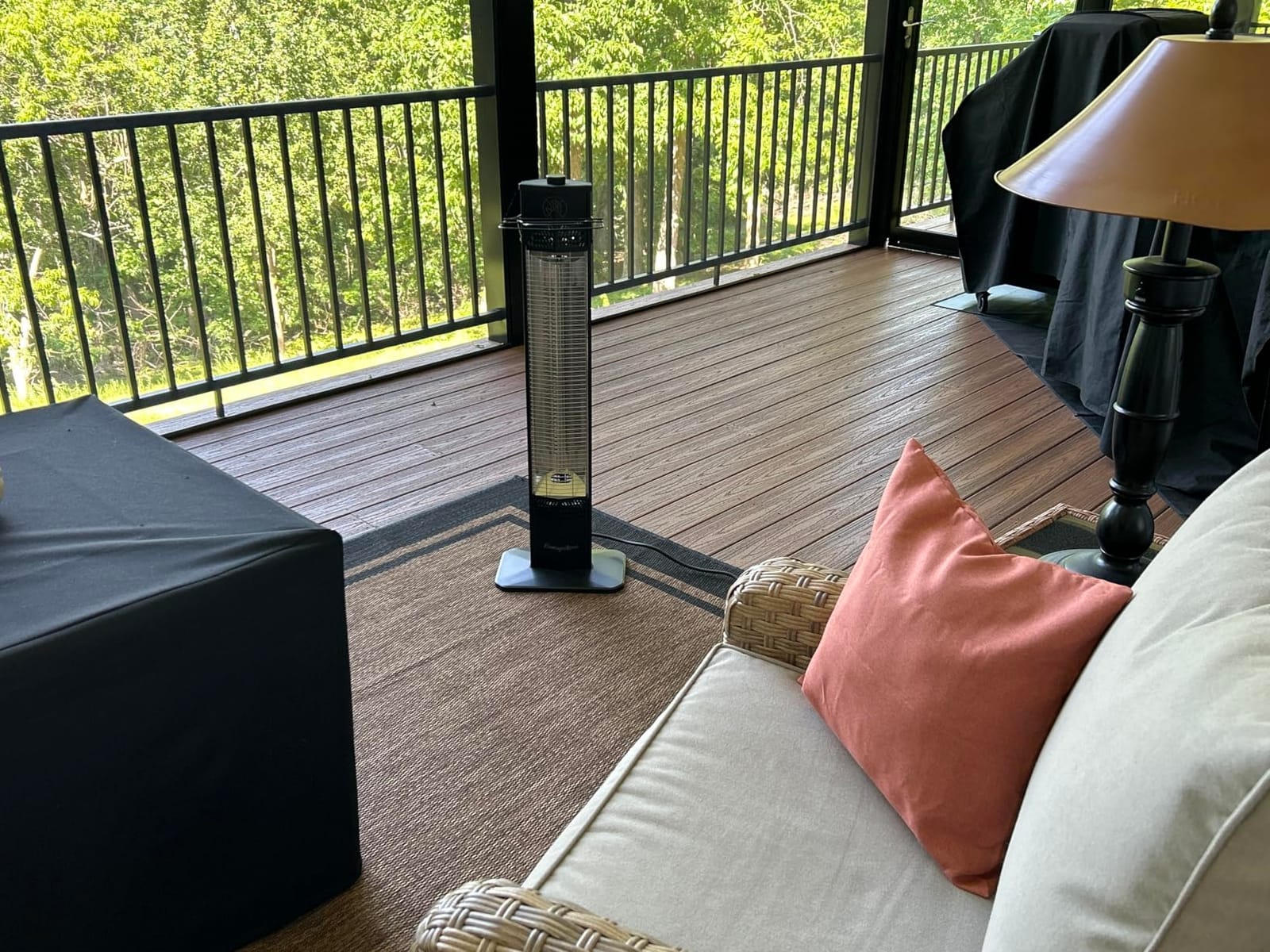
Why you might run two instead of one
Every radiant heater on this list has a narrow cone, and the cheapest way to widen a warm zone is to add a second smaller unit rather than one expensive one. At 600W and 7.5 pounds, a pair of these covers two work spots in a two-car bay for a fraction of the cost of a single high-output fixed unit.
Check the cord length before you plan your layout
The manual advises against extension cords, and on a 120V resistive heater that advice is worth following because cord length adds resistance and a thin extension lead becomes a heat source of its own. Outlet placement decides the layout here, not the other way around.
5. Paraheeter 1500W – Best for Three-in-One Mounting and Certification
Paraheeter Outdoor Electric Infrared Patio Heater, 1500W
1500W on 120V
IP65 weatherproof carbon fiber
CSA certified with safety grille
10 to 15 foot reach radius
Pros
- IP65 rating backed by a carbon fiber tube rated for 10000 hours of element life
- CSA certified with a grounded three-prong plug and metal safety grille
- Wall
- ceiling or tripod mounting all included
- No fumes
- no noise and no odor
Cons
- Foam shipping pad must be removed from the tube before first use
- Useful reach is only about 10 to 15 feet
- 18.8 pounds is heavy for the output
- Single heat level only
Two things set this one apart for garage use. The first is certification: CSA listed, with a metal safety grille and a grounded three-prong plug, which is a stronger safety story than most of the unbranded import units in this price band. The second is the carbon fiber tube, rated by the manufacturer for a 10,000 hour lifespan.
It also arrives ready for whichever mounting style you have room for, with wall hardware, ceiling hardware and an adjustable tripod stand in the box. A picture-based manual and an install video mean the first-time setup is close to self-explanatory.
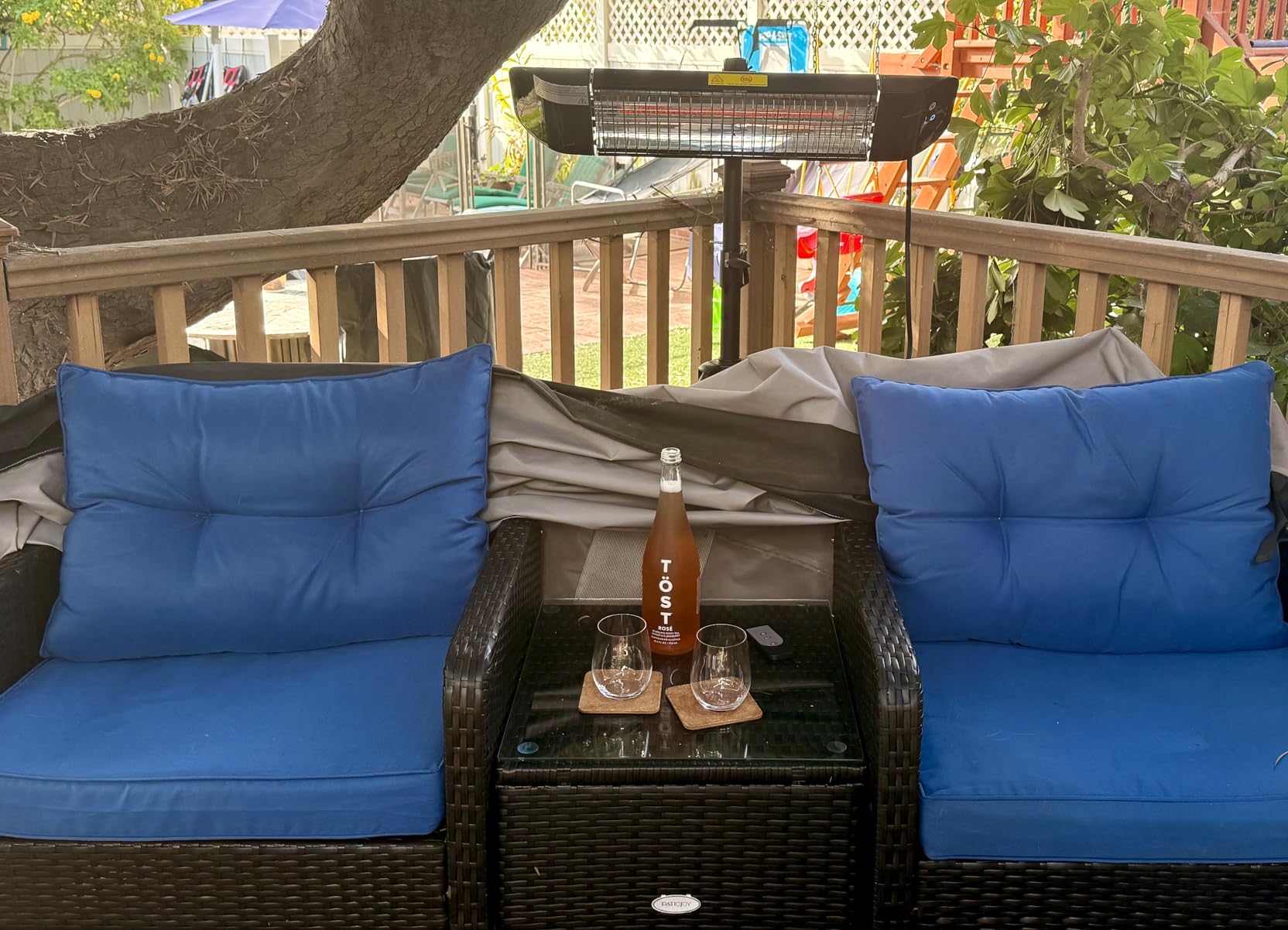
Owners frequently highlight the running cost against a propane comparison, with the manufacturer putting operating cost at roughly a tenth of a propane heater. That comparison holds for a zone heater, because a propane unit burns fuel continuously to move air while a radiant unit only heats what is in front of it.
There is one setup step that matters more than anything else here: pull the foam protective pad off the heating tube before you power it on. Owners who skip it report the unit running hot. Also expect a single heat level with remote rather than the three-step adjustment most competitors offer, and a stated 10 to 15 foot reach radius, which means standing closer than you might expect.
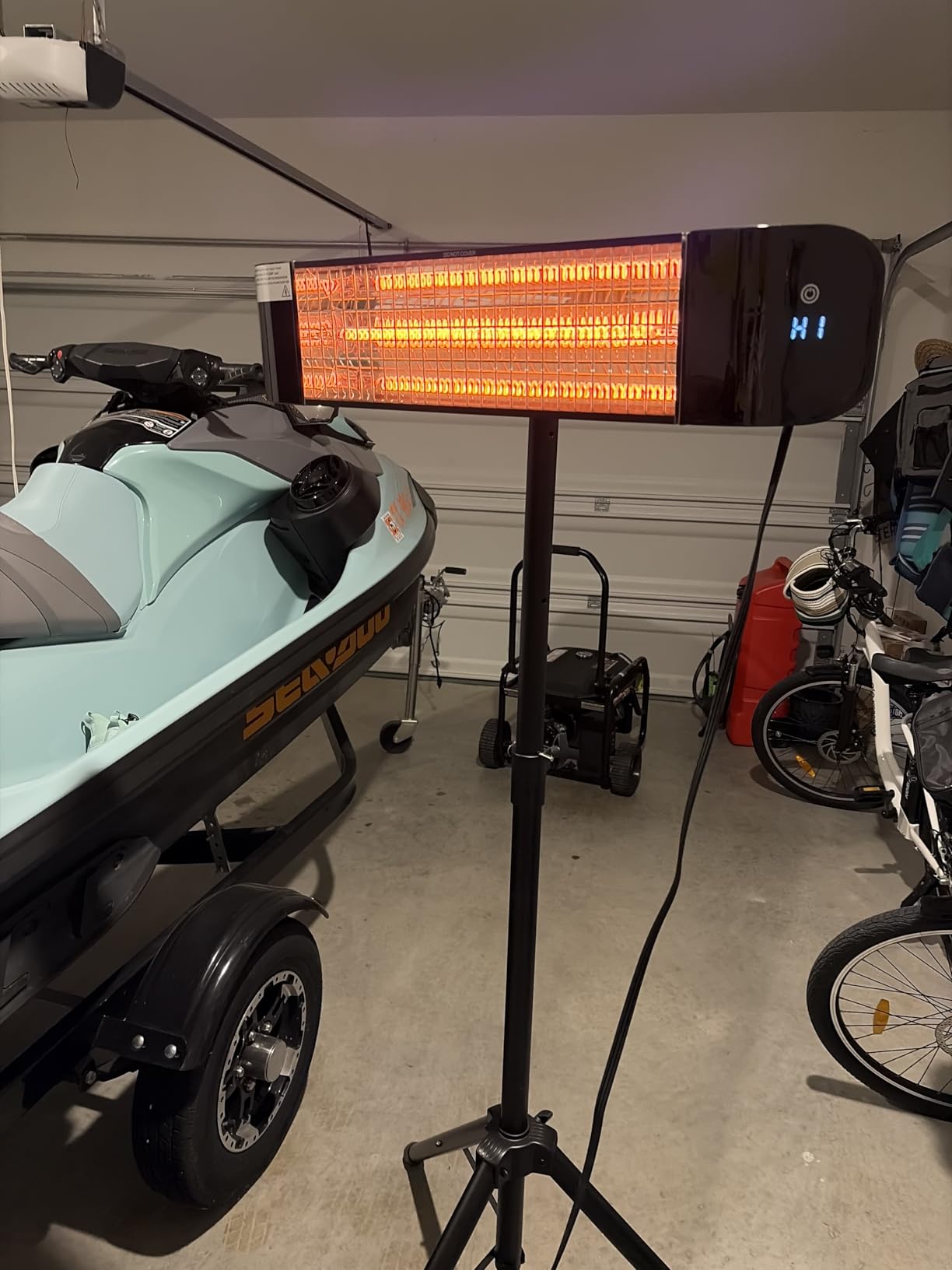
What CSA listing actually means here
A third-party listing from a recognized standards body means the unit has been evaluated for electrical safety rather than self-declared by the seller. In a garage full of sawdust, cardboard, fuel cans and a vehicle, that independent check is worth more to me than any smart feature.
Best as a seasonal spot heater
With no wattage adjustment, you run it or you do not. That is fine for a fixed spot like a bench you winterize a car at, and awkward if you want a low-output setting for a mild afternoon. The tripod lets you move the spot as the season and the job change.
6. SereneLife Wall-Mounted 1500W – Best for a Light, Wall-Mounted Setup
SereneLife Infrared Patio Heater, Wall-Mounted Electric Heater with Remote Control, 1500W, IP65 Approved, Odorless, Indoor/Outdoor for Patio, Restaurant, Backyard, Garage, Decks
1500W on 120V
IP65 with aluminium alloy frame
Only 5.7 pounds
18 sq ft heating range
Pros
- Strongest weather sealing in the roundup at IP65 with an aluminium alloy frame
- Lightest heater here at 5.7 pounds so it is easy to reposition
- Wall mounting frees the bench and the floor
- Mesh guard blocks contact with the element
Cons
- Single heat setting with no wattage adjustment
- Only 18 sq ft of rated coverage
- Needs drilling and mounting hardware so it is not a freestanding option
This is the wall unit I recommend when the floor space in the garage is more valuable than the flexibility of a stand. It mounts on a stud or a suitable anchor, throws a band of radiant heat across the bench area, and leaves the whole floor clear for lifting, jack stands and rolling a car in and out.
At 5.7 pounds it is the lightest heater in this group by a wide margin, so taking it down to move to a different wall or carry it to a work area outdoors is a one-handed job. The build is an aluminium alloy frame at an IP65 weather rating, with a mesh guard over the element and an LED indicator on the unit.

It is ETL certified and the carbon fiber element is rated at 88 percent efficiency. The rating distribution here is the healthiest shape in the roundup, with 19 percent four-star reviews, which usually signals solid rather than exceptional satisfaction. Buyers consistently mention the IP65 build and the remote.
What you give up is control and reach. There is a single heat setting, so it is on full or off, no in between. Rated coverage is 18 square feet, the smallest figure here, and it is a wall product, so it needs a drill and hardware before it does anything. For a one-car garage with a single bench zone, that trade still makes sense.
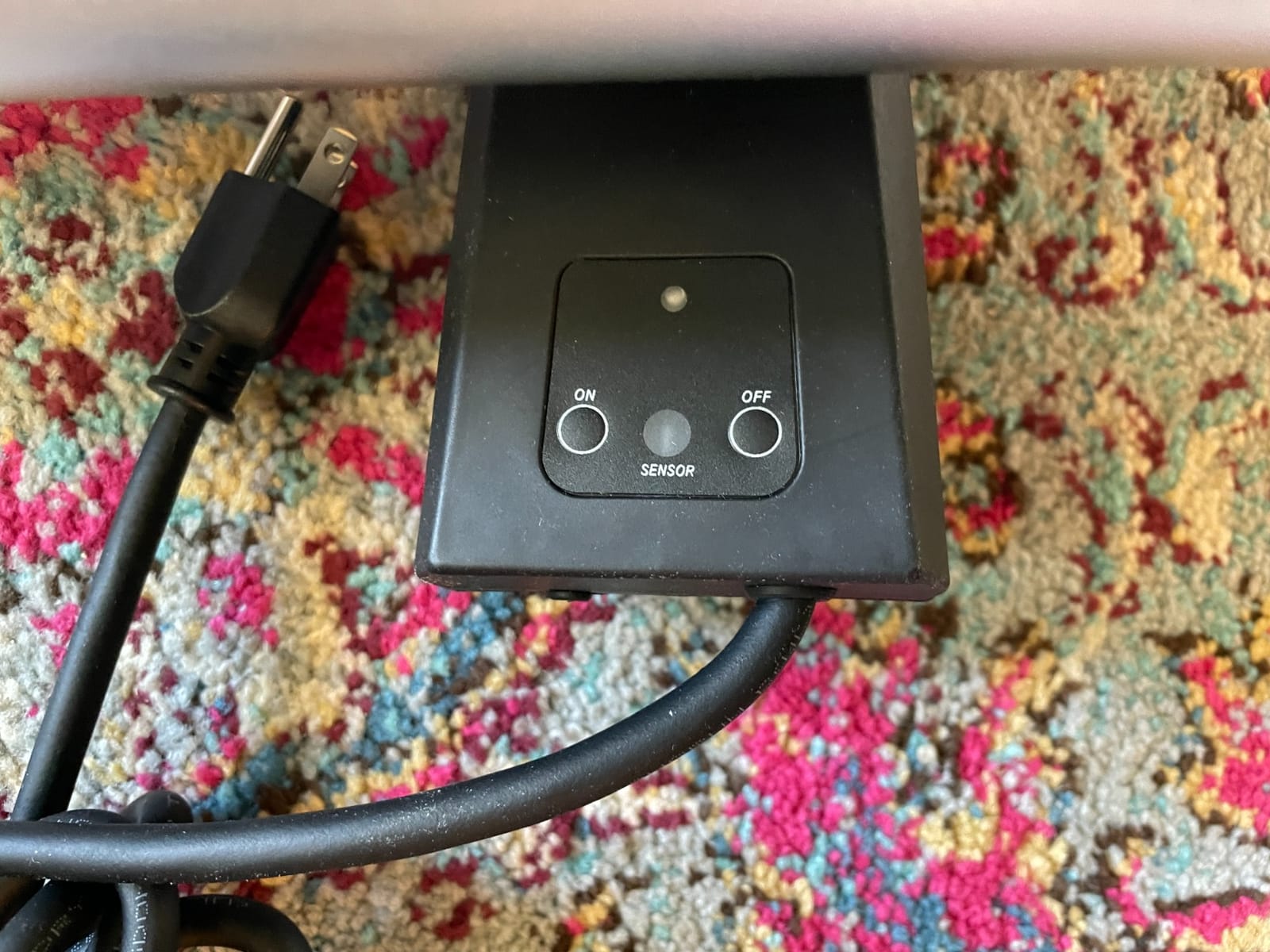
Find the framing before you drill
Locate a stud or a proper anchor and mount into solid material. The listed size is roughly 25 inches deep by 8.5 inches wide, so a bay that is narrower than about 30 inches will not take it without fouling the adjacent stud bay.
Why the IP65 rating matters in a garage
A garage is the wettest room most people own. Water tracked in on shoes, condensation off a cold car, damp concrete in spring. IP65 means dust-tight and protected against water jets from any direction, so the heater is not the thing you worry about on the list of things that can go wrong in there.
7. VAGKRI 1500W with 12-Hour Timer – Best for RV, Camping and Rolling Setups
VAGKRI Outdoor Heaters, Electric Infrared Patio Heater with Remote and 12H Timer, IP65 Waterproof, 3 Heat Levels, Wall Mount or Tripod Stand for Home, Office, Patio, Garage
1500W on 120V
IP65 waterproof
Wall mount or tripod stand
33 to 77 inch adjustable height
Pros
- Dual wall and tripod mounting makes it easy to move between the garage and a covered outdoor area
- Adjustable height from 33 to 77 inches lets you aim the heat where you work
- Twelve-hour programmable timer with remote
- IP65 build handles a wet RV bay or an exposed garage doorway
Cons
- Heating element is not user-replaceable if it cracks
- Effective reach is only about 3 feet
- Short heavy-gauge cord needs a nearby outlet
- Remote arrives without batteries
This is the one that earns its place if your garage is a base camp rather than a workshop. The height adjustment from 33 to 77 inches is unusually wide, and it is the feature that actually changes how you use it, because you can drop the cone to chest height for a seated position and raise it to overhead level for a standing one.
It runs silent at 1500W, heats in about a second, and offers three levels at 700W, 1000W and 1500W with a 12-hour programmable timer on the remote. The tripod has a wide, heavy base that resists tipping on uneven ground, which is the detail that matters if you are using it outdoors on grass or gravel.
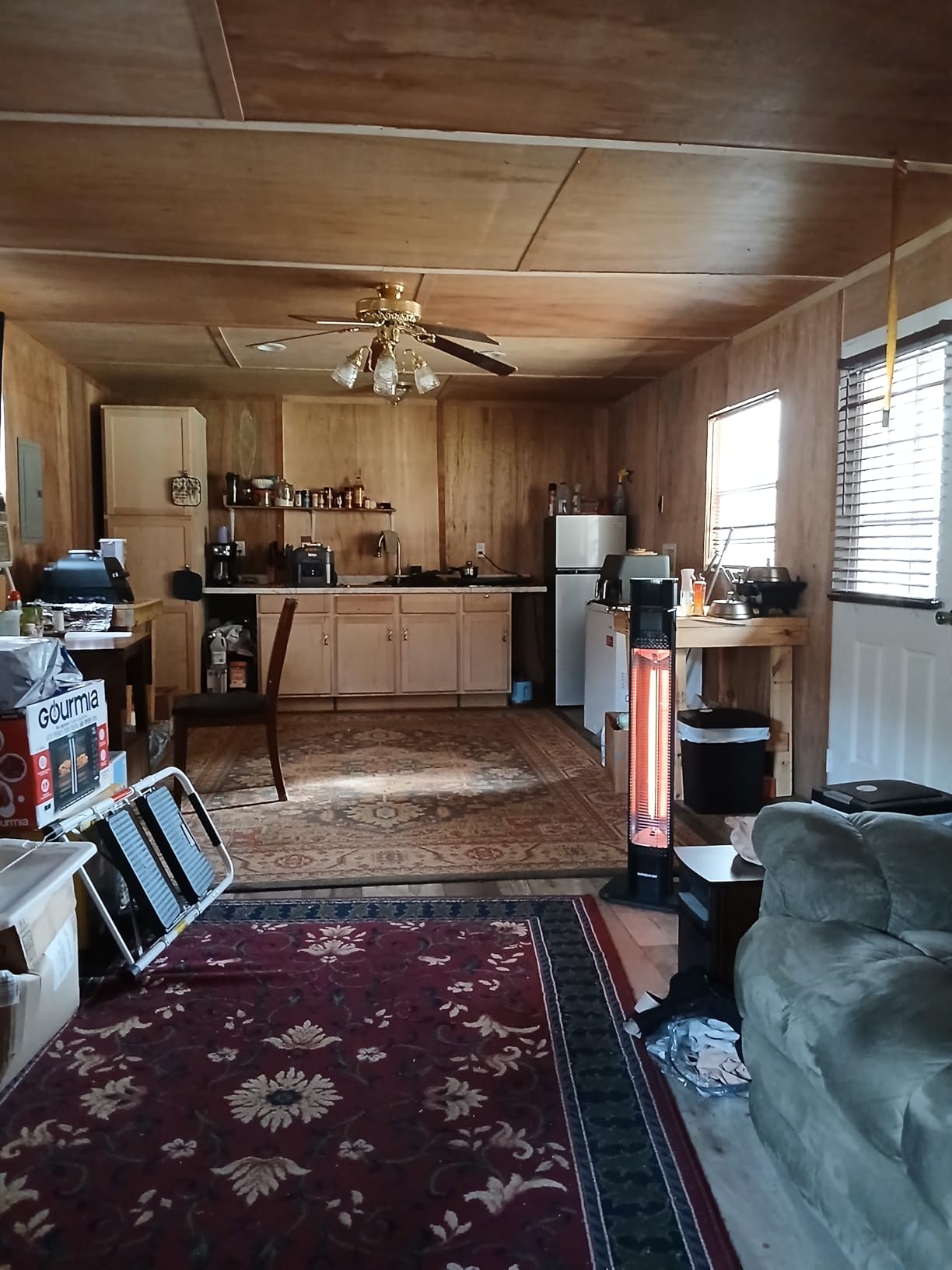
Owners in the reviews are using it at workbenches, in RV and camping setups, at open garage doors and on patios, and the praise is consistent: instant, silent, close-range warmth with no odor or fumes.
The negatives are structural rather than quality. The heating element is not user-replaceable, so a crack from a knock or a tip-over ends the unit rather than the run. The reach is roughly three feet, so you plan your position around a person rather than a zone, and a single unit often is not enough to cover a wide working area.
Also budget for a pack of remote batteries, because the remote arrives empty and the review mentions units being unable to power on until batteries are fitted. The cord is short and heavy-gauge, so the outlet location dictates where the heater can go.
Best for a mobile work zone
Between the tripod, the wall bracket and the 33-to-77-inch range, this is the easiest of the ten to re-aim. Working low under a car, sitting at a bench, standing at a parts counter: you change the height rather than the position. That is a real advantage in a working garage.
Keep the element out of harm’s way
Because the element cannot be replaced, treat the stand as a fixed position rather than something you nudge around a busy floor. Set it where a car door, a bike or a broom handle will not swing into it, and check the clearance before you start the season.
8. Sundate 1500W WiFi – Best for Smart Control and Scheduled Warm-Up
Sundate 1500W Infrared Patio Heater, WiFi App, 9 Heat Levels, 24H Timer
1500W on 120V
WiFi app plus remote and touch panel
Nine heat levels and 24 hour timer
Wall, hanging or ceiling mount
Pros
- Only heater here with WiFi app control alongside remote and touch panel operation
- Nine heat levels give finer control than the three-level models
- Detaches from the bracket for seasonal storage
- Includes an outdoor protective cover
- Mounts vertically
- horizontally or fully face down
Cons
- Physical unit is much smaller than the listing photos suggest
- Included wall bracket is flimsy and hard to angle
- Not enough heat for a large garage
- No on-unit manual switch and the remote is unreliable up close
The Sundate is the only unit in this group you can start from your phone. A Tuya-based app, an infrared remote and a touch panel, nine heat levels, and a 24-hour timer. If you want the garage at 70 degrees before you walk out to it, that scheduling is the reason to buy this one over a similar model without an app.
It is also the only one that includes a protective outdoor cover, which matters more than it sounds for a wall-mounted unit you will have to take down in spring. The heater body detaches from the wall bracket for storage while the bracket stays put, and it can be mounted vertically, horizontally, or hung face down without triggering the auto-shutoff.
Owners like the control granularity, the mounting flexibility, the dim amber glow instead of a harsh light and the fact that it is compact and light. Some use it in gazebos, hobby rooms and for keeping pets warm through a cold snap.
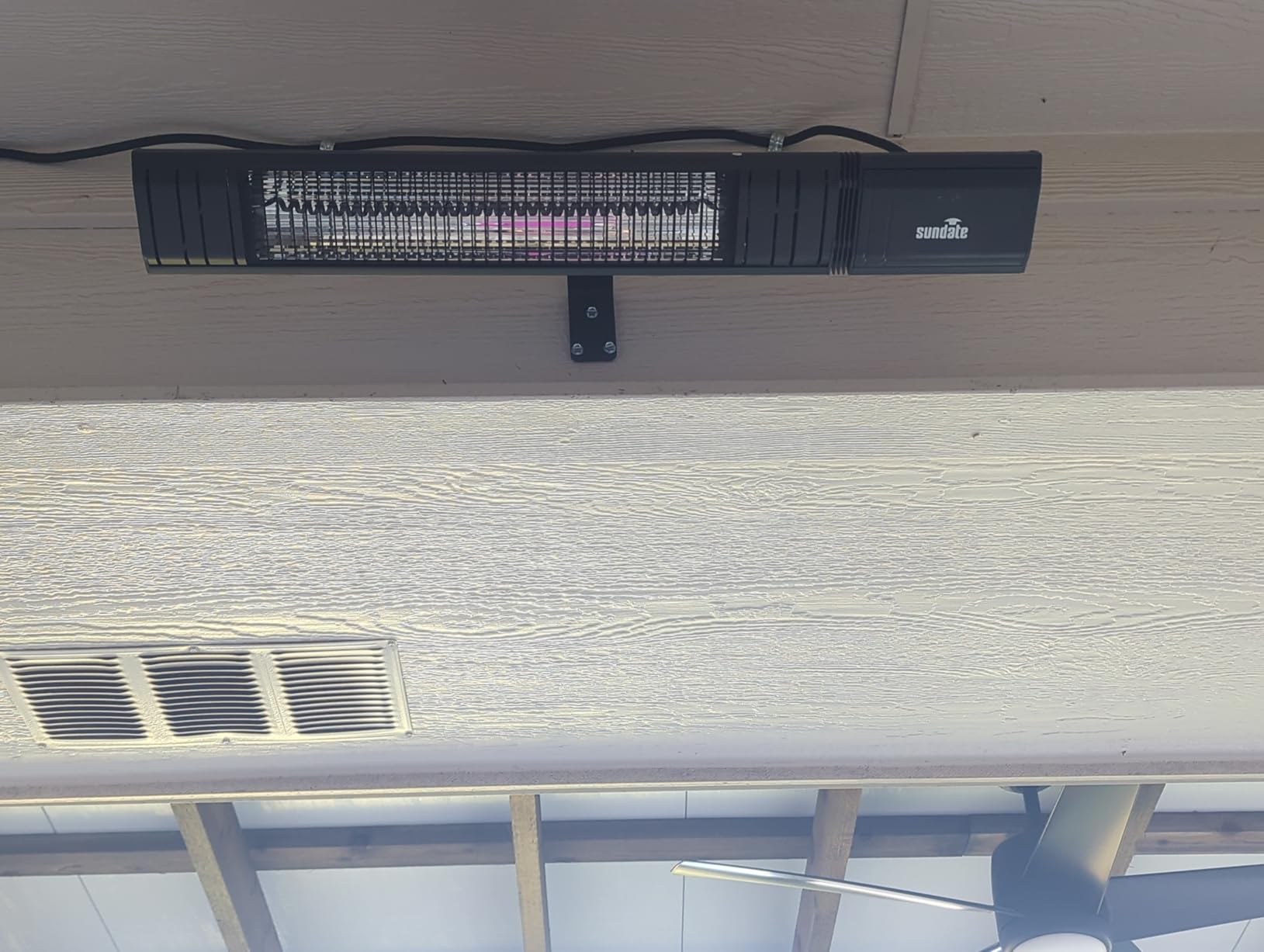
It is also the lowest-rated unit in the roundup, and the reason shows in the 14 percent three-star share. Owners frequently find it physically smaller than the listing photos suggest, which matters a great deal when you are trying to aim a cone of heat at a workbench. The bracket is described as flimsy and awkward to adjust, and the heat is modest for anything larger than a small covered space.
Two smaller annoyances add up: there is no on-unit manual switch, so if the remote misbehaves at close range you are relying entirely on the app, and the WiFi indicator blinks constantly when the app is not connected with no way to disable it. The ceiling hooks supplied are for the chains only, not for attaching to structure.
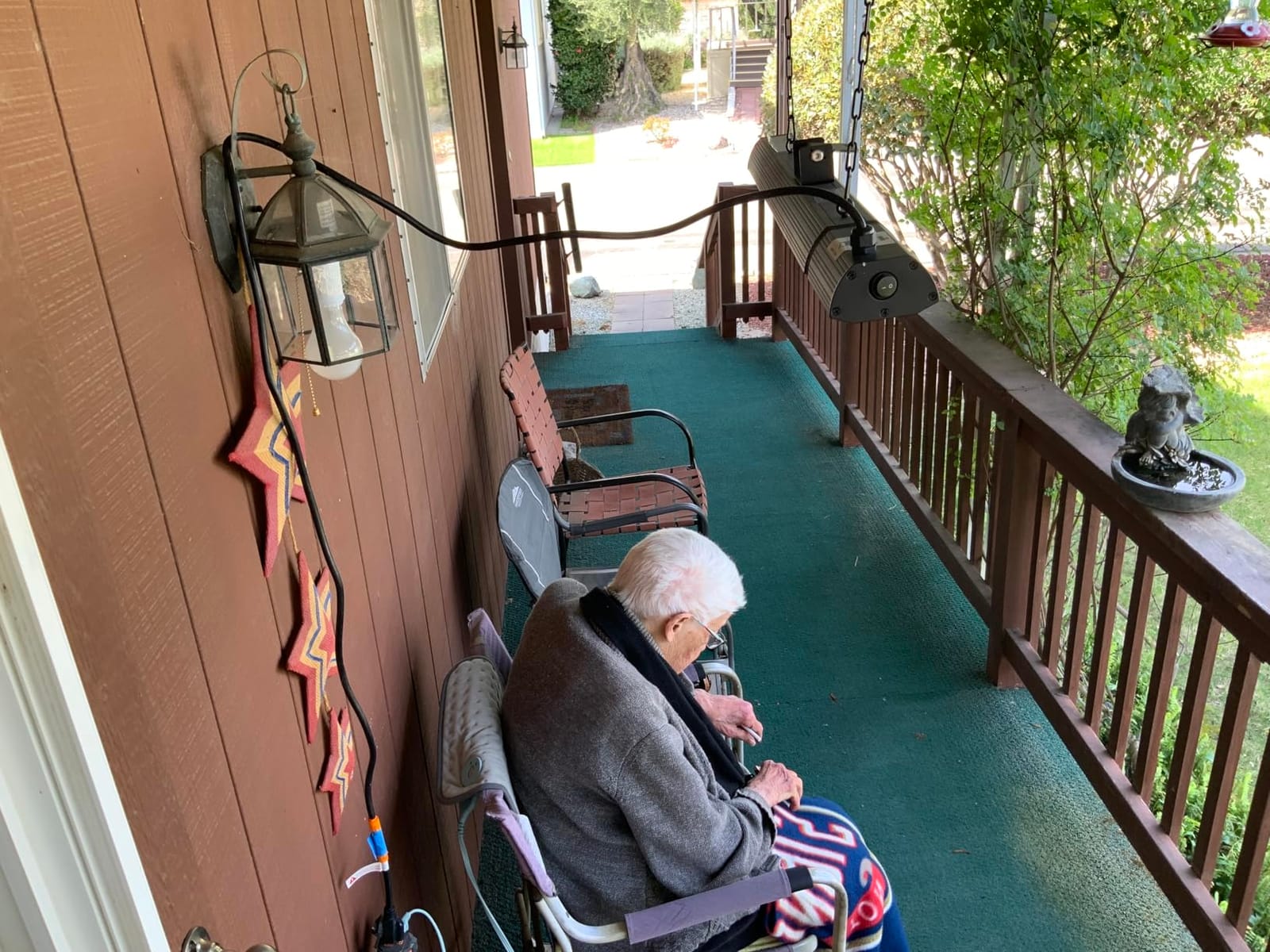
Best for scheduled, unattended warm-up
The 24-hour timer plus app control is the whole argument here. Run it on a schedule in the morning so the bench area is warm when you arrive, and switch it off remotely if you are working late elsewhere. Radiant heat from a scheduled start costs far less than heating a bay you are not in.
Measure before you trust the photos
The unit is about 27 inches deep by 5.5 inches wide and 3.9 inches tall. That is a small box. If you are covering a wide bench or a two-car bay, check that size against the area you want warm, and expect to position yourself close to it.
9. VAGKRI 42 Inch Tower – Best Rated, with the Widest Heat Spread
VAGKRI 42″ 1500W Electric Outdoor Infrared Heater with Remote, 9 Heat Levels, 24H Timer, 1S Fast Heating, IPX5 Waterproof Tower Space Heater for Home, Office, Patio, Garage
1500W on 120V
100-degree wide-angle radiant spread
Nine settings from 620W to 1500W
ETL listed with child lock
Pros
- Highest average rating in this group with 75 percent five-star reviews
- Nine power settings from 620W to 1500W give the widest adjustment available
- 100-degree radiant spread covers more of a bay than narrow-beam towers
- ETL listed with child lock
- tip-over protection and a digital display
Cons
- Smallest review base here at 106 ratings so long-term durability is less proven
- Still a 1500W unit so a large open bay needs more than one
- 5.7 inch footprint is easy to knock in a busy workshop
The 100-degree radiant spread is the feature that separates this tower from every other freestanding unit here. Most of them throw a narrow band, and you have to stand in the right place. This one throws a genuinely wide arc, which in a two-car bay means a bench, a parts counter and the floor between them are all inside the heated zone at once.
Power adjustment is the other standout. Nine settings from 620W to 1500W, with a digital display, remote control and a 24-hour timer, plus a child lock and tip-over protection. It is ETL listed, built in weatherproof aluminium and rated IPX5, so it works indoors and out with no fumes, odors or chemicals.
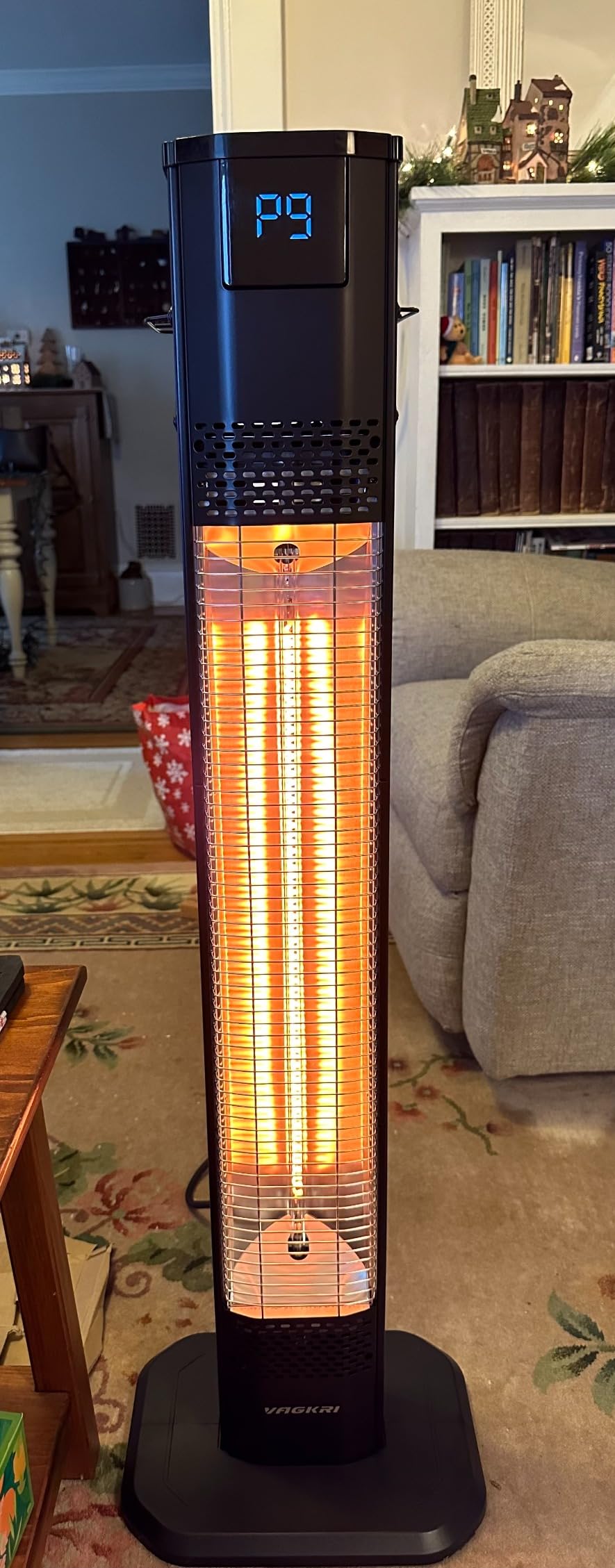
That feature set is unusual at this level of the price ladder, and it explains the rating. Owners point to one-second heating, the nine-level control, the wide-angle coverage and the safety package, and 75 percent of the reviews are five stars.
The honest caveat is the sample size. With 106 ratings this is the smallest review base in the roundup, and a thin review base tells you less about what happens in year three than a large one does. A 4.5 average on 106 ratings is a good sign, not a guarantee. Practically, a 1500W unit is still a 1500W unit, so a large open garage will need more than one.
Best for a garage with more than one work spot
When a single zone is not enough, the spread angle matters more than the wattage. This unit reaches across a wider piece of floor at lower settings, which is how you cover two working positions without buying two heaters. Start it at 620W and raise it as needed.
Watch the narrow footprint
At roughly 5.7 inches deep and 3.5 inches wide with an 8-pound weight, it is stable but not difficult to knock. In a busy workshop with a car door swinging or a bike being rolled past, set it against a wall or a stand rather than in the traffic lane.
10. SereneLife 1500W with Adjustable Stand – Best for Aiming at a Seated Position
SereneLife Infrared Patio Heater 1500W Electric Heater Indoor/Outdoor Use, Portable Stand with Remote Control, IP65 Approved, 360° Tip-Over Safety Switch for Restaurant, Patio, Backyard, Garage, Decks
1500W on 120V
Height adjustable stand
IP65 waterproof and dustproof
20 sq ft range
Pros
- Height-adjustable stand aims radiant heat at a seated position or a standing bench
- IP65 waterproof and dustproof with an aluminium frame and stainless base cover
- 360-degree tip-over switch
- overheat protection and a mesh grille
- Silent carbon fiber element with no gas to refill
Cons
- Cord runs up the pole leaving only a few feet at the base
- Unit sometimes cycles off and the standby LED stays lit
- 23.4 pound base with a stem that bends at the joint
- Effective reach is only about 4 feet
The height-adjustable stand is what makes this worth looking at rather than the 1500W figure, which nearly every heater in this roundup shares. Raising and lowering the element changes the geometry of the cone, and that is the only lever you have for making radiant heat land on a person rather than on the far wall.
The rest of the spec sheet is solid. IP65 waterproof and dustproof, an aluminium alloy frame and a stainless steel base cover, a 360-degree tip-over switch, overheat protection and a mesh grille, with a remote and an LED indicator. Owners use it in garages, man caves, screened porches and covered decks.
The carbon fiber element is silent and odorless with no tank to refill, and owners who already understand radiant heating are enthusiastic about the way it warms a person without blasting hot air across the room. Assembly directions are clear and the packaging is sturdy.
The engineering complaints are worth reading before you buy. Most of the cord length runs up the support pole, so only a couple of feet are usable at the base. The standby LED stays lit and owners report random shutdown cycling. The 23.4 pound base is paired with a stem that bends at the joint when moved. There are also a few serious quality and safety reports in the reviews, which is why this sits at the bottom of our ranking despite reasonable ratings.
Best for a seated work position
When you are sitting still for long stretches, lowering the head of the stand to seated eye level puts the cone exactly where you are. That is a real use case, and one of the few places where radiant heat clearly beats a fan-forced unit, because you are not fighting to warm a volume of air to get comfortable.
Know the limits of the four-foot reach
With about four feet of effective reach, this warms a chair, a desk or a small work area and nothing beyond it. If your garage is the size of a two-car bay, plan to sit or stand inside that bubble rather than expecting movement between the car and the bench.
How to Choose an Infrared Garage Heater
Start with the electrical service, because it eliminates half the market before you fall in love with a unit. Every heater in this roundup is a 120V plug-in appliance drawing 12.5 amps at full power. That is a standard household circuit, and you can run any of them from an existing garage receptacle. Nothing here needs a 240V circuit, an electrician or a sub-panel, which is a genuine change from the garage-heater market of a decade ago.
What you do need is a 20-ampere circuit. On a 15-ampere circuit, 12.5 amps leaves almost nothing for anything else, and a compressor or a welder on the same run will trip the breaker. If your garage has one 15-ampere receptacle and nothing else, have a 20-ampere circuit run before you buy, or plan your heater use around what is already on that run.
Match the mount to the ceiling height
For a bay with eight-foot ceilings, wall mounting at roughly bench-to-shoulder height is the efficient choice, because the cone travels horizontally into your torso. Ceiling mounting pushes the cone down and out, which wastes energy in a tall empty space unless the heater is over a surface you are working on. A tripod is the answer when you are not yet sure where the warm spot should be, or when the heater serves two bays.
Two-car garages with nine or ten foot ceilings are the hardest case for radiant heat. The further the element is above a standing person, the more of the cone misses them. In those bays, a wall-mounted or adjustable-stand unit placed near head height beats a ceiling unit every time.
Read the IP rating as durability, not decoration
IP24 covers splashing water only, which is fine under a covered patio. IPX5 and IP55 add protection against water jets and dust, and IP65 adds dust-tight sealing. In a garage, that is not a wasted outdoor specification. Garages collect damp concrete, road grit, insect nests and condensation, and a sealed chassis lives longer in that environment than an open-frame indoor unit.
Size the wattage to the spot, not the bay
Roughly 500 watts covers a seated position or a small bench corner. About 1500 watts, which is what every unit here runs, covers a work zone of several feet in front of it. Going above 1500W on a 120V circuit means hardwiring, a NEMA 14-50 outlet and a higher amperage breaker, which is the point at which you need an electrician. For a garage, that step rarely earns its cost on a radiant heater.
Because one unit covers one zone, the way to heat more of a garage is to add units rather than add watts. Two 1500W heaters on separate circuits cover more usable space than one 3000W unit mounted out of reach, because each person gets their own cone.
Do the electricity math before you commit
A 1500W heater consumes 1.5 kilowatt-hours per hour of run time, and a 900W setting consumes 0.9. Run a 1500W heater for four hours a day through a 30-day month and you are at 180 kilowatt-hours. Scale that against your own utility rate, and compare it with the 5000W to 7500W fan-forced garage heater people are often switching from: those draw three to five times as much for every hour you run them, and they take far longer to make the space comfortable.
Electric radiant heating also has no combustion, no fuel storage, no exhaust venting and no carbon monoxide production. That removes the cost of a propane refill and the installation of a vent, which is a hidden expense in any fuel-based comparison.
Check the certification
Look for ETL, UL or CSA listing. The Paraheeter is CSA certified, the VAGKRI tower and two SereneLife models are ETL listed, and several of the budget units are not independently certified at all. In a space with cardboard, sawdust, fuel cans and a vehicle, an independent safety listing is worth more than a smart app.
If you are also upgrading other parts of the space, our infrared heating pad guide covers recovery and desk-warming setups, and the portable infrared sauna roundup is the other end of the heat spectrum.
Garage Safety Rules for Radiant Heaters
Electric radiant heaters have a major safety advantage over propane and natural gas units: no flame, no exhaust and no carbon monoxide. That does not make them maintenance-free. The heater front, guard and element get hot enough to ignite paper and melt insulation, so clearance is the rule that matters.
Keep the unit away from cardboard, rags, paint, solvents, fuel cans and anything else combustible, and clear a working area in front of it where foot traffic will not swing the mount. Wall mounting above a bench gives you clearance naturally, which is one more argument for a fixed unit in a working garage.
Never run a heater unattended, and do not leave it on overnight in a garage with a vehicle, a battery charger or a heat pump running. Many of these units have no tip-over sensor at all, since a wall unit is not expected to tip, so the protection you rely on is your own decision to turn it off.
For an attached garage, keep the door to the living space closed while the heater runs and keep a working carbon monoxide alarm on the same floor as any combustion appliance, including a gas water heater. Electric radiant heaters do not produce carbon monoxide, but the ventless propane and gas units that often get compared against them do, and the alarm protects the whole house.
Finally, respect the ceiling clearance the manufacturer specifies and never mount a unit below the stated distance from the ceiling. If the space is too short for the mounting geometry, a freestanding or tripod unit is the right choice.
Frequently Asked Questions
Are infrared heaters good for garages?
Yes, for a defined work zone. Infrared radiant heaters warm people and surfaces directly instead of heating the whole air volume, so heat arrives in seconds rather than after a long warm-up. In an uninsulated garage with a frequently opened door, that speed is the main advantage. They are electric, so there is no combustion, no exhaust and no carbon monoxide. What they do not do is raise the air temperature across an entire bay, so they suit a workbench, a hobby corner or a garage gym rather than a room.
Can an outdoor patio heater be used in a garage?
Yes. An outdoor-rated infrared patio heater is a legitimate garage heater, and its weather sealing is an advantage indoors rather than a wasted specification. IP55 and IP65 units are protected against dust and water jets, which is what a damp concrete floor, road grit and condensation do to an open-frame indoor unit. Make sure the unit carries a safety certification such as ETL, UL or CSA, and keep the required clearance from anything combustible.
What are the downsides of using infrared heaters in a garage?
The main downside is the line-of-sight limitation. Infrared heat travels in a straight cone, so only people and surfaces within that cone get warm, and the air in the rest of the garage stays cold. High ceilings make this worse because a unit mounted overhead throws its heat past a standing person. Other drawbacks include a narrow warm zone, no whole-room temperature gain, hot surfaces near the element, and the need to stand close to feel any benefit.
Do I need an electrician to install an infrared garage heater?
Not for the 1500W units in this roundup. They are standard 120V plug-in appliances drawing 12.5 amps, so they run from a normal household receptacle. You do need a 20-ampere circuit, and if your garage has only a single 15-ampere receptacle you should have a 20-ampere circuit run before installing. Anything above 1500W on 120V is hardwired and needs a NEMA 14-50 outlet and a larger breaker, which is where an electrician earns their place.
How much electricity does an infrared garage heater use?
A 1500W heater uses 1.5 kilowatt-hours per hour at full output, and its 900W setting uses 0.9. Run at 1500W for four hours a day across a 30-day month and that is 180 kilowatt-hours. Compared with a 5000W to 7500W fan-forced garage heater, which draws three to five times as much per hour, the radiant unit is cheaper per hour but also heats a smaller zone. Run it only in the zone you are working in.
The Best Infrared Patio Heater for Your Garage
The DR. INFRARED HEATER 1500W is our pick for the best infrared patio heaters for garages, and the reason is the least glamorous one: over six thousand ratings, IP55 sealing, mounting hardware for both wall and ceiling in the box, and three power settings that let you dial a 900W bench zone or a 1500W thaw zone from the same outlet. Nothing in this group has a deeper service history.
Choose the Briza if you want one heater for a garage and a covered patio, since it is the only unit here that ships with a tripod and fixed-mount hardware together. Choose the Encyclpo if you want a silent, light unit you can carry between work spots on a budget. The Paraheeter earns its place on CSA certification and a 10,000-hour element rating, and the wall-mounted SereneLife is the right pick when floor space is scarce.
Whichever you choose, remember what these are: zone heaters, not room heaters. Aim the cone at where you will be standing, mount it so the line of sight lands on you, and you will have instant warmth in a garage where fan-forced units take twenty minutes and then lose it through the open door.
Last updated September 2026. Every rating, review count and specification above was taken from the product listing data at the time of writing, and we update this roundup as listings change.