
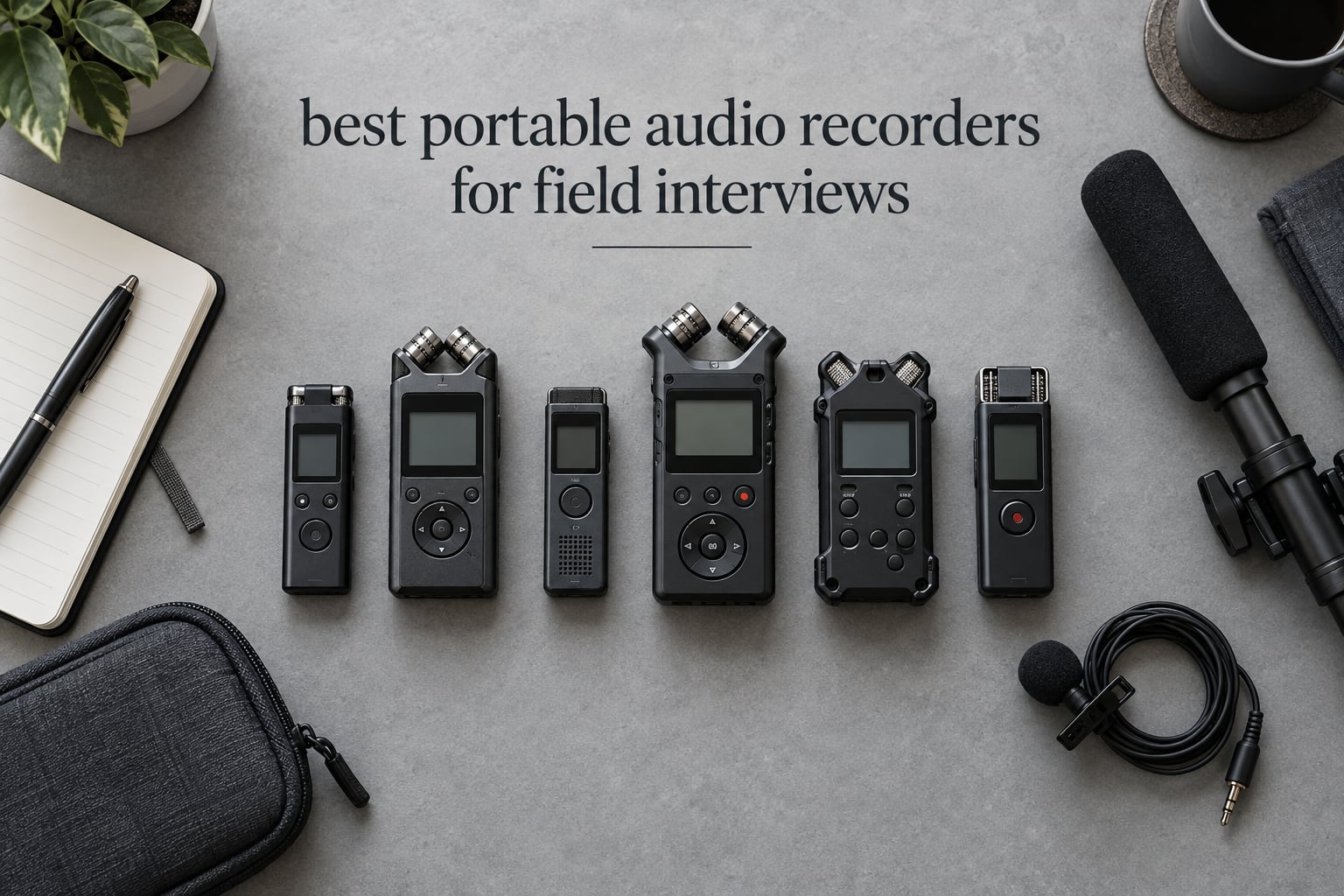
Interview audio is the one thing in production you cannot go back and re-record. A slipped quote, a badly clipped answer, a wind gust across the mic, and the take is gone. That is why the best portable audio recorders for field interviews are not really about specs; they are about how fast you can hit record, how little you have to think about levels once you do, and whether the thing fits in a jacket pocket at the end of a nine-hour shoot day.
We spent several months living with six recorders across two-person interviews, guerrilla street interviews, café conversations, and sit-down oral history sessions. We carried them, zipped them into bags, ran them flat, and offloaded the files to laptops in a car park afterward. This guide covers what each unit actually did in those situations, not what the box promises.
You will also notice we weigh everything in grams, because reviewers almost never do, and because a recorder you leave at home because it is too heavy is not a field recorder at all. If you want a broader view of related gear, our picks for the best wireless lavalier mics for interviews cover the wireless side of the same problem.
Table of Contents
What Is the Best Portable Audio Recorder for Field Interviews?
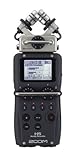
The Zoom H5 is the best portable audio recorder for field interviews overall. It weighs 115 g, records four tracks at once, gives you two XLR/TRS combo inputs with phantom power, and runs on two AA batteries you can buy anywhere. The capsule system lets you swap microphone configurations in seconds, which means it handles a one-person interview and a two-person interview with the same body.
The runner-up for anyone who never wants to touch a gain control is the Zoom F3, whose 32-bit float capture means you can hit record and walk away. Below that, the Tascam DR-70D covers panels and camera crews with four inputs, and the Tascam DR-10X disappears entirely on a handheld microphone for the most discreet interviews you will ever record.
Top 3 Picks for Best Portable Audio Recorders for Field Interviews in October

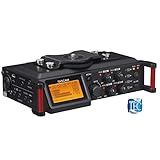
Tascam DR-70D
- 4 XLR/TRS combo inputs
- 2 built-in omnis
- Dual recording safety track
- SDXC to 128GB
Those three cover the widest range of real interview work we ran into. The H5 is the one we kept reaching for, the F3 is the one that removes the most stress, and the DR-70D is the one that handles more people at once.
All Six Recorders at a Glance in 2026
| Product | Specifications | Action |
|---|---|---|
| Zoom H5 |
|
Check Latest Price |
| Zoom F3 |
|
Check Latest Price |
| Tascam DR-70D |
|
Check Latest Price |
 Tascam DR-05XP Tascam DR-05XP |
|
Check Latest Price |
 Tascam DR-10X Tascam DR-10X |
|
Check Latest Price |
 Zoom F6 Zoom F6 |
|
Check Latest Price |
1. Zoom H5 – The Four-Track Workhorse With Swappable Capsules
Zoom H5 4-Track Handheld Recorder for Filmmakers & Musicians
Weight: 115 g
2 XLR/TRS combo inputs
4-track simultaneous
2 AA batteries
Pros
- Interchangeable capsule system
- Four tracks in a small body
- Combo inputs with phantom power and -20dB pad
- USB audio interface with loop-back
- Shock-mounted X/Y capsule
Cons
- SD/SDHC cards only up to 32GB
- Dated menu-driven controls
- No 32-bit float so gain still matters
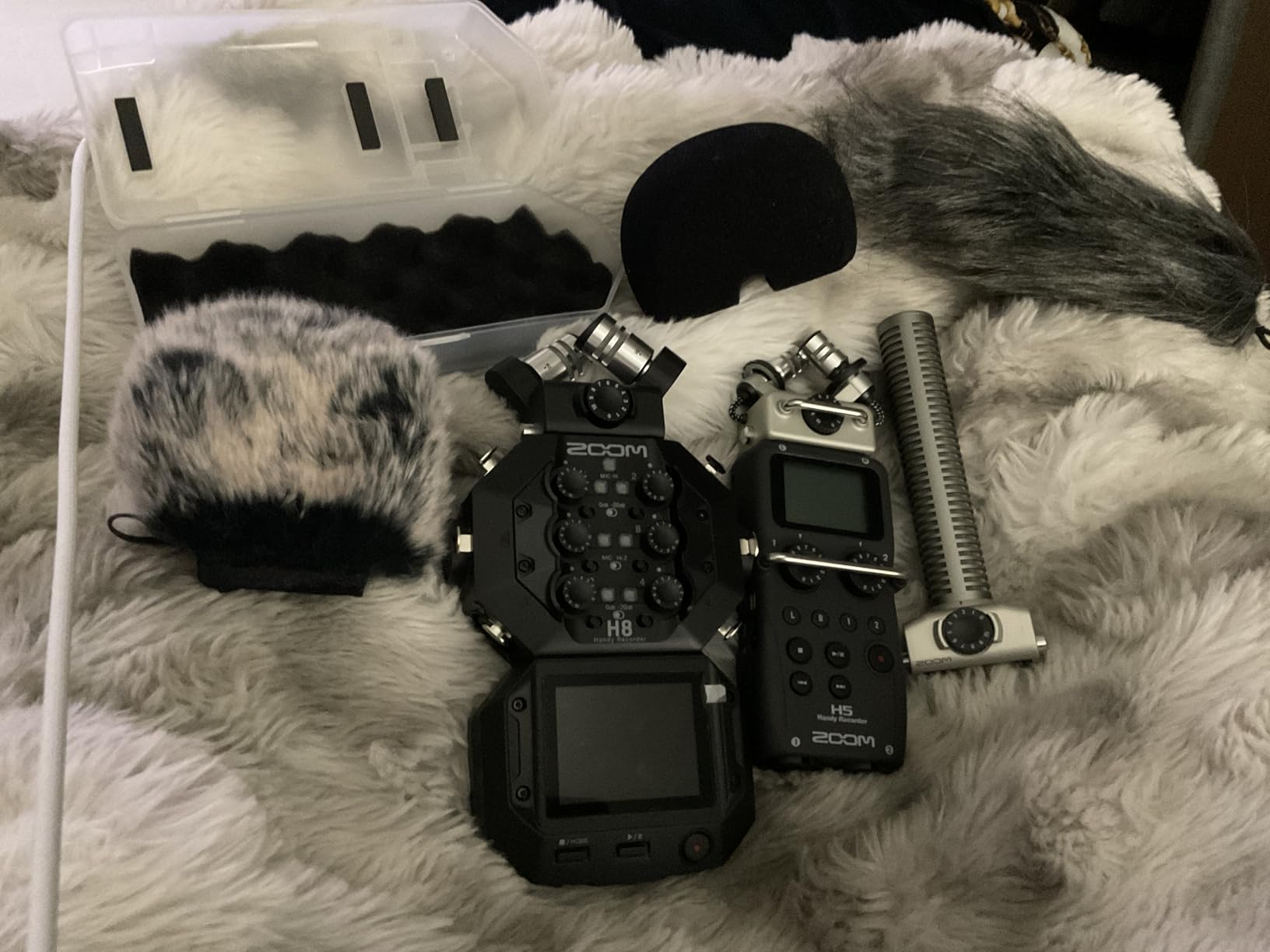
The H5 is the recorder we used most, and the reason is unglamorous: it does everything without asking permission. Two XLR/TRS combo inputs with selectable phantom power and a -20 dB pad sit on the bottom edge, and the detachable X/Y capsule with shock-mounted mics sits on top. You can record a lavalier on input one, a handheld mic on input two, and still capture the room on the built-in pair as tracks three and four.
At 115 g and 5.3 inches tall it disappears in a jacket pocket, which is the whole game. Long-time users on Elektronauts and Gearspace describe the H5 as a workhorse, and that matched our experience: it is not the newest design on the market, but it is the one that keeps working when you are moving between three locations in a day.
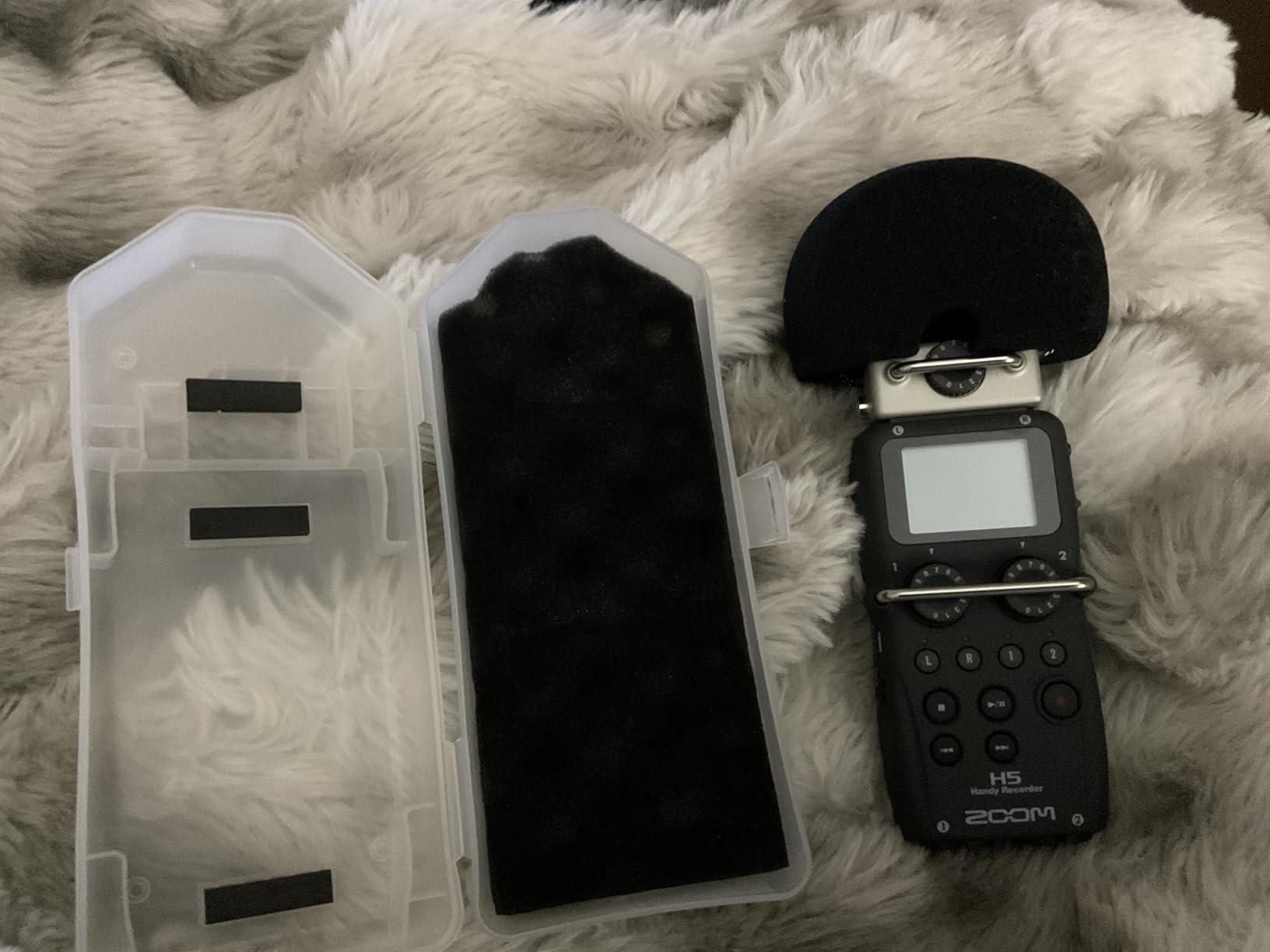
The detachable capsule is the feature nobody in our testing wanted to give back. Recording a quiet one-on-one interview, we left the X/Y capsule on for a stereo reference track. Recording an interview in a noisy street, we swapped to the shotgun capsule and pointed it at the subject while the combo inputs handled lavaliers on two speakers. That single screw-on change took about ten seconds.
Mechanically it is straightforward. Four tracks record simultaneously, the X/Y capsule is shock-mounted to reduce handling noise, and the unit doubles as a multichannel or stereo USB 2.0 audio interface for a PC, Mac, or iPad with a loop-back function for monitoring. Screen size is 1.9 inches, which is small but usable when you are not changing anything mid-interview.
What the H5 does well for interviews
The audio safety net is the quiet hero here. Four-track simultaneous recording with per-track safety on the built-in pair means that if your lavalier connector fails mid-answer, you still have a usable reference from the room mic. In a long-form interview with a subject who tells one important story, that redundancy is the difference between a retake and a hole in the edit.
Power is another win. Two AA batteries, roughly 10 hours of digital recording time, and no proprietary pack to lose in a bag. The -20 dB pad on each combo input handles loud handheld interview mics without preamp strain, which is a real problem when the subject gets animated.
Where the H5 frustrates you
The storage ceiling is the biggest one. Records to SD and SDHC up to 32 GB, which on a long interview day with four tracks running means changing cards or dropping track count. For a session-based interview this is fine; for a multi-day documentary run you will be swapping media more than you would like.
Second, there is no 32-bit float, so gain staging still matters. Set it once for a seated interview at a normal distance and you will be fine, but a subject who moves toward and away from the mic will need a second thought about levels. Third, the menus are button-driven and feel dated next to touch-screen recorders, which matters when you want to find a setting quickly before the subject arrives.
2. Zoom F3 – Clip-Free 32-Bit Float In a Pocket Cube
Zoom F3 Professional Field Recorder for Filmmakers & Musicians
Weight: 8.48 oz
32-bit float
2 locking XLR inputs
Up to 73 hours on microSD
Pros
- 32-bit float removes level babysitting
- Very low self-noise preamps
- Roughly half the size of an F8
- Locking XLR inputs stay secure
- Works standalone or as a USB interface
Cons
- Only two inputs and no built-in mics
- No 3.5mm input
- Memory card door opens easily
- Does not show file name while recording
The F3 is the recorder we hand to people who say they do not understand gain. It records 32-bit float with dual A/D converters, which means there is no ceiling to clip into, so you can set a rough level and never touch it again. Members on r/fieldrecording point out that this is exactly why 32-bit float matters for beginners, and after a month with the F3 we agree completely.
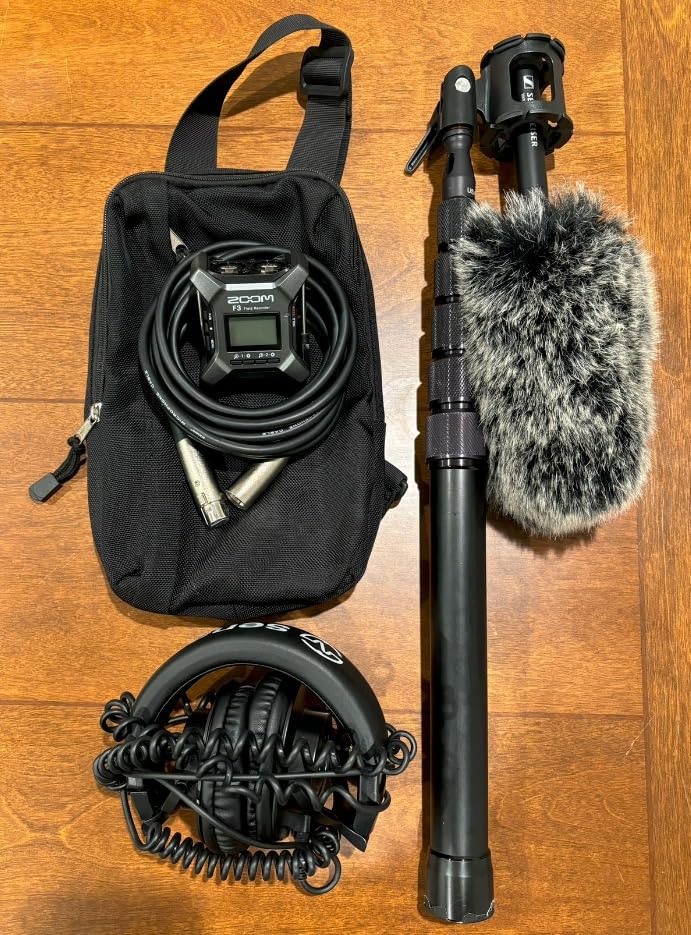
Physically it is a metal-and-plastic cube, 3.04 by 2.95 by 1.88 inches and 8.48 ounces, roughly half the size of the F6. Two locking XLR/TRS inputs sit on the panel, and they stay put when the recorder is mounted on a stick or a rig. That locking collar is a small thing that matters enormously when a cable gets brushed during a live interview.
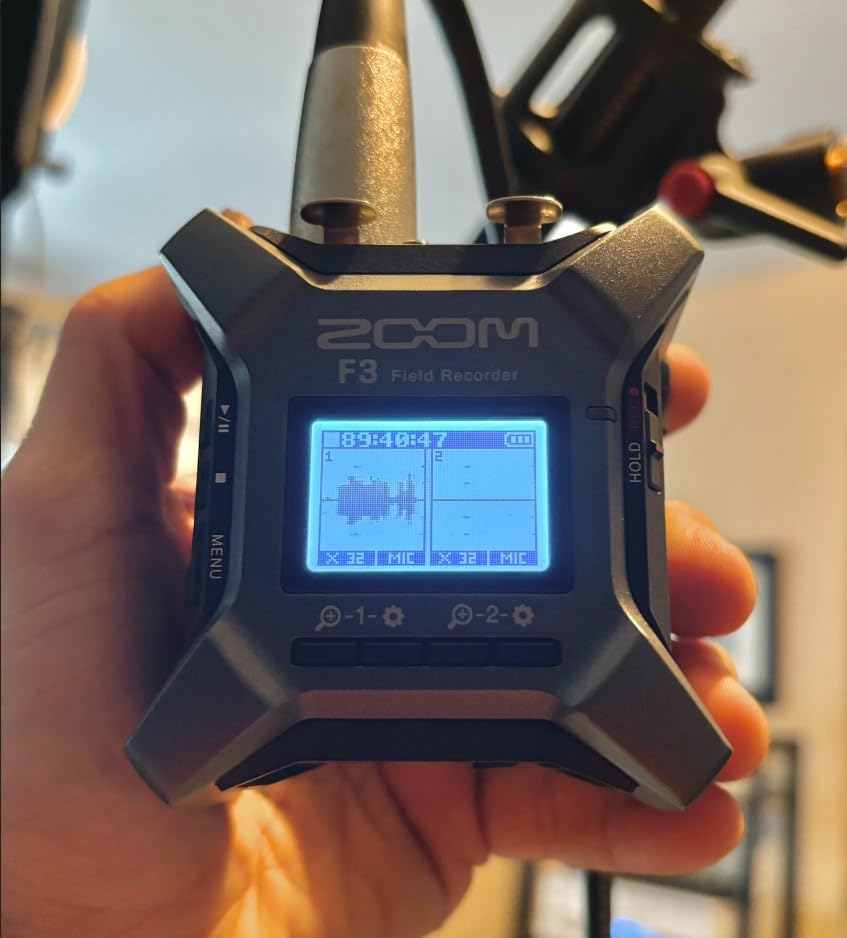
Recording headroom is the headline feature. Ultra-low-noise preamps capture whisper-quiet dialogue in a silent room without forcing you to crank the gain, and the same converters handle a sudden peak or a subject who laughs loudly. Up to 73 hours to microSD, up to 512 GB, and WAV format throughout, so a full day of interviews fits on one card.
Power is flexible: two AA batteries, external DC, or USB bus power, and the unit works standalone or as a USB audio interface. There is also wireless control from a compatible app, which lets a second person set levels without walking into frame. Owners report syncing it to camera audio with a single clap in post, which is a very cheap way to handle a camera with no timecode output.
Why the F3 suits a two-person interview
Two inputs is exactly enough for the most common two-speaker setup: a lavalier on the interviewer or guest one, and a lavalier or handheld on guest two. Because both channels are on locking XLR and phantom power is available, you can run two condenser lavs and get consistent level on both without touching anything once the interview starts.
The low-noise preamps also matter here in a specific way. If one guest speaks quietly and the other loudly, 32-bit float means you can set both channels at a similar conservative setting and let the gain difference live in post, rather than constantly riding a level control. That is the practical version of the per-track approach the DR-70D handles with hardware knobs.
Where the F3 gets in the way
There are no built-in microphones and no capsule, so you must supply microphones. That is fine if you own lavs, and a problem if your plan was to walk into an interview with nothing in your bag. There is also no 3.5 mm input, so line-level sources need an adapter or an external preamp.
Phantom power is capped around 10 mA across both channels combined, which is a real limit if you like long cable runs or high-current condenser microphones. The memory card door pops open easily if brushed against a bag, and we had to check the card was still seated twice in a day. Finally, the unit does not display the file name while recording, so on a busy card you have to track takes in your own notes.
3. Tascam DR-70D – Four Inputs For Panels And Camera Crews
TASCAM 4-Channel Portable Audio Recorder for Videographers, 4 Combo XLR/TRS Inputs, 2 Internal Mics, Limiter, HP Filter (DR-70D)
Weight: 1.2 lb
4 XLR/TRS combo inputs
2 built-in mics
4 AA batteries
Pros
- Four independent combo inputs with per-track control
- Built-in stereo pair for fast interviews
- Dual recording safety track plus limiter and low cut
- Camera-mountable above or below a camera
- Exports four discrete files for your editor
Cons
- Can be picky about memory cards
- Small 3.5mm jacks for line and headphones
- Fiddly battery compartment resets the date
- No compressor and no MP3 option
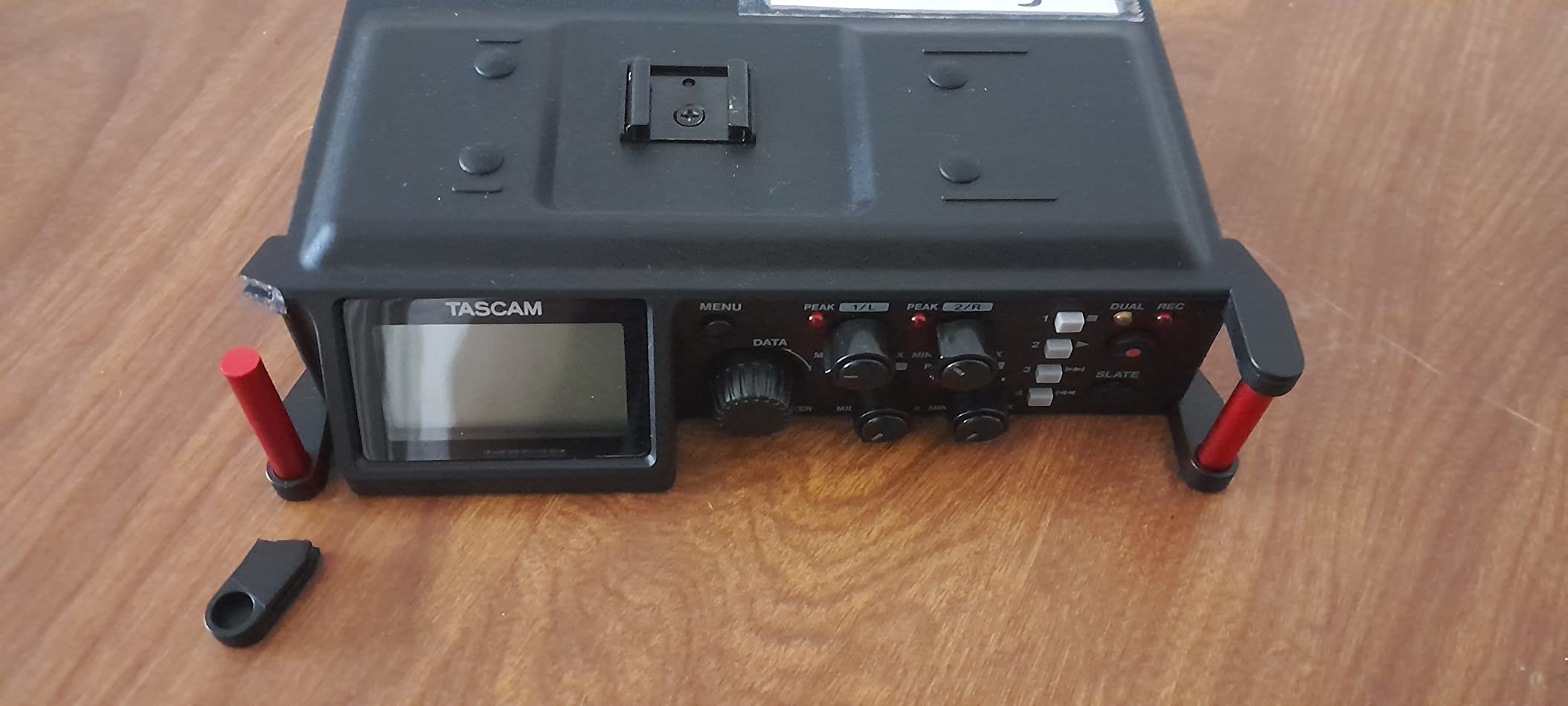
The DR-70D is the answer when more than two people are talking. Four balanced XLR mic inputs with 48V phantom power, each with its own gain, pan, record enable, and limiter, sit on a body that mounts above or below a camera. Around 1.2 pounds, it is the heaviest recorder here, but it also does the most per square inch of front panel.
Reviewers consistently call it exceptional value for DSLR and solo-shooter work, and we agree for a specific reason: the per-track level controls mean speakers with different volumes can be balanced in post rather than with your fingers during a live conversation. HDDA preamps provide 64 dB of gain, which is enough headroom for a quiet subject without adding hiss.
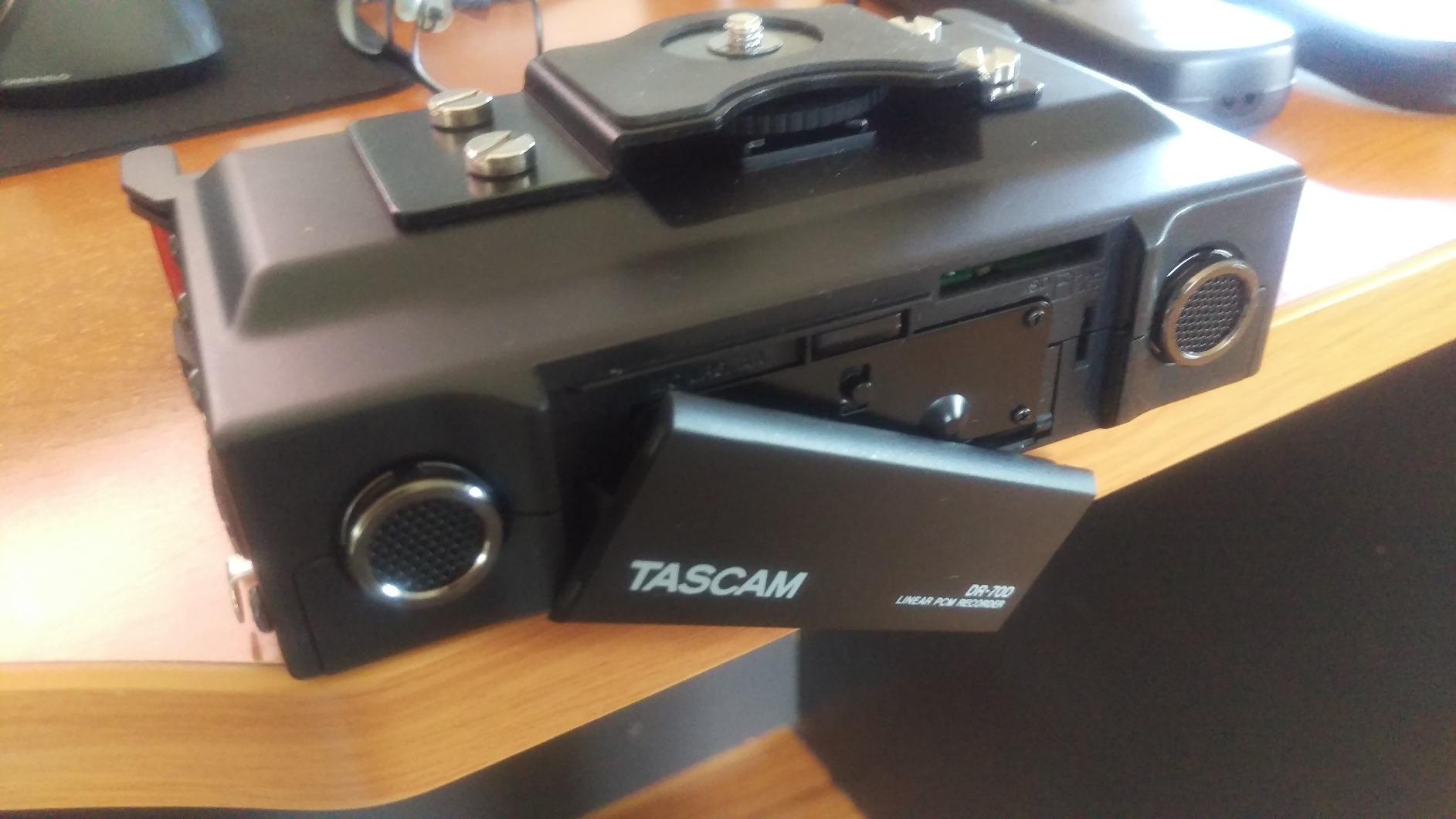
Dual Recording mode writes a second safety copy at a lower level, so if a take distorts you have a backup. A limiter and a high-pass filter round out the level-control tools, and tracks are captured to SD, SDHC, or SDXC media with cards up to 128 GB supported. Recording time is quoted at 100 hours, and the unit runs on four AA batteries, which are included.
The built-in stereo microphone pair is not the main event, but it saved us on a guerrilla interview where there was no time to rig anything. Recording the four tracks exports as four discrete files that drop straight into an editing timeline without splitting, which saves a step that eats time on every multi-speaker project.
Where the DR-70D earns its weight
Roundtables, panels, and any interview where a subject and interviewer both have a mic in hand with different levels. Four inputs means you can run two lavs, a boom for safety, and a handheld backup without needing a second recorder or an external interface.
Camera crews get the mount above or below the body, plus line in, line out, and headphone monitoring. If your video has no usable onboard audio, the DR-70D mounted under the camera is a genuine production-sound setup rather than a backup, and the safety track plus limiter means a loud subject will not ruin the take.
What to watch out for
It is picky about memory cards, and owners report write errors on cards that were not recommended. Buy a card from the supported list before the shoot, not on the way to it. The line and headphone jacks are 3.5 mm rather than full-size, which means losing an adapter would be bad luck on a long day.
The battery compartment is fiddly and the clock resets when you change cells, so timestamped file names need checking after a battery swap. There is no built-in compressor and no MP3 recording option, so plan on WAV and edit compactly. Build quality is moderate, and some owners report the tripod thread or a small top part rattling over time.
4. Tascam DR-05XP – 32-Bit Float For A Pocket And A Single Voice
TASCAM DR-05XP 32-Bit Float Portable Handheld Field Recorder and USB-C Audio Interface — Digital Stereo Recording of Music, Sound, Voice, Audio for Video and Podcasting
Weight: 4.48 oz
32-bit float
Built-in 125dB SPL mics
17.5 hours on 2 AA
Pros
- 32-bit float at an entry-level price
- Omnidirectional condensers rated to 125dB SPL
- Pocket weight of 4.48 ounces
- USB-C audio interface for direct recording
- About 17 hours on two AA cells
Cons
- No XLR or mic input of any kind
- Fixed onboard microphones that cannot be aimed
- No timecode input for video sync
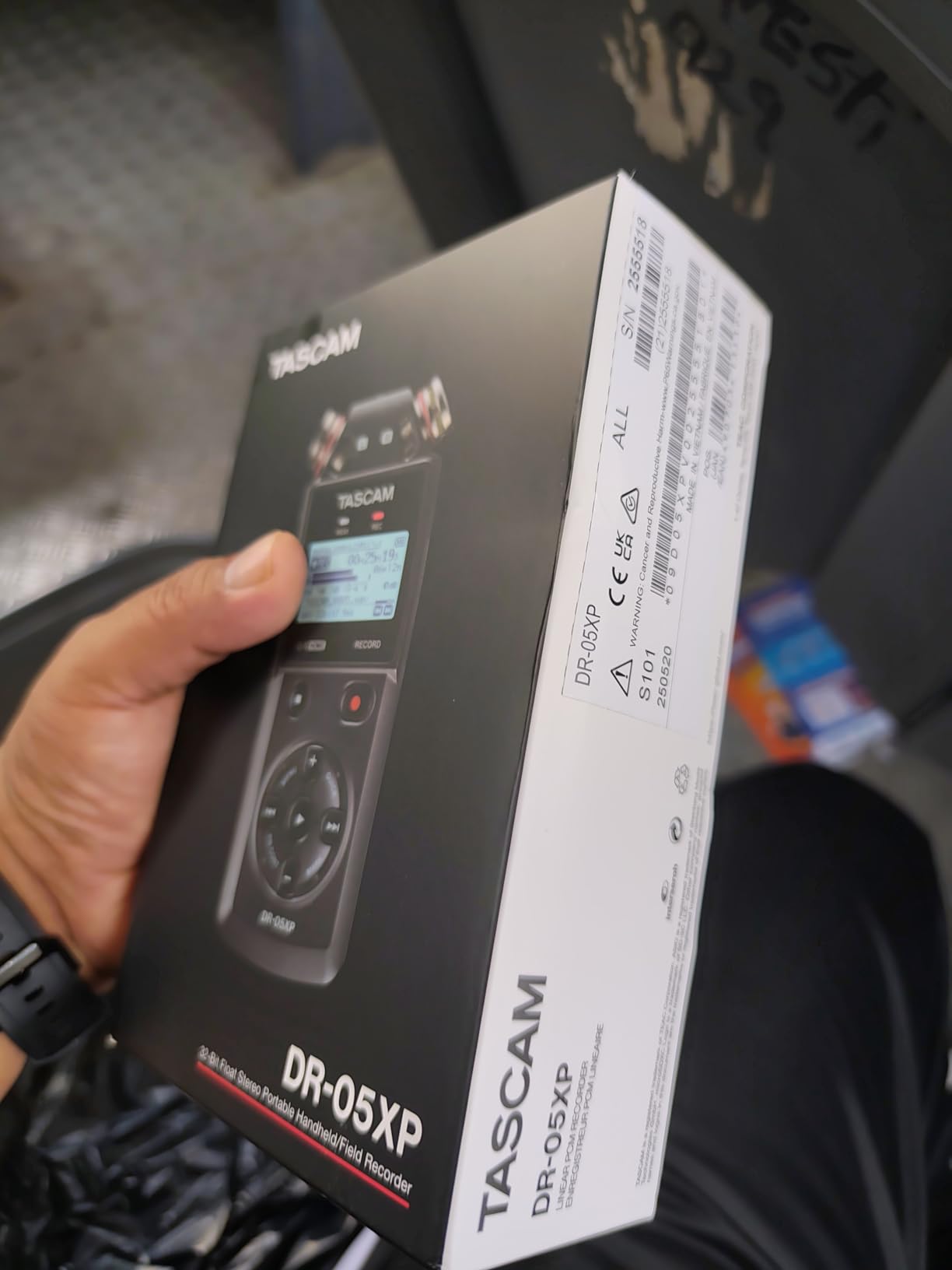
The DR-05XP is the smallest 32-bit float recorder in this group at 4.48 ounces and 5.6 inches long, and it delivers the single most valuable feature in interview recording at a price that undercuts most alternatives. There is no gain ceiling, so you cannot clip a loud answer, and there is no menu diving because there is nothing to configure.
Built-in omnidirectional condenser microphones are rated to handle 125 dB SPL, which is genuinely loud. In our tests they handled a raised-voice answer in a small room without breaking up, which is more than many pocket recorders at twice the weight can do. Recording modes cover 32-bit float, 24-bit, and 16-bit, with 96 kHz, 48 kHz, and 44.1 kHz sampling plus MP3 capture.
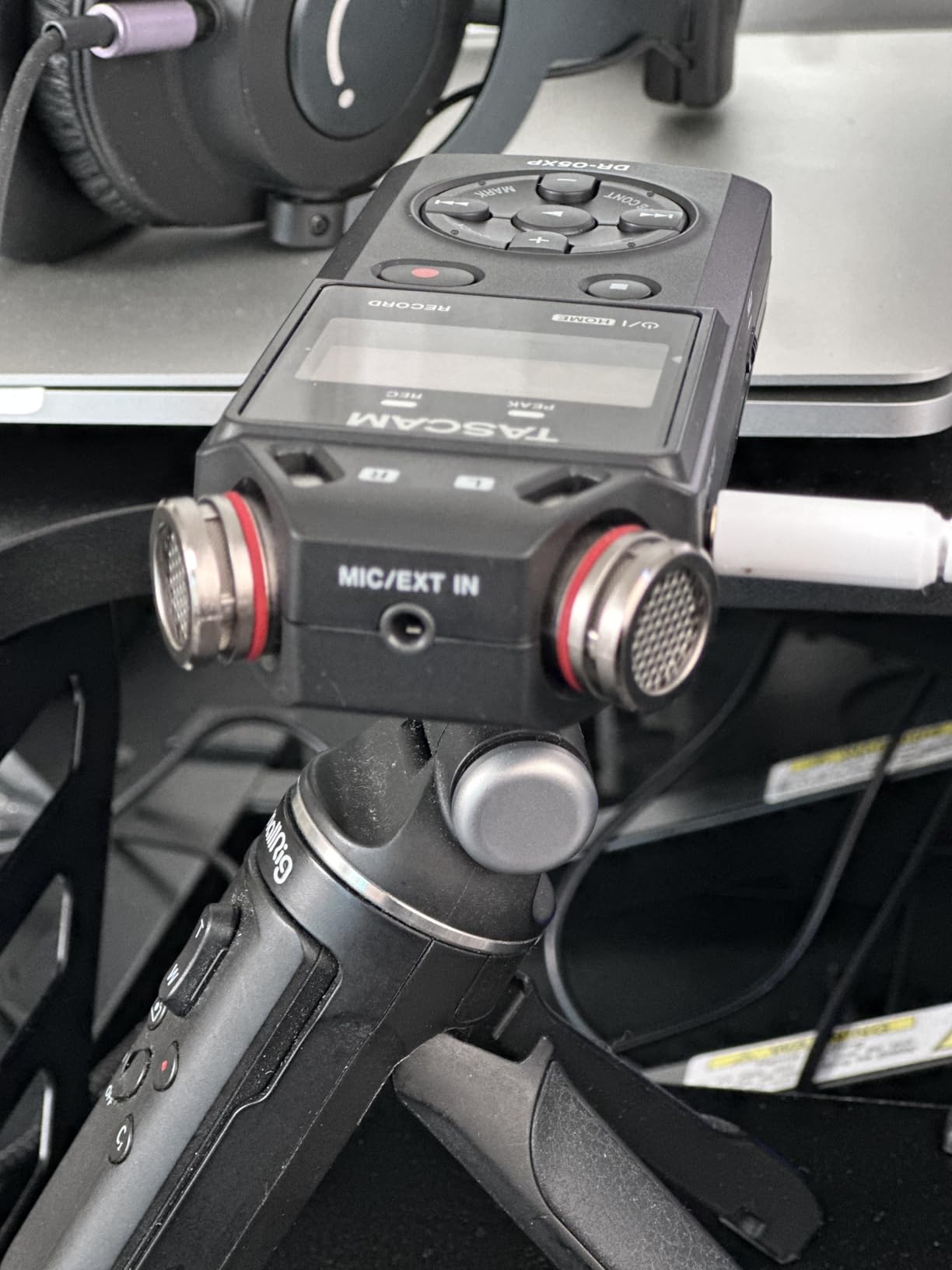
Battery life is the other headline. Around 17.5 hours on two AA batteries, quoted as 17 hours of recording time, means a full interview day without a battery in your pocket. Cards up to 512 GB are supported, and there is a 2-in/2-out USB-C audio interface for recording straight to a computer when you want a bigger workflow than a handheld.
The 4.2 average rating reflects one honest limitation rather than quality problems. There is no XLR or mic input at all, so external microphones cannot be connected, and the onboard mics are fixed, which means you aim the whole recorder rather than the capsule.
When the DR-05XP is the right tool
Solo voice capture. Dictation-style notes after an interview, quick verbatim quotes, and any situation where you need a recorder that costs nothing if it gets sat on. Held at the right distance, aimed at the mouth, the built-in omnis produce usable dialogue audio for interviews, research, and voice notes.
It also makes sense as a second unit in a bag. A DR-05XP in one pocket recording a wide reference track while a primary recorder runs a lav gives you a safety copy with zero menu work. Anyone who finds level meters intimidating can learn on this recorder and move up later without ever having blown a take.
Where it will not do the job
Anything with more than one speaker at a normal interview distance. Built-in omnis at arm’s length in a room with any reverberation will sound thin, and you have no way to fix it because there is no input. Outdoors, without wind protection, the fixed capsule has no way to be shaded from gusts either.
There is no timecode input, so if you shoot video and want frame-accurate sync you will need the clap-sync or post-alignment workflow instead. For our purposes, that is the deal-breaker line: it is a recorder for one voice, not for interview craft.
5. Tascam DR-10X – The Body-Worn Clip For Handheld Interview Mics
TASCAM XLR Micro Audio Portable Digital Recorder for XLR Microphones, Voice Recorder, Interview and News Gathering, Black (DR-10X)
Weight: 2.56 oz
Captive XLR connector
Auto and manual gain
Up to 120 hours recording
Pros
- 2.56 ounces and clips straight to a handheld mic
- Solid XLR connection with no wireless interference
- Automatic gain works for run-and-gun
- Dual recording safety at -6 or -12dB
- Closes the file automatically if the battery dies
Cons
- No phantom power so condenser mics need their own battery
- microSD capacity tops out at 32GB
- Lightweight plastic body and a non-locking collar
- Automatic gain can pump on uneven speech
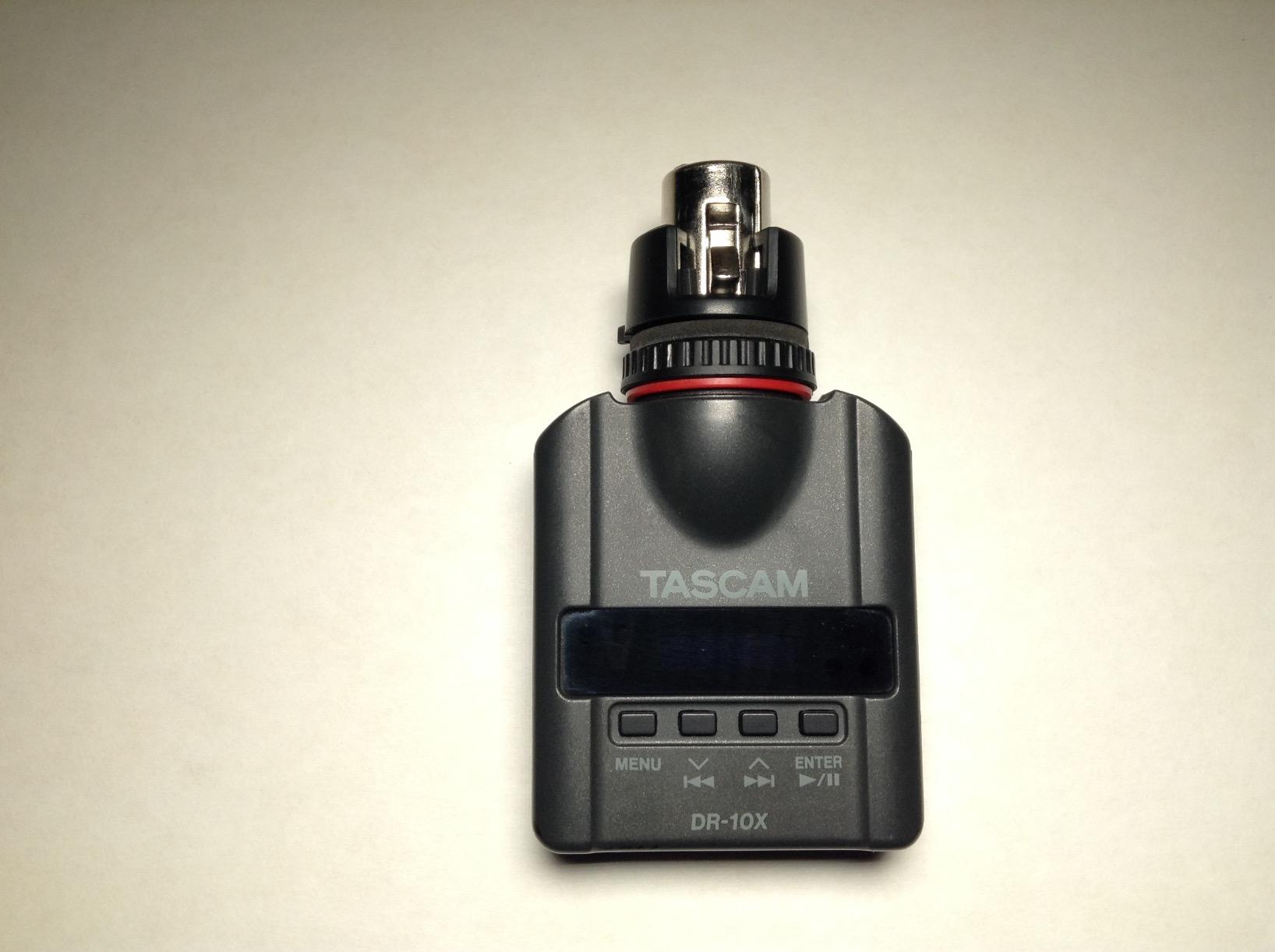
The DR-10X is not really a handheld recorder. It is a body-worn clip that attaches to the XLR connector of a handheld interview microphone, making the pair something a subject can hold without noticing any extra weight. At 2.56 ounces it is by a wide margin the lightest recorder in this roundup, and in our two-person interviews the subject genuinely forgot it was there.
The captive XLR connector is the whole design. Because the connection is physical and wired, you get the reliability of a hard-wired signal with none of the interference risk that comes with wireless plug-ons. Recording and playback cover both WAV and MP3 to microSD, with days of audio possible on a card, and quoted recording time is 120 hours on the included lithium battery.
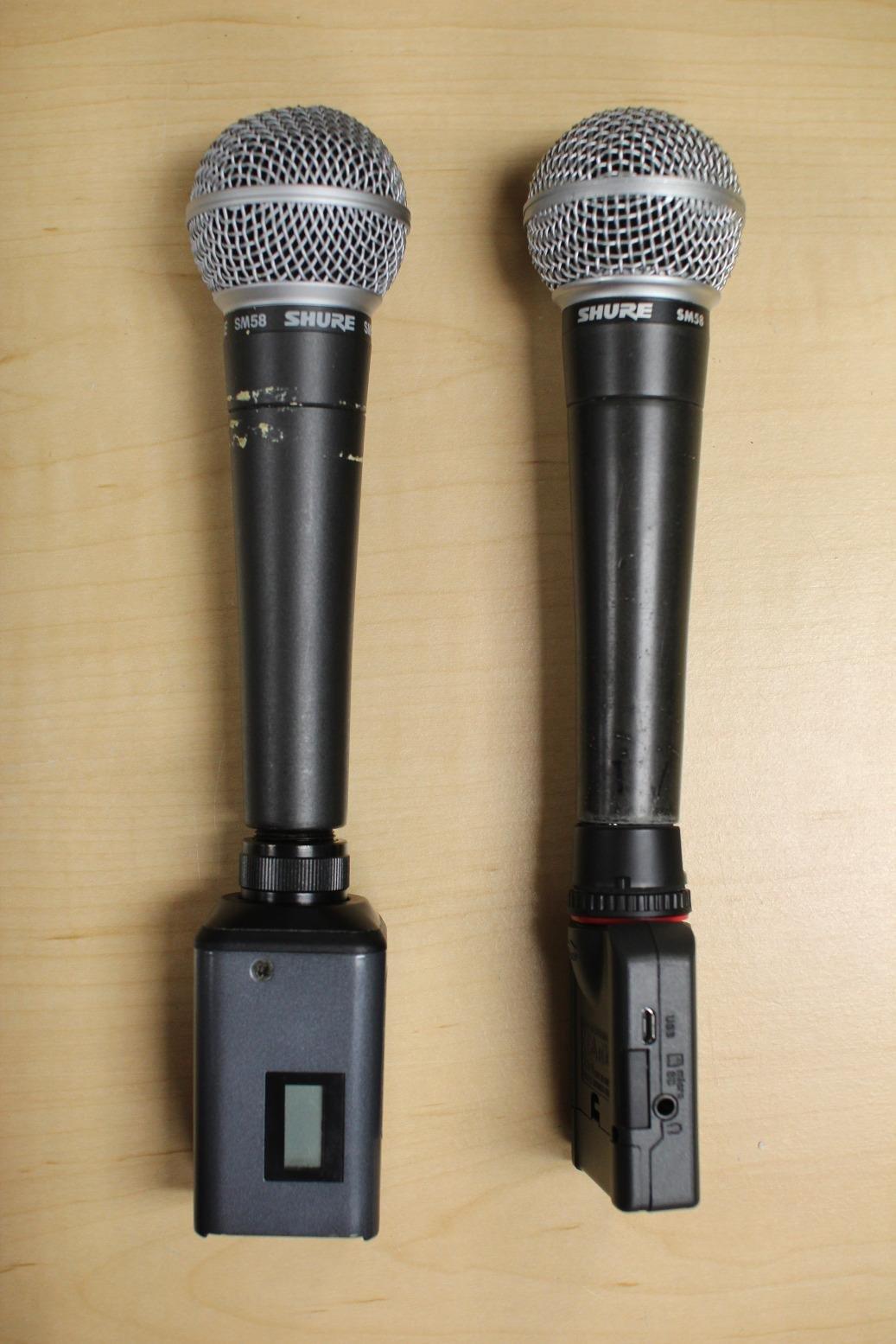
Two details show this was designed with journalists in mind. The record control is a sliding switch rather than a button, which prevents accidental activation from a pocket or a jacket press. And if the battery dies, the unit automatically closes the file so you do not lose the recording that was in progress, which is the kind of small insurance policy that matters when a source is talking.
Gain works both ways. Manual and automatic modes are both available, with a low cut filter and a limiter to prevent overloads. Dual Recording captures a copy at a lower level, adjustable at -6 or -12 dB, so a surprise loud answer still has a usable safety file.
Where the DR-10X beats everything else here
Discretion, and candid interview work. Verité-style documentary interviews where the recorder has to go on the mic rather than on the table are the clear win. It also serves as a redundant capture from a mixer’s XLR output if you need a second isolated copy of a feed.
Headphone monitoring lets you check the recording immediately after a take and hear what the subject actually sounds like, which matters when a handheld mic is aimed badly. That instant verification habit is the single most useful habit in interview recording, and this is one of the few units here that makes it easy because the jack is right there on the body.
Limits to plan around
There is no phantom power, so a condenser microphone needs its own battery, which is fine for interview condensers and inconvenient for everything else. Maximum microSD capacity is 32 GB, the lowest ceiling in this group, so plan on swapping cards during a long session.
The body is lightweight plastic and the XLR collar is non-locking; some owners report the connector loosening over months of daily use, so check it before an important interview. There is no 3.5 mm or other input, because it records only from the attached mic. And automatic gain can pump or breathe on uneven speech, so for a long-form interview where the subject’s voice level changes, manual gain with the safety track sounds better.
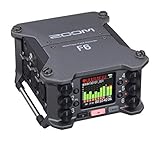
6. Zoom F6 – Timecode And Six Inputs For Documentary Work
Zoom F6 Professional Field Recorder for Filmmakers & Musicians
Weight: 2.4 lb
6 XLR inputs, 14 tracks
32-bit float
Timecode input and output
Pros
- Six XLR inputs with up to 14 tracks
- 32-bit float with dual converters
- Timecode input and output for camera sync
- Travel-friendly body for location work
- Works standalone or as a USB interface
Cons
- Heavier and larger than the F3 or H5
- No built-in microphones
- Small screen for quick menu work
- A step up in price from entry handhelds
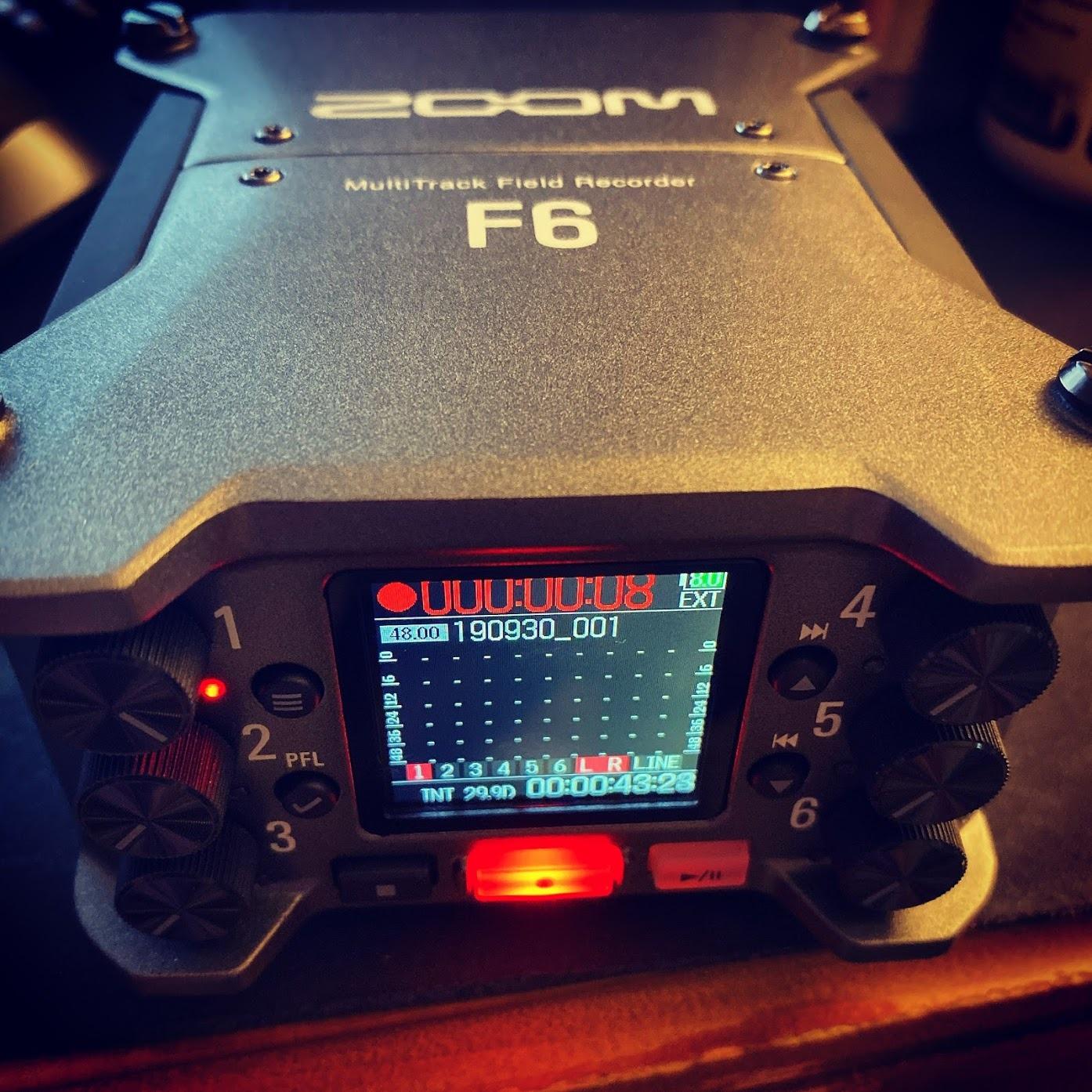
The F6 is what you reach for when an interview day turns into a shoot day. Six XLR inputs with up to 14 tracks handles a boom, two lavs, and a wireless feed simultaneously with room to spare, and 32-bit float recording with dual A/D converters captures everything from quiet dialogue to a sudden shout without clipping. At 2.4 pounds it is a carry, but the body is compact and the mount included is designed for location work.
The distinguishing feature is timecode input and output. If your camera generates or accepts LTC, the F6 locks to it and your interview audio lands frame-accurately against picture, which removes the alignment step entirely. For crews without timecode, the same 32-bit float reliability still applies and owners still sync with a clap in post.
Power options are broad: four AA batteries, external DC, or USB bus power, and the unit doubles as a USB audio interface with headphone monitoring and line input. Quoted recording time is 119.2 hours, with WAV format throughout. The package includes four AA batteries, a camera mount adapter, and Cubase LE and Wavelab LE download codes for anyone who wants to edit multitrack files without buying software.
The 4.7 average across 235 reviews reflects owners who treat it as professional kit rather than a gadget. The comment we kept hearing was not about features at all; it was that the recorder holds up in a bag, on a stick, and in weather, and still produces publish-ready audio.
Where the F6 changes how you work
Multi-speaker interviews and any session where a sound recordist and a camera operator are working together. Six inputs means you can track every person separately, add a boom for safety, and still record a reference, all in one file set rather than several recorders kept in sync by ear.
Timecode is the quiet win for documentary work. Once audio and video share a clock, the edit session starts with everything already aligned, which on a long interview-heavy project saves hours compared with waveform matching. Headphone monitoring with line input also means you can feed the recorder from a mixer and keep a clean isolated copy.
Where it is more machine than you need
At 2.4 pounds and 4 by 4.5 by 2.5 inches, the F6 is noticeably larger and heavier than the F3 or the H5, and you will feel that difference at hour nine of a walking interview day. There are no built-in microphones, so it is useless without a full mic kit in the bag.
The screen is small for fast menu navigation compared with newer models, which means routing changes take longer. And it is a step up in price from entry handhelds. For a solo interviewer recording one subject at a time, two inputs is plenty and the extra four will never get used.
Buying Guide: How to Choose a Portable Audio Recorder for Field Interviews
How many inputs does your interview actually need?
Count the people, not the microphones. One interviewer and one subject need one channel for the subject. Add a second speaker and you want two channels so you can balance levels independently. Add a third person and you are into territory where a four-input recorder pays for itself, because a boom or room mic becomes a safety track rather than an extra expense.
A useful rule we came back to: one mic per speaker, plus one safety channel, plus the built-in mics as a last resort. For a one-on-one that is one XLR and the built-in pair, which the H5 covers. For a two-person interview it is two XLR channels, which the F3 handles exactly, or two combo inputs on the H5 with a third and fourth track from the capsule. For a panel of four, the DR-70D with four combo inputs is the minimum that keeps everyone on a discrete file.
Think about phantom power at the same time. Condenser lavaliers need +48V. The F3, DR-70D, and H5 provide it on their combo or XLR inputs. The DR-10X does not, and the DR-05XP has no inputs at all. That single spec eliminates half the shortlist faster than any other.
32-bit float, explained
32-bit float recording is a format that keeps a recording recoverable across an enormous range of loudness, so there is no ceiling for a sudden peak to clip into. A conventional recorder converts sound into fixed-scale numbers: set the gain too low and you get hiss from an empty top end, set it too high and the loudest moment distorts permanently.
Float recording solves this with a second and third converter reading the signal at different levels, then combining them. In practice, you set the level roughly once and stop thinking about it. The F3 and F6 use dual A/D converters for this reason, and the DR-05XP brings the format to a small body at an entry price. The H5 and DR-70D are 24-bit recorders, so on those you still gain-stage carefully before the interview starts.
One caveat. 32-bit float does not fix a bad microphone position, a rubbing lavalier, or a subject talking across a noisy street. It fixes levels, and only levels.
Handheld versus pocket recorders for interviews
The best handheld recorder for interviews is the one you will actually have in your hand when the subject starts talking. Handhelds with combo inputs win on control and on monitoring, because you can hear the feed and re-aim in seconds. Pocket recorders win on weight and on spontaneity, because you can start recording while you are still walking toward the subject.
If you are torn, use this rule. If interviews are planned, seated, and indoors, choose the handheld with combo inputs. If they are unpredictable, on the move, or in places where you cannot set up, choose the pocket or body-worn option and accept the audio limits.
Microphone pickup and on-location technique
Built-in microphones handle a quiet office. A real interview happens in rooms with refrigerators, traffic, chairs, and other people. On-location, our rule is that built-in mics are a backup and never the plan.
For lavalier work, the three failure modes are predictable. Clothing rub happens when a mic sits against a stiff collar or a zipper, so tape the capsule to skin or to a flat, quiet surface and route the cable away from moving fabric. Wind hits fixed capsules hardest, so outdoors you want a furry windscreen on anything exposed. Distance matters more than brand: a lav two inches below the mouth outperforms a shotgun held three feet away.
Shotgun microphones work when you cannot touch the subject and the background has some low-frequency rumble to hide behind. They fail in open air, where there is nothing to absorb sound. Omnidirectional built-in mics, by contrast, pick up the room, which is useful for atmosphere and room tone and poor for isolation. If you plan to record room tone for editing, note that the F6 and DR-70D both give you spare channels for exactly that.
Cable routing is the recurring physical annoyance we heard about from users, and it is worth planning. A lav cable that runs down the back of a shirt is invisible and secure. One that crosses a collar is visible and gets yanked.
Recording in noisy places
Cafés, streets, and cars are a dynamic range problem, not a recorder problem. A subject at 60 dB speaking over traffic at 75 dB gives the preamp a 15 dB signal to work with, and no amount of gain staging fixes that ratio. The answer is to get the microphone closer and to accept that the background will be audible.
In practice: move the mic, not the recorder. A lav beats a handheld at any distance. If the environment is unavoidably loud, record a short stretch of ambient noise on a separate track, which gives you a clean profile for denoising later and gives you a room tone reference if you need to cover a cut. None of the units here denoise on the way in, and that is deliberate; in-field denoising eats speech consonants.
Consent, privacy, and protecting your sources
None of the competitors covering this topic cover the legal side, so here it is plainly. Recording law in the United States splits into one-party consent states, where only one person in the conversation needs to agree, and two-party consent states, where everyone must. Several states and a number of countries fall in the two-party group, and the practical rule is that consent is worth getting in every case.
Get consent on the recording itself, not only in a notebook. Say it at the top of the interview, ask the subject to say their name and the date, and keep that audio. It costs five seconds and it is the strongest evidence you can have. For sensitive interviews, also get written agreement on how the material will be stored and published.
On hardware, protection is limited and that is worth knowing before you rely on it. None of these recorders advertises file-level encryption for interview audio, so treat the device as a hard drive that anyone can pick up. Transfer files to an encrypted drive or an encrypted laptop as soon as you leave the location, and delete the card. If a source’s safety depends on the audio, keep a written note of who holds copies.
Battery, storage, and offloading
Prefer AA batteries for anything involving travel. Spares exist in every town, whereas proprietary lithium packs mean a dead unit at the worst moment. The H5 runs on two AA, the F3 and DR-05XP on two, the DR-10X on a single lithium cell, the DR-70D on four AA, and the F6 on four AA with external DC and USB bus options as backup.
On storage, check the maximum card size before you buy and before you buy cards. The DR-10X and the H5 cap at 32 GB, the DR-70D reaches 128 GB, and the F3 and DR-05XP reach 512 GB. On an interview day with four tracks recording, a 32 GB card fills quickly.
Use this offload sequence before you leave the scene:
1. Stop recording and confirm the file closed properly on the device.
2. Play ten seconds of the last take back through headphones and confirm the audio is present.
3. Copy files to two separate drives, not one.
4. Format the card in the recorder rather than on a computer, which keeps filenames consistent.
5. Note the take numbers and times on paper before the card is reused.
That fifth step sounds old-fashioned until the day you cannot remember which card held the good answer.
If you also carry video gear, our picks for the best camera field monitors cover checking levels on set, and our guide to dictation recorders for professionals covers the voice-notes end of the spectrum. For timekeeping on long assignments, we have covered field watches for men separately.
Frequently Asked Questions
What is the best audio recorder for interviews?
The Zoom H5 is the best audio recorder for most interviews. It records four tracks at once, has two XLR/TRS combo inputs with phantom power, weighs 115 g, runs on two AA batteries, and uses a swappable capsule system so you can reconfigure it for one-on-one or multi-speaker interviews. For a two-person interview with no gain worries, the Zoom F3 adds 32-bit float capture.
Do I need a separate audio recorder if my camera already records sound?
Yes, for anything you cannot afford to lose. Camera onboard microphones sit far from the subject, pick up handling noise and camera rumble, and often clip on a loud answer. A dedicated recorder puts the microphone where the mouth is, gives you isolated per-speaker files, and writes a separate safety track. Keep the camera audio as a sync reference rather than as your only copy.
How many XLR inputs do I need for a two-person interview?
Two is the practical minimum: one channel per speaker so each person has an independent level you can balance in post. Add a third channel if you want a boom or room mic as a safety track. A one-on-one interview needs only one channel. Panels of four or more speakers push you toward a four-input recorder such as the Tascam DR-70D.
Is 32-bit float recording worth it for interviews?
For most interview work, yes. It removes the level ceiling, so a sudden laugh or a raised voice cannot clip and you set the gain roughly once instead of watching meters. It does not fix a badly placed microphone, clothing rub, or a noisy room. If gain staging already feels natural to you, a 24-bit recorder with a safety track can produce the same finished result.
Is it legal to record an interview without telling the person?
It depends where you are. In one-party consent states only one person in the conversation must agree, while two-party consent states require agreement from everyone, and some other countries require clear notice. Get consent on the recording itself, ask the subject to state their name and the date, and keep that audio. The five seconds it takes is the strongest evidence you can have.
What We’d Buy: The Final Verdict
For most people recording the best portable audio recorders for field interviews work, the Zoom H5 is the answer. Four tracks, two real combo inputs, 115 g, AA power, and a capsule system that covers one-on-one interviews, two-person setups, and multi-speaker sessions without a second device. It is the recorder we carried most and the one we would buy first.
Buy the Zoom F3 instead if you would rather never think about gain, and the Tascam DR-70D if more than two people are talking. For the smallest possible footprint, the Tascam DR-10X clips onto a handheld mic at 2.56 ounces, and the Zoom F6 is the right call once timecode and six inputs matter.
Whichever you pick, set up gain before the subject arrives, confirm consent on the recording, and copy the files to two drives before you leave the location. Those habits matter more than any spec on the box.