
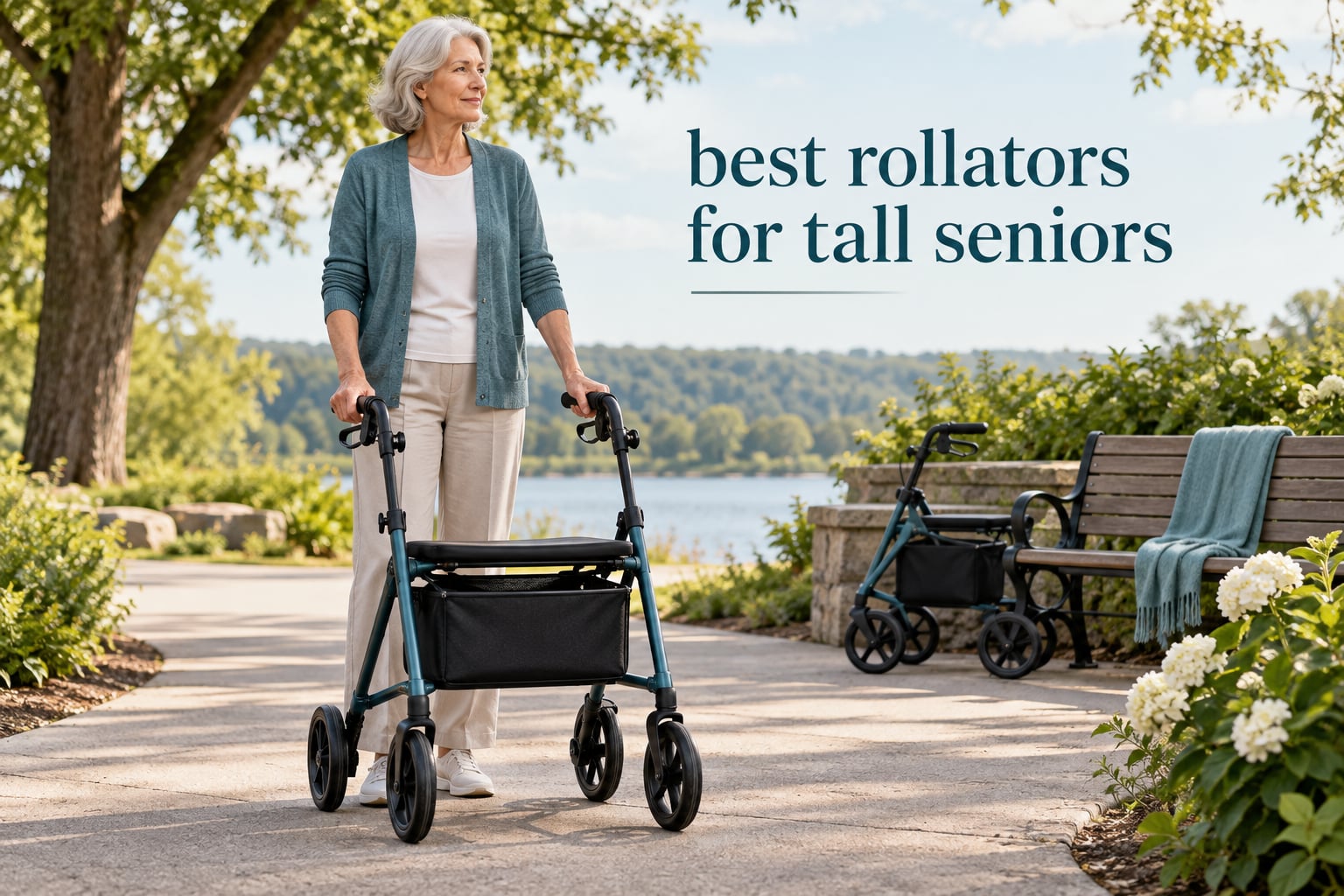
If you are shopping for the best rollators for tall seniors, the specs that matter most are handle height ceiling, seat-to-floor height, weight capacity, wheel diameter and frame type. Most rollator walkers stop adjusting at about 38 inches, and that single number is why so many tall adults end up walking bent over. If your wrist crease sits higher than the handles can reach, you are leaning forward all day, and that forward lean loads the lumbar spine, tires the neck and takes away your steering control. A tall-friendly rollator is simply one whose handle height adjusts to at least 40 inches and whose seat sits roughly 23.5 to 26 inches off the floor, so you can stand upright with a soft bend in the elbows instead of a permanent stoop.
That is the whole idea behind our picks below. We compared ten of the tallest frames available right now, pulling handle ranges, seat heights, wheel diameters, weight capacities and frame weights for each one so you can match a model to your body rather than guessing from a product photo. If you want a broader starting point first, our general guide to the best rollators for seniors covers the basic categories.
A word of caution before you go further. This article is written for shoppers, not clinicians, and a rollator is medical equipment that has to fit a specific body. Talk to a physical therapist or occupational therapist, or ask your doctor for a referral, before you buy. Medicare Part B covers rollators as durable medical equipment when a clinician prescribes one, and a short assessment often prevents an expensive return.
Table of Contents
The five specs that decide whether a rollator fits a tall body
Handle height ceiling: at least 40 inches from the floor for adults over six feet. Below 38 inches you will hunch.
Seat-to-floor height: 23.5 to 26 inches. A low seat forces a deep squat to stand back up, which is hard on knees and hips.
Weight capacity: 300 to 350 pounds for standard tall frames, 400 to 550 pounds on reinforced bariatric frames.
Wheel diameter: 8 to 12 inches if you walk on pavement, gravel or grass. Six-inch wheels are an indoor-only choice.
Frame type: a four-wheel rollator with loop brakes for outdoor walking, or an upright forearm-support walker if you stoop even with the handles at maximum height.
Top 3: The Best Rollators for Tall Seniors in October 2026

Drive Medical Nitro Sprint
- Tall frame for users 6 ft and taller
- 350 lb capacity
- 10 inch front casters
- Three-mode braking system

Helavo Bariatric Rollator
- 550 lb capacity
- Handles 33.1 to 39.0 inch
- 22.4 inch handle spacing
- Two-year warranty

ELENKER Upright Walker
- Armrests 38 to 47 inch high
- 10 inch front wheels
- Breathable mesh seat
- Folds flat
Ten Tall Rollators Compared in October 2026
Every row below lists the numbers that decide fit. Handle height is measured from the floor to the top of the grip, and seat height from the floor to the top of the seat pad.
| Product | Specifications | Action |
|---|---|---|
| Drive Medical Nitro Sprint |
|
Check Latest Price |
 MAXWALK Tall Rollator MAXWALK Tall Rollator |
|
Check Latest Price |
| Helavo Bariatric Rollator |
|
Check Latest Price |
 HOMLAND Bariatric 500 lb HOMLAND Bariatric 500 lb |
|
Check Latest Price |
 FlyingJoy 450 lb Rollator FlyingJoy 450 lb Rollator |
|
Check Latest Price |
| ELENKER Upright Walker |
|
Check Latest Price |
 Helavo Upright Walker H1160 Helavo Upright Walker H1160 |
|
Check Latest Price |
 HOMLAND All-Terrain HOMLAND All-Terrain |
|
Check Latest Price |
 RollisRoll 12 Inch Wheels RollisRoll 12 Inch Wheels |
|
Check Latest Price |
 Vive Upright Walker Vive Upright Walker |
|
Check Latest Price |
1. Drive Medical Nitro Sprint Rollator – Best Overall for Tall Seniors
Drive Medical Nitro Sprint Rollator Walker with Seat, Tall Height, Blue
Aluminum tall frame
350 lb capacity
10 inch front casters
19.5 lb frame
Pros
- Purpose-built for users 6 feet and taller
- One-hand fold to a compact 9.65 inch profile
- Three-mode brakes with integrated slowdown control for downhill walking
- 10 inch front casters with improved tread
- Extra-large contoured backrest with viewing window
Cons
- Rear wheels are smaller than the 10 inch front casters
- Brake adjustment and assembly have a learning curve
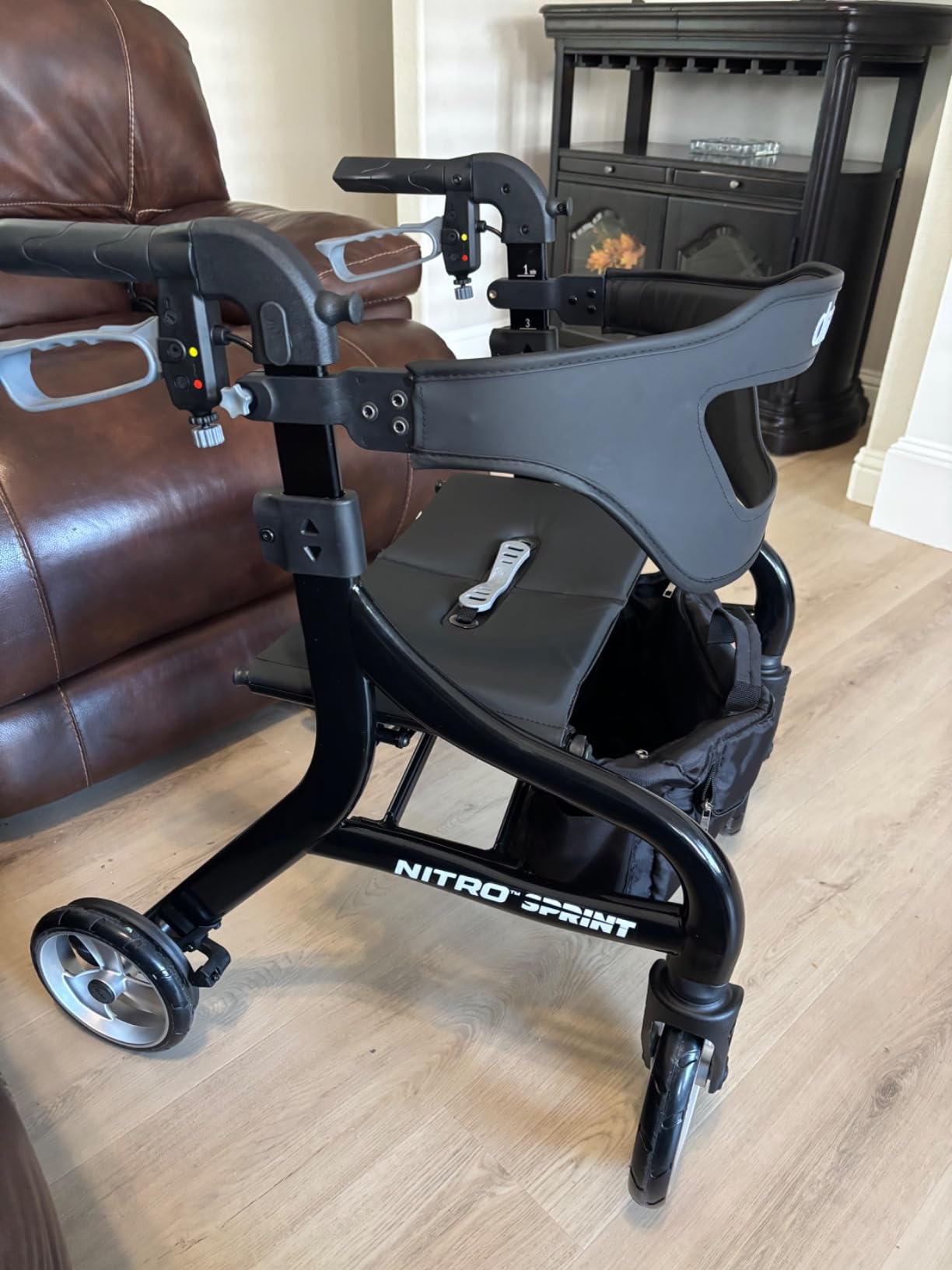
The Nitro Sprint is the frame we keep coming back to because Drive Medical builds it specifically for people six feet and taller, rather than stretching a standard frame. The aluminum tubing runs taller, which is the single change that decides whether you stand up straight or hunch for the length of a grocery trip.
It weighs 19.5 lb, which is mid-range for a reinforced tall frame, and it folds with one hand down to a 9.65 inch profile. The folded dimensions matter more than most sellers admit: an AgingCare caregiver told us the ability to fold a rollator into a car was the deciding factor in their purchase, and this one folds flat enough for a trunk or a back seat.
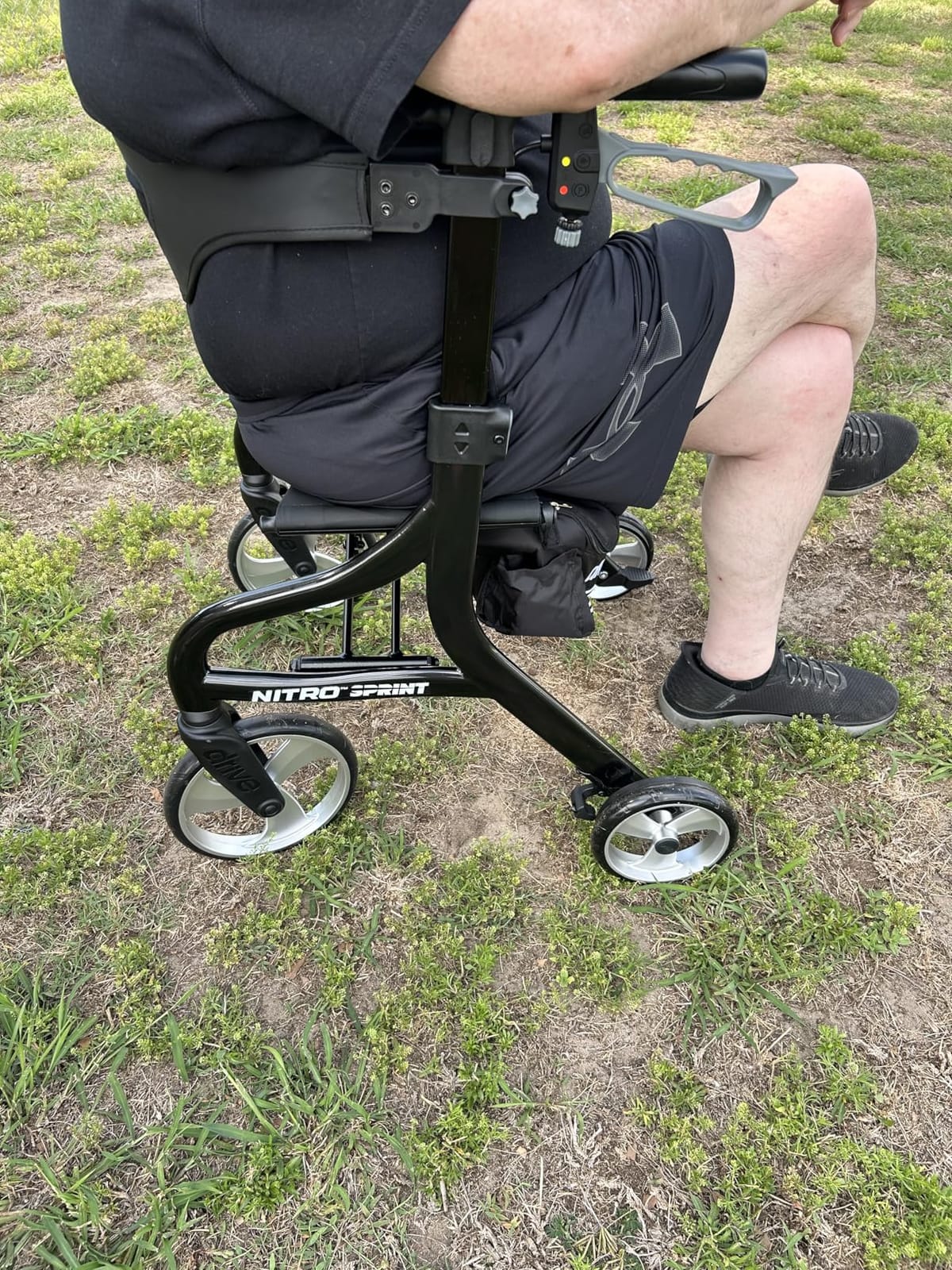
The braking system is the part that separates this from a basic tall walker. It runs in three modes, free roll, slowdown and park, and the integrated slowdown brake is genuinely useful on a slope because it takes the panic out of a descent. Reviewers also point to the extra-large contoured backrest, which has a viewing window and adjusts in height, so the seat backs you rather than pressing into your lower back.
The storage bag mounts in three positions, at the handlebars, at the front, or under the seat, which is a small detail that decides whether you can carry a purse, shopping or a water bottle without a second bag. Drive Medical also offers this same frame in standard and petite heights, so the tall version is a deliberate SKU rather than a stretched standard one.
Is the Nitro Sprint right if you walk outdoors every day?
If your usual route involves pavement seams, grass verges or a gravel driveway, the 10 inch front casters are the reason to pick this frame. They roll over cracks and small stones that stop a six-inch wheel dead, and the improved tread gives shorter stopping distances on wet pavement.
It is also the safest of the ten here for downhill walking, because the slowdown mode lets you bleed speed without hauling on the loop brakes. If you live somewhere with hills, that single feature will do more for your confidence than any seat padding.
Should you skip it if you lift your walker into a car alone?
At 19.5 lb it is heavier than the lightest frame in this list but still manageable for many people, particularly because the one-hand fold means you do not have to wrestle it closed. If your strength is limited or a caregiver is not available, look at a lighter aluminum option instead.
The trade-off is that lighter frames usually top out lower on handle height, and that is the one spec you should refuse to compromise on. A frame that is easy to lift but stops at 38 inches will put you back into the forward lean you are trying to escape.
2. MAXWALK Tall Rollator Walker – Best for the Highest Seat
MAXWALK Walkers for Seniors with Seat, Tall Rollator Walker, Foldable
Handles 36.6 to 40.1 inch
Seat 22.8 to 24.4 inch
12 inch front wheels
20.6 lb frame
Pros
- Seat adjusts up to 24.4 inch
- one of the highest we found
- Handles reach 40.1 inches
- 12 inch front and 10 inch rear rubber wheels
- Built-in brake cable routing
- Quick fold using the seat pull-cord
- Removable cup holder and cane holder included
Cons
- 300 lb weight limit is lower than the bariatric frames
- Seat is narrower than the extra-wide models
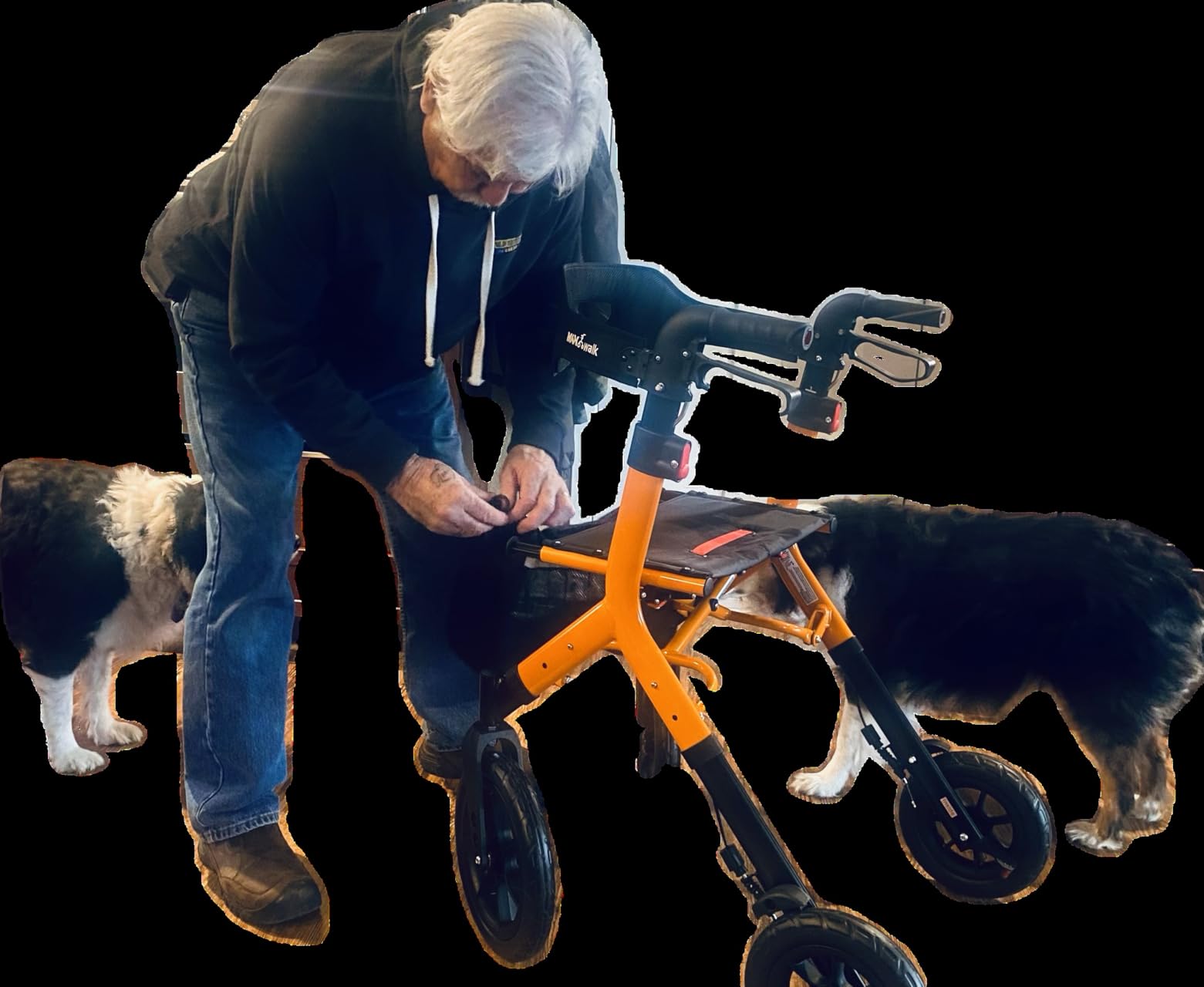
This is the frame to look at if sitting down and standing back up is your biggest daily problem. The seat adjusts through two levels from 22.8 to 24.4 inches off the floor, and at the top setting a tall user can almost straighten the legs rather than dropping into a squat. That matters enormously if you use a cane for a few steps and then sit down again every few hundred yards.
MAXWALK states the frame fits users from 5 ft 3 in to 7 ft, which is the broadest height window of any rollator in this roundup. The handle adjusts across four levels from 36.6 to 40.1 inches, and because it is a listed range rather than a single number, you can dial in your exact wrist crease rather than accepting a top setting that is slightly too tall.
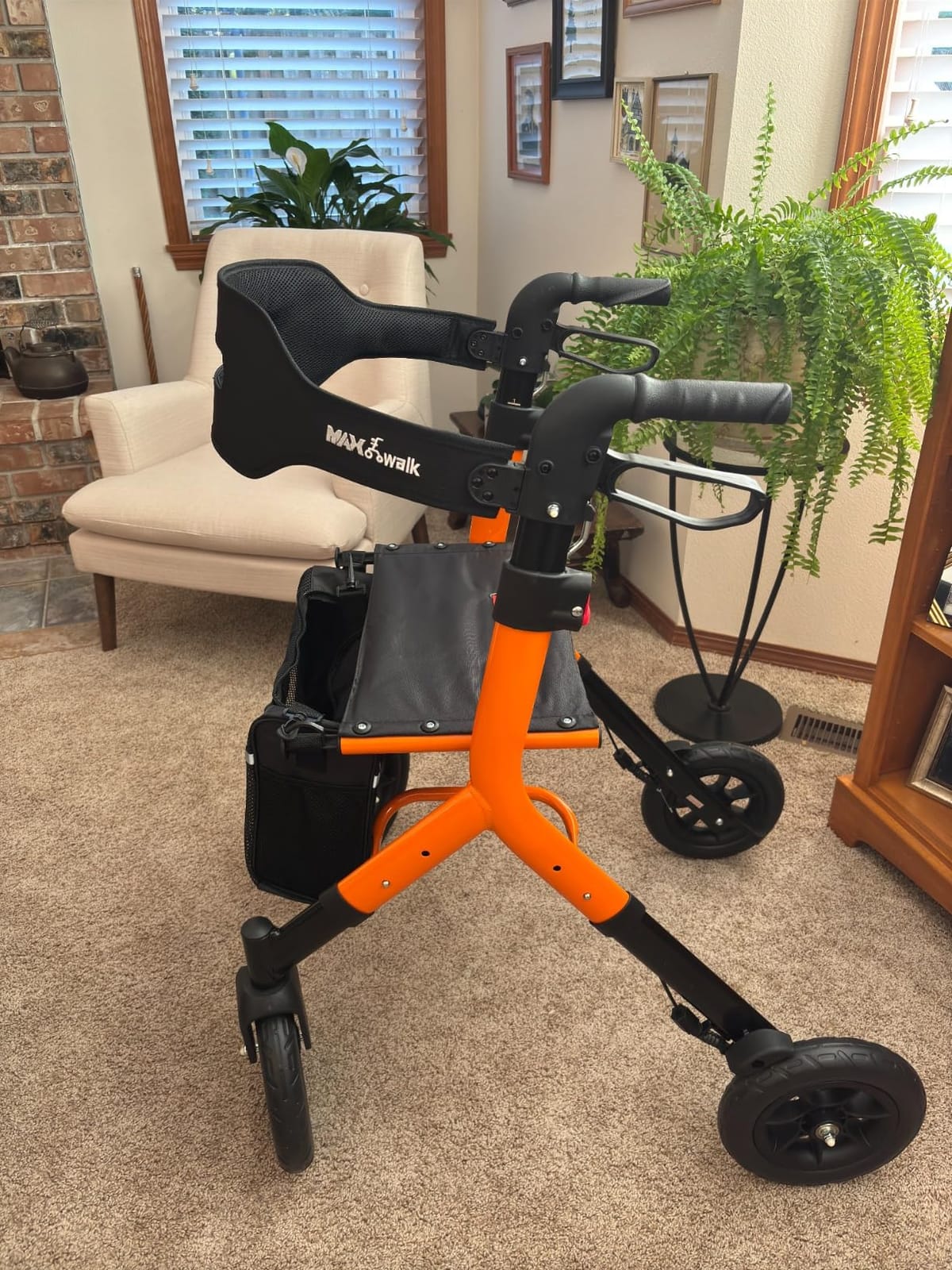
The wheels are the story here. Twelve-inch rubber fronts and ten-inch rears with 360 degree swivel roll smoothly over gravel, grass and cracked concrete, and reviewers describe them as noticeably quieter than the small hard wheels on a standard indoor rollator. The brake cables run inside the frame instead of looping around the outside, so there is nothing to snag on a doorway or trip over in the dark.
Folding is handled by a pull-cord under the seat, and the folded package measures 9.8 inches wide by 29.5 inches deep. That is thin enough for most car boots and apartment cupboards, and it stands on its own when folded, which stops it tipping over in a hallway.
Will the 300 lb limit be a problem for you?
Only if your body weight plus whatever you carry in the basket approaches 300 lb. For most tall adults who use a rollator for balance rather than weight bearing, the limit is comfortable and the frame is correspondingly lighter and less bulky than a reinforced steel model.
If you are over that range, this is the wrong frame. Go to a reinforced bariatric model with a 450 to 550 lb rating, and accept the extra weight that comes with it.
Does the two-level seat adjustment make up for a narrow seat?
The seat measures 17.7 by 9.8 inches, which is narrower than the extra-wide bariatric frames here by several inches. For a tall, lean adult who mainly uses the seat for a short rest, that width is fine and it keeps the base narrow in a hallway.
If you plan to sit for ten minutes or more, or if you carry weight on your lap when you sit down, spend the money on a 20 or 22 inch seat instead. A high seat you cannot comfortably use is no better than a low one.
3. Helavo Extra Wide Bariatric Rollator – Best Rated for Tall and Heavy Users
Helavo 28.3″ Extra Wide Bariatric Rollator Walker, 550 lbs Capacity
550 lb capacity
Handles 33.1 to 39.0 inch
Seat 20.9 to 22.8 inch
21.4 lb frame
Pros
- Highest weight capacity in this roundup at 550 lb
- 22.4 inch handle spacing gives a genuinely wide seat
- Handle range reaches 39 inches for users over six feet
- Still light enough at 21.4 lb to lift into a car
- Large under-seat cubby with cup and cane holders
- Two-year warranty extendable to three
Cons
- Bulky frame is awkward to carry and hard to load in smaller vehicles
- Seat is firm and not ideal for long sits
- Minimum handle height may be too tall for users under 5 ft 4 in
Among the ten frames we examined, the Helavo H1150 carries the highest customer rating and the highest weight capacity, and it does both without turning into a piece of garden equipment. A 550 lb rating on a 21.4 lb aluminum frame is a genuinely efficient piece of engineering, and it means a tall adult does not have to choose between a frame that holds their weight and one they can still lift themselves.
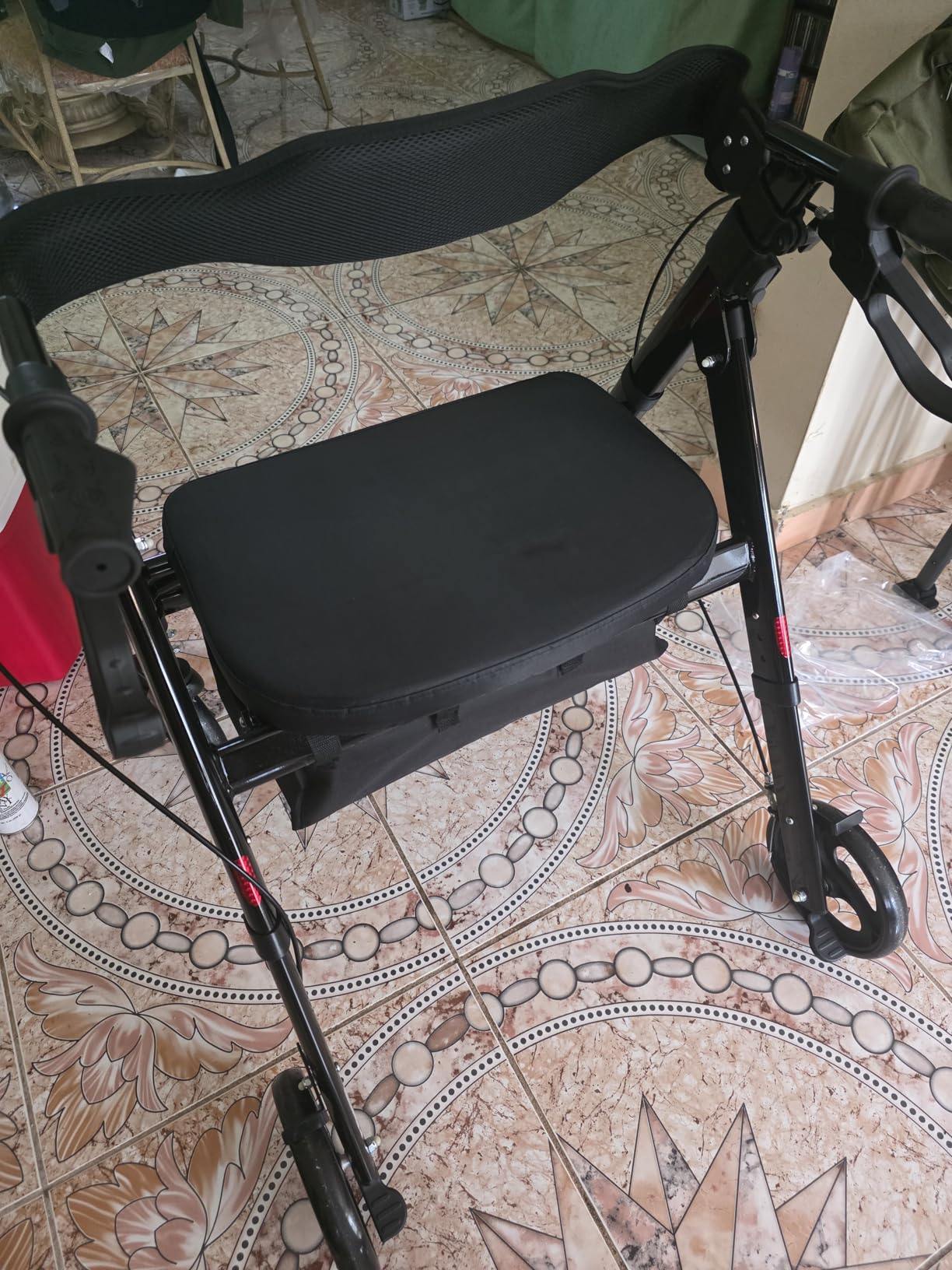
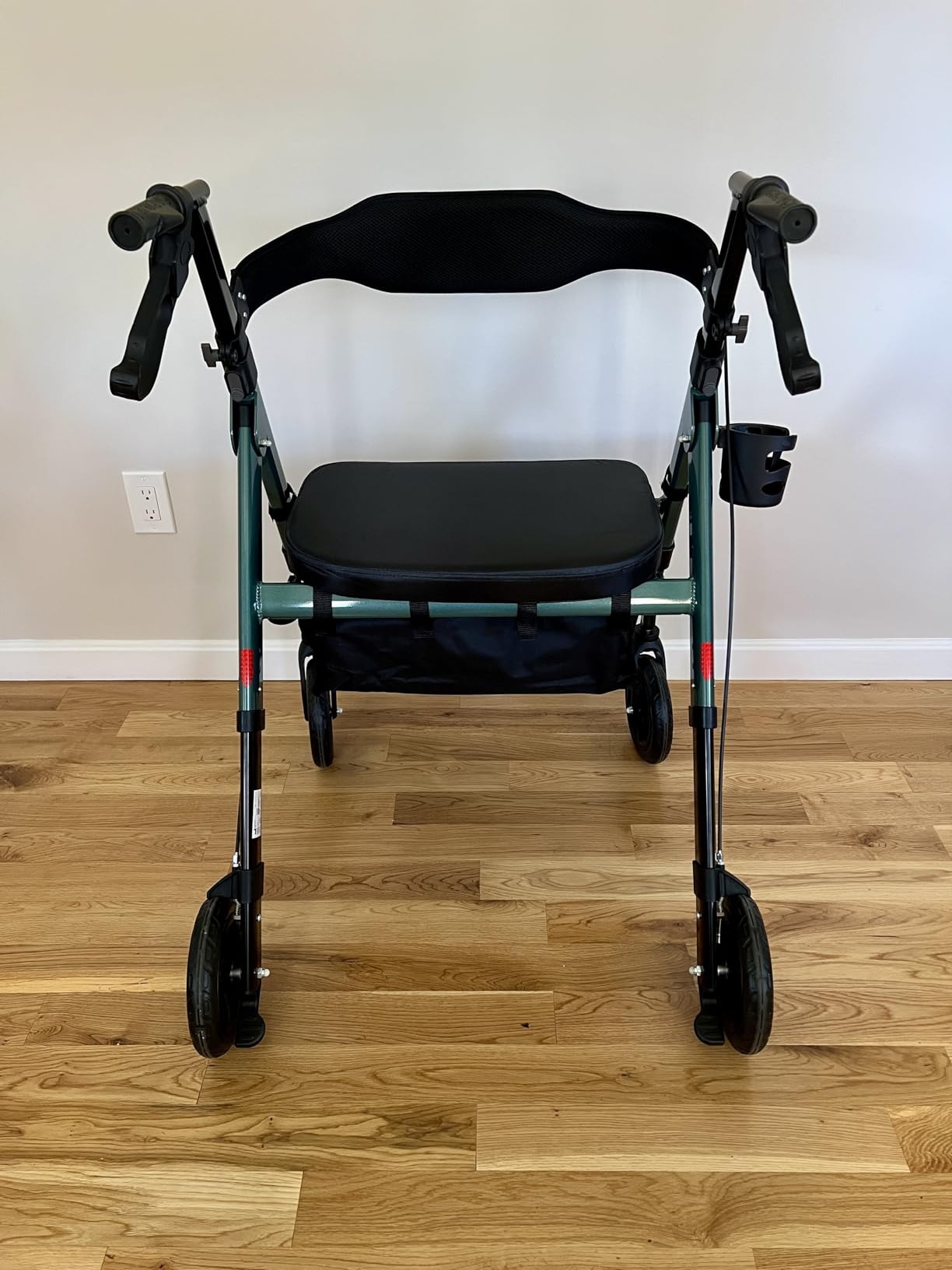
Handle height runs from 33.1 to 39.0 inches and the seat adjusts from 20.9 to 22.8 inches, with a vertically adjustable backrest. The 22.4 inch spacing between the handles is the detail that makes this a bariatric frame rather than a tall one: it gives you room to sit down without your knees and hips fighting the side rails.
Helavo backs the frame with a two-year warranty that can be extended to three, plus 24/7 support and replacement parts. That matters for a mobility aid, because the failure points are brakes, wheels and folding joints, and a spare caster costs very little when a supplier will send it.
The honest drawback is bulk. The folded size is 37.8 by 28.3 by 13.8 inches, so this is a two-handed lift and a wide load. Reviewers also describe the seat padding as firm, which is fine for a two-minute rest on a shopping trip and uncomfortable for a long afternoon on a bench.
Is this the right choice if you are tall and over 300 lb?
Yes, and it is the frame we would point a tall, heavier adult toward first. The 39 inch handle ceiling is high enough to keep a six-footer upright with a slight elbow bend, and the 550 lb rating leaves a wide safety margin above your actual body weight.
Check your doorways before you commit. With a frame this wide, a narrow internal doorway or a tight bathroom can rule it out, and a rollator you cannot get through your own front door is useless in the house.
Would a lighter standard frame serve you better?
If you are under 300 lb and you are strong enough to lift a frame into a car solo, a standard aluminum tall rollator will be easier to handle and cheaper to own. You will give up the wide seat and the reinforced rating, and you will carry much less weight when you fold it.
The trade-off is only worth it if the extra width genuinely does not fit your home. A narrow hallway and a small bathroom are the two rooms that decide this.
4. HOMLAND 500 lb Bariatric Rollator – Best for 500 Pound Frames
HOMLAND Bariatric Walkers for Seniors with Seat, 500lb Heavy-Duty Rollator
500 lb capacity
Handles 33 to 40 inch
Seat 20 to 23 inch
24 lb carbon steel frame
Pros
- Handle height reaches 40 inches
- Steel frame with double support bars rated to 500 lb
- 20 inch padded seat is among the widest here
- Reflective strips for evening visibility
- Tool-free assembly and enclosed folding joints
Cons
- Around 24 to 25 lb
- heavy for anyone with limited lifting strength
- Backrest is fixed and cannot flip for table seating
- Velcro folding strap slips and does not reliably hold the frame shut
HOMLAND takes a different approach from the aluminum frames here: a reinforced carbon steel chassis with double support bars, rated to 500 lb, and it is still the only steel frame in our picks. Steel does not bend, which is why it is the right material for a user who is tall, heavy, or simply puts more force through the handles when they push off.
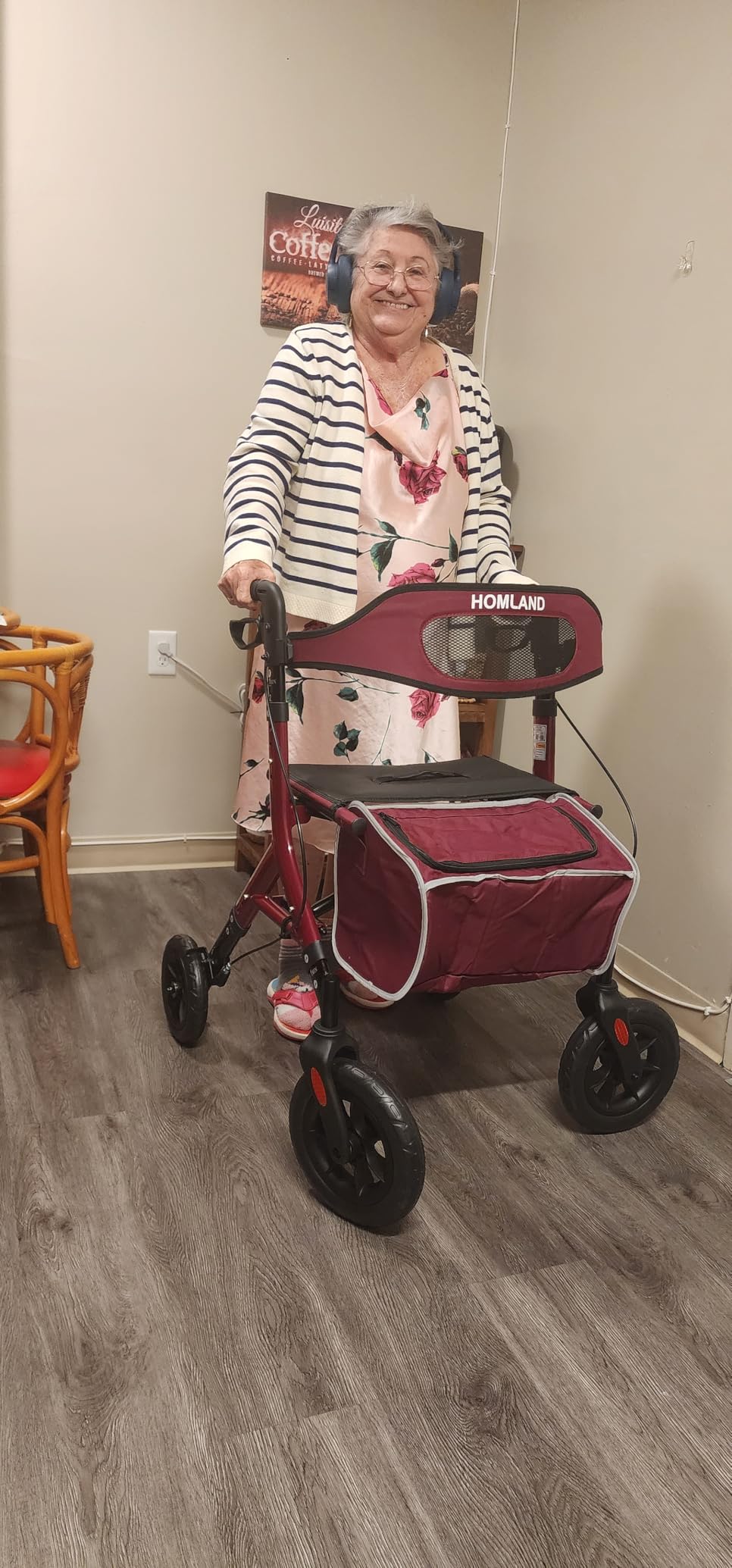
The handle height reaches 40 inches, matching the tallest standard frames on the market, and HOMLAND lists the fitting range as 4 ft 7 in to 6 ft 5 in. The seat adjusts from 20 to 23 inches on a 20 inch wide padded cushion with a 5.5 inch backrest, so the seating is genuinely wide rather than nominally wide.
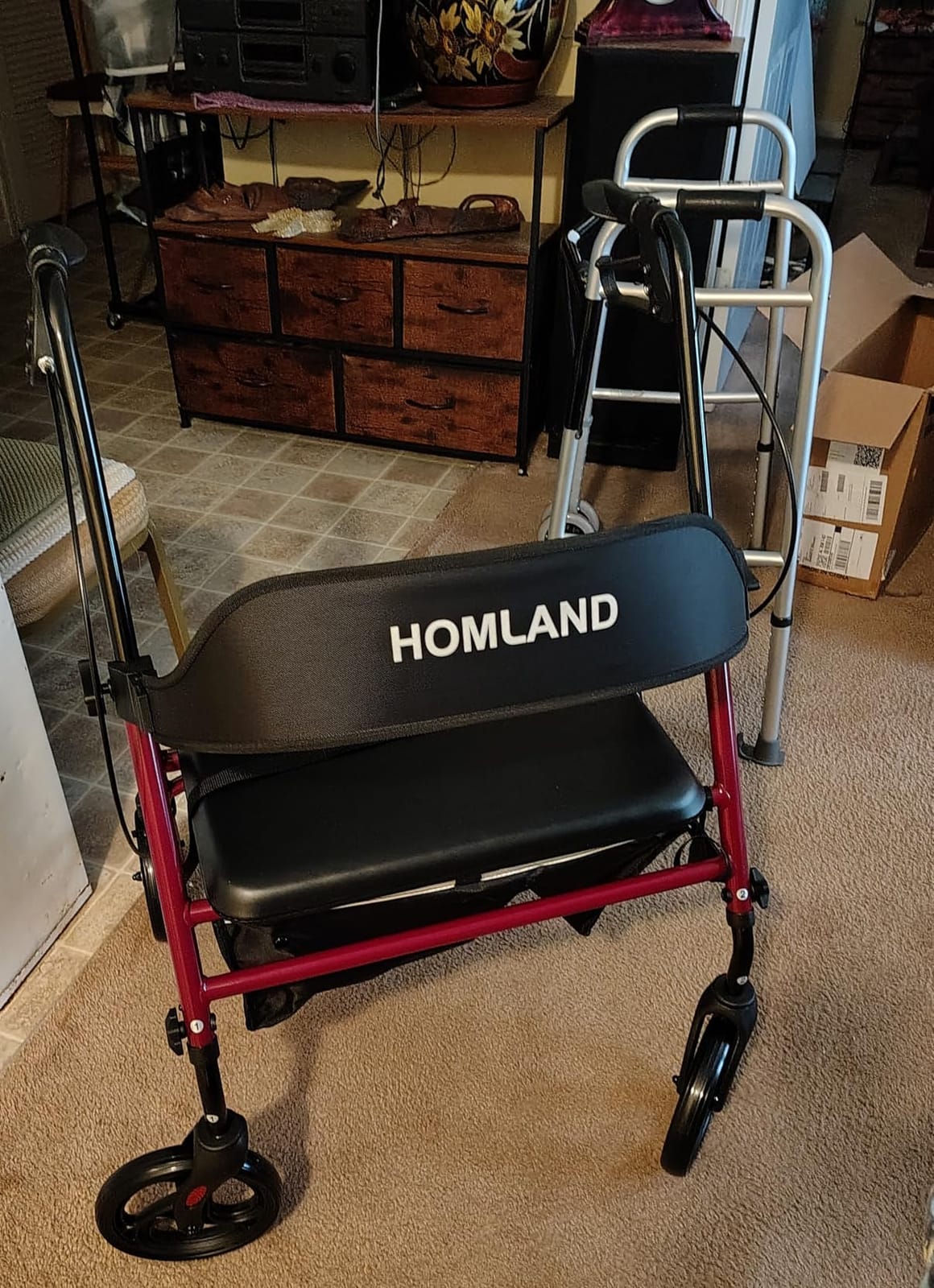
The eight-inch anti-slip wheels handle grass, gravel, carpet and pavement, and reflective strips on the frame improve visibility at dusk. Assembly is tool-free, and the frame folds down to fit most car trunks with the under-seat storage bag still attached.
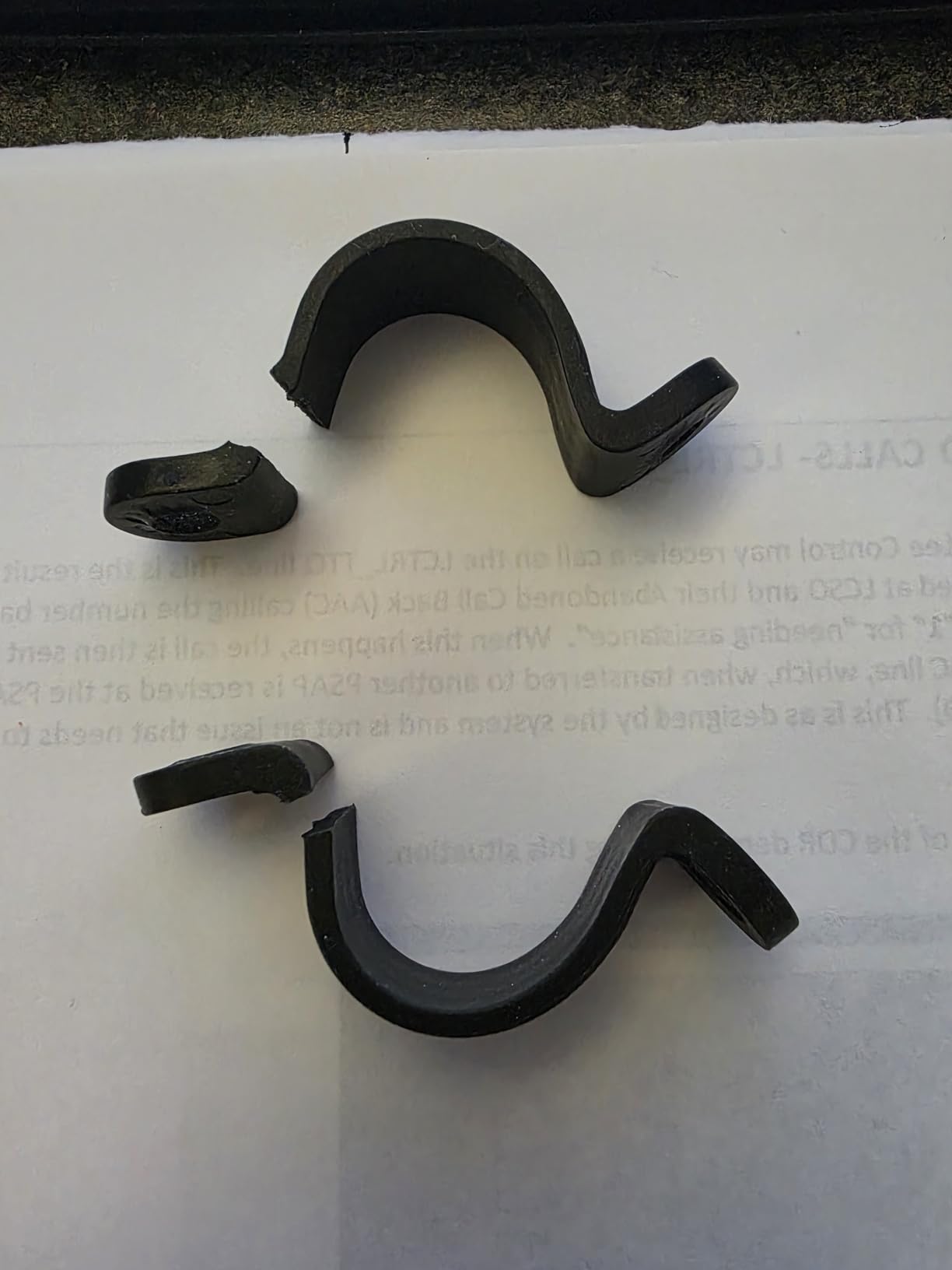
Be clear-eyed about the weight. This is the heaviest frame we tested at about 24 lb, and the folding strap is the single most repeated complaint in reviews, since a front-to-back fold leaves the handles sticking out and the strap does not reliably hold them together. Both matter if you load and unload regularly.
Do you need a steel frame this strong?
Only if you are a heavier user or you push down hard on the handles, which many people instinctively do when they start walking. Under roughly 300 lb, an aluminum frame gives you a lighter, cheaper rollator that will still hit 40 inches of handle height.
If you do need the capacity, this is a well-built frame with a sensible range, and the fixed backrest is only a problem if you plan to roll up to a table and reverse under it.
Is 24 lb too heavy to lift into a car?
For a caregiver loading it, no. A carer on AgingCare described folding a rollator into a car as the deciding factor in their purchase, and this frame folds, though you will want two hands and a firm grip.
For a solo user with weak arms or shoulder problems, it is a hard lift. Choose a lighter aluminum model even if it means dropping capacity, because a rollator that stays in the garage is not a mobility aid.
5. FlyingJoy 450 lb Rollator – Best for the Tallest Handle Reach
450Lbs Bariatric Rollator Walker,Heavy-Duty Walkers for Seniors with seat
Handles 33 to 41.5 inch
Seat 19.5 to 23 inch
450 lb capacity
23 lb frame
Pros
- Tallest handle range here at 41.5 inches
- 22 inch extra-wide breathable mesh seat
- Tool-free assembly in about ten minutes
- Lockable hand brakes with a parking function
- Air-free never-flat tires with reflective strips
Cons
- 25.98 inch base is difficult through narrow doorways
- Fixed back brace can press into the lower back
- Textured seat material can feel slippery when you lean back
If you are six foot four or taller, the handle ceiling is the only number that matters, and FlyingJoy reaches 41.5 inches across eight positions. That is the tallest adjustment range of any four-wheel rollator we found, and it leaves real slack so the handles can sit at your wrist crease rather than at maximum extension.
The frame is reinforced aircraft-grade aluminum rated to 450 lb, which puts it in the middle of this group: stronger than a standard frame, lighter than the steel model. Handle positions run from 33 to 41.5 inches and the seat adjusts from 19.5 to 23 inches across the same eight points.
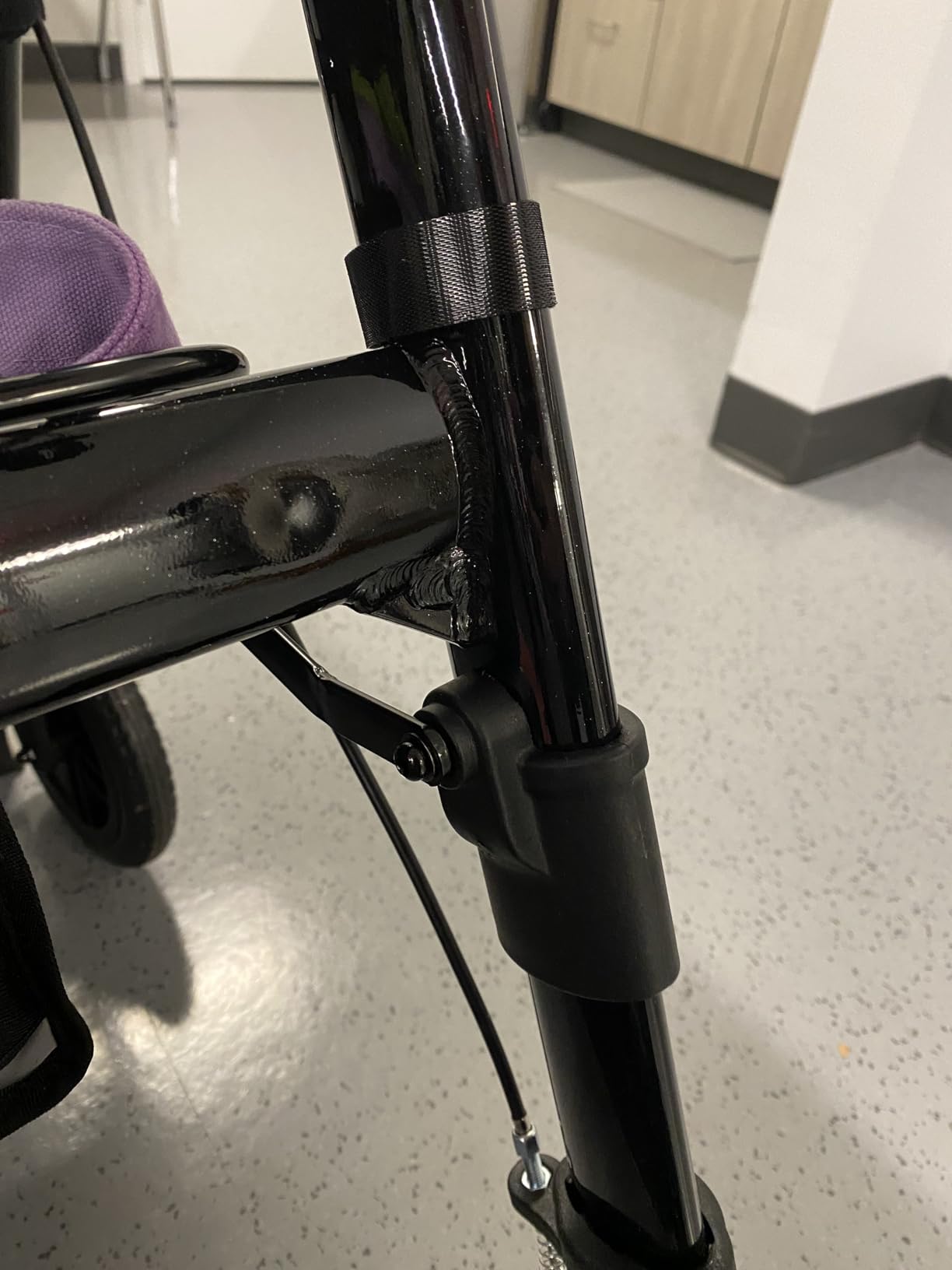
The seat is the standout feature at 22 inches wide in breathable mesh fabric, twice the width of a standard rollator seat. Mesh matters more than buyers expect, because it does not hold sweat and it does not slide when you lean back, and the reflective safety strips on the tires and the storage bag help on an evening walk.
Assembly takes about ten minutes with no tools, and reviewers report the frame is stable and free of wobble once built to the instructions. Wheel bearings on some units needed greasing out of the box, which is worth checking during the first week of use.
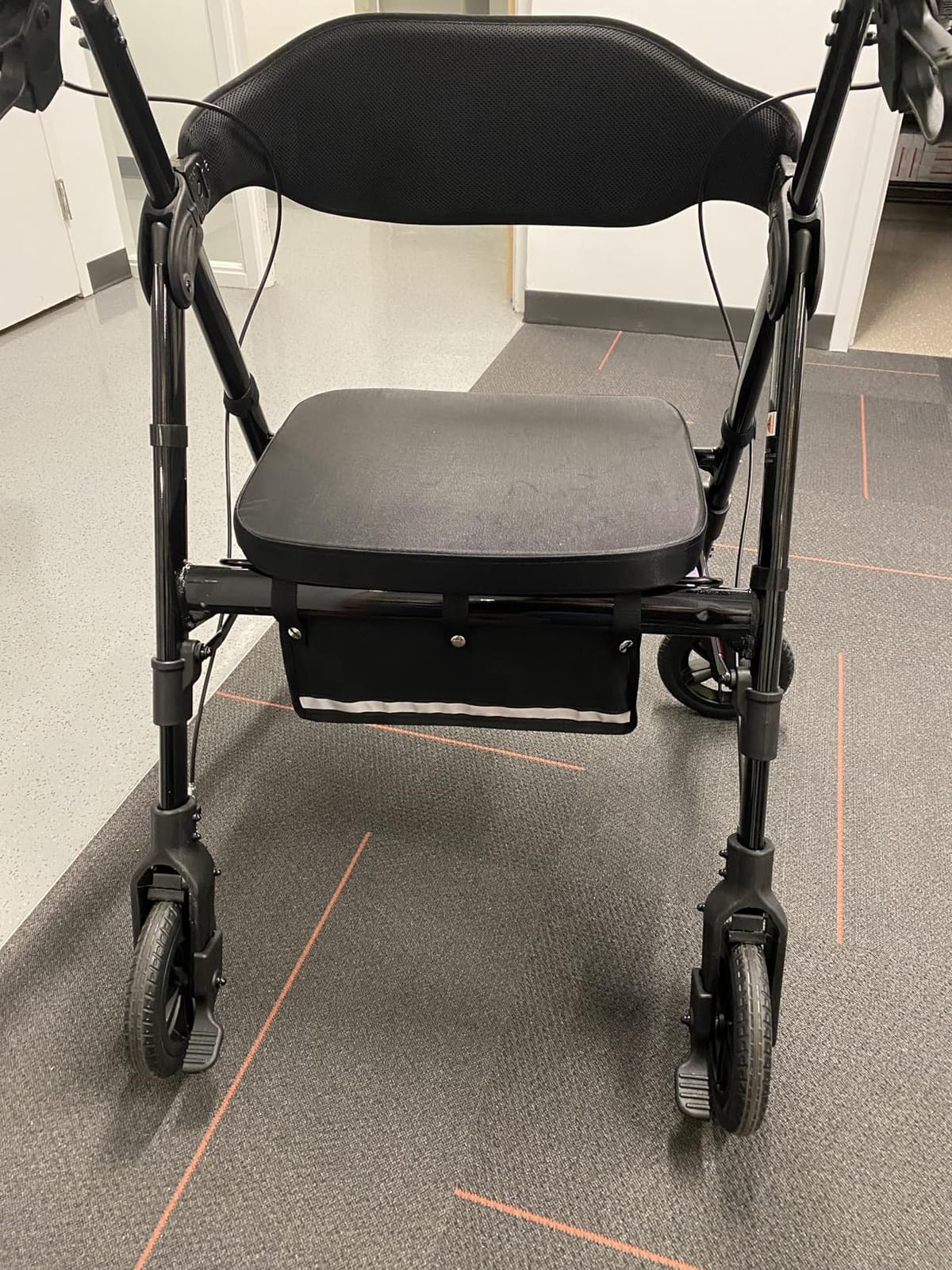
Does the 25.98 inch base make this unusable indoors?
It depends entirely on your narrowest doorway. The manufacturer publishes the base width precisely because it is the number that trips people up, and a standard interior door is often 30 to 32 inches so the frame will pass, while a 26 inch door with a bulky handle will not.
Measure the narrowest opening in your home and the bathroom door before ordering. This is the single most common reason a bariatric rollator gets returned, and it is entirely avoidable.
Is the fixed back brace a problem over a long walk?
Some buyers report the back brace pressing into the lower back when they sit back, and it does not move up or down. If you plan to sit for a rest every half mile, that pressure becomes noticeable after a few repetitions.
It is a manageable complaint if your walks are shorter, and the adjustable-height backrests on the aluminum frames here are the better choice for long walks. Weigh that against the extra 1.5 inches of handle reach before deciding.
6. ELENKER Upright Walker – Best for Upright Posture
ELENKER Upright Walker, Stand Up Folding Rollator Walker Back Erect Rolling Mobility Walking Aid with Seat, Padded Armrests for Seniors and Adults, White
Armrests 38 to 47 inch
10 inch front and 8 inch rear wheels
24 lb frame
Solid PVC
Pros
- Forearm support keeps your back erect and relieves shoulder pain
- Quiet operation compared with standard aluminum walkers
- 10 inch front wheels with a lift lever on each rear wheel for kerbs
- Folds flat and fits in a compact car
- Seat and backrest with lockable rear wheels
Cons
- Front and rear wheels are different sizes
- Arm rails can feel wobbly side to side at first
- 24 lb is heavy for anyone with limited lifting capacity
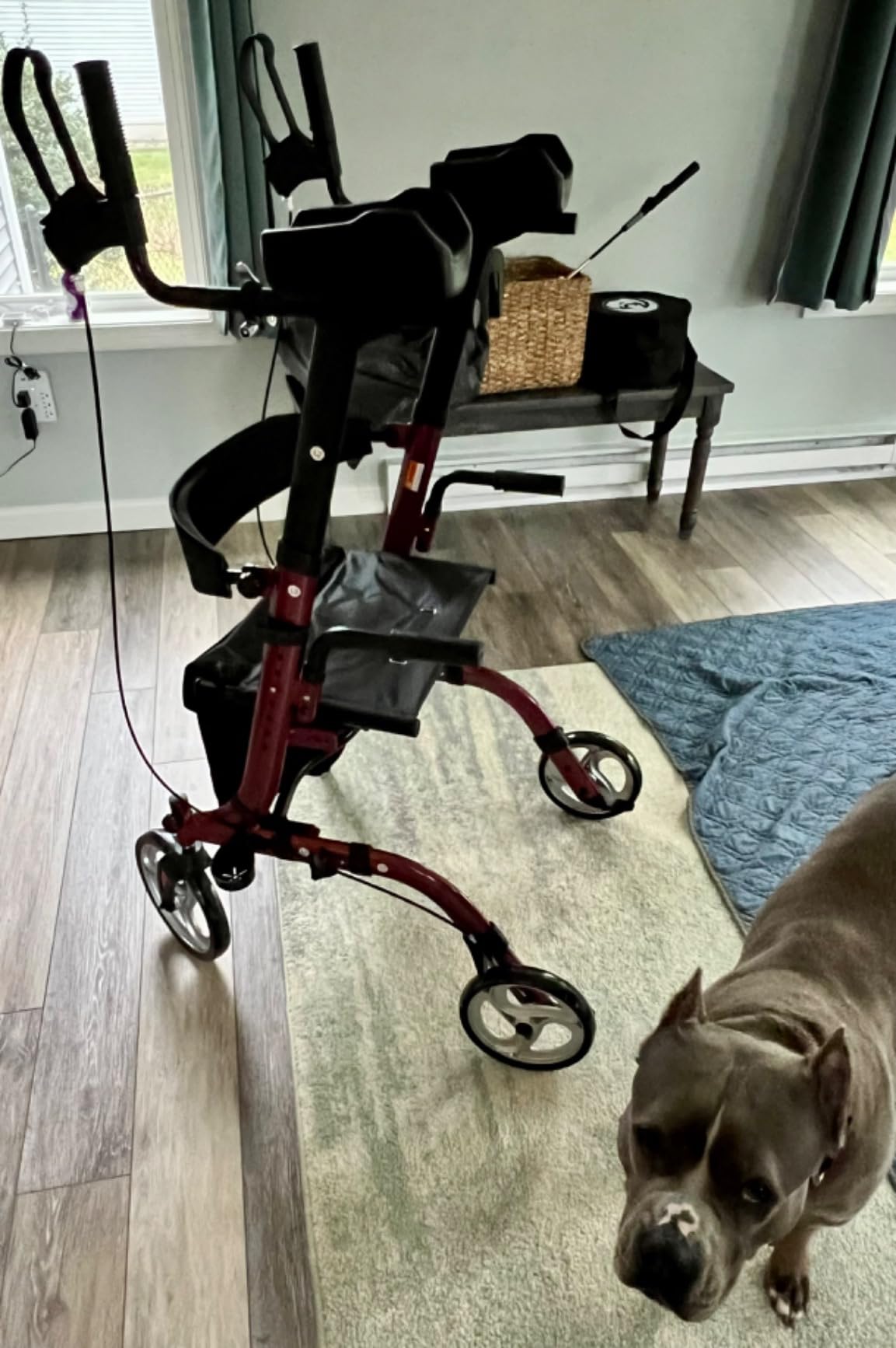
This is an upright or forearm-support walker, not a standard rollator, and that difference is the entire point. You rest your forearms on padded armrests set 38 to 47 inches from the ground rather than gripping handles at waist height, which lets you stand up straight and keeps weight off your wrists and shoulders.
A poster on The Chat Board described upright rollators as sleeker and less bulky than standard rollators, and added that having a tall option is a real advantage. The same thread noted that most seniors who do not strictly need a rollator are better served by lighter upright models, which matches what we see in the reviews of this frame.
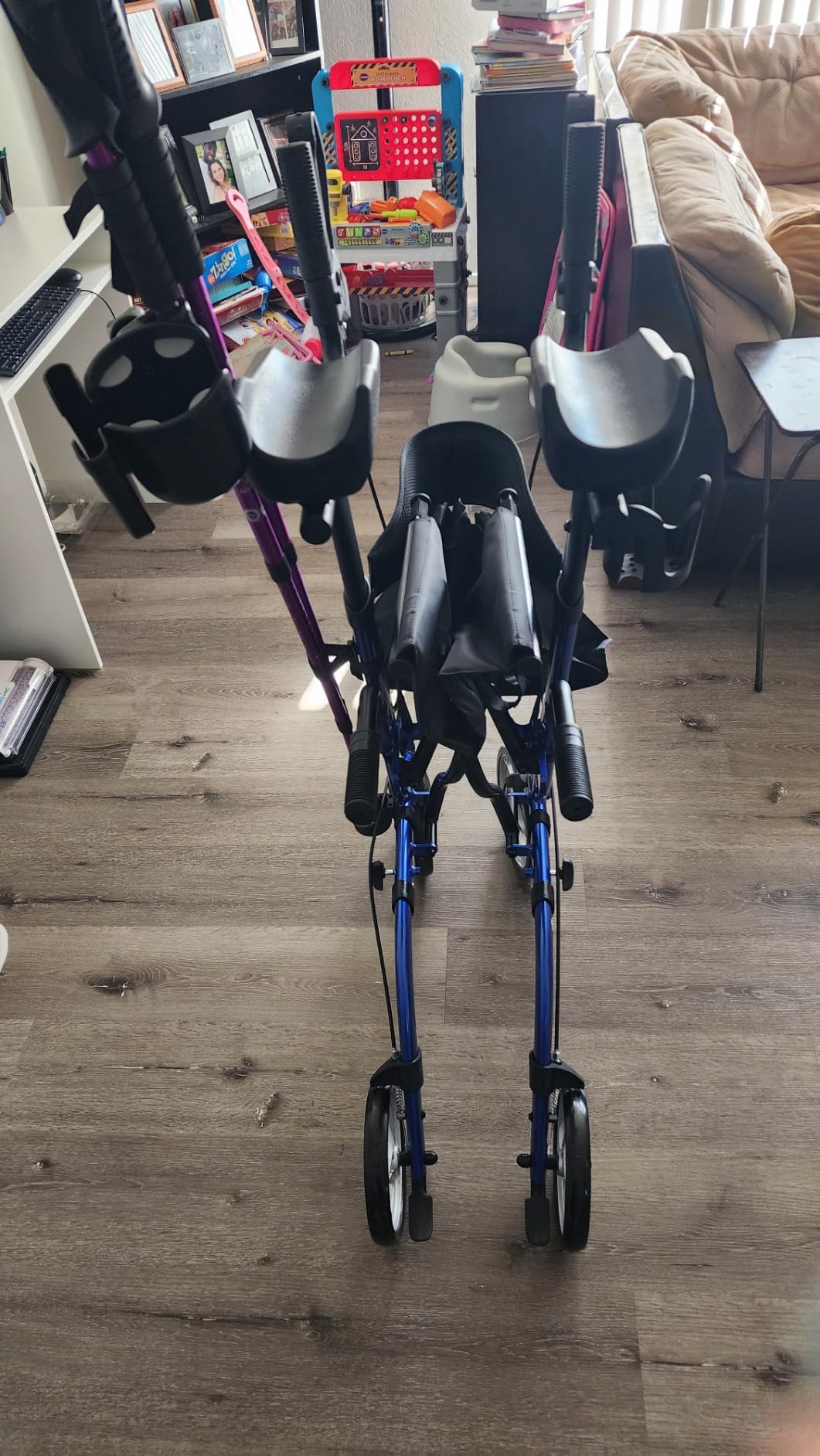
The build is solid PVC with 10 inch front and 8 inch rear wheels, and the front pair swivels 360 degrees for tight indoor turns. Each rear wheel has a lift lever for kerbs and ramps, and the ergonomic hand brakes push forward to slow or stop, which takes less hand strength than a squeeze brake.
The seat measures 18 by 10 by 21 inches in breathable mesh with a durable backrest, and the rear wheels lock for stable seating. It folds for compact storage and fits in the back of a small car, which is the practical test that matters for most buyers.
Should a tall senior choose an upright walker over a rollator?
If you stoop even with a standard rollator at maximum height, yes. Forearm support keeps your spine in a neutral line, and owners repeatedly credit this frame with relief from shoulder and lower-back pain that a four-wheel rollator never solved for them.
The trade-off is bulk. Upright walkers are wider and heavier than standard rollators, so they are harder to move between rooms and harder to load in a car. Measure your doorways before choosing one.
Is the armrest height range right for a very tall user?
At 38 to 47 inches, this covers most adults up to about six foot three, and it sits at the top of the armrest range in this group apart from the Vive. If you are significantly taller, check the maximum before you commit, because the top setting here is lower than the Vive reaches.
The spacing between the arm supports is fixed, so shorter users may find it wide. A r/physicaltherapy commenter put the general case well: rollators are good for some people, but anyone who needs to actually bear weight is better served by a different aid.
7. Helavo Upright Walker H1160 – Best Premium Upright for Outdoors
Helavo Upright Walker with Seat, Foldable Stand Up Walker with Rubber Tires
Frame height 46.9 inch
10 inch rubber tires
Seat up to 22 inch
22.7 lb aluminum frame
Pros
- Very tall 46.9 inch frame supports a fully upright posture
- Padded armrests and ergonomic height adjustment reduce shoulder strain
- 10 inch puncture-proof rubber tires roll on rough ground
- Adjustable padded backrest and cushioned 18.9 inch seat
- Cup holder and cane holder included
Cons
- 18.9 inch seat is narrower than the extra-wide bariatric models
- 300 lb capacity is a standard rating rather than heavy duty
- Frame height can feel tall for shorter users
The Helavo H1160 is the upright walker we would pick if your walking happens outside. It stands 46.9 inches tall, putting the padded armrests at a level most tall users find restful, and it rides on 10 inch puncture-proof rubber front wheels that do not go flat and do not rattle over cracked pavement.
Soft padded armrests and height-adjustable ergonomic handles take the load off your shoulders, upper back and arms, which is the whole point of an upright frame. Owners who switched from a standard rollator report less upper-body strain within a few weeks of regular use.
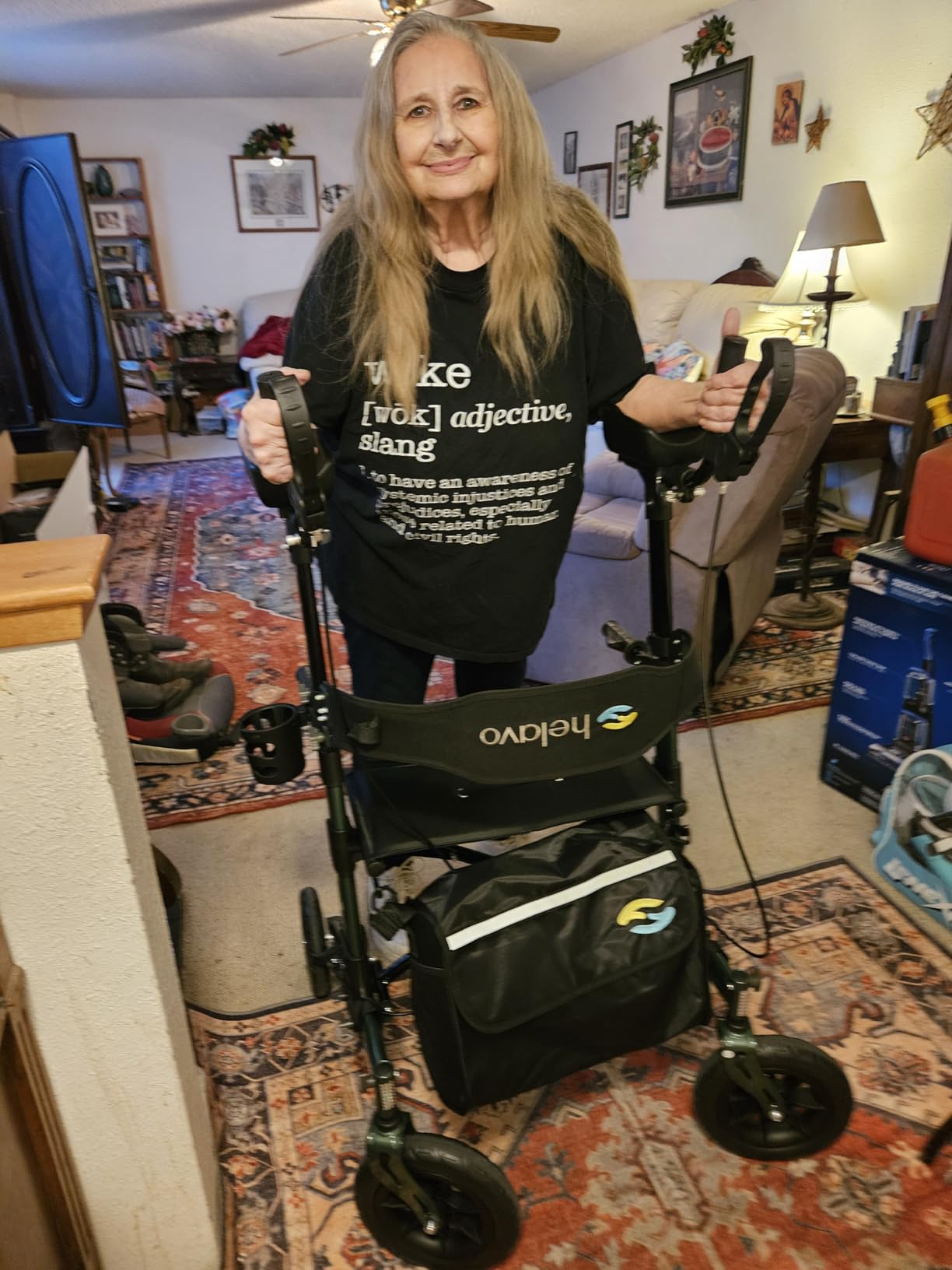
The seat is 18.9 inches wide and 9.1 inches deep with a maximum height of 22 inches, and the padded backrest adjusts in height. A cup holder, an integrated cane holder and a brake system with a parking brake are all standard, and the frame is aluminum at 22.7 lb supporting 300 lb.
The warranty is two years and can be extended to three, with 24/7 support, replacement parts and video assembly instructions. That is a stronger support package than most frames in this price class offer, and it matters over a five or ten year ownership period.

Is the outdoor wheel package worth paying more for?
If you walk on pavement, grass or a gravel driveway more than once a week, yes. Puncture-proof rubber tires need no inflation, survive kerbs and cracks, and stay quiet on smooth indoor floors, which means you can use the same frame inside and out.
If you walk only on flat indoor flooring, six or eight inch non-marking wheels are quieter and cheaper, and an indoor-only frame is a reasonable choice.
Will the 46.9 inch frame feel awkward in an apartment?
It is tall, and turning a tall frame in a narrow hallway takes practice in the first few days. Reviewers also note the frame can feel too tall for users below average stature, so this is a frame for a tall user who wants to stand up fully straight.
Check that your ceiling clearance and door heights accommodate a 26.4 inch wide base before ordering, and give yourself a week of short indoor walks to adapt before taking it outside.
8. HOMLAND All-Terrain Rollator – Best for Lightweight Handling
HOMLAND All-Terrain Rollator Walker with Seat for Seniors, Aluminum Frame
16.4 lb frame
Handles 33.5 to 38 inch
Folds to 9 inch wide
10 inch front wheels
Pros
- Lightest frame here at 16.4 lb
- One-hand fold to a 27.5 by 9 by 33.5 inch package
- 10 inch shock-absorbing front wheels for grass and light gravel
- Dual loop brakes with a firm parking lock
- 18 inch padded seat with a 6.5 inch backrest
Cons
- Handle range tops out at 38 inches
- well below the tall frames
- 18 inch seat is standard width
- 300 lb capacity is below the bariatric models
At 16.4 lb this is by some distance the lightest frame in our roundup, and that single fact changes who can realistically use a rollator. It folds with one hand to a package only 9 inches wide, which is the difference between a rollator that goes in the car and one that stays by the front door.
A r/CFS user described picking a light four-wheel model for exactly this reason, in a small house where it was easy to lift into a car. If you live alone, do your own shopping, or have nobody to help you load a walker, weight is a functional spec rather than a preference.
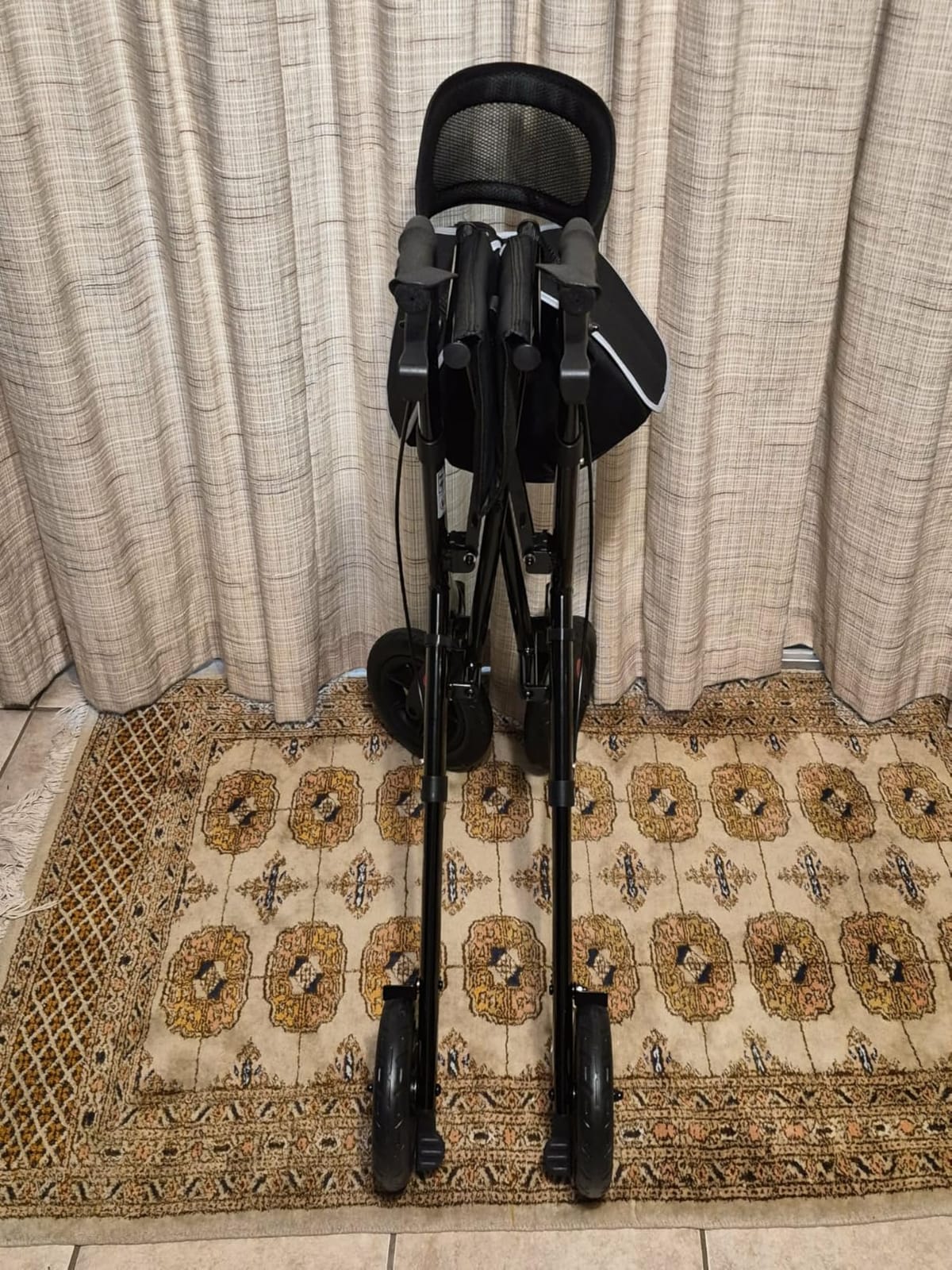
The wheels are still serious outdoor hardware, with 10 inch shock-absorbing rubber fronts and 8 inch rears that cope with grass, pavement and light gravel. Dual loop brakes give smooth speed control and a firm parking lock, and the ergonomic grips reduce hand fatigue on longer walks.
The trade-off is height. The handle adjusts from 33.5 to 38 inches, which HOMLAND rates for users from 4 ft 7 in to 6 ft 6 in, but a wrist crease above 38 inches will leave you leaning. If you are tall in the legs rather than tall overall, this frame may suit you perfectly.
Is 38 inches of handle height enough for a six-footer?
It depends on your wrist crease, not your height in feet. Measure from the floor to the wrist crease with your arms hanging, and if that number is 36 to 38 inches this frame fits you well. If it is 39 inches or more, keep looking.
Several tall users are shorter in the arm than their overall frame suggests, which is why we recommend measuring rather than estimating. A frame that fits your wrist crease will keep your elbows at a natural angle.
Would a heavier frame serve you better on rough ground?
If you walk on uneven ground regularly, a heavier frame with bigger front casters holds its line better and absorbs more jolts. You give up the one-hand fold and the easy car load, and you need two hands to lift it.
For mostly paved or indoor routes, this lightweight frame is the more practical choice, and the dual loop brakes are a genuine step up from the small push brakes on budget walkers.
9. RollisRoll 12 Inch All-Terrain Rollator – Best for Narrow Doorways
Walkers for Seniors, Rollator Walker with Seat, 12″ Big Rubber Wheels All Terrain Rolling Walker with Backrest, Foldable Rollator Walker, Reinforced Aluminum Frame, Built-in Cable, Orange
Handles 32.6 to 37 inch
23.8 inch frame width
12 inch front wheels
19.2 lb frame
Pros
- Narrowest base here at 23.8 inches for tight doorways and lifts
- 12 inch front and 10 inch rear rubber wheels
- Quiet solid build compared with rattly loaner rollators
- Three-second quick fold that stands upright when folded
- Five-minute tool-free assembly
Cons
- Handle range tops out at 37 inches
- Strong factory odour that takes about two days of air to clear
- Seat is narrower than the bariatric models
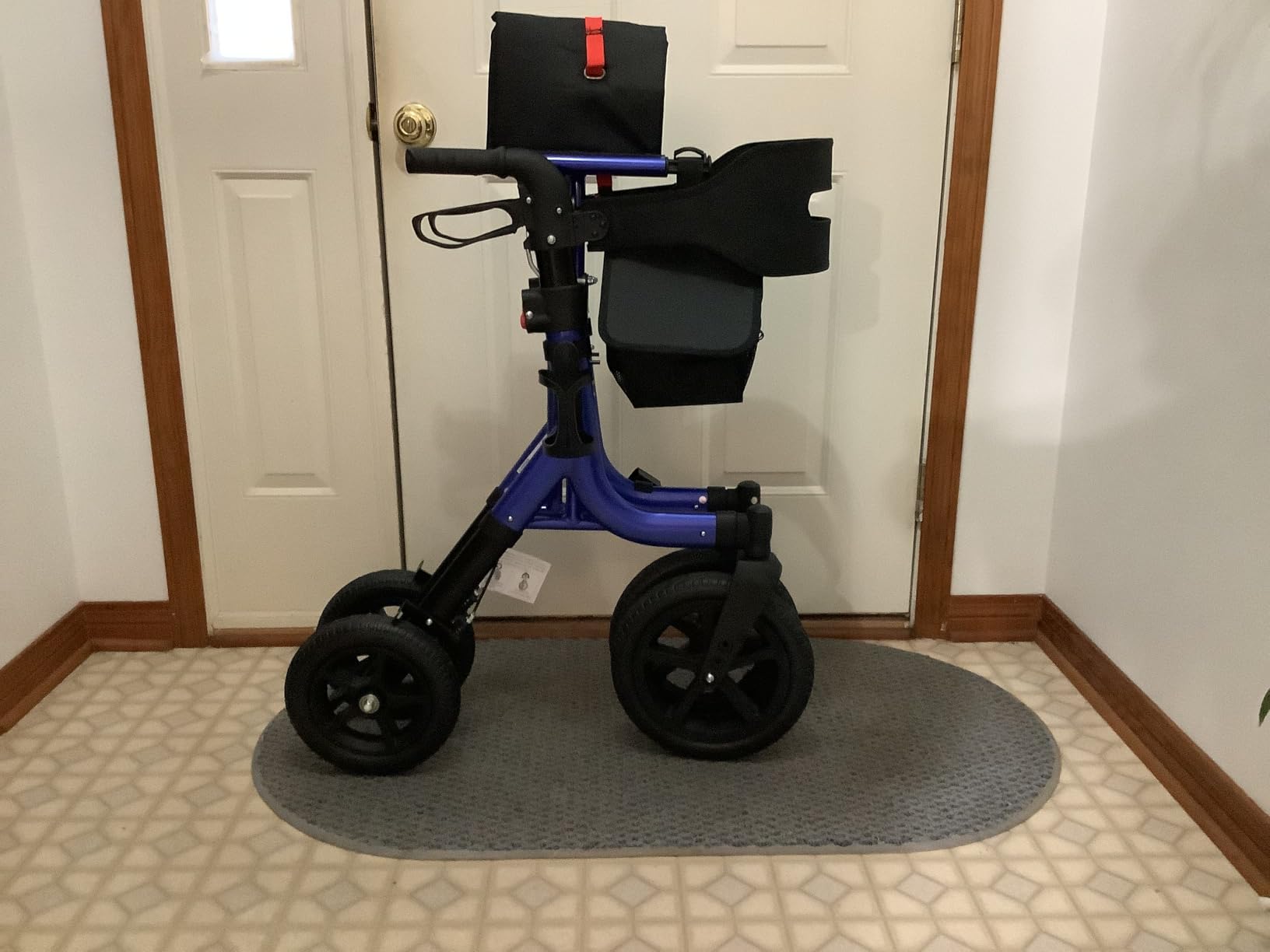
Most of the frames in this roundup are wide, which is what makes them stable and what makes them difficult to get through a doorway. This one runs 23.8 inches across, several inches narrower than the bariatric alternatives, which makes it the pick for a flat with narrow internal doors, a small lift or a bathroom with a tight approach.
It still has the biggest wheels we found, 12 inch rubber fronts and 10 inch reals with 360 degree swivel, and they roll over gravel, concrete and grass with shock absorption. A reviewer who works in home medical equipment singled out the quiet solid construction as a clear step up from the lightweight loaner rollators people often start with.
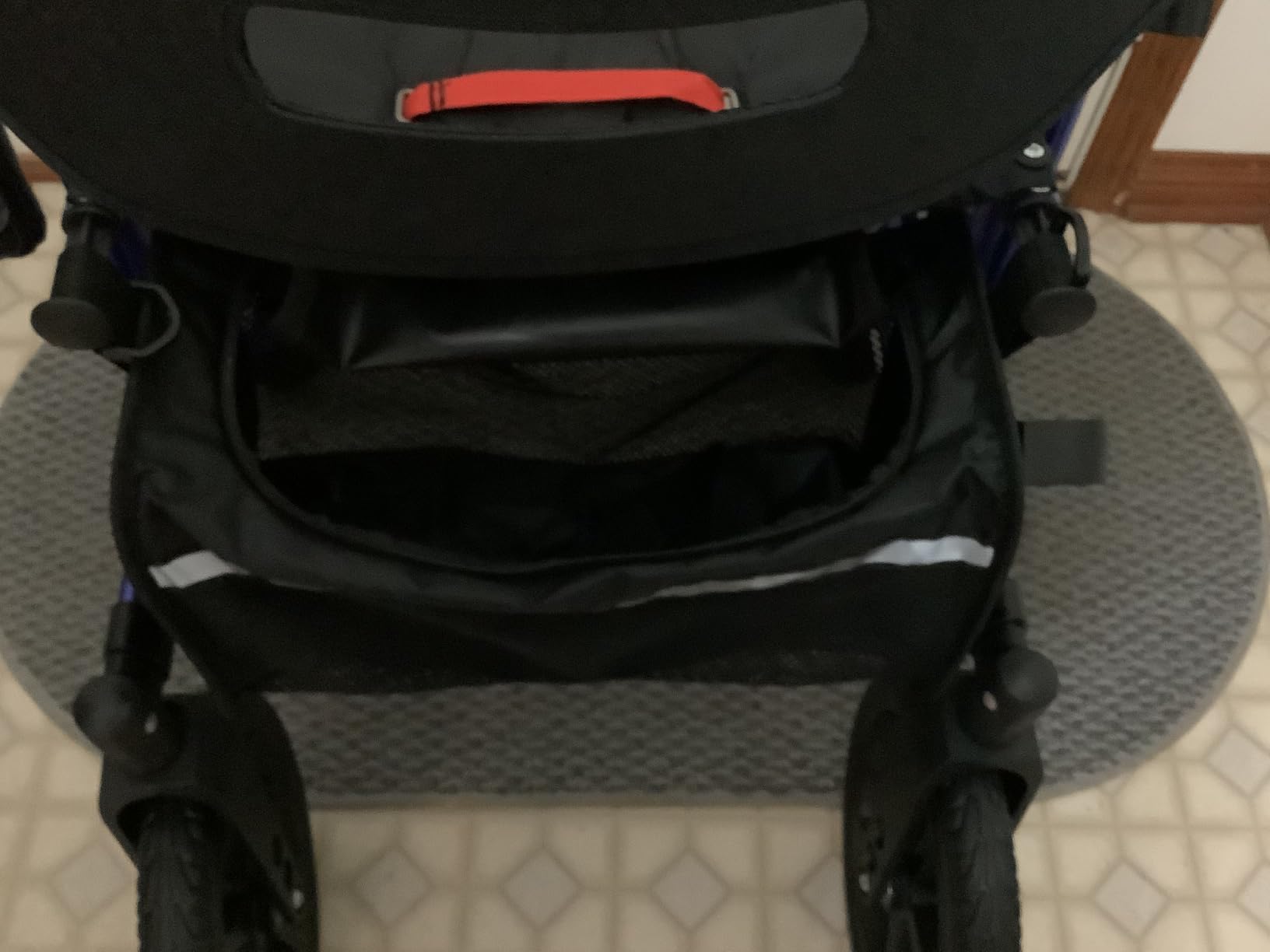
The frame is reinforced aluminum at 19.2 lb supporting 300 lb, and the three-second quick fold leaves it standing upright in a corner rather than lying flat on the floor. Assembly takes about five minutes without tools, and the integrated brake cable keeps the lines inside the frame.
Extras include a removable cup holder, a large-capacity storage bag, a walking stick holder and reflective strips. The eighteen-month warranty is shorter than the Helavo frames offer, and the first thing most buyers notice is a strong manufacturing smell that clears after a couple of days of airing out.
Does the narrow base make it less stable?
Only slightly, and only on uneven ground. A 23.8 inch base still tracks well, and the 12 inch wheels roll over the small obstacles that make a narrow frame twitchy. For a user who is tall but not heavy, the width is a reasonable trade.
If you are a heavier user, prioritise the reinforced frames instead and measure your doorways first. Stability and doorway clearance pull in opposite directions, and one of them has to give.
Should you rule this out if you are a very tall user?
Probably. The handrails adjust across five settings from 32.6 to 37 inches, and the manufacturer rates the frame for 5 ft to 6 ft 4 in. Above that, you will be pushing the handles to their limit and leaning forward again.
The seat is also narrower than the bariatric frames, so it is a good fit for a tall, lean adult in a small home rather than for a large, heavy user with a wide seat requirement.
10. Vive Mobility Upright Walker – Best for Adjustable Forearm Pads
Vive Mobility Upright Walker with Seat – Stand Up Rollator
Handles 45 to 52 inch
Adjustable forearm pads
8 inch wheels
20 lb aluminum frame
Pros
- Tall 45 to 52 inch handle range supports a fully upright posture
- Forearm pads slide forward and backward to fit different arm lengths
- Lightest upright frame here at 20 lb
- Folds to fit a trunk or back seat
- Loop brakes lock the wheels for stable seating
Cons
- Short 8 inch front wheels raise the centre of gravity
- Brake cables stretch with use and no adjustment instructions are included
- Some buyers reported parts loosening or breaking
The Vive upright walker reaches the highest handle position in this roundup, 45 to 52 inches, and its forearm pads slide forward and backward so you can set the support where your elbows naturally rest. That adjustment is the feature no other upright frame in this group offers, and for a very tall user with long arms it is the difference between a comfortable frame and a compromise.
The seat is 17.5 inches wide with contoured armrests and length-adjustable hand grips, and the loop brakes lock the wheels so you can sit without the frame rolling. The aluminum frame is 20 lb, supporting 300 lb, and it folds to fit a trunk or a back seat.
I want to be straight about the drawbacks, because they are consistent across reviews. The 8 inch front wheels are short for an outdoor frame, and the raised centre of gravity has been blamed in detailed accounts of forward and sideways tip-overs on slopes, ramps and uneven pavement seams. The manufacturer states the walker is not intended for uneven terrain.
Is this safe to use outdoors?
On flat, paved, level ground, yes, and most owners use it that way successfully. On slopes, ramps, gravel or broken pavement, no. Several detailed reviews describe falls traced to the short front wheels and to brake cables that lose tension as they wear.
If your walking is mostly on pavements and indoor floors, the tall handle range makes this a strong choice. If you need a walker for a rough path, choose a frame with 10 inch or 12 inch front wheels instead.
Should you check the brakes early if you buy it?
Yes, and this is worth a short paragraph of its own. The reported issue is cable stretch, which means the brakes feel less firm after a few weeks, and the manufacturer does not include cable adjustment instructions in the box.
Test the brake hard on level ground in the first week, and if it feels soft, contact the supplier early rather than assuming it will improve. A walker that cannot stop reliably is a hazard, and that matters more than any comfort feature.
How to Measure Your Wrist-to-Floor Height in Four Steps
Every recommendation on this page assumes one number: the distance from your wrist crease to the floor, measured while you stand. That is the height your handles need to be, and it is the only way to know whether a frame will keep you upright.
Step one, wear your walking shoes. Measure in the footwear you will actually use on walks, because a thick-soled shoe adds an inch or more and quietly throws the whole calculation off.
Step two, stand tall against a wall with relaxed shoulders. Keep your arms loose at your sides rather than pushing your shoulders back. The measurement is only correct when you are standing the way you naturally stand.
Step three, let your arms hang and mark your wrist crease. The wrist crease is the joint on the side of your wrist where the hand meets the forearm, not the top of your hand and not your knuckles. Ask someone to help if keeping your arm still is difficult.
Step four, measure from that mark to the floor. Read it in inches, write it down, and use it as your handle height target. The elbows should end up bent roughly 15 degrees, which is far more comfortable than any handle setting chosen by eye.
Once you have the number, subtract nothing. If your wrist crease is 40 inches, you need a frame that adjusts to 40 inches, not 38.
Buying Guide: How to Choose a Rollator for Your Height
Match the handle ceiling to your wrist crease
This is the rule that decides the purchase. Standard rollators commonly stop adjusting between 35 and 38 inches, which forces anyone with a wrist crease above that into a permanent forward lean. A tall frame reaches 40 inches or more, and the upright forearm-support frames in this roundup go far higher, from 38 up to 52 inches.
Do not accept a maximum below your measurement, even if the frame is cheaper, better reviewed or lighter. Every other feature on the list is a convenience; this one is the difference between walking upright and walking bent over.
Height bands: what to look for at each stature
Wrist crease 34 to 36 inches, roughly 5 ft 2 in to 5 ft 8 in: a standard rollator with handles adjusting to 36 or 37 inches is enough. Comfort beats extra height here.
Wrist crease 36 to 38 inches, roughly 5 ft 8 in to 6 ft 1 in: pick a frame that reaches 38 inches with a seat at 20 to 22 inches, such as the lightweight all-terrain model here.
Wrist crease 38 to 40 inches, roughly 6 ft 1 in to 6 ft 4 in: you need a genuine tall frame, handles to 40 inches or beyond, and a seat at 22.8 inches or higher. Several bariatric frames reach 40 and 41.5 inches.
Wrist crease above 40 inches, over 6 ft 4 in: look at the upright forearm-support walkers, where armrests run to 47 and 52 inches. A four-wheel rollator will leave you leaning at this height.
Above 6 ft 4 in or above 350 lb: combine a reinforced bariatric frame rated 450 to 550 lb with a tall handle range, and measure your doorways before ordering.
Seat height decides whether you can stand up easily
Standard rollator seats sit 18 to 20 inches off the floor, which is comfortable for most people. For a tall adult, a low seat means dropping into a squat every time you sit, and the effort of standing back up is what turns a rest break into a problem.
Aim for a seat at 22.8 inches or higher, and look for two levels of seat adjustment so you can lower it for a taller companion or a cafe table. The same logic applies to other seating: a chair sized for someone shorter forces a similar squat, which is why our guides to recliners for tall people and big and tall office chairs start with seat and floor measurements rather than style.
Wheel size decides where you can walk
Six-inch wheels are for flat indoor floors only. Eight-inch wheels handle carpet, pavers and thresholds, and they are the minimum for anyone who walks outdoors regularly. Ten to twelve inch wheels roll over cracks, gravel and grass, and they need less force from your arms to push.
Puncture-proof or air-free tires remove the maintenance of checking pressures, and pneumatic tires give the smoothest ride on rough ground at the cost of occasional punctures. For most buyers on pavement and grass, air-free tires are the calmer choice.
Brakes, folding and frame weight decide daily usability
Loop or squeeze brakes give finer speed control, while push-down brakes need less hand strength, which matters if you have arthritis. Whichever you choose, make sure you can lock both brakes before you sit down, and test the brake force in the first week.
Folding decides whether the rollator travels. A cross-brace side-to-side fold is fastest, while a front-to-back fold is often narrower when closed. Frame weight decides whether you can load it yourself, and models here run from 16.4 lb to about 24 lb.
Indoor versus outdoor use, and where to buy
Measure your narrowest doorway, including the bathroom, before you order. The frames here run from 23.8 inches wide to just under 26 inches, and a bariatric frame that will not fit through a 26 inch door is unusable inside your own home.
Medicare Part B covers a rollator as durable medical equipment when prescribed by a clinician, and a supplier who accepts your insurance is usually the cheapest route to a properly fitted frame. Buying online is fine when a retailer publishes the full handle range, seat range and base width, because those three numbers plus your wrist crease and your weight answer the fit question completely.
Upright Rollators Are the Best Frame Type for Tall Users Who Hunch
Even a correctly sized four-wheel rollator can leave a very tall user leaning, because the handle bar sits in the same place on every frame and your shoulders still end up in front of it. An upright or forearm-support walker solves that differently: it raises the support to your forearms, so you push the frame with your arms extended at a comfortable angle rather than stooped at the waist.
Owners of upright frames describe relief from shoulder and lower-back pain within weeks, and a r/disability user credited a Drive Medical hemi-height model for getting the fit right for their height. In our ten, the ELENKER reaches 47 inches of armrest height, the Helavo H1160 stands 46.9 inches tall with outdoor-rated tires, and the Vive reaches 52 inches with forearm pads that slide forward and back.
There is a real trade-off. Upright walkers are wider, heavier and more expensive than standard rollators, and they are harder to steer in tight spaces. A physical therapist commenter on r/physicaltherapy described rollators as good for some people but not for anyone who needs to bear real weight, and the same principle applies here: if you are recovering from surgery or can only manage with your hands on a rigid walker, an upright rollator is not the right aid.
Safe Use: Lock the Brakes, Sit Slowly and Turn in Small Steps
Fit matters, but technique matters more. Lock both brakes into the parking position every single time before you lower yourself onto the seat, and push yourself straight down rather than dropping or sliding.
Never pull up on your rollator to stand. A rollator is a balance aid, not a weight-bearing frame, and using it as a handrail is the most common cause of the backward falls that put people back in hospital.
Stay inside the frame. Your body should be between the handles and behind the seat, not out in front of the wheels where a sudden stop can pitch you forward.
Turn in small steps, moving the rear wheels in a wide arc rather than swinging the whole frame. Push the frame forward with the rear legs, never pull it backward, and take kerbs and thresholds straight on at a slow pace with a hand ready on the handle.
Check the brakes, tyres and folding joints once a week. A brake that feels soft or a wheel that runs to one side is a reason to stop using the frame until it is fixed, not a reason to push on more carefully.
Frequently Asked Questions
What rollator is best for tall people?
The best rollator for a tall person is one whose handles adjust to at least 40 inches from the floor and whose seat sits roughly 22.8 to 26 inches off the floor, so you can stand upright with a 15 degree bend in the elbows. Among our picks, the MAXWALK Tall Rollator reaches 40.1 inches with a seat up to 24.4 inches, and the Drive Medical Nitro Sprint is built specifically for users 6 feet and taller. If you are over 6 foot 4, add an upright forearm-support walker where the armrests sit at 47 to 52 inches.
What rollator walker is suitable for large and tall people?
A rollator walker suits a large and tall adult when three numbers line up: the handle range must reach your wrist-to-floor measurement, the weight capacity must exceed your body weight with room to spare, and the base width must fit your narrowest doorway. A tall adult also needs a seat at 22.8 inches or higher so standing back up is not a deep squat. Frames rated 450 to 550 lb handle both a tall body and a heavy one, but check the base width before ordering because bariatric frames run nearly 26 inches across.
What is better than a rollator?
It depends on what you need the aid to do. An upright or forearm-support walker is better if you hunch over a standard rollator, because it supports your forearms and keeps your spine upright. A standard rigid walker without wheels is better if you need to put real weight through your hands, for example during recovery from a hip or knee operation. A knee or knee scooter walker is better for short-term use on one leg, and a transport wheelchair is better when someone else is pushing you rather than you pushing yourself.
Can a too short rollator cause back and neck pain?
Yes. When the handles cannot reach your wrist crease you lean forward, which rounds the lumbar spine and tilts the head forward to look ahead. Held over hours per day, that posture compresses the lower back and neck and tightens the shoulders, and it also reduces your control over the frame, which makes a fall more likely. Raising the handles to the correct height so your elbows stay bent about 15 degrees is often enough to resolve discomfort that had been blamed on age.
What are the best rollators according to Consumer Reports?
Consumer Reports does not publish a tall-specific rollator ranking, and we will not invent one. Our list is built on published manufacturer specifications rather than hands-on lab testing: handle adjustment range, seat-to-floor height, wheel diameter, weight capacity, frame weight, base width and warranty for each of ten models, cross-checked against what buyers report in their reviews. If you want a clinical fit, ask a physical therapist or occupational therapist to measure you before you buy, and check whether Medicare Part B coverage applies to a prescribed frame.
Conclusion: The Best Rollator for Tall Seniors in 2026
After comparing ten tall frames spec by spec, the Drive Medical Nitro Sprint is the best rollator for tall seniors overall, because it is engineered for six-foot-plus users, holds 350 lb, folds one-handed to under 10 inches and adds a three-mode brake that makes downhill walking safer than the alternatives.
Pick a different frame if your body calls for it. Go to the Helavo bariatric model for a 550 lb rating, the FlyingJoy for the tallest handle reach at 41.5 inches, the MAXWALK for the highest seat, or an upright forearm-support walker such as the ELENKER or Helavo H1160 if you still hunch at maximum handle height.
Measure your wrist-to-floor height and your narrowest doorway before you order, and talk to a physical therapist or occupational therapist if you are unsure. That ten minutes of measuring prevents the most common and most expensive rollator mistake.