
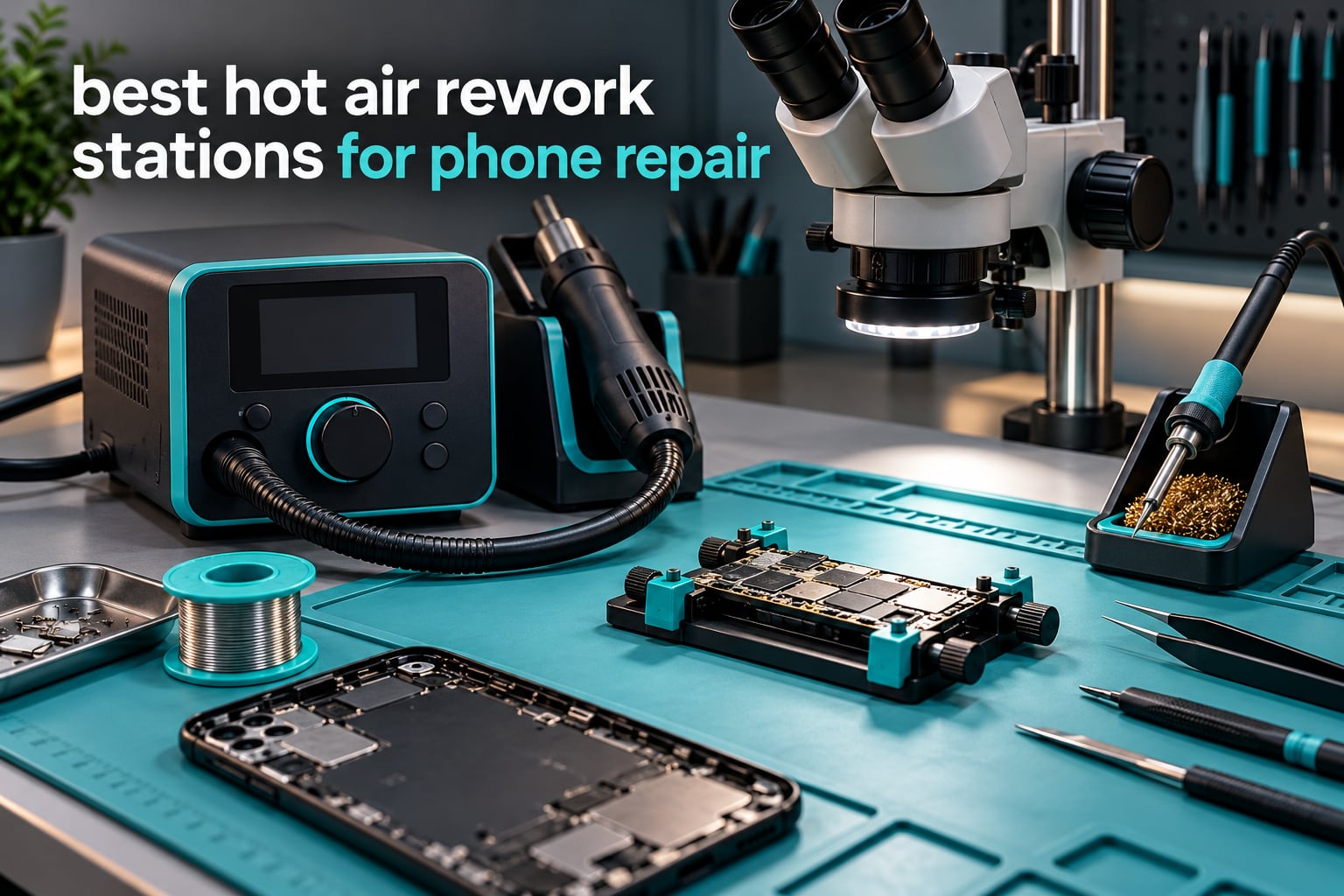
If you only want one answer: the YIHUA 8786D I is the best hot air rework station for phone repair overall, the YIHUA 862BD+ carries the highest rating in this group, and the YIHUA 853D 2A USB wins if your bench also needs a DC supply and a USB test port. All three are 2-in-1 units that put a soldering iron and a hot air gun on one chassis, run on 110V for US outlets, and cost roughly the same as a single dedicated hot air tower.
That matters because a phone logic board is a hard heat environment. You are desoldering charging ports, power management ICs and stacked EMI shields on a board covered in 0201 passives that will fly off the board if airflow is too aggressive. The number that matters is not the wattage on the label. It is how steady the outlet temperature stays while you move the nozzle across a board, and how finely you can turn the air down at the low end.
We spent weeks putting these twelve stations through phone-repair work: connector swaps, shield can lifting, eeprom and storage removal, MOSFET desolder on charging ports, and the small passive cleanup that follows. Our ranking below is written phone-repair-first, which is not how most hot air roundups are organised. If you are also building out a repair bench, our controller drift repair kit guide covers the other half of the micro-soldering setup for game controllers.
Table of Contents
Top 3 Picks for Best Hot Air Rework Stations for Phone Repair in October

YIHUA 8786D I 2 in 1 Station
- Dual LED display and dual power switches
- PID control on iron and hot air
- Fail-safe cut-off if airflow stops
- 10 tips and 4 nozzles included
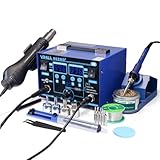
YIHUA 862BD+ 2 in 1 Station
- PID sensing every 20 milliseconds
- Three digital readouts
- 0-99 minute sleep mode
- Complete kit with solder and ESD tweezers
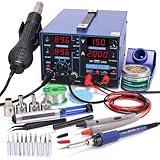
YIHUA 853D 2A USB Workstation
- Hot air
- iron and DC supply in one box
- 0-15V output and 35V test mode
- 5V USB testing port
All 12 Hot Air Rework Stations Compared Side by Side in 2026
Every pick below runs on 110V for US outlets, so there is no voltage mismatch to plan around. That said, check the voltage version on any listing before you order, because marketplace sellers mix 220V and 110V versions of the same model. Temperature ranges are the manufacturer-listed outlet ranges, not the temperature at the joint.
| Product | Specifications | Action |
|---|---|---|
| YIHUA 8786D I |
|
Check Latest Price |
| YIHUA 862BD+ |
|
Check Latest Price |
| YIHUA 853D 2A USB |
|
Check Latest Price |
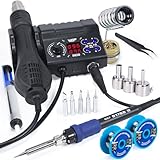 WEP 882D WEP 882D |
|
Check Latest Price |
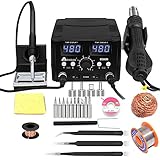 MYPOUOS 8588D SET1 MYPOUOS 8588D SET1 |
|
Check Latest Price |
 TXINLEI 8586 TXINLEI 8586 |
|
Check Latest Price |
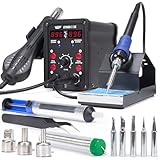 WEP 8786D-I SE WEP 8786D-I SE |
|
Check Latest Price |
 TXINLEI 858D TXINLEI 858D |
|
Check Latest Price |
 WEP 8858-V WEP 8858-V |
|
Check Latest Price |
 LRT 8858 LRT 8858 |
|
Check Latest Price |
 LRT 858D LRT 858D |
|
Check Latest Price |
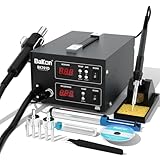 BAKON BK701D BAKON BK701D |
|
Check Latest Price |
How We Picked These Stations
Everything in this roundup was chosen against one question: will it let a phone technician remove and replace a surface-mount component without lifting a neighbouring pad or cooking a lithium cell? We weighted six criteria, in this order.
Thermal stability. PID regulation with a short sensing cycle keeps the outlet steady when you pull the nozzle away and bring it back. A station that hunts 20°C between cycles will either under-heat a lead-free joint or scorch the board around it.
Airflow resolution at the low end. Connector and charging port work lives or dies on low flow. A 20% setting that holds steady is worth more than 200L/min at maximum.
Pump and fan design. A brushless blower in the base is quieter, steadier and longer-lived than a brushed motor in the handle. Handle induction adds a real safety benefit too, since the element stops the moment the gun goes back in the cradle.
Range and control. Phone boards need roughly 200°C to 400°C of useful range. An upper limit of 480°C to 500°C is plenty. Headroom above that is rarely needed and only makes the station harder to control.
Serviceability and parts. Detachable handpieces, replaceable heaters and nozzles you can order separately decide whether a station survives three years of daily work.
Bench fit. Footprint, cord length, and whether the readouts are legible under a microscope all affect how many jobs you finish in a day.
One honest disclosure: temperature and wattage figures come from the manufacturer listings and the published product data, not from our own pyrometer readings. Where owners report calibration offset, we say so in the individual reviews.
1. YIHUA 8786D I 2 in 1 Station – Best Overall for Phone Repair
YIHUA 8786D I 2 in 1 Hot Air Rework and Soldering Iron Station with 10 Solder Iron Tips, 4 Hot Air Nozzles, °F /°C, Cool/Hot Air Conversion and Sleep Function
740W
200°C to 896°F
Dual LED display
Fail-safe airflow cut-off
Pros
- Largest review base in this group at more than 2600 ratings
- Dual display with separate power switches for iron and gun
- PID control on both channels
- Fail-safe shuts the element if airflow stops
- Ten tips
- four nozzles
- pump and IC extractor included
Cons
- Cables are short on a crowded bench
- Bundled accessories are adequate rather than professional grade
- Supplied iron tips wear faster than spares
The 8786D I is the station we keep reaching for when a phone board job needs both hot air and a decent iron on the same bench. It runs 740W, holds a 200°C to 896°F range on the hot air side, and puts a separate LED readout and power switch in front of each channel. On a connector swap you can kill the iron and keep air flowing, or the reverse, without unplugging anything.
Temperature control is PID with fast compensation, and on phone work that translates to a joint that actually reaches solder melt instead of wandering. The fail-safe is the detail I like most: if the gun stops outputting air, the unit alarms and cuts power to the heating element. Owners on r/mobilerepair repeatedly single out the Quick 861DW for airflow quality, and on this tier the 8786D I is the closest shelf match in a far more widely serviced unit.
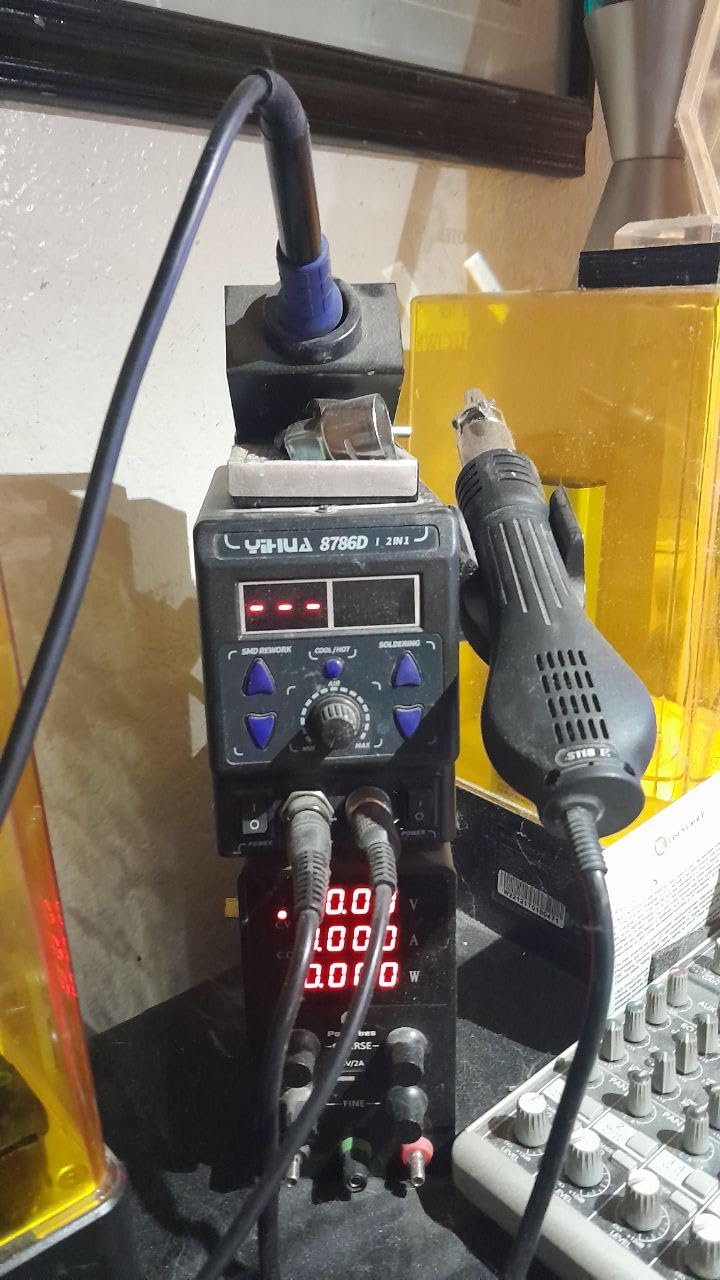
The box carries ten soldering tips, four hot air nozzles, an IC extractor, a desoldering pump and a roll of 0.8mm lead-free solder. That is more than enough to cover shield can lifting, port removal and the passive cleanup that follows. Reviewers describe the negatives consistently: the cables are short, and the consumables in the box are entry-level. Swap the tips early and the rest holds up.
It is also UL compliant and built for 110-127V with a US power plug, which removes the single most common buyer mistake with this class of tool.
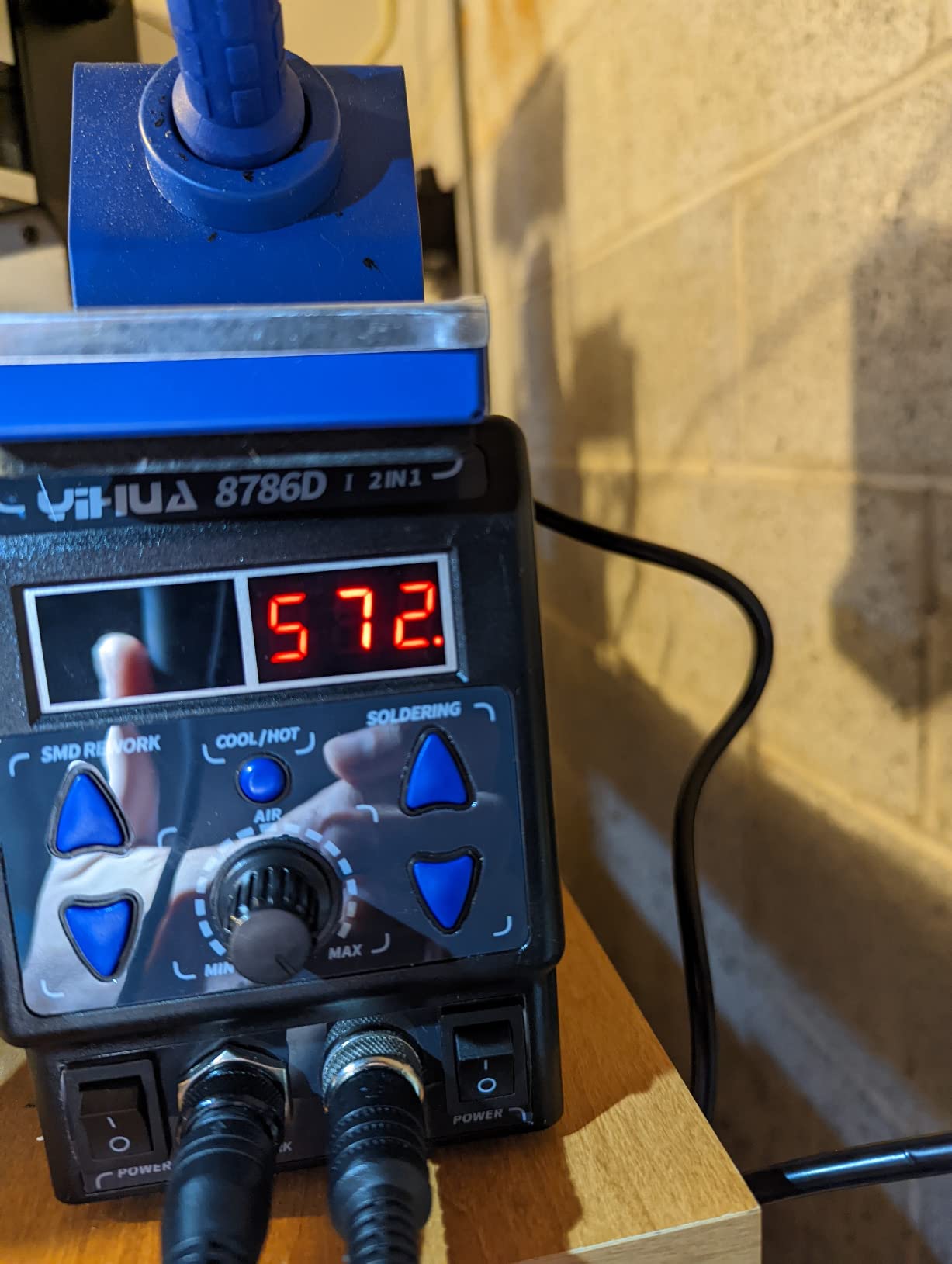
Why it wins for dense phone boards
Modern phone boards put components shoulder to shoulder, so the useful question is how small you can go before the neighbours start moving. The 8786D I has four nozzle sizes in the box and steers airflow with a dedicated control, which is enough to work a 3mm nozzle over a charging port without pushing the neighbouring 0201s off the pad. The combined iron and gun also means one power switch and one bench footprint instead of two devices fighting for space under a microscope arm.
Where it falls short
The short cords are the first thing you notice on a deep bench, and the supplied tips are the second. Neither is a reason to skip it, but budget for a better tip set and a proper solder reel. If your shop already runs a separate high-end iron, the 853D 2A USB below is the better match because of its DC supply and USB test port.
2. YIHUA 862BD+ – Highest Rated Station With 20ms PID Sensing
YIHUA 862BD+ SMD ESD Safe 2 in 1 Soldering Iron Hot Air Rework Station °F /°C with Multiple Functions
750W
20ms PID cycle
Three digital displays
0-99 min sleep mode
Pros
- Highest rating in this group at 4.6 out of 5
- PID senses actual element temperature every 20 milliseconds
- Three readouts for iron
- hot air and air volume
- 0-99 minute sleep mode extends element life
- Detachable handpieces are individually replaceable
Cons
- Some delivered models have a hot air gun coupling that does not seat
- Not calibrated out of the box
- Readings commonly run 5 to 10°F low on both channels
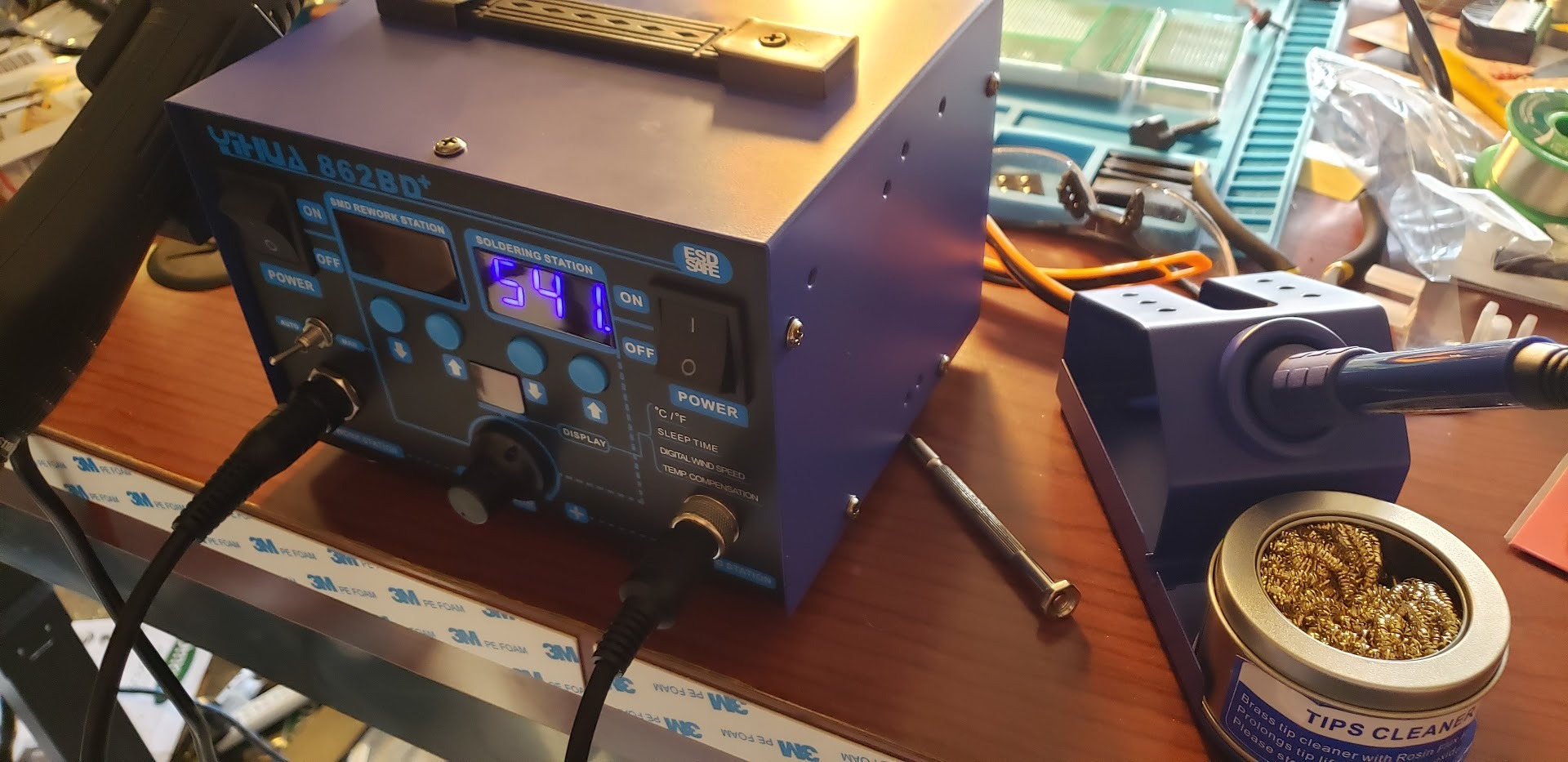
The 862BD+ is the most technically specified station in this group. PID control samples every 20 milliseconds and corrects against actual element temperature rather than a timer, and there are three digital displays: iron temperature, hot air temperature and a simulated air volume readout. Long-term owners report thousands of devices repaired on this unit across phones, amplifiers and computers, with stability that holds for both SMD and through-hole work.
It heats to solder temperature in roughly 30 seconds, and the 0-99 minute adjustable sleep mode is a small feature that adds up on a shop that leaves the station powered all day. Both handpieces detach into safety receptacles and can be replaced on their own, which is exactly what you want when a cable frays on a bench that sees eight jobs a day.
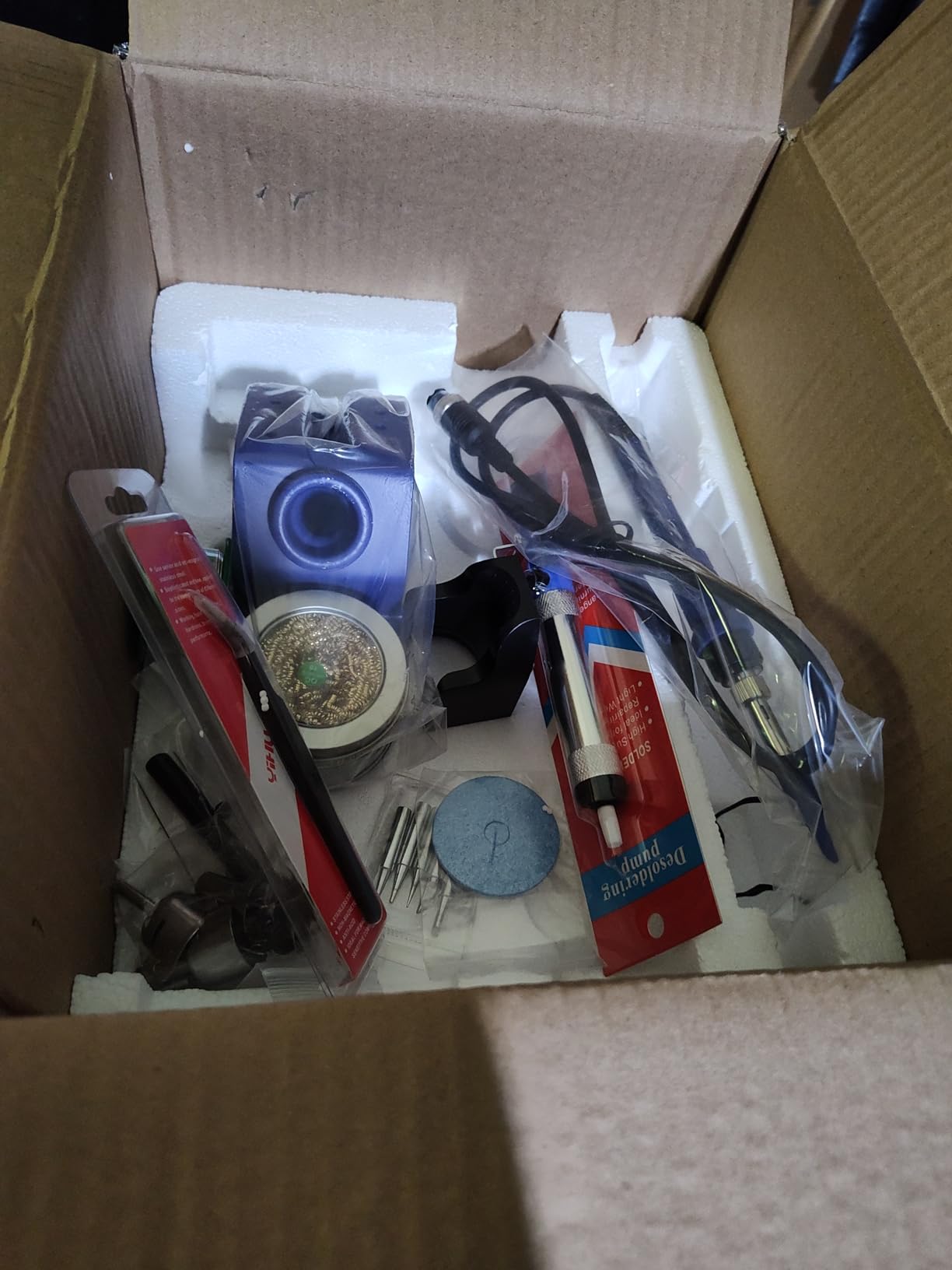
Two caveats are worth planning around. The most common complaint is an out-of-the-box hot air gun coupling fault that stops the fan on startup, so inspect the thread and seat the gun firmly the first time you power it. Second, the unit is not calibrated when it arrives. Run a pre-tip and tinning cycle and confirm the reading against a known joint before you trust the number on a phone board.
On r/consolerepair, a user reports the Yihua 959D has served them very well over four years and recommends it as a budget hot air station. The 862BD+ is the same family with a faster control loop, which is why it earns the second slot.
Best for precision charging port work
Charging port jobs are long, hot and unforgiving, and the 862BD+ handles them well because the fast sensing loop recovers temperature the instant you lift the nozzle to check a pad. The three-readout layout also helps when you want to confirm air volume is holding between adjustments. Owners doing fine connector work on mobile boards consistently report the display clarity and control separation as the reason they recommend it.
Who should not buy it
If you are buying your first bench and you care more about the total footprint, the WEP 882D below gives you the same 2-in-1 layout in a much smaller case for less. And if you have no way to verify temperature with a probe, the uncalibrated reading is a real issue on board-level work. Calibrate before the first paid job.
3. YIHUA 853D 2A USB – Best When Your Bench Needs a DC Supply
YIHUA 853D 2A USB SMD Hot Air Rework Soldering Iron Station, DC Power Supply 0-15V 0-2A with 5V USB Charging Port and 35 Volt DC Voltage Test Meter
Iron, hot air and DC supply in one box
0-15V output
5V USB port
120L/min airflow
Pros
- Only station here combining soldering
- hot air and a bench DC supply
- 5V USB port lets you test a board while it stays powered
- 120L/min max air volume with PID stabilisation
- DC output measured accurate against a reference meter
- Manufacturer support resolved a faulty fan quickly
Cons
- Calibration can be off by 10 to 30°C out of the box
- Nozzle clamps are awkward to tighten
- Short cords on the iron
- gun and mains lead
- Larger footprint than a plain 2 in 1
Three stations in one chassis: soldering iron, hot air rework and a DC power supply with a voltmeter mode. The DC output runs 0-15V at up to 2A, with a separate 0-35V test mode, and there is a 0.5A 5V USB port on the front. On phone work that USB port is the reason to buy it, because you can power a board and watch a rail while you probe a charging circuit.
The hot air side reaches 212°F to 896°F with air volume adjustable up to 120L/min, which is the largest flow figure listed in this set. PID stabilisation runs on both the iron and the gun, and sleep mode plus automatic shut-down extend element life on a bench that stays powered.
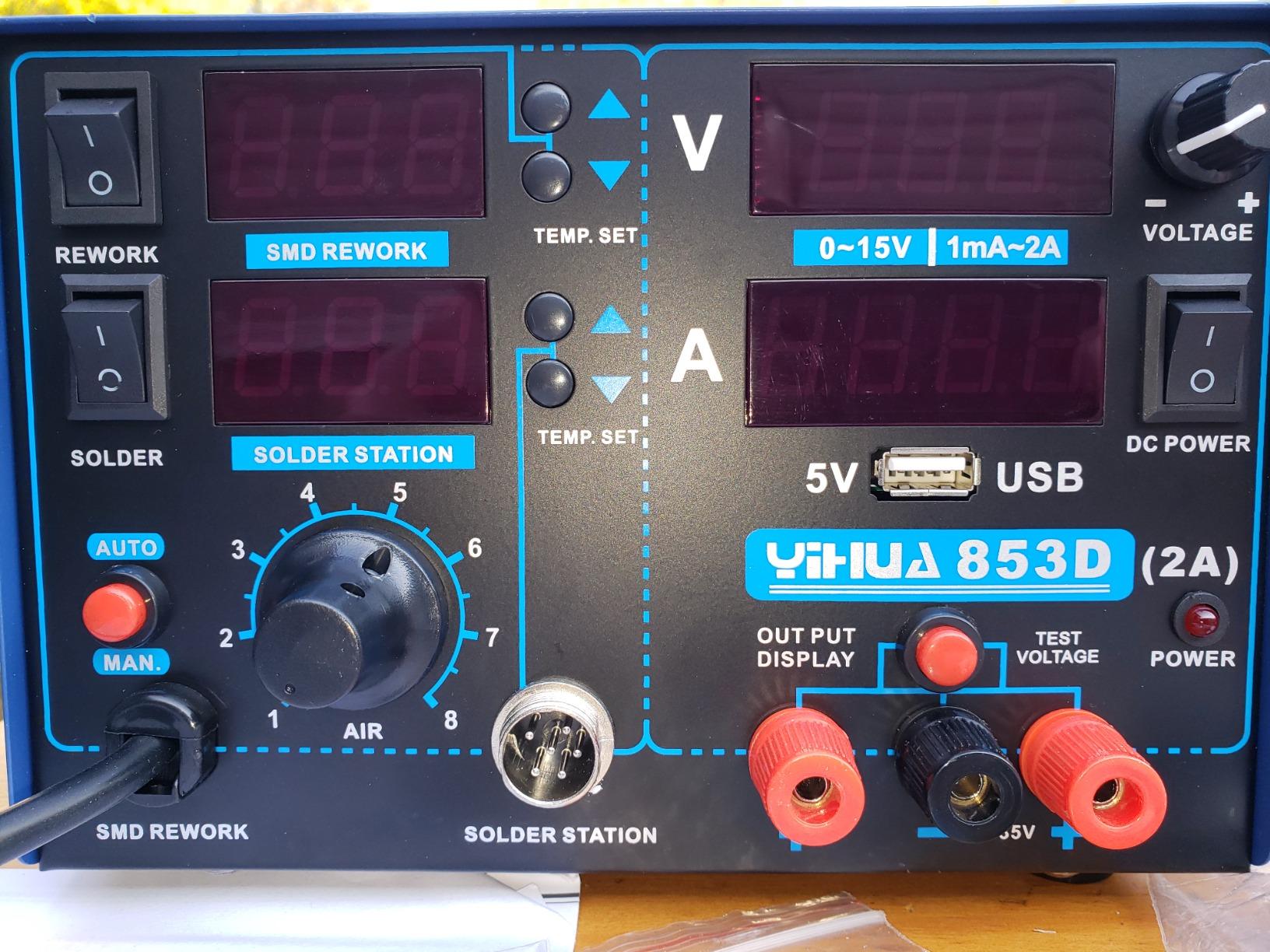
Reviewers working on surface-mount boards report clean eeprom and SMD chip removals with no pad damage, and the DC supply output measuring accurate against a reference meter. The negatives are specific: the nozzle clamp screws and square nuts do not seat flat, so the clamp feels awkward, the cords are short, and calibration can be 10 to 30°C out of the box without a temperature probe.
None of that is a problem for connector and shield work. It matters more if you are chasing power rail faults on a board that needs the DC supply in the first place, which is exactly who this unit is for.
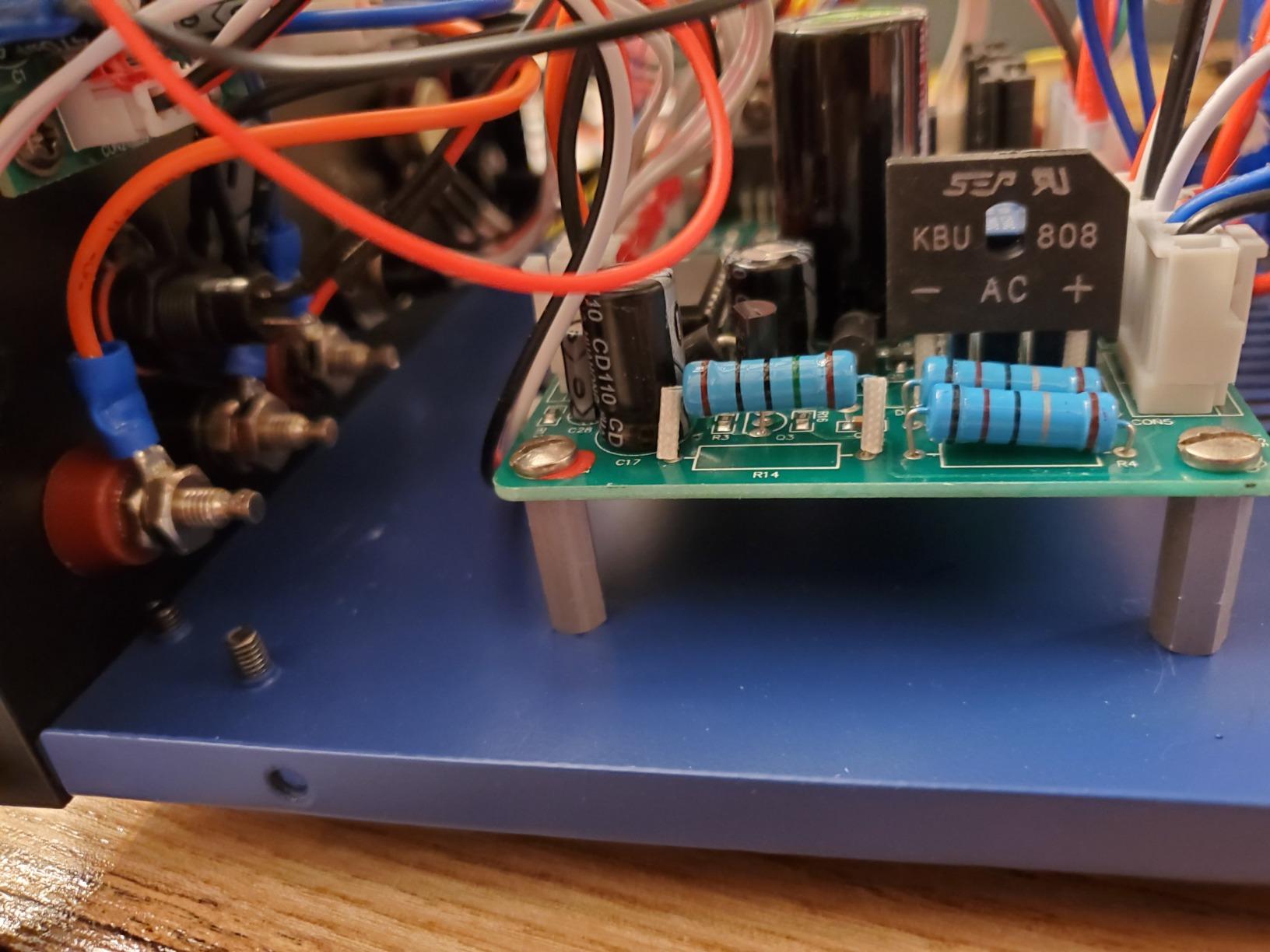
Where the DC supply earns its keep
Modern phone charging circuits fail in ways that are not visible with a multimeter alone. Feeding a controlled rail into a board while watching current draw on the display separates a dead charging IC from a shorted capacitor, and doing that with a separate bench supply means a second device, a second power lead and another thing to fail. Reviewers doing exactly this work single out the integrated supply and USB port as the deciding feature.
The calibration caveat
A 10 to 30°C offset out of the box is larger than the tolerance band most phone work needs. If you buy this, budget for a cheap thermocouple probe and a calibration cycle before it touches a customer device. Once calibrated, the 120L/min ceiling and the PID loop make it the most capable hot air section here.
4. WEP 882D – Best Compact 2-in-1 for Small Benches
WEP 882D Soldering Iron Station 2-IN-1 SMD Hot Air Rework Station with 2 Spools of Solder Wire, 5 Soldering Tips, 3 Hot Air Nozzles, Brass Wool Tip Cleaner, Tweezers, Desoldering pump
750W
212°F to 896°F hot air
Compact 1.1kg body
Calibration function
Pros
- Compact 2 in 1 body saves real bench space
- PID program on both iron and gun
- Includes two spools of solder wire
- five tips and three nozzles
- Sleep and standby modes plus auto shutdown
- Calibration function improves temperature precision
Cons
- Small body means small readouts and buttons
- Accessories are adequate rather than professional grade
- Temperature and air volume adjust by button rather than a dedicated dial
The WEP 882D solves a problem most roundups ignore: bench space. At 3.54 inches deep, 5.9 wide and 2.28 high, it is roughly half the volume of the 853D 2A and it still carries both a soldering iron and a hot air gun. For a repair bench sharing a desk with a microscope arm, a PCB holder and a fume extractor, that footprint matters more than a longer feature list.
It runs 750W, with the iron adjustable from 392°F to 896°F and hot air from 212°F to 896°F with variable air volume. Both channels run a PID program. Sleep mode covers the iron and standby mode covers the gun, with automatic shutdown, degree conversion and a calibration function to correct the readout.
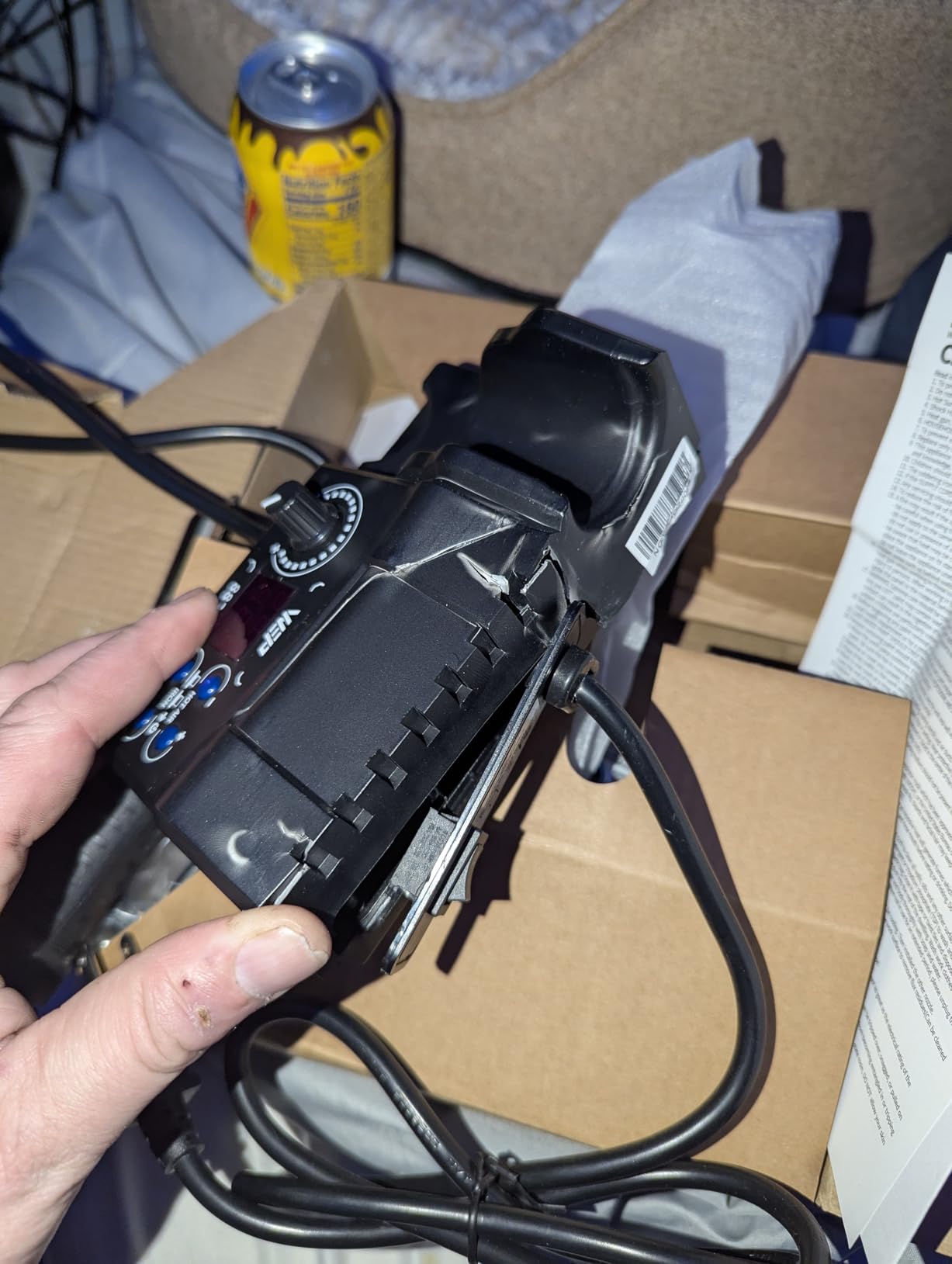
It carries a #8 rank in Soldering Stations, which is unusually strong for a station in this class, and the kit is generous for the money: two spools of solder wire, five tips, three nozzles, brass wool, tweezers and a desoldering pump. WEP backs it with a year of USA technical support and 24-hour assistance.
The trade is control ergonomics. Air volume and temperature move by button rather than a dedicated dial, and on a compact panel the readouts are small. Under a microscope with a board in a holder, button navigation is slower than a knob.
When footprint beats features
If you work on one phone at a time at a small desk, the 882D gives you the same usable temperature range and PID behaviour as larger units in a fraction of the space. The standby and sleep functions mean you can leave the station powered between jobs without cooking the gun. That combination, compact body plus idle protection, is why it works well for a home bench that is also an office desk.
Where it is not the answer
Button-only air volume adjustment gets tiring on long board-level sessions, and the small display is hard to read when your head is down in a microscope. If you run more than a few board-level jobs a day, the larger 862BD+ with three separate readouts and a faster PID loop will save you more time than it costs.
5. MYPOUOS 8588D SET1 – Fastest Heat-Up With a Ceramic Core
MYPOUOS 2 IN 1 750W LED Digital Soldering Station Hot Air Gun Rework Station Electric Soldering Iron For Phone PCB IC SMD BGA Welding SET 110V (8588D SET1)
750W
100°C to 480°C
Ceramic core element
±2°C tolerance
Pros
- Ceramic core element is more consistent than mica cores on cheaper units
- Heats up in about 10 seconds
- Dual blue LED readout with 1°C setpoint steps
- Reported to keep working after four-plus years
- Cooldown after power-off works properly
- Large accessory assortment in the box
Cons
- Blue LED display is hard to read in direct light
- All-plastic iron handle with no insulating collar
- Sleep mode cannot be disabled
- No master power switch
- Cheap wick and brass wool in the kit
The 8588D is the fastest to working temperature in this group. Owners report heat-up in about ten seconds, which matters more than it sounds when you cycle through a queue of connector jobs and each cool-down is dead time. The heating element is ceramic core rather than mica, and that is the main structural reason temperature holds steady between pulses.
Range is 100°C to 480°C with a tolerance within ±2°C, set in single degree steps on a dual blue LED display. Handle induction provides automatic cooling and automatic constant temperature, and the unit adds full anti-static design with fault self-detection and warning.
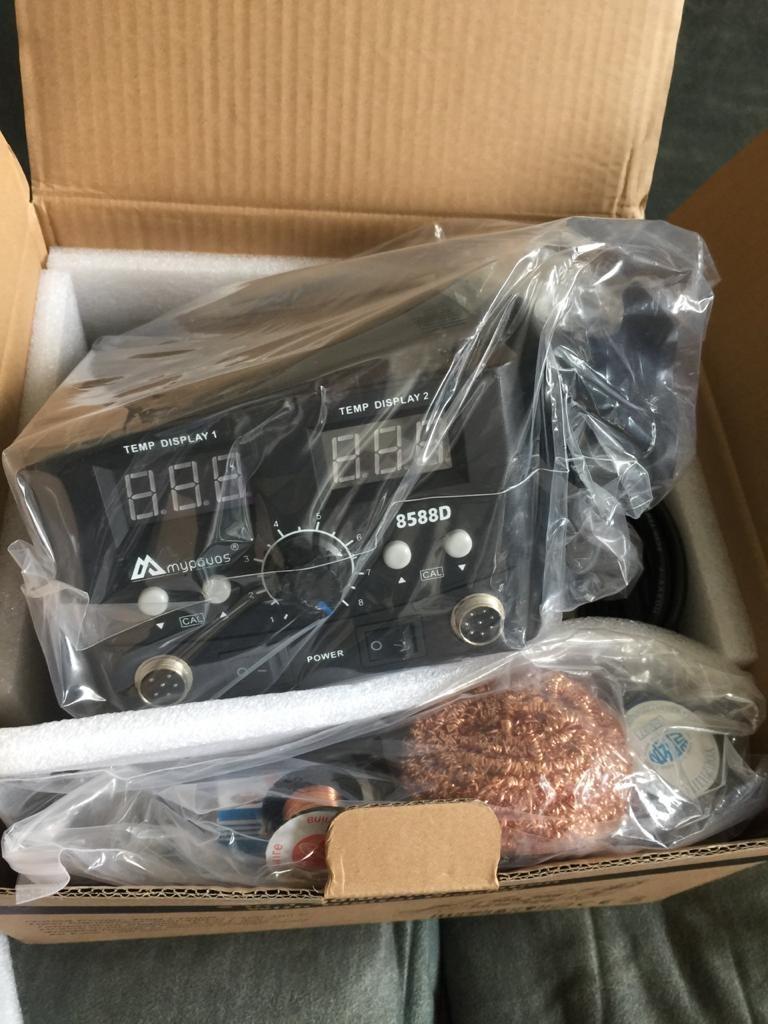
The accessory list is unusually long for the money: ten tips, four nozzles, solder wire, a solder sucker, wick, three anti-static tweezers, an IC puller and a sponge. One owner reports it still working after four-plus years of regular use, and reviewers specifically call out that cooldown after power-off behaves correctly, which they describe as uncommon at this tier.
The complaints are about consumables and ergonomics. The blue display is hard to read in direct light, the iron handle is all plastic with no insulating collar, and the included wick and brass scrubber are poor quality. There is also no master power switch, so plan on a switched power bar.
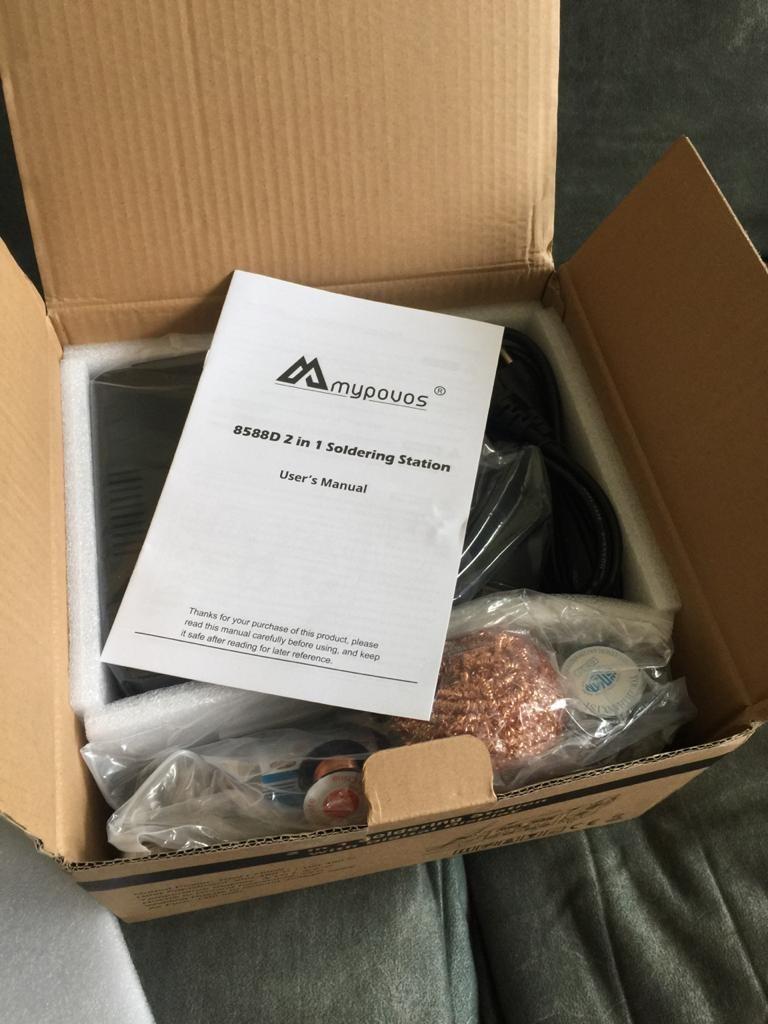
Best for throughput on connector queues
Ten-second heat-up and correct cooldown behaviour are exactly what a high-volume port and screen-connector bench needs. The 480°C ceiling is lower than the 8786D I and 862BD+, which is not a weakness for phone work, since most phone joints sit in the 200°C to 380°C band. You simply get a tighter, easier-to-hold temperature window.
Buy a better iron handle early
The all-plastic handle has no insulating collar and reviewers expect the tip-holder threads to be the eventual failure point. The bundled wick and brass wool wear quickly too. Spend your first few dollars on spares, because on a bench running ten jobs a day those are consumables, not accessories.
6. TXINLEI 8586 – Best Kit With Spare Heaters in the Box
TXINLEI 8586 110V Solder Station, 2 in 1 Digital Display SMD Hot Air Rework Station and Soldering Iron, 12pcs Different Soldering Tips, Tweezers,Desoldering Pump,700W 480℃
100°C to 480°C
Handle induction
Spare iron and gun heaters
19-in-1 kit
Pros
- Richest kit in this group with 12 tips
- spare heaters and BGA tools
- Handle induction starts and stops heating from the cradle
- Clear LED temperature display
- Ground wiring and grounded ceramic heater verified by an inspecting owner
- Explicitly aimed at phone and laptop board repair
Cons
- Manual is hard to read and the calibration procedure is opaque
- Supplied solder tips are low quality and wear quickly
- Keeps blowing hot air after power-off until the element drops to 100°C
- Ceramic element sits loose in the handle and does not reach full tip depth
The TXINLEI 8586 is the pick if you want the spares in the box rather than on an order form. The 19-in-1 kit includes the station, twelve iron tips, six-in-one BGA tools, a desoldering pump, two tweezers, an iron heater and a hot air gun heater, plus an IC puller. Having both heaters spare in the kit is genuinely useful, because a dead element otherwise ends your work day until a replacement arrives.
Temperature runs 100°C to 480°C on a digital LED display under microcomputer control, and handle induction means the unit powers up when you lift the handle and stops when it goes back in the cradle. It is listed for SOIC, CHIP, QFP, PLCC and BGA desoldering.
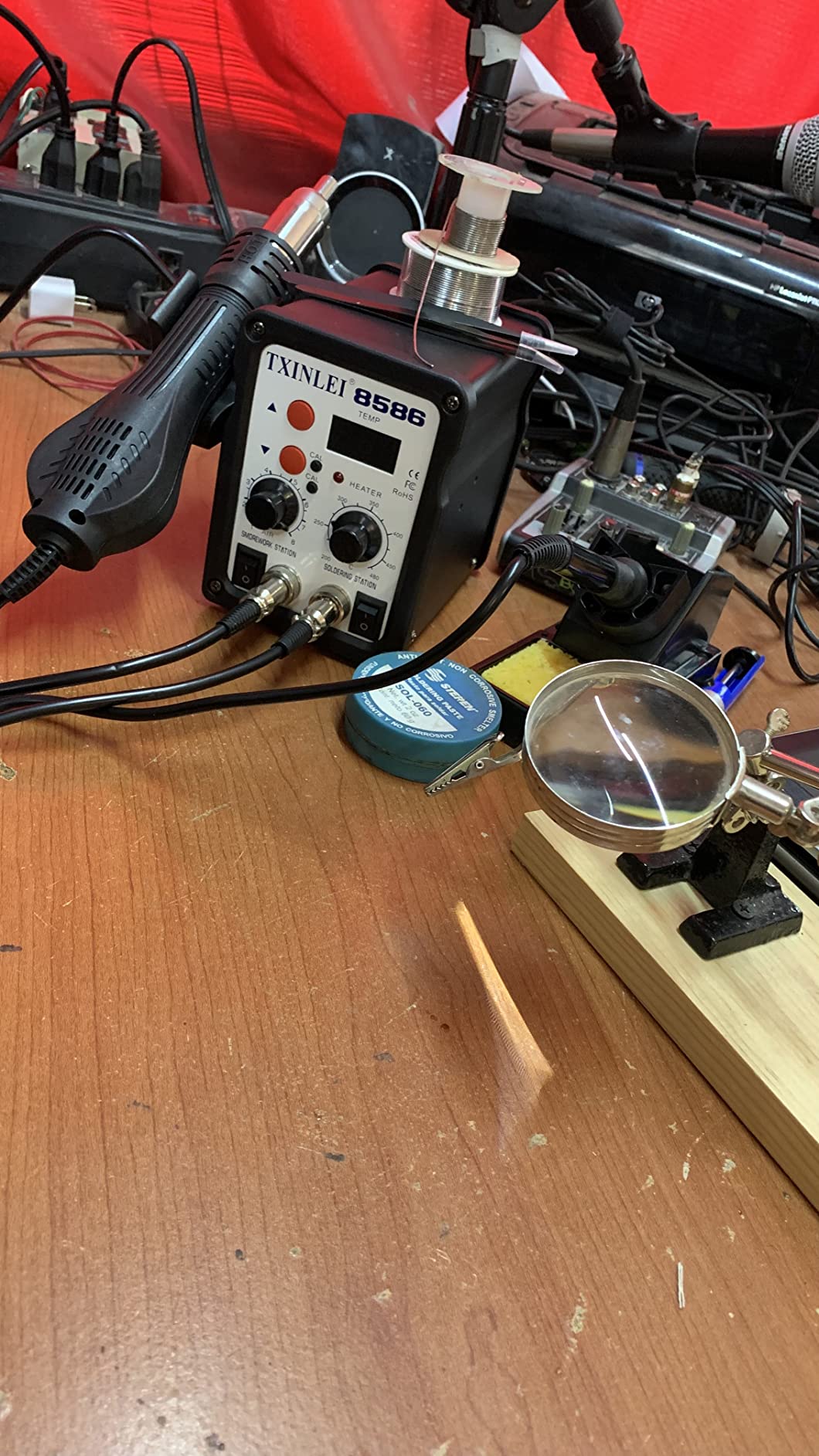
One owner opened the unit and confirmed the internal wiring is properly ground-wired with a grounded ceramic heater, which is more than most buyers at this level verify. Buyers doing real board-level work report fast heat-up and stable temperature on chip removal and phone repair.
The recurring theme in the reviews is documentation. The manual is difficult to decipher and the calibration procedure is obtuse. The blower also keeps running after power-off until the element drops to 100°C, blowing hot air for up to a minute, and the ceramic element sits slightly loose in the handle so it does not reach full tip depth.
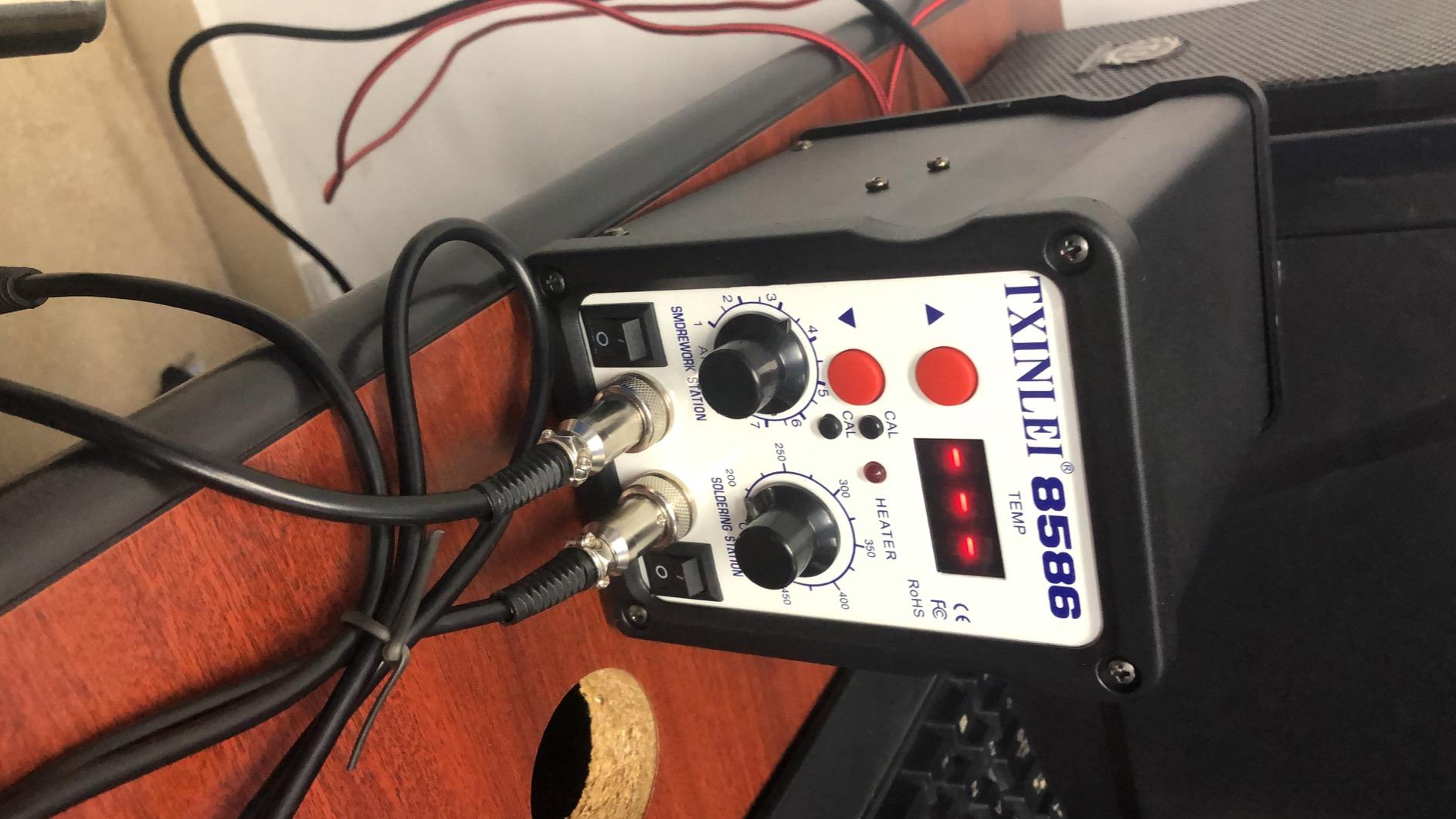
Why the spare heaters matter on a shop bench
A hot air element is the part most likely to fail, and on models where the handpiece is a sealed assembly, its failure means replacing the whole gun. The 8586 ships a replacement for both the iron and the gun, so a dead element is a five-minute swap instead of a shipping wait. For a shop that cannot afford downtime, that is worth more than a slightly cleaner manual.
The manual is the real cost
If you are new to SMD rework, an opaque calibration procedure is a real barrier. The listed tolerance is 1°C, but treat that as a nominal figure until you have verified it yourself. Pair this station with a thermocouple probe, and it becomes a solid board-level tool with unusually good parts support.
7. WEP 8786D-I SE – Best Light-Duty Pick for eMMC and Small SMD Work
WEP 8786D-I SE Hot Air Soldering Iron Station Kit 2-IN-1 for Rework, Desoldering with Lead-Free Solder Wire, 5 Soldering Tips, 3 Hot Air Nozzles,Tweezers, Desoldering Pump
212°F to 896°F hot air
Air volume knob
10-minute sleep, standby cooling
Light 1.69kg body
Pros
- Light
- compact and sturdy with a small bench footprint
- Fast heat-up with steady PID control on both handpieces
- Air volume knob and temperature control are easy to read and adjust
- Standby and sleep modes cool the gun and protect the element
- Suited to eMMC removal and light phone board jobs
Cons
- Iron heat transfer is poor on larger components and thick copper
- Some examples have a defect where the iron tip has no thermal contact with the element
- Hot air gun suits light rework rather than professional desoldering
- One nozzle is improperly tapped and will not tighten
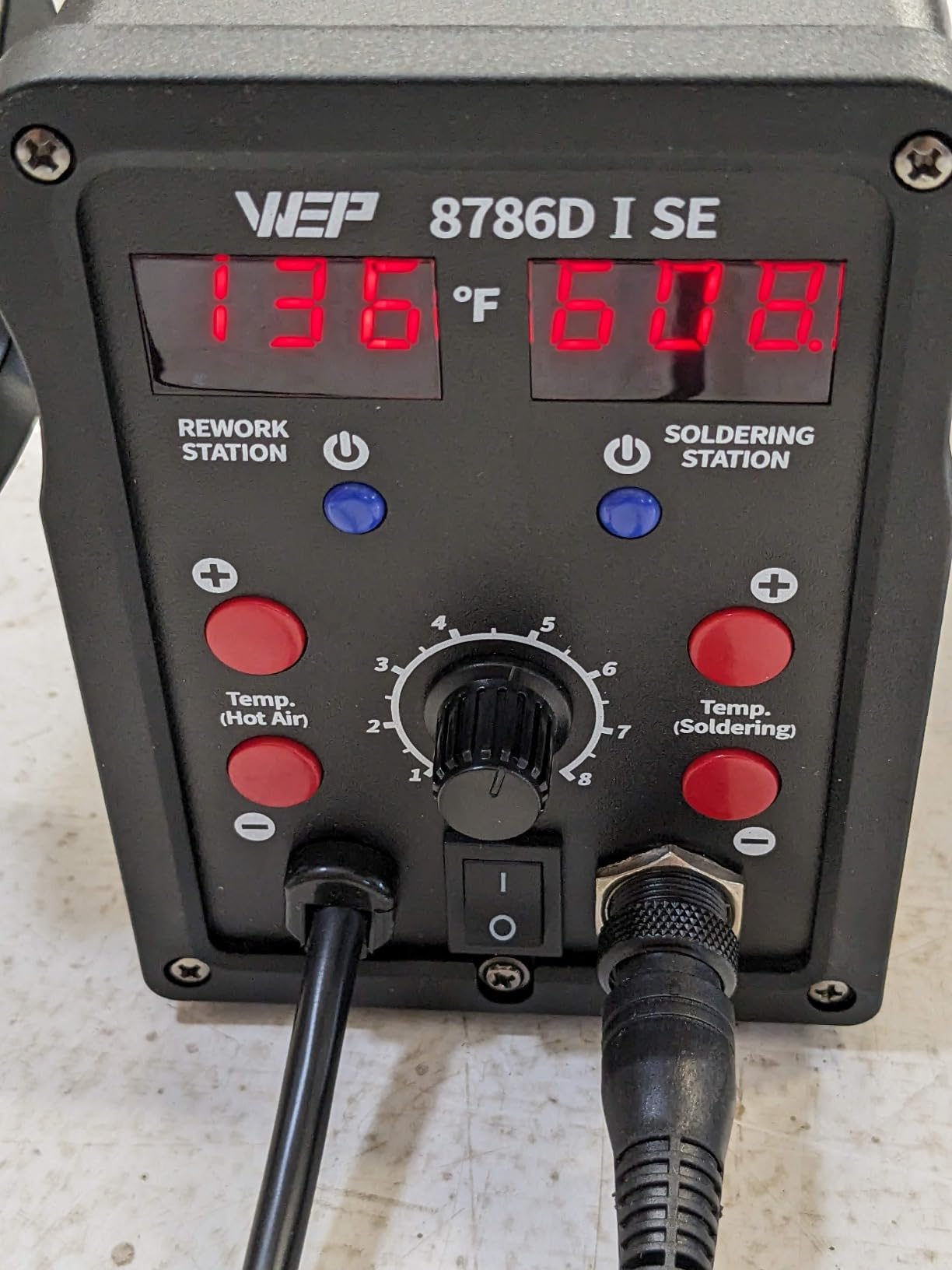
The 8786D-I SE is a small, light unit that owners describe as comfortable through long sessions. The hot air side runs 212°F to 896°F with PID stabilisation, and the standby mode cools the gun to 212°F in the holder. The iron adds a ten-minute sleep mode, 392°F to 896°F range, and both channels have their own digital readout in Fahrenheit.
For phone work the useful detail is control layout. Air volume sits on a dedicated knob and temperature on a separate control, both easy to read and adjust while your eye is on a board in a holder. Owners doing eMMC removal and other light SMD jobs rate it well for exactly this kind of work.
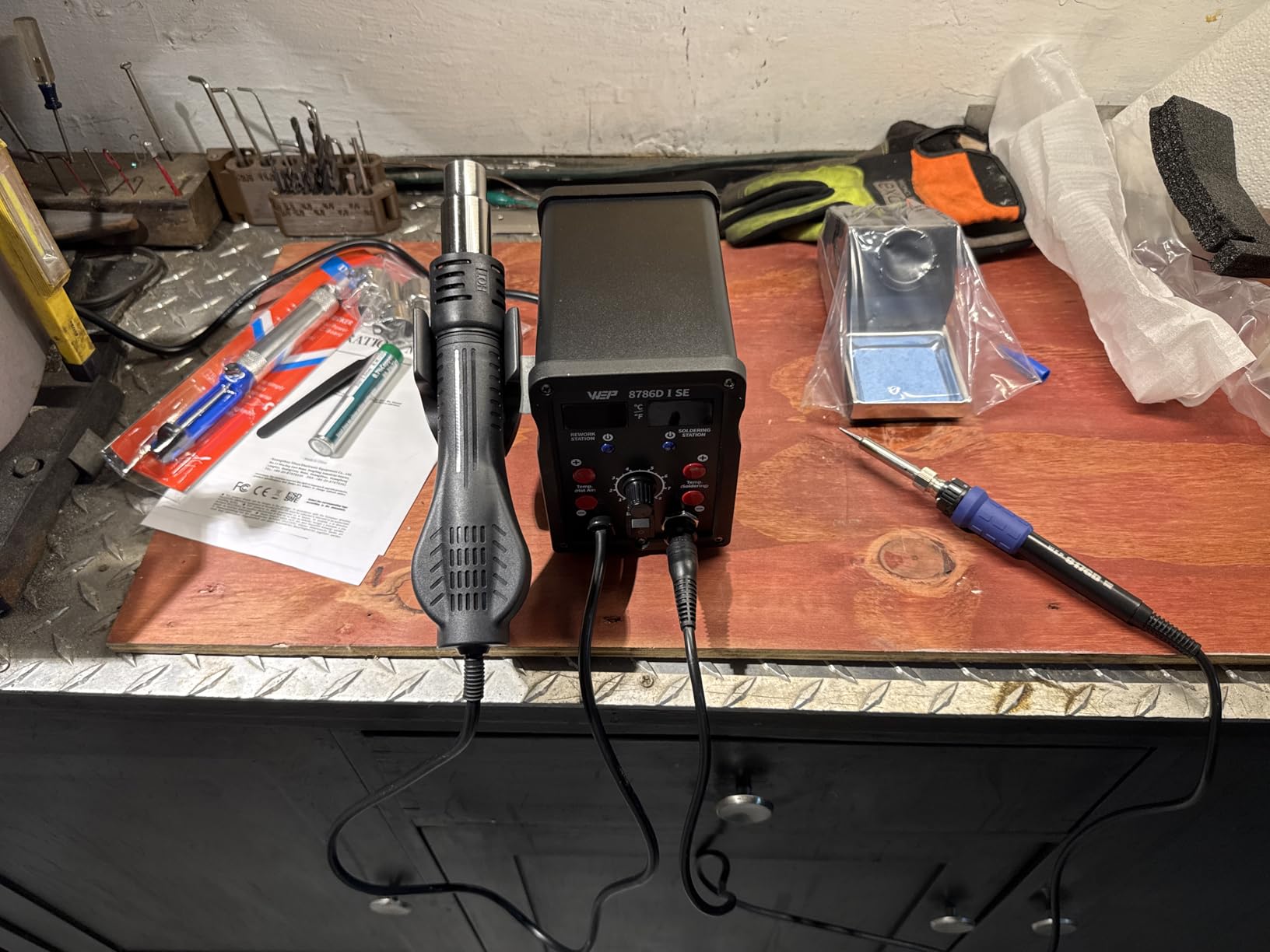
The known weakness is on the iron side rather than the hot air side. Heat transfer from element to tip is poor on larger components and thick copper, and some units ship with a manufacturing defect where the tip has no thermal contact with the heating element at all. Applying thermal compound inside the tip is the common owner workaround. One supplied nozzle is also improperly tapped and will not tighten.
Replacement tips are another friction point, since there is no clear indication of where to order them and some supplied tips do not fit the storage rack.
Best for storage and light board work
Modern phone storage removal is a light thermal job. A shielded eMMC over a thin board does not need 700W and a large element, and a station that holds a steady low-to-mid temperature is easier to control on those jobs. This unit does that well, and the standby cooling means you can park it mid-session without worrying about the element.
Skip it for large-joint soldering
If you routinely rework thicker copper, laptop power sections or through-hole connectors, the iron side will disappoint you. Verify the tip has thermal contact on day one, or plan to do contact work with a separate iron. WEP includes a year of USA technical support, which helps when a nozzle or tip needs replacing.
8. TXINLEI 858D – Best Entry 2-in-1 With Handle Induction
TXINLEI 858D 110V Solder Station, Digital Display SMD Hot Air Rework Station Solder Iron Kit Heat Gun, Tweezers, Desoldering Pump
700W
100°C to 450°C
Under 45dB noise
Handle induction auto stop
Pros
- Lowest entry point to a full 2 in 1 kit with a hot air gun
- pump
- tweezers and BGA tools
- 700W heating with quick warm-up and a clear digital display
- Handle induction stops heating when the iron is parked
- Three nozzle sizes cover a useful chip size range
- Includes a spare hot air gun heater
Cons
- Documentation is thin and the accessory list is unclear
- Small digital display relative to the unit body
- Accessories are entry-level only
- Temperature readout appears on the hot air side only
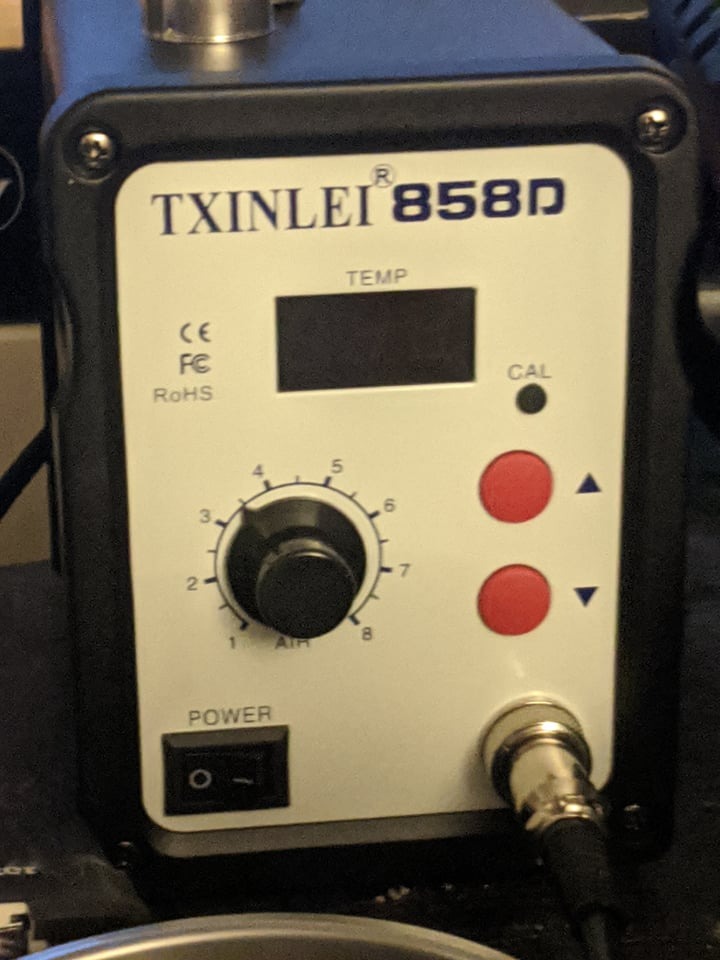
The 858D is the cheapest way into a full 2-in-1 bench with a hot air gun, and it is positioned for exactly the phone and board repair work this guide is about. It puts out 700W across a 100°C to 450°C range, runs under 45dB, and operates on 110V AC with a microcomputer-controlled digital readout on the hot air side.
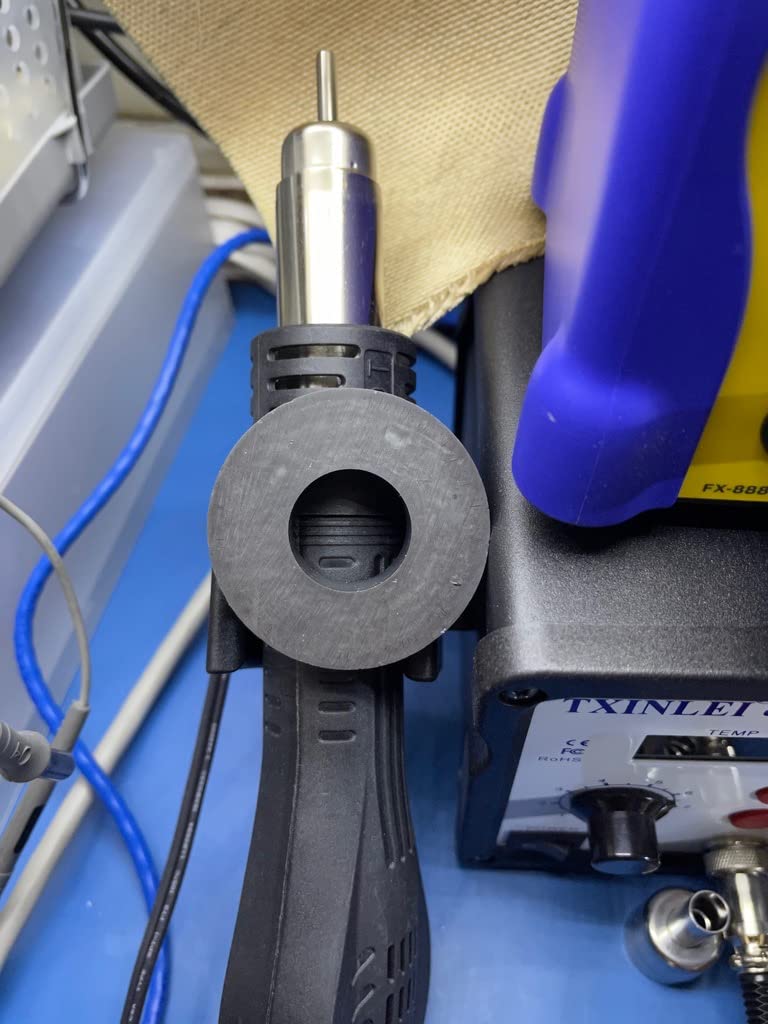
Handle induction is the feature that makes it safer than it looks: the unit works when you lift the handle and stops automatically when you put it back. The kit includes an IC puller, a spare hot air gun heater, two tweezers, a desoldering pump, six-in-one BGA tools and three replaceable nozzle sizes in big, medium and small.
The manufacturer’s own guidance is worth following here: set temperature as low and airflow as high as practical to protect the heating element and the ICs on the board. That is good phone-repair practice regardless of which station you own, and this entry-level unit benefits from it most.
Owners rate it as an entry bench rather than a shop tool. Documentation is thin, the accessory set is not clearly spelled out, and the display is small. Feedback is mostly about build value and bundled tool quality rather than temperature performance.
Best for a first repair bench
For someone moving past through-hole joints and starting on real SMD phone work, this covers the essentials: adjustable temperature, three airflow-friendly nozzle sizes, and a soldering iron in the same box. Handle induction means you are not walking away from a heating element between jobs, which is a real safety gain for a beginner.
What you give up
You give up PID precision, fine airflow control and accessory quality. The 450°C ceiling is fine for phone boards but tight if you later move to laptop work, and entry-level tweezers will not survive microsoldering. Treat it as a learning bench and plan an upgrade once you are doing board-level work daily.
9. WEP 8858-V – Smallest Hot Air Station With a Built-In Nozzle Holder
WEP 8858-V Hot Air Rework Station Kit with Compact Size, Integrated Nozzle Holder, 3 Nozzles, 2 Tweezers, Adjustable Temperature& Air Volume, PID Program, °C/°F Conversion and More
Palm-sized body
212°F to 896°F
PID with calibration
Single air volume knob
Pros
- Palm-sized body with built-in gun and nozzle holders
- PID program maintains steady temperature on delicate components
- Air volume adjusts from a single panel knob with no menu diving
- Digital temperature calibration on a unit this small
- Three nozzle sizes plus straight and bent tweezers
- Fail-safe hot air protection and degree conversion
Cons
- Hot air only with no soldering iron in the box
- Small LCD limits how much information is visible at once
- 22W class entry suggests light duty rather than sustained reballing
The 8858-V is the smallest station here at 3.5 by 4.6 by 2.4 inches, and its layout is the best bench-friendly design in the group. The gun holder and nozzle holder are integrated into the body, so there is no separate cradle taking up desk space and no loose nozzles rolling off the back of the bench.
Temperature runs 212°F to 896°F under a PID program that continuously monitors and adjusts power, with digital temperature calibration to tighten the readout. Air volume comes off a single panel knob with no secondary menu, which is faster to operate than button navigation on the compact 2-in-1 units.
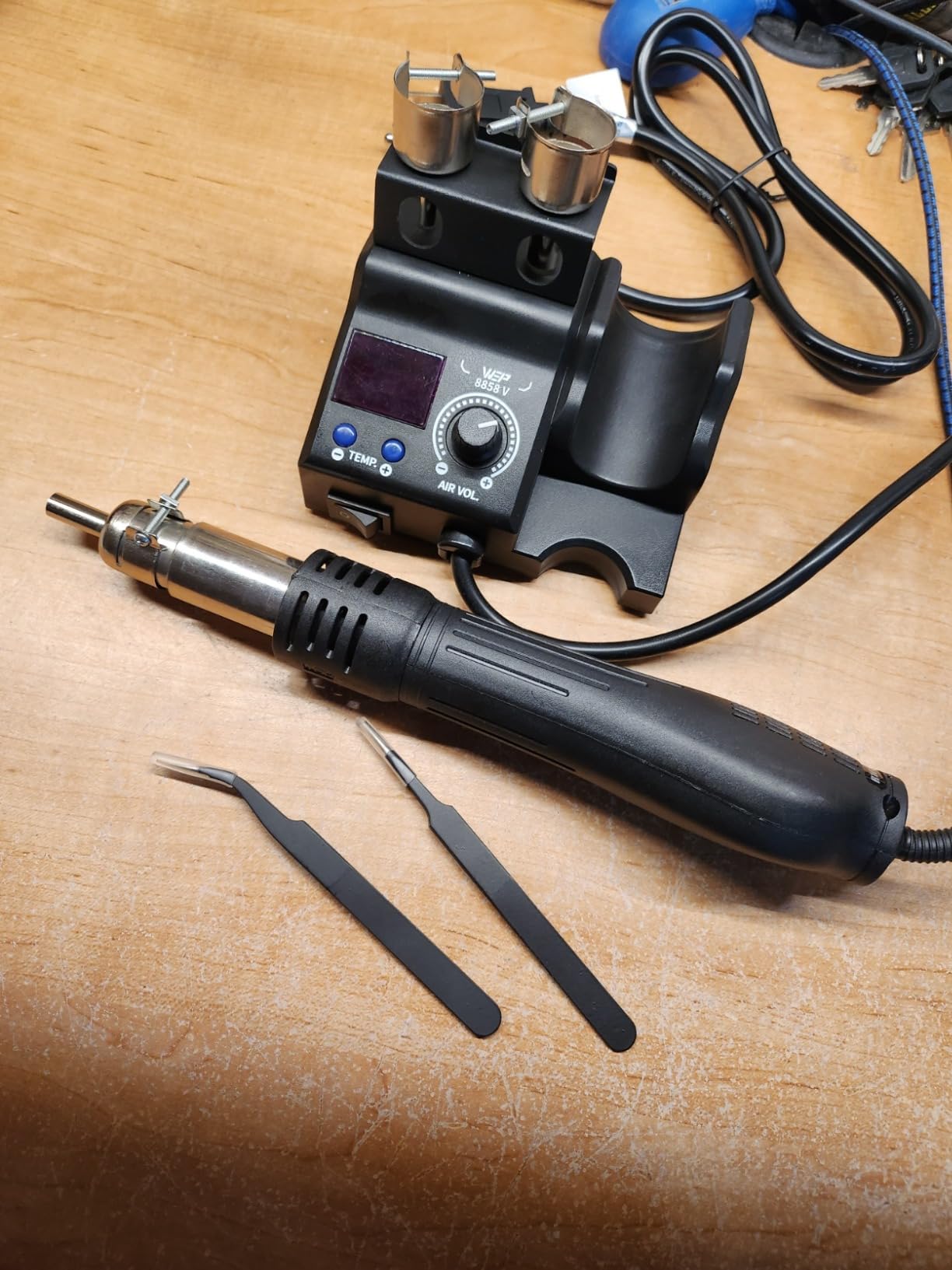
The recurring theme in owner reviews is footprint. People with crowded benches single out the integrated holders and the one-knob air control. PID, digital calibration and fail-safe hot air protection are the features cited by name, and the kit includes three additional nozzles plus straight and bent tweezers.
The limitation is structural: there is no soldering iron, so this is a hot air only station. The LCD is small, and the 22W class entry suggests light-duty work rather than sustained reballing on a large board.
Best for a crowded or shared bench
If you already own a soldering iron and want the smallest possible hot air contribution to the bench, the 8858-V is the pick. The single-knob air control means you can drop airflow one-handed while holding a board in a holder, which is the difference between a clean shield can lift and three passives on the bench. Owners with crowded desks describe it as the most bench-friendly layout they have used.
Where the size costs you
Light-duty means light-duty. Sustained BGA reballing or large thermal-mass boards will outrun what this unit can hold. And with no iron included, budget for a separate soldering station. If you want one box to do both, go back to the WEP 882D.
10. LRT 8858 – Best Portable Station for Calls and Mobile Benches
LRT 8858 Hot Air Rework Station, Digital Heat Gun for SMD Repair
100°C to 500°C
0.7kg controller
F1-F10 stepped airflow
Six nozzles
Pros
- Micro-sized 0.7kg controller is genuinely portable for mobile repair work
- Covers 100°C to 500°C on a microprocessor-controlled digital setting
- Sleep function cools the handle in the holder
- F1-F10 airflow steps let you drop flow to stop small parts flying
- Six nozzle sizes from 3mm to 10mm included
- ESD tweezers and IC extractor in the kit
Cons
- Hot air only with no soldering iron included
- Stepped airflow is less fine-grained than a continuous knob
- Budget build with minimal bundled extras
- Lower review volume means limited long-term data
The LRT 8858 is built for a technician who does not sit at one desk. At 0.7kg the controller is genuinely portable, and it covers 100°C to 500°C on a microprocessor-controlled digital adjustment. That makes it a credible bench-mate for a shop that takes on-site jobs or works from a shared repair counter.
Airflow is stepped in ten increments from F1 to F10 rather than adjusted continuously. For phone work that stepping is actually a feature in one respect: the coarse steps make it easy to dial down flow far enough to stop 0201 passives flying off the board, which is the single most common complaint about budget stations on dense boards.
Six precision nozzle sizes from 3mm to 10mm is the broadest nozzle range in this group, which is genuinely useful when you move between storage chips, connectors and shields. The intelligent sleep function cools the handle in the holder, and the kit includes anti-static tweezers, an IC extractor, a stand and a power cable.
There is no soldering iron, airflow is stepped rather than continuous, and the review base is smaller than the other picks, so long-term durability data is thin. If you rely on this daily for paid work, that last point deserves weight.
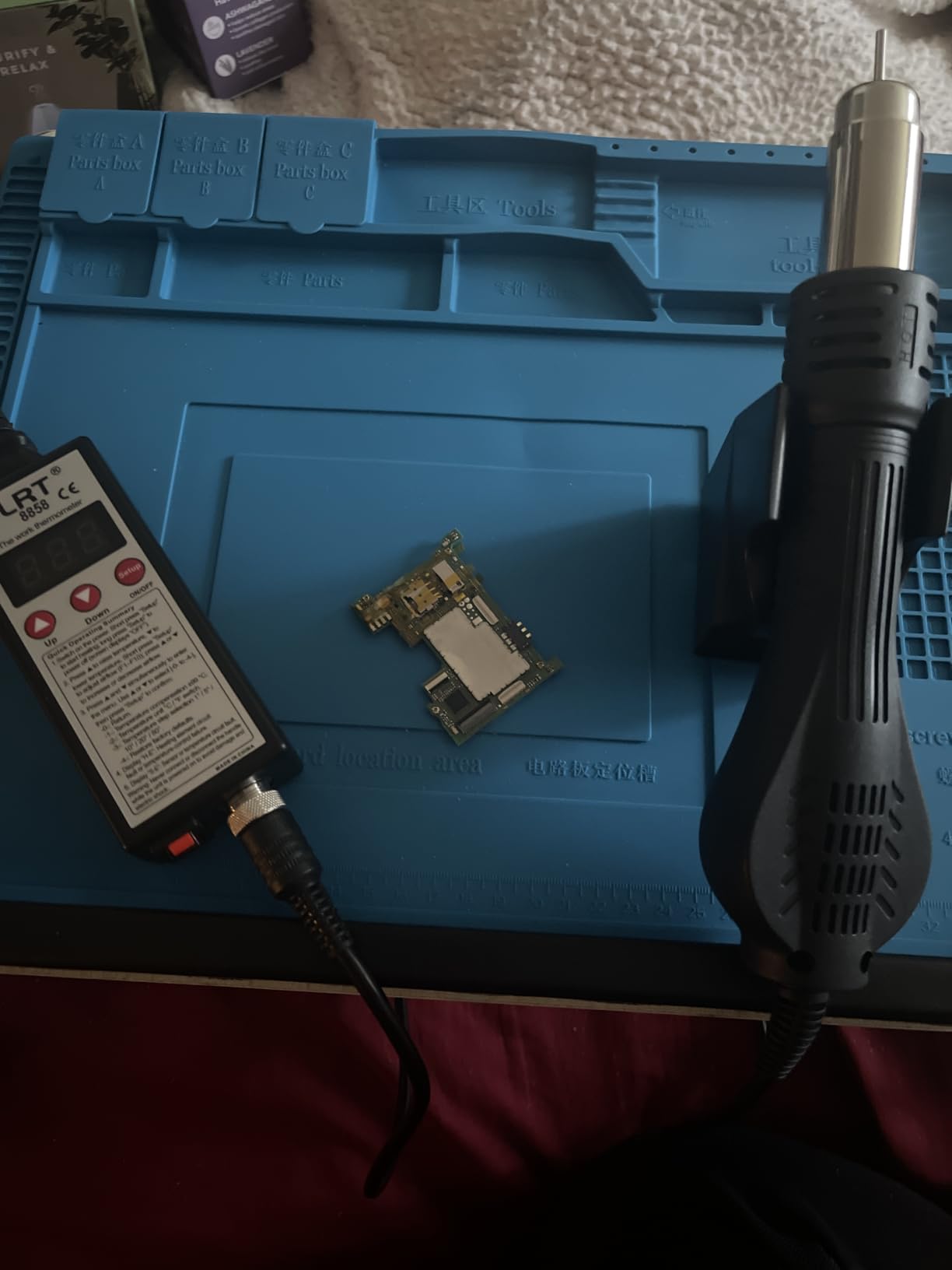
Best for on-site and shared-counter work
Portability is the whole case here. A 0.7kg controller with a 500°C ceiling and a holder-mounted sleep mode can live in a tool case and travel between a counter and a customer’s desk for a no-solder diagnostic. The ten airflow steps also make it a good teaching tool, because each step is an obvious, repeatable setting rather than an analogue guess.
Limits to plan around
Plan on buying a separate soldering iron, since this is hot air only. And if you move from phones to laptop boards or denser multilayer work, the stepped airflow will feel coarse compared with a continuous knob. For phone-level jobs it is a good fit.
11. LRT 858D – Best Hot Air Station With a Brushless Fan
LRT 858D 700W Digital Hot Air Rework Station for PCB IC SMD Repair
700W
Brushless fan
100°C to 450°C
Digital airflow control
Pros
- Brushless fan gives steadier airflow and longer service life than brushed motors
- 700W element heats fast and recovers temperature under load
- Digital readout with adjustable temperature and airflow
- Lead-free compatible element for continuous operation
- Ergonomic handle and compact body for long sessions
- Marketed for USB-C port replacement and phone repair
Cons
- Hot air only with no soldering iron in the box
- Minimal accessory bundle beyond the fan and handle
- Smaller review base than the top-rated stations
The LRT 858D is the one hot air only unit here with a brushless fan in the base. Owners consistently identify that as the differentiator, and the reasoning is sound: brushless motors deliver steadier airflow, run quieter and last longer than the brushed motors fitted to most budget stations. Airflow steadiness is exactly what you need when a nozzle is parked over a joint for a five-second pulse.
It runs 700W with rapid heat-up and stable temperature recovery across a 100°C to 450°C range, and the digital LED display lets you adjust both temperature and airflow. The lead-free compatible heating element supports continuous operation, and the ergonomic handle and compact body are built for long repair sessions.
It is explicitly aimed at PCB repair, IC removal, BGA rework, SMD soldering and USB-C port replacement, so the use case matches this guide closely. On r/AskElectronics, users searching for a station for small chip replacement on laptop boards land in the same territory, and the brushless fan is the feature that separates this from cheaper answers there.
The limitations are the usual ones for a hot air only unit: no soldering iron in the box and a minimal accessory set, just the fan and handle. You will need nozzles, tweezers and a holder sourced separately, and the review base is under 400, so treat long-term claims as provisional.
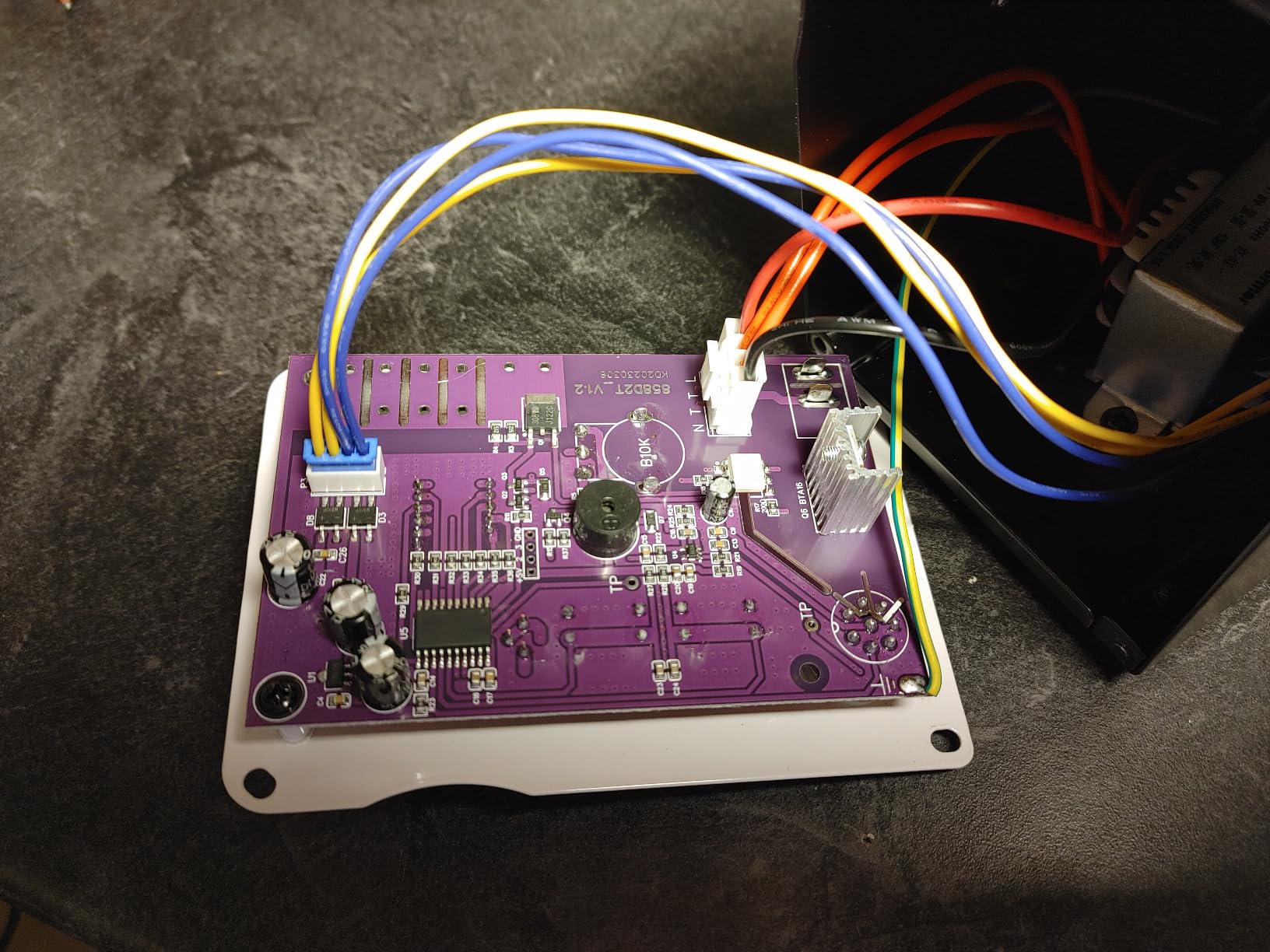
Why the fan matters more than the wattage
Two stations with the same wattage can behave completely differently if one fan pulses. On a five-second heating cycle, a motor that surges and stalls delivers uneven heat, so the same joint behaves differently on the first pass and the third. A brushless fan holds the flow curve flat, which makes your muscle memory and your settings transfer between boards.
Plan for the extra buying
Because nothing is bundled beyond the handle, budget for nozzles, an iron holder, tweezers and a soldering iron before this becomes a working bench. Once assembled, it is a strong hot air section for USB-C port work where airflow control at low settings decides whether the neighbouring passives survive.
12. BAKON BK701D – Widest Hot Air Range at 932F
BK701D 700W Soldering Station, 2 In 1 Hot Air Rework & Soldering Iron Station, SMD ESD Safe Solder Station,Electronic Soldering Kit For Mobile Phone Laptop Repair or Circuit Board Soldering
Hot air to 932°F
Iron to 896°F at 90W
20ms PID iron
Auto sleep and cool
Pros
- Widest hot air range here at 212°F to 932°F
- Iron and gun operate independently so you can run just one
- Iron PID cycles every 20 milliseconds for tight stability
- Auto sleep and auto cool after 10 minutes in the holder
- ESD safe and aimed at mobile phone wiring work
- One-year US warranty with 24-hour support
Cons
- Lowest average rating in this group with a larger share of one-star reviews
- Heavier build with 700W hot air plus an iron on one box
- Highest non-YIHUA price here
- Only two hot air nozzle sizes in the kit
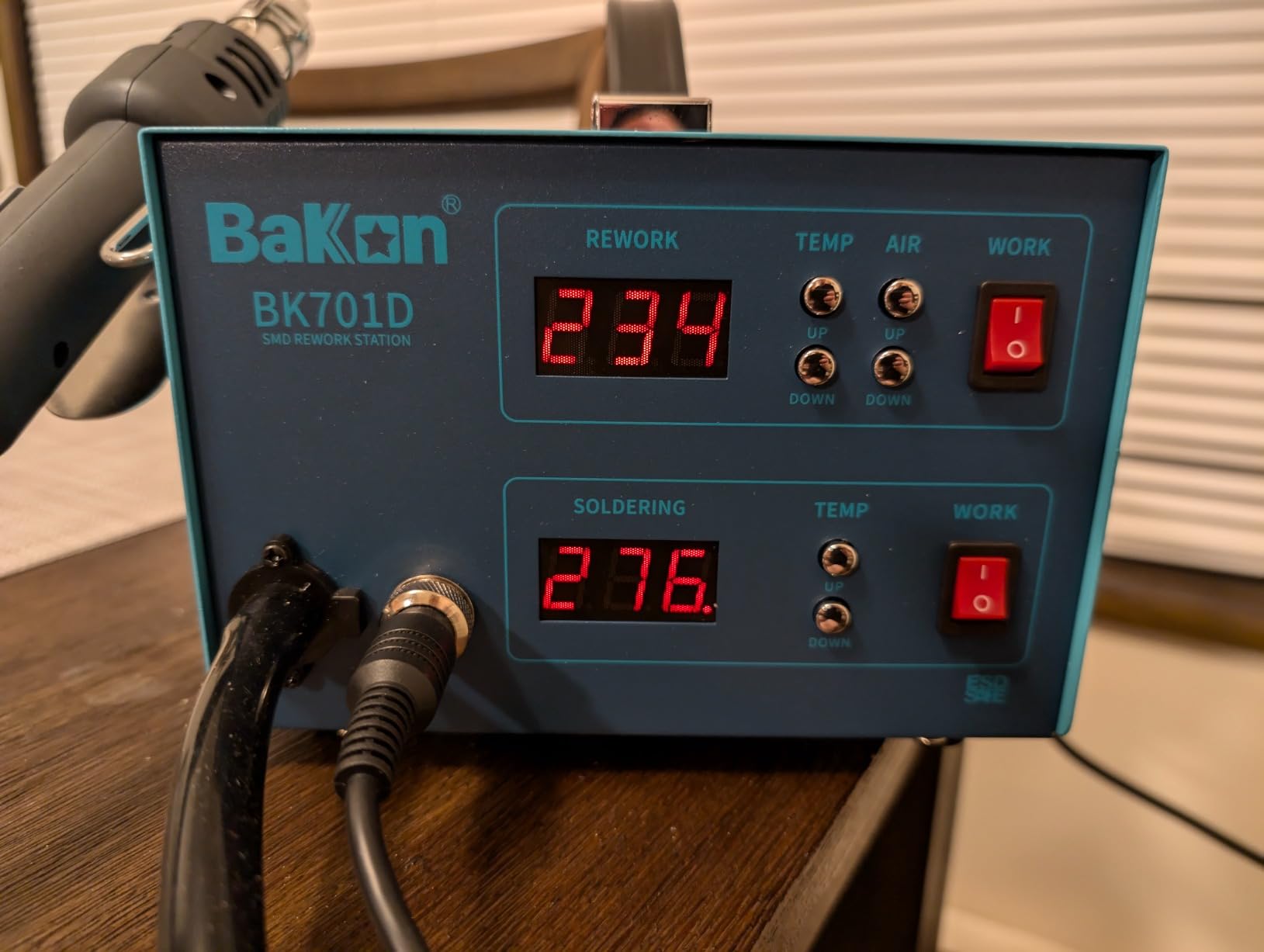
The BK701D is the odd one out in this list, and the reason is the hot air ceiling. It reaches 932°F where everything else in this group stops at 896°F or lower. That extra headroom is genuinely useful on high thermal-mass board work where you need to get through a large ground pad quickly, though for phone logic boards you will rarely use it.
The iron runs 212°F to 896°F at up to 90W with PID control cycling every 20 milliseconds, and both handpieces operate independently so you can run just one. Auto sleep and auto cool after ten minutes in the holder extend heater core life, which matters on a unit this size.
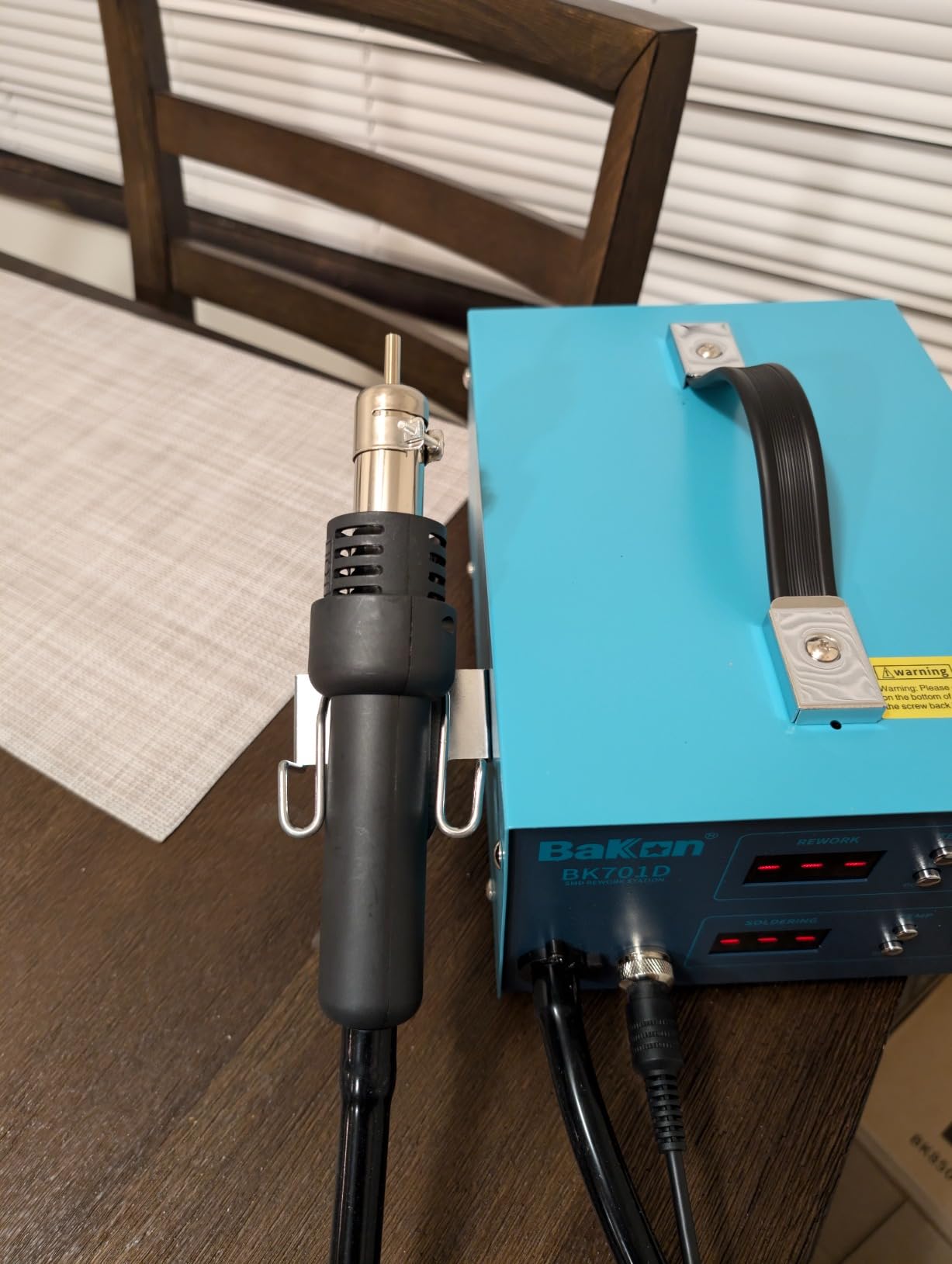
Owners value the 932°F range, the PID iron and independent handpiece operation for phone board work. The kit is complete enough: 30g of solder, five tips, solder suction tape, brass wool, a pump, tweezers and two hot air nozzles, with a one-year US warranty and 24-hour support.
The rating tells the rest of the story. It scores lowest in this group with 66% five-star and 12% one-star, which points to more variance in build consistency and accessory quality than the YIHUA and WEP units show. It is also the heaviest option and the priciest outside the YIHUA line, for a specification edge most phone work will not use.
Best for mixed phone and laptop bench work
If your queue includes laptop power sections and phone boards, the extra heat range stops you from fighting the top of the dial on a large ground pad, and the 90W iron has the power for thicker joints. Independent handpiece operation also means you can leave the gun idle during a long connector job without powering it.
The rating spread is a real signal
A 12% one-star share on a bench tool usually means inconsistent quality control rather than a design fault. If you buy it, inspect both handpieces on arrival and keep the receipt. For most phone-focused buyers, the 862BD+ or the 8786D I are the steadier choices at the same spend.
What a Rework Station Can and Cannot Do on a Phone
A hot air rework station is for component work. It blows heated, temperature-controlled air through a nozzle to melt solder so you can remove or replace surface-mount parts: charging ports, power management ICs, storage chips, shield cans, microphones, and the small passives that get torn when a connector is pulled. A heating element raises air to a set temperature, a fan pushes that air through a nozzle chosen to match the component, and PID regulation holds the outlet steady while you move between joints.
It is not for opening a phone. Screen separation on modern phones is a heat plate or separator job, not a hot air job, and this is where the single most expensive mistake in a new repair shop happens. A hardware store heat gun runs with no airflow control and no temperature regulation. A phone battery is a lithium pouch cell that can be punctured by a screw, cracked by a sharp pry, or thermally abused into venting. Applying uncontrolled 500°C-plus airflow to a glued glass back is how people set batteries alight.
If you need a screen off, use a heat plate or a proper separator at a controlled temperature with a defined dwell time, and treat the battery as a live hazard throughout. Our hot air brush guide covers why brush-style hot air tools behave differently on delicate surfaces, if you are comparing them for heat shaping work.
There is also a skill tier structure that repair communities use, and it is worth adopting. Component swaps on connectors and storage are tier one. Board-level IC work on power and charging circuits is tier two. Chipset and full BGA reballing is tier three, and that needs a microscope, schematics and a proper BGA system with a board heater, not a bench rework station. Reddit users are blunt that a cheap station is the wrong tool for fine-pitch chipset work, and we agree.
Settings Cheat Sheet: Temperature and Airflow by Repair Task
These are starting points, not laws. Airflow is the dial you adjust between jobs; temperature is the dial you adjust between metals. The two variables trade against each other, and the combination plus nozzle size is what determines the heat delivered to a joint, not the wattage on the box.
Charging port or flex connector removal. Start around 340°C to 360°C with airflow at 40 to 50 percent and a 3mm to 5mm nozzle. Move the nozzle constantly. Ports are anchored to ground pads on a multilayer board, so give the heat time to travel rather than raising the temperature.
Power management IC removal. Around 380°C to 400°C with airflow at 50 to 60 percent and a nozzle matched to roughly half the package width. Lift with tweezers the instant the solder releases, and never pry.
Shield can and EMI shield lifting. Around 300°C to 330°C with airflow at 20 to 30 percent and the largest nozzle that still concentrates heat on the shield. Low airflow is the whole game here, because the neighbours are 0201 passives and they will leave the board if you push hard.
Storage chip and eMMC removal. Around 360°C to 380°C with airflow at 30 to 40 percent. This is a lighter job than a charging port and over-tempting is the usual failure, so be patient rather than aggressive.
Small passive cleanup after a port job. Drop to 300°C or below with airflow under 20 percent and the smallest nozzle you have. Removing a lifted 0402 next to a pad you are trying to save is a patience job.
Lead-free versus tin-lead. Tin-lead melts around 183°C, lead-free SAC305 melts near 217°C to 221°C. Lead-free needs a higher target temperature and more aggressive flux, and it puts more thermal stress into the board. If you routinely see pad lift on lead-free work, your airflow is usually too low for too long, not your temperature too high.
Bottom preheat. For multilayer boards and any large ground plane, preheat the underside to around 100°C to 120°C. It slows the top-side climb, reduces the temperature difference across the board, and is the single most effective way to stop thermal shock cracking on dense phone boards. If your station is not paired with a preheater, at least warm the board with the nozzle before you bring it to the joint.
Stepwise Heating: The Cycle That Saves Lifted Pads
Differential thermal expansion is what destroys logic boards. Heat the top of a multilayer board and the layers expand at different rates, which shears pad connections off the substrate. The fix is not a lower temperature. It is giving the heat time to equalise.
Work in pulses of three to five seconds on, then three to five seconds off. Repeat, adding time each cycle rather than adding temperature. Between pulses, check whether the solder has just gone liquid and whether the component is starting to lift on its own. The moment it moves, take the tweezers to it.
Keep the nozzle moving during every pulse. A stationary nozzle over one spot creates a hot spot long before it creates a good joint. And if the component will not come free after a few cycles, the answer is almost always more flux and one more cycle, not more degrees.
Building the Rest of Your Phone Repair Bench
A station alone will not fix phones. The rest of the bench is where repair success actually lives, and most guides skip it entirely.
Microscope. Stereo, not monocular, with enough working distance to put a board holder underneath. Fine phone work is not possible with a loupe, and this is the single highest-impact purchase after the station.
PCB holder. A spring-loaded or magnetic phone board holder fixes the board at a height where your eye can stay over the microscope while both hands are free. This is the accessory that makes two-handed work possible.
Bottom preheater. A ceramic plate or mini hot plate that brings the underside of the board to 100°C to 120°C before you touch the top side. On stacked phone boards it is the difference between a clean port swap and a warped board.
Flux. No-clean flux with a real dispensing pen, plus a separate bottle of decent no-clean flux for lead-free work. Flux is not optional; it is the difference between solder that wets and solder that balls.
ESD mat and ground. A grounded mat and a wrist strap. A rework station with an ESD-safe design protects the part on the bench, not the board you just set down.
Fume extraction. A small fume extractor with a filter. Flux smoke is the one thing on this list that affects your health directly over years, and it is the item most often skipped.
If you also run thermal work on other devices, our phone cooler guide covers the opposite problem, and the gimbal roundup is relevant if your shop also fits stabilisers.
Seven Criteria That Decide Which Station You Buy
1. PID control and sensing cycle. A station that measures actual element temperature and corrects against it holds a joint temperature far better than one that estimates from a timer. The 862BD+ cycles every 20 milliseconds and the 8786D I uses fast compensation; units without PID hunt, and hunting burns pads. If the listing does not mention PID, assume it does not have it.
2. Airflow resolution at the low end. Not maximum litres per minute, but the smallest usable step. Shield can removal on a phone board happens at 20 to 30 percent flow, and if your lowest setting still moves 0201 components, the station is wrong for the job. A dedicated air volume knob, as on the WEP 8786D-I SE, is better than menu navigation.
3. Pump and fan design. Three architectures are common. A brushless blower in the base, as on the LRT 858D, gives the steadiest flow and the longest life. A diaphragm or lower-cost motor is cheaper and adequate for hobby work. A blower in the handle, which is the layout on most compact 2-in-1 units, is lighter but puts the motor where heat and impact live. Handle induction, where the element stops when the gun is parked, is a safety feature worth paying for.
4. Nozzle availability and cost. Check that replacement nozzles are orderable and cheap before you buy, not after. A station with three or four sizes included and no clear source of spares will frustrate you within months. The LRT 8858 ships six sizes from 3mm to 10mm, which is the broadest range here.
5. Temperature range that matches your work. Phone logic board work lives roughly between 200°C and 400°C. A 100°C to 480°C or 100°C to 500°C range covers it with room to spare. Headroom above 500°C adds risk rather than capability, and the extra 932°F ceiling on the BK701D is mostly useful on laptop boards.
6. Standby, sleep and fail-safe behaviour. Standby cooling, an adjustable sleep timer and airflow fail-safe cut-off are what keep a station alive over years rather than months. The 862BD+ has a 0-99 minute sleep mode, the 8858-V has fail-safe protection, and the 8786D I cuts power to the element if airflow stops. On a shop station that stays powered all day, this is the difference between a five-year tool and a three-year one.
7. Voltage version and certification. Every unit in this roundup is rated for 110-127V with a US plug. Do not plug a 110V unit into a 220V socket, and be careful with marketplace listings that do not state the version. Look for a recognised certification mark on the listing, and buy from a seller who will confirm the voltage in writing before you order.
On the question of separate versus combo: if hot air rework is your primary job, a dedicated hot air station gives you a bigger pump, better controls and no competition for bench space. If you also do a lot of through-hole and connector soldering, a 2-in-1 saves money and space, and every pick above except the three hot air only units is one. On r/soldering, at least one user pairs a Hakko FX-888D soldering station with a separate hot air unit specifically for control at the individual joint level, which is the argument for splitting your bench as you grow.
On brand reputation, the honest picture from repair communities is that Hakko and Weller lead on build quality and support, Quick is regularly cited on r/mobilerepair as the best value station for airflow quality and temperature consistency, and the Yihua family is widely described as adequate and, in some cases, excellent. The r/soldering view that a Geeboon TC22 paired with an AiXun H314 works as excellent work horses for iPhone repairs is representative of how the value tier is actually used in the field. None of that replaces calibrating your own station before paid work.
Counterfeits, Voltage Versions and Spare Parts
Counterfeit and grey-market listings of premium models are a recurring problem in this category, and Quick units in particular attract them at implausible prices. The tell is usually a missing certification mark, a listing with no model number in the specifications, and a seller who will not confirm the voltage version or serial number in writing. If a premium-branded station appears for a fraction of the going rate, assume it is not the premium-branded station.
Used and refurbished units are a reasonable way to reach a better station, but check three things: that the heating element has not been run dry, that the PID readout matches a known reference after warm-up, and that the fan does not pulse. A dead element on a unit with sealed handpieces is a total loss, so ask whether the handpieces are individually replaceable.
Spare parts are where budget stations quietly cost you. Proprietary fittings and no clear ordering path are a common reason a cheap station ends up unused. The 8586 is the counterexample in this list, shipping spare iron and hot air heaters in the kit, and the 862BD+ has both handpieces individually replaceable.
What Technicians Say About These Stations
Repair communities are sharply split and honest about it. On r/mobilerepair, multiple technicians name the Quick 861DW as the best value station for airflow quality and temperature consistency, which is why several of the picks here are judged partly on how well they approximate that airflow control. On r/soldering, one user runs a Geeboon TC22 alongside an AiXun H314 and calls both excellent work horses for iPhone repairs.
On r/consolerepair, a user reports the Yihua 959D has served them very well over four years and recommends it as a budget hot air station, which is consistent with the multi-year ownership reports in the review data for the Yihua units here. Elsewhere on r/soldering, the preference is a separate Hakko iron paired with a dedicated hot air unit for joint-level control. EEVblog hosts a long-running discussion separating touchscreen-interface stations from button-interface budget models that cell phone repair shops actually buy.
The recurring warnings are the same ones our own testing surfaced: cheap stations drift in temperature and are not calibrated, high airflow blows tiny 0201 and 0402 passives onto the bench, and heat guns are not a safe way to open a phone. One user put it plainly, preferring not to light a battery on fire. Treat that caution as correct.
Frequently Asked Questions
What is the best heating machine for mobile phone repairing?
The best hot air rework station for phone repair in our testing is the YIHUA 8786D I, a 2-in-1 unit with dual LED displays, PID control on both channels and a fail-safe that cuts the element if airflow stops. The YIHUA 862BD+ scores highest on owner ratings thanks to a 20ms PID sensing cycle, and the YIHUA 853D 2A USB adds a DC supply and USB test port for power-rail diagnosis.
What is the best soldering station for mobile phone repair?
For phone repair the best value is a 2-in-1 station that pairs a soldering iron with a hot air gun, because most phone jobs need both and one chassis saves bench space. The WEP 882D is the most compact option, the YIHUA 8786D I is the best overall, and the YIHUA 862BD+ is the highest rated. Pick a unit with PID control, adjustable airflow and a sleep or standby mode.
What is the best rework soldering station?
For general rework the best choice balances PID stability, airflow resolution and parts availability. The YIHUA 862BD+ leads on rating and control speed, the YIHUA 8786D I on accessory value and review depth, and the TXINLEI 8586 on bundled spare heaters. Whatever you pick, calibrate against a known reference before you use it on paid board-level work.
What is the best heat gun for mobile repairing?
For component work, a hot air rework station is the correct tool, not a heat gun. A hardware store heat gun has no airflow control and no temperature regulation, so it scorches glass, adhesives and display modules. For opening a phone screen, use a heat plate or a proper separator at a controlled temperature instead, and treat the lithium battery as a live hazard throughout.
Are Yihua soldering stations any good?
Reviewers consistently describe the Yihua 959D as having served them very well over four years and recommend it as a budget hot air station. The Yihua family in this roundup holds 4.5 and 4.6 owner ratings across thousands of reviews, with recurring caveats about out-of-box calibration and bundled accessory quality. For daily phone work they hold up well, provided you calibrate and buy better tips.
What is the best soldering station for hot air rework?
If hot air rework is your primary job, choose a dedicated hot air station for a larger pump, better airflow control and no competition for bench space. A combo unit is better value if you also do through-hole and connector soldering. Among dedicated hot air options here, the LRT 858D offers a brushless fan for the steadiest airflow, and the WEP 8858-V has the smallest footprint.
Which Hakko soldering station is considered the best?
Among the models repair technicians name most often for iron work, the Hakko FX-888D is the frequent recommendation, often paired with a separate hot air unit for joint-level control. On the hot air side, repair communities more often cite the Quick 861DW for airflow quality and temperature consistency. No Hakko model appears in our tested roundup, so we did not rank one here.
Which is better, Hakko or Weller?
Hakko tends to lead on build quality, calibration accuracy and long-term support, which is why it is the more common choice for a single bench station. Weller offers comparable build quality with broader availability and a wider accessory ecosystem, often at a slightly higher entry cost. For phone repair specifically, the airflow control of the hot air side matters more than the iron brand.
Final Verdict: Which Hot Air Rework Station Should You Buy in 2026?
For most phone technicians in 2026, the YIHUA 8786D I is the best hot air rework station for phone repair: the deepest review base, dual displays, PID control and a fail-safe that protects the element. If you want the sharpest controls, the YIHUA 862BD+ is the pick, and calibrate it before paid work. If your diagnosis involves power rails, the YIHUA 853D 2A USB gives you a DC supply and a USB test port in the same box.
Buy the WEP 882D if bench space is tight, the TXINLEI 8586 if you want spare heaters on hand, the LRT 858D if airflow steadiness from a brushless fan matters most, and the WEP 8858-V if you need the smallest hot air only footprint. Whatever you choose, buy a microscope, a board holder and a preheater with it, and keep the heat gun away from the battery.