
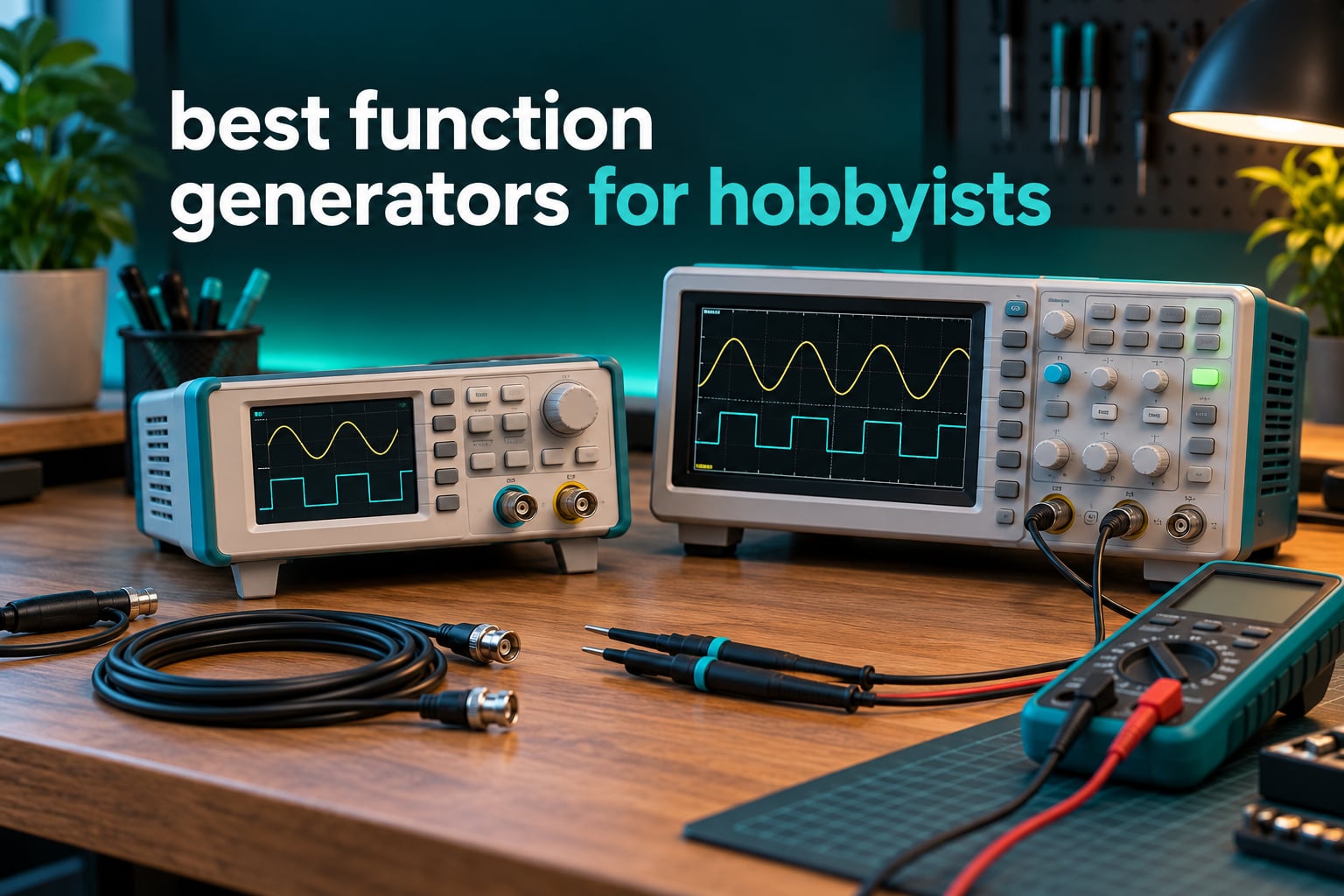
Most people who ask for a function generator do not need a laboratory instrument. They need one waveform, at one frequency, at one amplitude, to fix one thing. A 1 kHz sine at 6 Vpp to bias the chorus circuit of a Juno-60. A slow ramp to watch a thermostat board settle. A square wave to prove a comparator still switches.
That narrowness is the point. We compared 10 function generators for hobbyists across kit-level builds, pocket modules and bench AWGs to find the cheapest thing that actually does the job, plus the units worth stepping up for. Every pick below lists the honest limitation as well, because the fastest way to waste a weekend is buying a generator that cannot deliver the amplitude you assumed it could.
This guide is updated for 2026 and covers frequency range, amplitude control, waveform quality, output impedance and the specs that separate a useful bench tool from a party trick. If you are still choosing instruments, our oscilloscope guide for hobbyists covers the other half of the bench.
Table of Contents
Top 3 Picks for Best Function Generators for Hobbyists in October

What Is a Function Generator?
A function generator is an electronic test instrument that produces standard output waveforms, mainly sine, square, triangle and sawtooth, at a frequency, amplitude and duty cycle you set, so you can inject a known signal into a circuit and watch how it responds.
In practice a hobbyist uses one for a short list of jobs:
Injecting a known sine or square wave into an amplifier stage to measure gain and find the clipping point
Calibrating vintage gear, including synthesizer chorus and VCA bias circuits that need a precise amplitude at a precise frequency
Sweeping a filter or a speaker through its range and plotting the response on a scope
Bringing up a microcontroller board by clocking it with a clean, known frequency
Verifying a comparator, a Schmitt trigger or a 555 timer with a repeatable edge
The catch is that a function generator is a source, not a measuring instrument. It tells you nothing about your circuit unless you also have a scope watching the node in question.
The 10 Best Function Generators for Hobbyists in 2026
| Product | Specifications | Action |
|---|---|---|
| Koolertron 15MHz DDS Signal Generator |
|
Check Latest Price |
 MiOYOOW PWM Frequency Generator Module MiOYOOW PWM Frequency Generator Module |
|
Check Latest Price |
 Seesii 60MHz Dual-Channel DDS Generator Seesii 60MHz Dual-Channel DDS Generator |
|
Check Latest Price |
 Seesii 1Hz-500kHz DDS Signal Generator Seesii 1Hz-500kHz DDS Signal Generator |
|
Check Latest Price |
 HiLetgo ICL8038 Function Generator Kit HiLetgo ICL8038 Function Generator Kit |
|
Check Latest Price |
 XR2206 DIY Function Generator Kit XR2206 DIY Function Generator Kit |
|
Check Latest Price |
 DOMINTY FY6900 60MHz DDS Generator DOMINTY FY6900 60MHz DDS Generator |
|
Check Latest Price |
 FG-200 0.01Hz-500kHz DDS Module FG-200 0.01Hz-500kHz DDS Module |
|
Check Latest Price |
 Lwuey 1Hz-500kHz Mini DDS Generator Lwuey 1Hz-500kHz Mini DDS Generator |
|
Check Latest Price |
 OWON DGE2070 70MHz AWG OWON DGE2070 70MHz AWG |
|
Check Latest Price |
1. Koolertron 15MHz DDS Signal Generator – Best All-Round Bench Unit for Hobbyists
Koolertron 15MHz DDS Signal Generator, Dual-Channel
Dual-channel DDS to 15MHz sine
200MSa/s, 14-bit resolution
60 user waveform slots, 2048 points each
Pros
- Largest installed base of reviews in this list
- FPGA and crystal-referenced stability
- Independent frequency and duty cycle per channel
- Frequency period and pulse width measurement built in
- Stores 99 instrument state groups
Cons
- TTL level output with no amplitude control
- Dense front panel with a real learning curve
- Sine amplitude not user adjustable
Best for: hobbyists who want one bench unit that covers analog, digital and audio work without a second purchase.
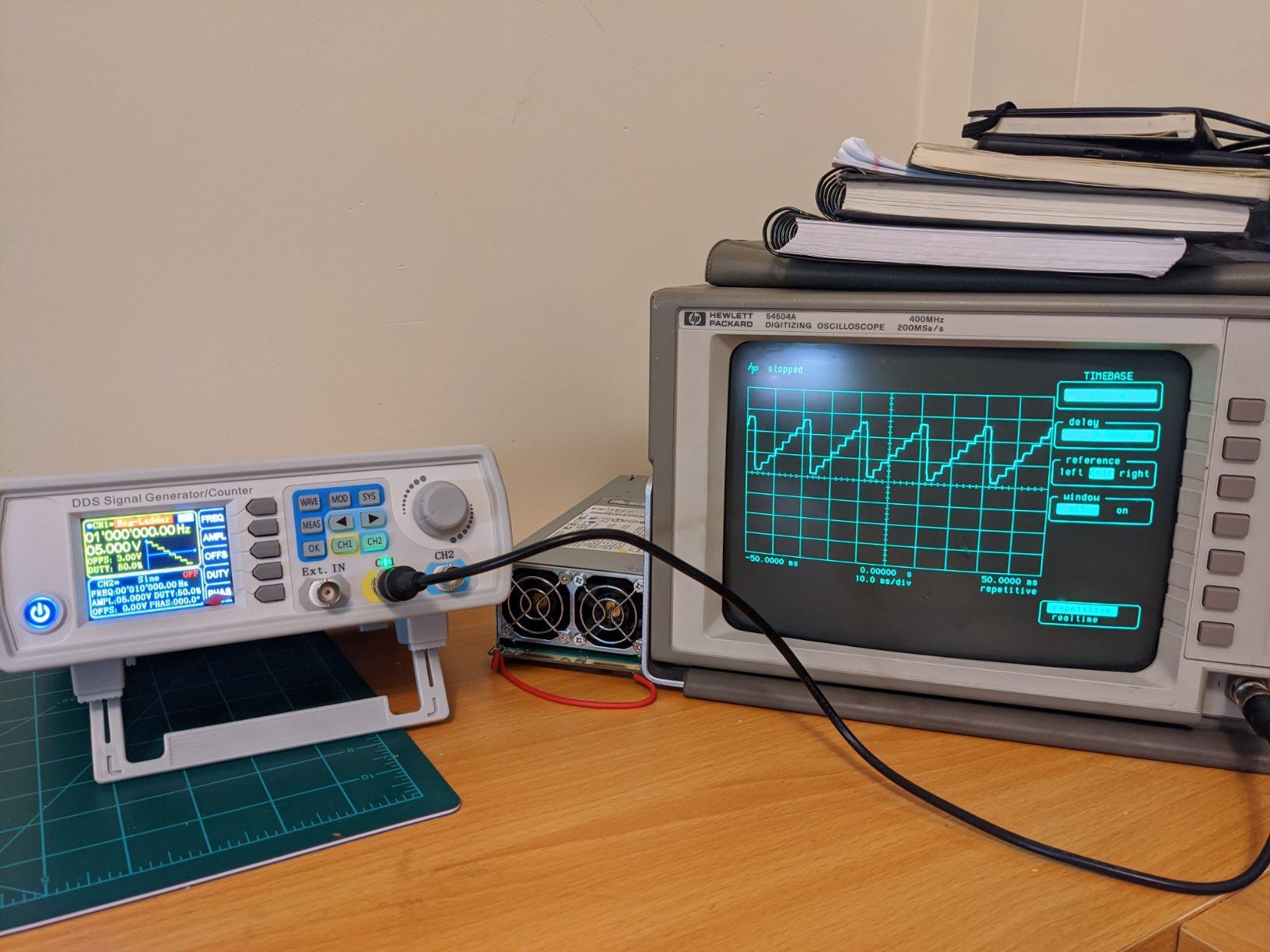
This is the unit I keep reaching for, and the reason is boring rather than exciting. It is an FPGA-based dual-channel DDS generator with a 200 MSa/s sampling rate and 14-bit vertical resolution, capped at 15 MHz of sine output. Both channels set frequency and duty cycle independently, which is what you need the moment you start testing anything with two nodes.
The measurement side is unusually complete for a unit at this level. It counts frequency, measures period, and reads positive and negative pulse width, so you can verify your own circuit instead of trusting the dial. Sixty user waveform slots at 2048 points each and 99 stored state groups mean setup survives a power cut.
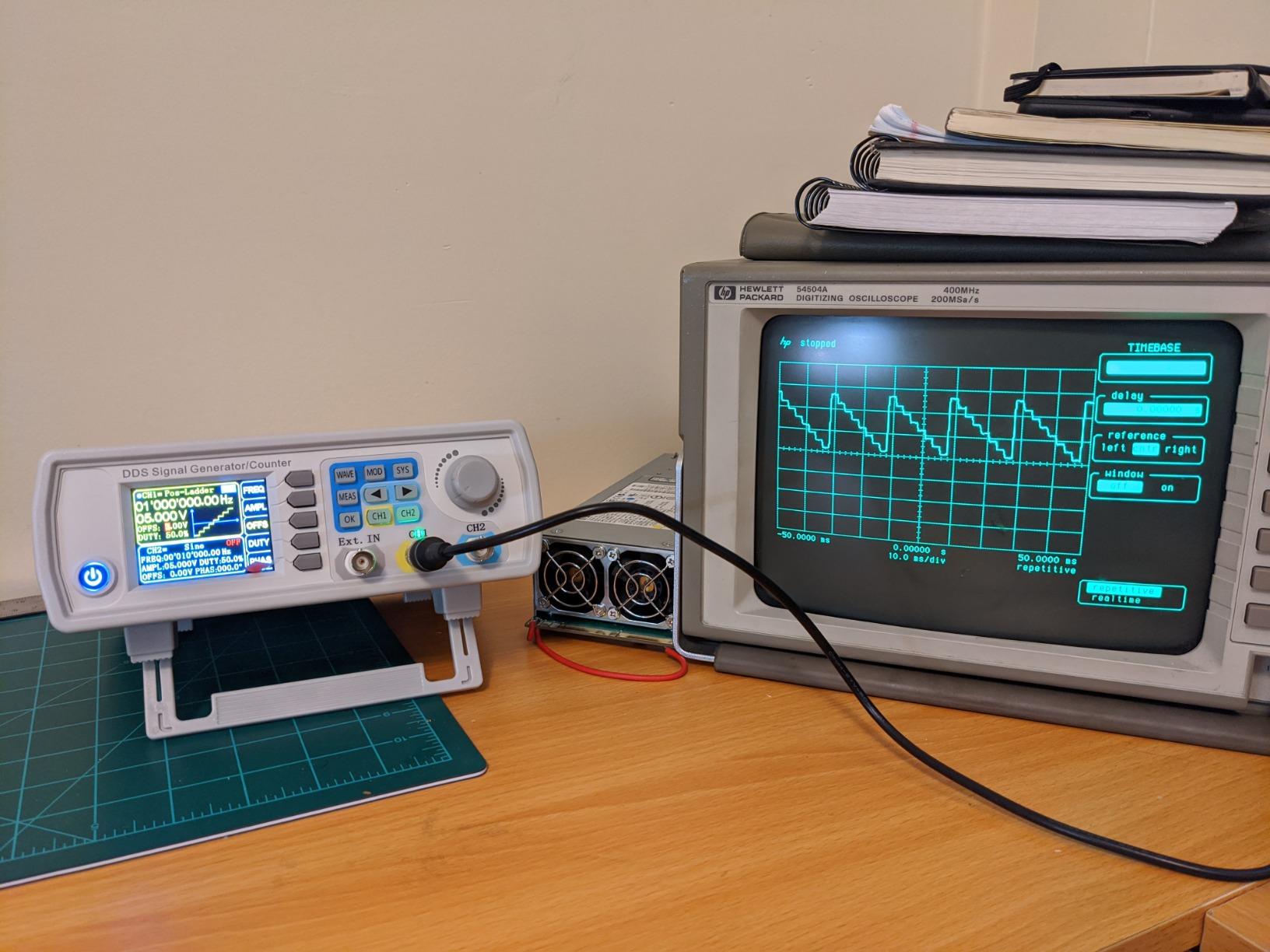
The honest limitation is output control. Both channels deliver TTL level output and there is no amplitude control, so if your project needs 6 Vpp at 1 kHz you need an external attenuator or amplifier. The front panel is also dense, and reviewers repeatedly mention the learning curve.
Frequency stability is the quiet strength here. Reviewers credit the FPGA core and the active crystal oscillator reference for signal that holds still over long sessions, and the installed base of 473 reviews is by far the largest in this list, which means problems surface in public rather than in your own head.
When the Koolertron is the right call
Choose it when your work spans more than one waveform type, when you want two channels you can cross-check, or when you want the frequency counter in the same box. The measurement functions alone justify it for anyone doing filter or oscillator bring-up.
It also holds up as a teaching instrument. Students can set a signal, measure it with the same unit, and see the relationship directly.
When to buy something else
Skip it if your project needs a specific voltage at a specific amplitude into a high-impedance load. TTL output is the wrong tool for biasing a vintage audio circuit unless you add hardware.
Also reconsider if you mostly drive speakers or power stages at low frequencies, where amplitude control matters more than 15 MHz of headroom.
2. MiOYOOW PWM Frequency Generator Module – Best Value for Motor and Driver Work
MiOYOOW PWM Frequency Generator, 1-Channel 1Hz-150KHz Adjustable Pulse Duty Cycle Function Generator, Square Wave Signal Generator Module with LCD Display and Rotary Switch
1Hz-150kHz PWM and square output
Adjustable duty cycle with precision mode
LCD readout, UART control, setting lock
Pros
- Accurate PWM verified against a rubidium reference
- Retains settings through power cycles
- Runs from almost any 3.3V-30V supply
- Handles motor drivers pumps and dimmers
- Small and light at 1.44 ounces
Cons
- Output amplitude is fixed without an external potentiometer
- Rotary encoder is awkward for coarse changes
- Menu timeout reverts to pulse width mode
- Higher output impedance can load older test gear
Best for: PWM work, motor drivers, dimmers and microcontroller bring-up on a tight budget.
At a couple of fingers wide and barely over an ounce, this module does one job: it produces a clean 1 Hz to 150 kHz PWM or square output with an adjustable duty cycle, and it does it accurately. One reviewer verified the output against a rubidium standard and reported agreement, which is the strongest accuracy claim in this whole guide.
The build quality at this size is a pleasant surprise. The LCD shows frequency and duty cycle at a glance, settings survive a power cycle, and a lock function stops the encoder from being knocked mid-test. It runs from nearly any 3.3V to 30V DC supply, and supports UART control for driving it from a microcontroller.
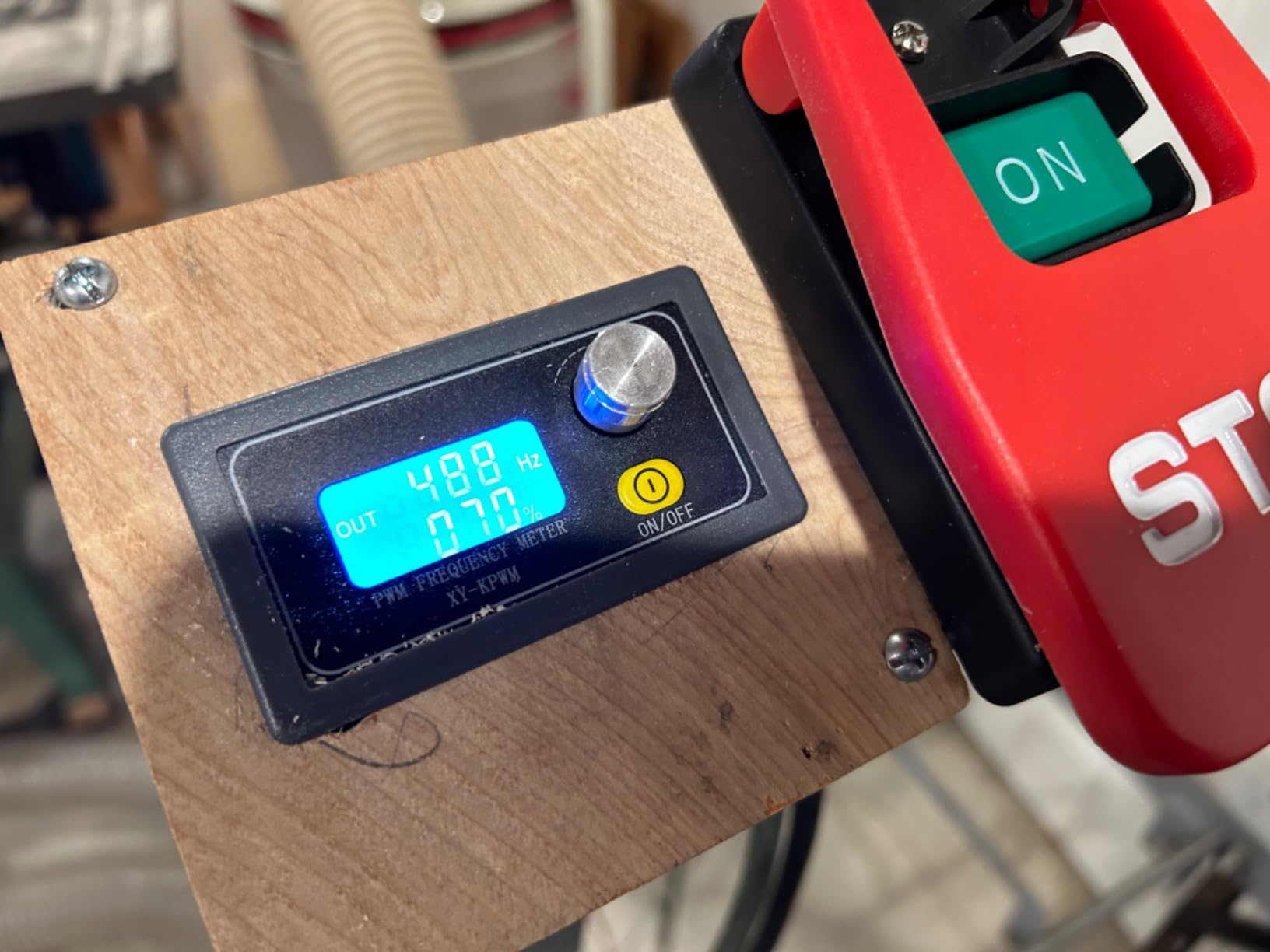
What you give up is drive. Output impedance is around 1 kOhm, so this will not push a speaker or a power amplifier stage, and the amplitude is fixed unless you solder a potentiometer to the output. Reviewers also note the rotary encoder is unpleasant for coarse frequency changes and that the menu timeout is too short, reverting to pulse width mode before you finish reading it.
One further warning: higher output impedance can load some older test gear, and there are isolated reports of boards failing or arriving with broken mounting tabs.
When the MiOYOOW is the right call
Buy it if your project is about timing, not voltage. Injecting a variable-duty PWM into a motor driver, a dimmer, a pump controller or a microcontroller pin is exactly what it is built for, and the accuracy holds.
It is also the easiest entry point on this list. No assembly, no menu learning curve worth worrying about, and small enough to live in a drawer until you need it.
When to buy something else
Move up if you need to drive a load rather than a logic pin. Around 1 kOhm of output impedance means anything current-sensitive will sag the signal.
Choose a dual-channel unit instead if you need to compare two nodes at the same time, since this is a single-channel source.
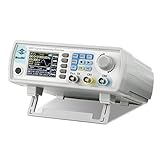
3. Seesii 60MHz Dual-Channel DDS Generator – Best Dual-Channel Bench Workhorse
Professional Upgraded DDS Signal Generator Counter, Seesii 60MHz LCD Display High Precision 200MSa/s Dual-Channel Arbitray Waveform Function Generator Frequency Meter
Dual-channel DDS to 60MHz sine
200MSa/s sampling rate
Linear and log sweep to 999.9s, PC software
Pros
- Dual channel with per-channel duty cycle control
- Useful linear and logarithmic sweep for filter testing
- Fast square wave transitions and clean sine
- PC software for authoring custom waveforms
- 99 stored state groups
Cons
- Noticeable output noise on sensitive work
- No sweep trigger output to synchronise a scope
- Some overshoot on square wave edges
- Counter reads roughly 12 cycles high against a standard
Best for: hobbyists who want high-frequency headroom and two independent channels with sweep built in.
Sixty megahertz of sine on two channels sounds excessive until you remember that the sample rate is what matters for edge quality on your scope. At 200 MSa/s you get a usable square wave well above the frequency where most hobbyist circuits stop being interesting, and reviewers specifically praise the fast transitions and clean sine output.
Sweep is the feature that earns its place. Linear sweeps run to 999.9 seconds and there is a logarithmic mode for frequency response work, plus per-channel duty cycle adjustment. Bundled PC software lets you author custom waveforms and frequency combinations and push them to the device.
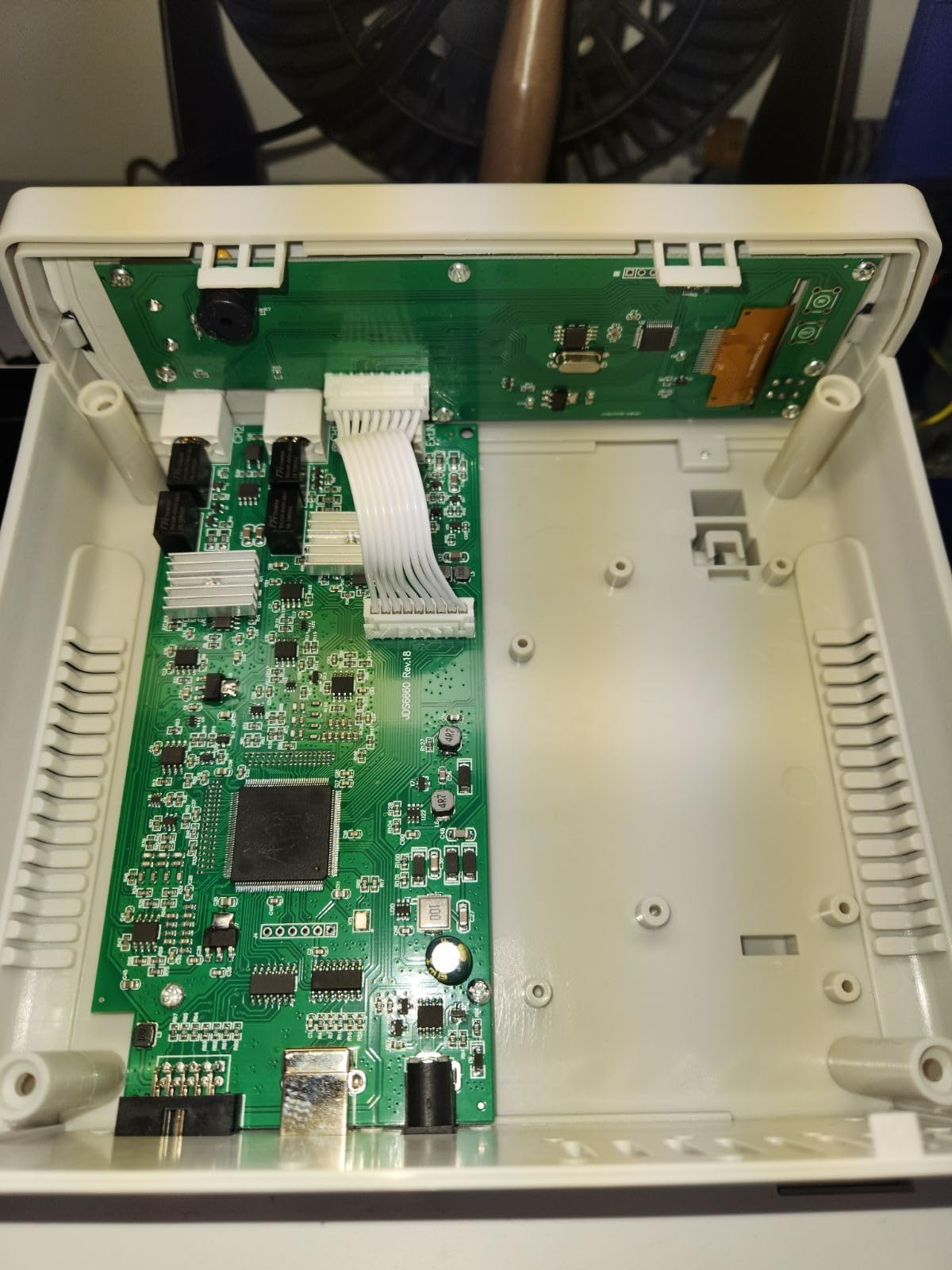
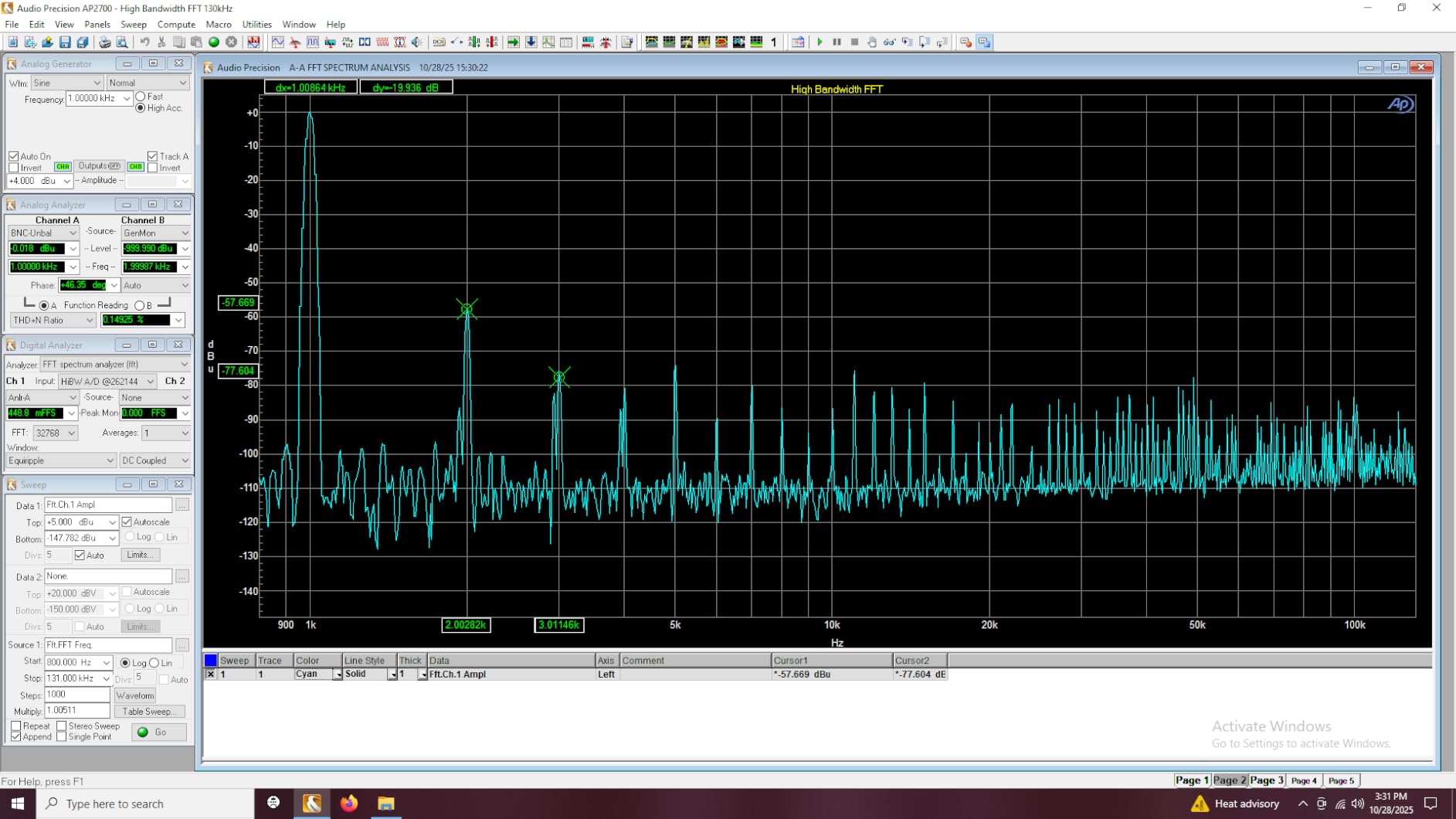
The complaints are specific and worth weighing. Output noise is audible on sensitive work, there is no trigger output in sweep mode so you cannot drive a scope scan to match, and square wave leading and trailing edges show some overshoot. Its own counter has been measured reading roughly 12 cycles high against a precision standard, so treat the on-board count as a convenience, not a reference.
Construction is light. Reviewers mention a lightweight case with hard plastic feet that slide on a hard bench, and a few reports of problems developing after long powered-on sessions.
When the Seesii is the right call
Pick it when your work involves two nodes at once, such as an amplifier input and output, or when you are plotting a filter response. The sweep functions make frequency-response measurement much faster than stepping a dial.
It is also the choice for anyone prototyping at clock speeds where a 15 MHz ceiling gets in the way, such as SPI or fast digital timing checks.
When to buy something else
Avoid it if low-noise signal purity is the whole point, such as driving a very high-gain audio stage. The output noise will show up first there.
Also consider the alternative if you need a hardware trigger output, because you cannot synchronise a scope sweep from the internal sweeper here.
4. Seesii 1Hz-500kHz DDS Signal Generator – Best Portable Unit for Audio and Field Work
SEESII 1Hz-500kHz DDS Signal Generator with Schumann Resonator
1Hz-500kHz DDS output
Four waveforms plus switchable filter
AC/DC adapter or external battery power
Pros
- Compact enough for a tool bag
- Frequency output verified accurate against lab gear
- Sine and triangle are the cleanest outputs
- Useful as a backup source when a bench unit fails
- Runs from a USB power brick
Cons
- Membrane buttons feel clunky and hard to press
- Weak and vague documentation
- Some distortion in square and sawtooth outputs
- Needs an external amplifier for audible output
Best for: hobbyists who need a small, accurate source they can carry to a rehearsal room, a friend’s bench or a class.
The headline number here is 500 kHz of DDS range in a box roughly the size of a deck of cards, with sine, square, triangle and sawtooth outputs and a switchable filter for cleaning up sine and pulse. Reviewers who checked it against lab gear report the frequency output holds up, and sine and triangle come out cleanest.
Power is flexible. It runs from an AC/DC adapter or an external battery pack, and reviewers point out it will happily run off a USB power brick. That makes it a genuine second instrument rather than a bench-only unit.
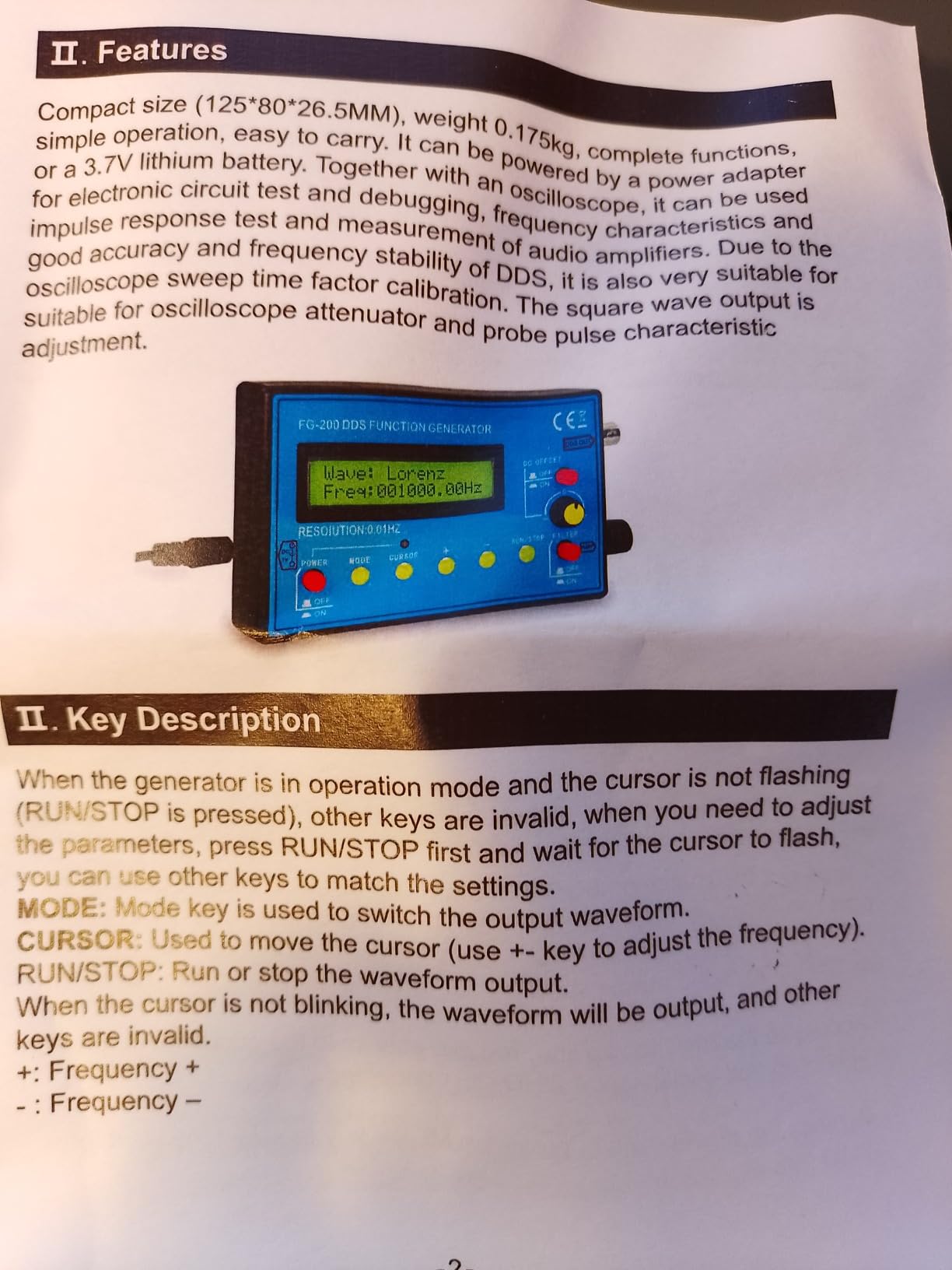
It also carries an integrated 7.83 Hz Schumann resonator. Be skeptical of that: reviewers broadly treat it as a gimmick rather than a working feature, so ignore it and judge the unit on its 500 kHz sine range.
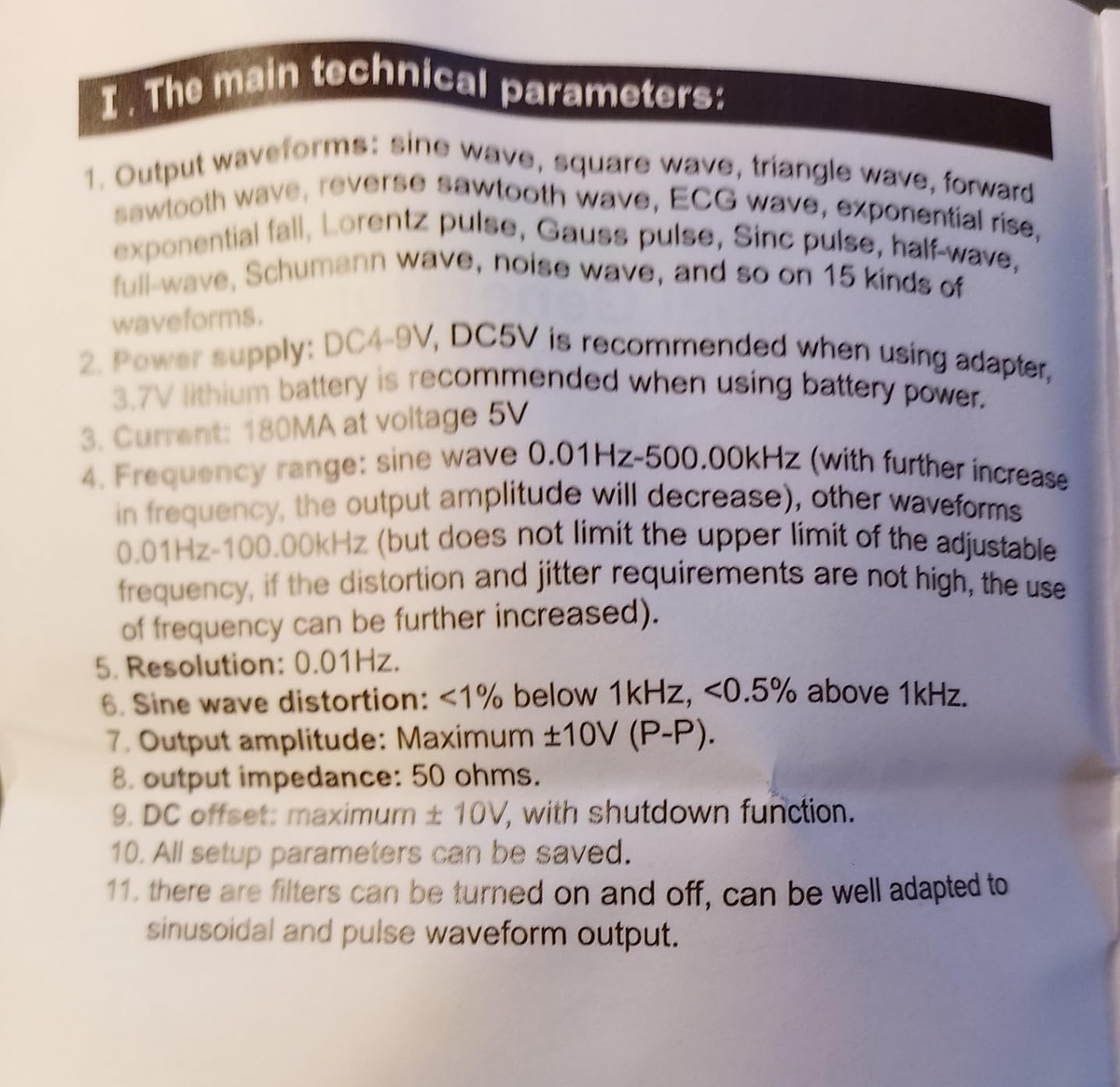
The real weaknesses are ergonomic. Membrane buttons feel clunky and hard to press, the documentation is weak and vague, and square and sawtooth outputs show some distortion. If you want audible output you need to bring an external speaker or amplifier, and the power plug protrudes awkwardly.
When the portable Seesii is the right call
Choose it for portability plus a genuine backup role. Keeping one of these in the drawer means you are never blocked when the main bench unit is busy or has failed.
For audio measurement below 100 kHz it is more than adequate, and the switchable filter helps when you are chasing a clean sine for an amp bias check.
When to buy something else
Look elsewhere if you will use it daily. Squared-off buttons and thin documentation get old quickly, and a dual-channel unit removes a lot of guesswork when comparing two nodes.
It is also not a substitute for a generator with adjustable amplitude if your circuit needs a specific voltage.
5. HiLetgo ICL8038 Function Generator Kit – Best Kit for Learning to Solder
HiLetgo 2pcs ICL8038 Monolithic Function Signal Generator Module DIY Kit Sine Square Triangle
Two ICL8038 boards per pack
50Hz-5kHz range, 12V DC
Through-hole parts on a labelled PCB
Pros
- Easy to assemble with good solderability
- Two kits per pack for practice and spares
- Great way to learn or sharpen soldering
- Can be dropped into custom circuits for better distortion
- Very low cost
Cons
- One board in a pack sometimes arrives dead
- Frequency output unstable and hard to tune
- No instructions included
- Requires prior soldering experience
Best for: students and new hobbyists who want to build a working generator and practise soldering at the same time.
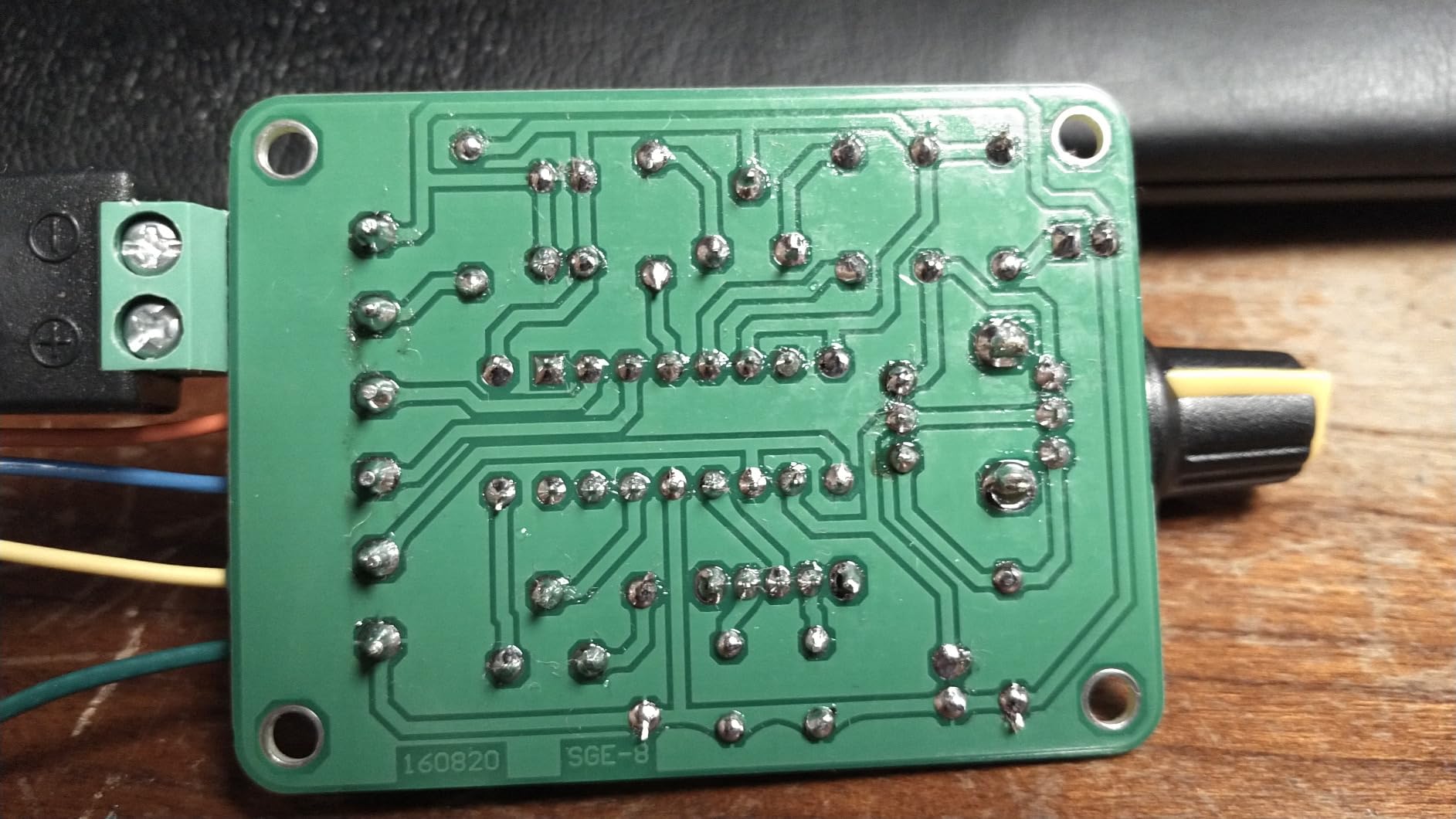
The ICL8038 is a genuine classic. This pack gives you two through-hole boards, each covering 50 Hz to 5 kHz with sine, square and triangle outputs from a 12V supply. Parts sit on a clearly labelled PCB and reviewers consistently report the components solder well, which is the whole point when the kit is a learning exercise.
Two boards per pack is a smart allocation. One is your working unit and the other is a spare or a second circuit, and since reviewers report roughly one board in a pack arriving non-operational, likely from a damaged IC, having the second board saves a return.
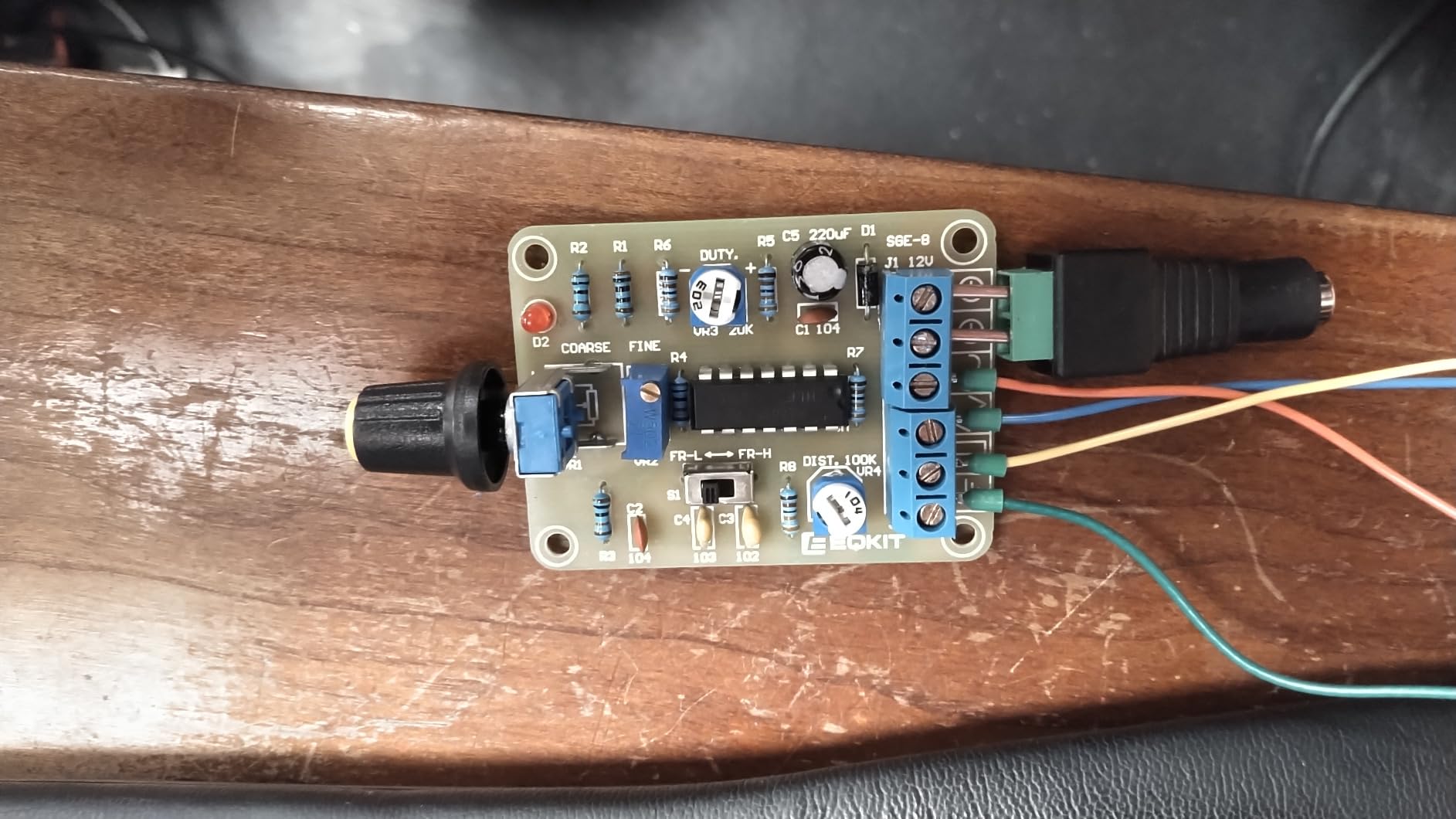
The engineering is old-school analog, and that shows. Frequency output is unstable and hard to tune, and some owners report the scope trace jumping intermittently, possibly from a suspect capacitor. There are no included instructions, and at least one kit arrived missing a screw connector.
Note the range: 50 Hz to 5 kHz. That covers audio fundamentals and nothing above. If your project needs anything near a clock signal, this is the wrong board.
When the HiLetgo is the right call
Buy it if the goal is the build. Reflowing through-hole joints, reading a schematic and getting a working oscillator on the first afternoon is a better electronics exercise than unboxing another finished device.
It is also fair value as a donor circuit. A few owners drop the module into their own designs where the lower distortion of the IC compared with a crude RC oscillator helps.
When to buy something else
Do not buy it as your only signal source. The narrow band, the tuning instability and the missing instructions make it a frustrating first instrument for someone who just wants to test a circuit.
Move up to a finished DDS module once you have the soldering confidence and want something you can trust on the bench daily.
6. XR2206 DIY Function Generator Kit – Best Starter Build for Audio Experiments
EC Buying High Precision Function Signal Generator DIY Kit XR2206 Adjustable Frequency Amplitude Module Sine Triangle Square Output 1Hz-1MHz DC 9-12V
XR2206 based, 1Hz-1MHz range
Sine triangle and square outputs
9-12V DC or 9V battery operation
Pros
- Fun quick build that works as advertised
- Good practice for improving soldering skills
- Battery operation suits bridged and floating outputs
- Low cost for a working generator
- PCB is drilled properly so parts fit
Cons
- Amplitude knob runs in reverse
- Very low output level needs an external amplifier
- Poor instructions and missing components reported
- Unipolar floating output on battery
Best for: hobbyists who want a wide-range analog generator on a weekend build and do not mind adding an amplifier later.
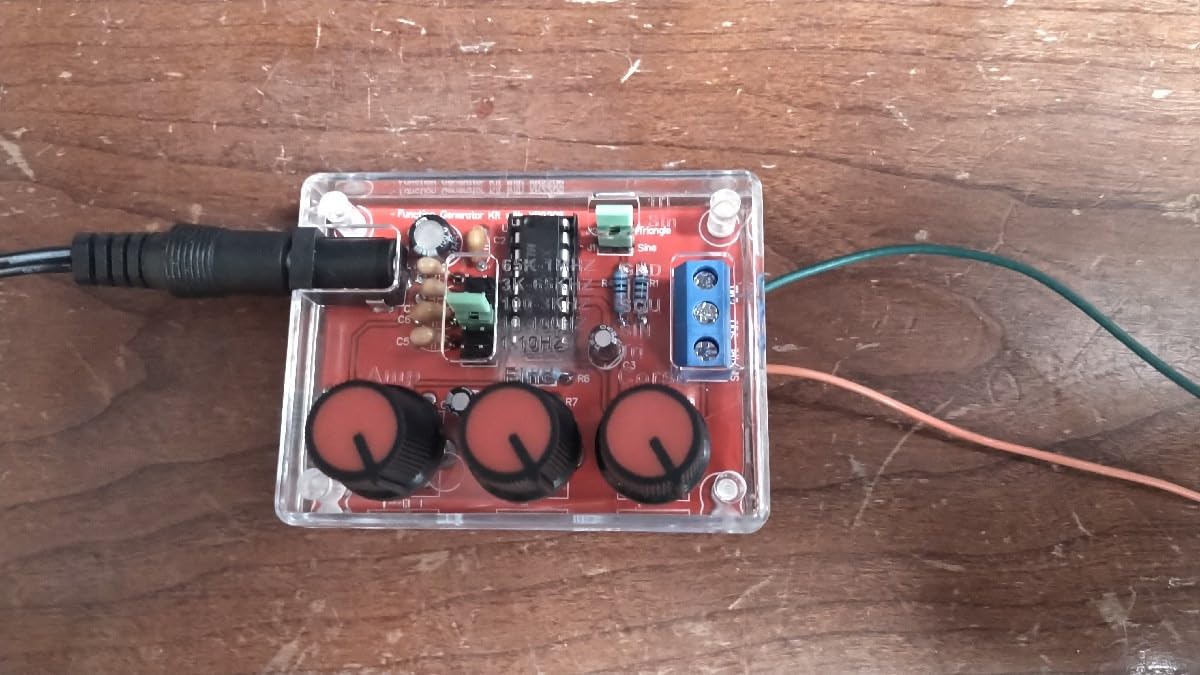
The XR2206 reaches 1 Hz to 1 MHz with coarse and fine tuning, offers sine, triangle and square outputs and has an adjustable amplitude control with 5-bit resolution. That range is a big step up from the ICL8038 kit, and the board is drilled properly so components fit without fighting the layout.
Battery operation is the detail most reviewers mention first. Running from a 9V battery gives a floating, unipolar output, which is exactly what you want for testing bridged or tension-style outputs where tying ground to your bench earth would short something.
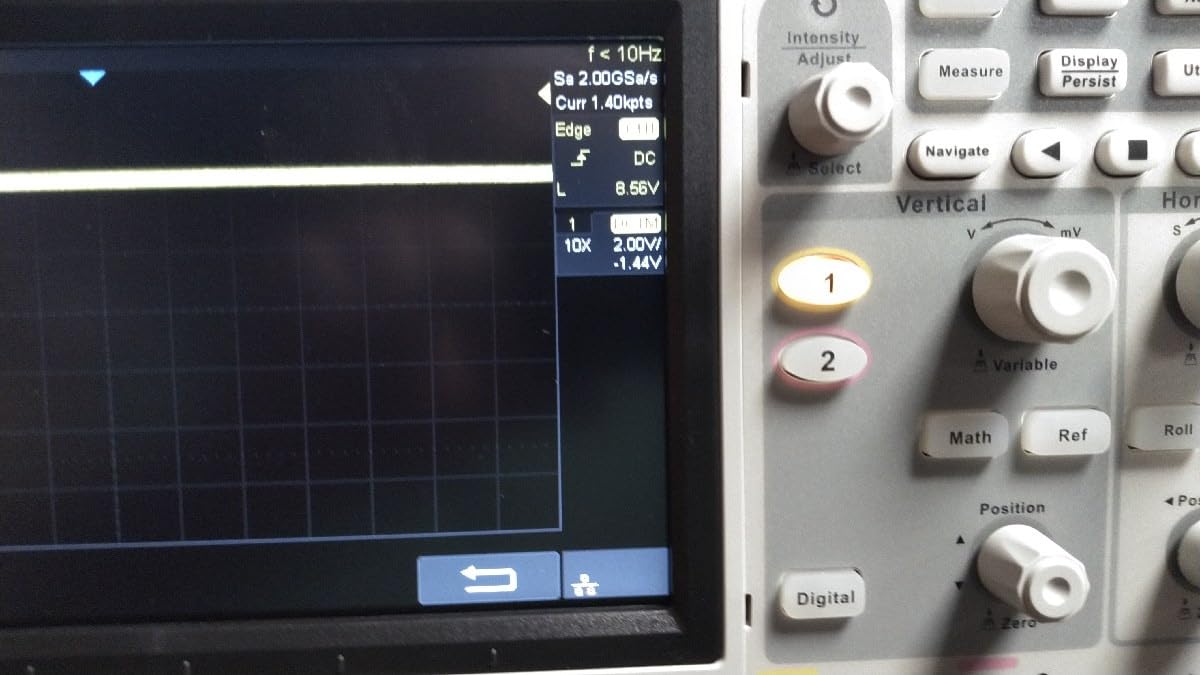
Now the honest part. The amplitude knob runs in reverse, with clockwise at minimum, which will confuse you the first time. The output level is very low, so driving a speaker needs an external power amplifier. Instructions are poor and at least one kit arrived missing the 2200nF capacitor.
The unipolar floating output is a feature and a trap. If your circuit expects output referenced to ground, you will need a series coupling capacitor before the signal makes sense.
When the XR2206 is the right call
Take it when you want more frequency range than the 8038 kit gives you and you enjoy the build. It covers everything from audio tones up through early logic-level timing tests.
It is also a good first kit if you have soldered before, since the through-hole parts are forgiving and the circuit is simple enough to debug with a multimeter.
When to buy something else
Skip it if you need to drive anything with current. The output is small-signal only, and adding an amplifier turns a weekend build into a project.
Choose a finished DDS module instead if reverse-running controls and a missing-component risk would end the fun on day one.
7. DOMINTY FY6900 60MHz DDS Generator – Best Value Dual-Channel AWG for Classrooms
DOMINTY Function Generator AC100-240V FY6900 60MHz Double Channel DDS Function Arbitrary Waveform Signal Generator Frequency Meter 250MSa/s Sine Square/Triangle/Pulse/Sawtooth Wave/Staircase Wave
60MHz dual-channel DDS output
250MSa/s sampling rate
Six waveform types plus frequency counter
Pros
- Strong value for students and college lab work
- Accuracy far better than older analog generators
- Adds a sweep the old analog units lacked
- Attenuated driver keeps output noise acceptable
- Works out of the box for physics classes
Cons
- Very small screen and hard to read digits
- Case feels flimsy and the unit is smaller than expected
- No trigger output in sweep mode
- Waveform glitches on any control change
- Uncomfortable encoder and no printed manual
Best for: students, teachers and hobbyists replacing an aging analog generator with something that sweeps.
This is the unit that replaced a lot of Wavetek-style bench gear in home labs. Sixty megahertz dual-channel DDS output at 250 MSa/s, six waveform types including pulse and staircase, plus a frequency counter and sweep functions. Reviewers repeatedly compare it favourably to older analog generators on accuracy, and the sweep is the feature their old units simply did not have.
Output noise is acceptable because the driver stage is attenuated, which is the right engineering trade for this price class. It works out of the box for physics and instrumentation classes with no learning curve.
The frustrations are ergonomic. The screen is very small and the digits are hard to read, the case feels flimsy, and the whole thing is smaller than buyers expect. The encoder knob is uncomfortable and the small knobs are hard to adjust. Several reviewers mention the waveform glitching whenever you touch a control.
Two structural notes. There is no trigger output in sweep mode, so you cannot drive a scope scan from the internal sweeper. And the chassis and BNC shells are tied to AC ground, so there is no floating ground issue with earthed bench equipment, but that same fact means it is not the tool for bridged output testing.
When the FY6900 is the right call
Pick it for a lab or classroom bench that needs two channels, a fast sample rate and sweeps. It costs less per hertz than anything else here, and the accuracy jump over vintage analog units is the reason most buyers keep it.
It suits measuring amplifiers, filters and small-signal stages without any special setup.
When to buy something else
Look at a unit with a larger display if you will be reading it from across a bench. Small digits matter more than sample rate in a teaching environment.
Choose a battery-capable or floating-output source if you need to test bridged or isolated outputs, which this cannot do.
8. FG-200 DDS Module 0.01Hz-500kHz – Best Low-Cost Scope Calibration Source
FG-200 DDS Function Signal Generator 0.01Hz -500Khz Frequency Counter Signal Source Module Sine+Square+Sawtooth Waveform
0.01Hz-500kHz sine, 0.01Hz-100kHz other waveforms
DC bias switch and output filter
Settable memory of operating settings
Pros
- Accurate enough for scope time base and probe calibration
- Smooth sine with plenty of amplitude for power amplifiers
- Runs over an hour at 20Hz without drifting
- Compact and simple to operate
Cons
- Frequency cannot be changed while output is running
- Loose power connector that disconnects when moved
- No manual and filter function is not self-explanatory
- No battery included
Best for: hobbyists who need a cheap, accurate source for calibrating a scope time base or probe compensation.
Starting at 0.01 Hz on the sine output and reaching 500 kHz, with square and sawtooth to 100 kHz, this module covers the slow end that most generators cannot reach. That low limit is what makes it useful for probe calibration and time base checks rather than just signal injection.
Reviewers report that it is accurate enough for those jobs once checked against a modern counter, and that the sine is smooth with enough amplitude to test large power amplifiers. One owner logged more than an hour at 20 Hz with no drift, which is the kind of stability you want from a calibration reference.
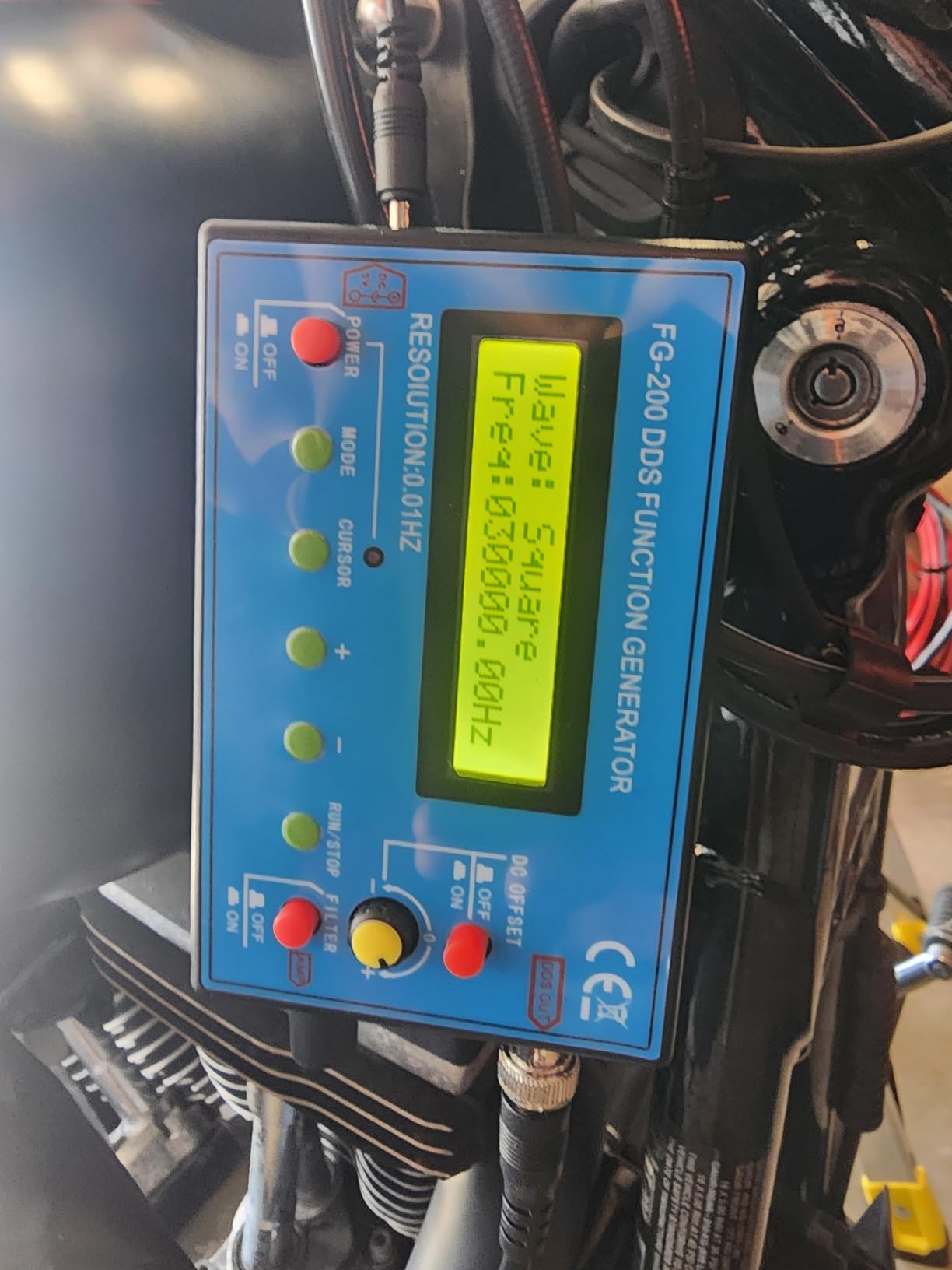
The workflow is the annoyance. Frequency cannot be adjusted while the output is running; you have to stop it, step through the digits and restart. The power connector is loose enough to disconnect when you move the unit, there is no manual, and the filter function is not self-explanatory. The recommended supply is a 4-9V adapter or a 3.7V lithium cell drawing around 180 mA at 5V, and no battery is included.
Amplitude also falls as frequency rises, which matters if you assumed a flat output across the range.
When the FG-200 module is the right call
Buy it if you specifically need a low-frequency source for scope work. Probes are calibrated at low frequencies, and a generator that starts at 1 Hz cannot help you there.
The DC bias switch and the filter above 300 kHz also make it more versatile than a bare three-waveform kit for amplifier work.
When to buy something else
Choose a dual-channel unit if you need to compare two nodes, and choose one with a tuning knob if you will be sweeping frequencies by hand often.
The stop-edit-restart cycle is the deal-breaker for anyone doing live adjustment, so look elsewhere if that describes your work.
9. Lwuey 1Hz-500kHz Mini DDS Generator – Best for Speaker and Audio Sweeps
Lwuey DDS Function Signal Generator, 1Hz-500kHz Mini Kit
1Hz-500kHz DDS output
Sine square triangle pulse and arbitrary waveforms
AC/DC adapter or battery powered
Pros
- Good value for speaker diagnostics and frequency response sweeps
- Reliable for audio work below 100kHz
- Portable and simple enough for limited experience
- Sawtooth output suits specific project needs
- Economical for regular electronics testing
Cons
- No frequency knob so you stop and restart to change it
- Noticeable distortion above 100kHz and poor square wave at 100kHz
- Switching regulator noise on output at low levels
- One report of a dead unit on arrival
Best for: hobbyists plotting speaker and amplifier response below 100 kHz with a microphone and a scope.
This compact unit covers 1 Hz to 500 kHz with sine, square, triangle, pulse and arbitrary waveforms, plus modulation options for communication-style testing. Reviewers single out speaker diagnostics and frequency response sweeps with a mic and scope as the job it does best, and describe it as reliable for audio work below 100 kHz.
Portability and simplicity are its selling points. It runs from an AC/DC adapter or a battery, the form factor is small, and owners with limited technical experience report it is straightforward to operate. The sawtooth output has satisfied specific project needs for several buyers.
When the Lwuey is the right call
Take it if your audio work stays under 100 kHz. That covers speaker sweeps, amp gain checks and general tone work, which is where most hobbyist audio projects live.
It is a good travelling companion as well, since battery operation means you can sweep a speaker in the room it lives in.
When to buy something else
Do not push it above 100 kHz. Distortion becomes noticeable there and the square wave at 100 kHz is described as poor, which rules it out for digital timing work.
Also look elsewhere if low-level signals matter to you, because the switching regulator noise appears on the output at low signal levels. And if you will adjust frequency while watching a live circuit, there is no knob to turn.
10. OWON DGE2070 70MHz AWG – Best for Taking a Bench on the Move
OWON DGE2070 70MHz Dual Channel Arbitrary Waveform Generator, 300MSa/s Sampling Rate, 14-Bit Resolution, 150 Built-in Waveforms, 3.6” LCD, Portable Signal Generator for Lab & Electronics Testing
70MHz dual-channel, 300MSa/s
14-bit vertical resolution
150 built-in waveforms, AM FM PM FSK
Pros
- Highest rated unit in this list at 4.6
- Intuitive menus with informative button markings
- Crisp easily readable 3.6 inch display
- Reliable and well built for the class
- Test leads included in the box
Cons
- Level adjustment control is not user friendly
- Menus need exploring before they feel natural
- One reviewer found frequency accuracy lagged a Uni-T unit
Best for: hobbyists who need real AWG features, modulation and a readable screen in a thin portable body.
This is the most capable instrument on the list and the highest rated at 4.6 across its reviews. Seventy megahertz of dual-channel output at 300 MSa/s with 14-bit vertical resolution, five standard shapes plus 150 built-in arbitrary waveforms, and AM, FM, PM and FSK modulation modes. Sweep and burst functions are there too, with PC software for remote control.
The screen is the practical winner. A 3.6 inch LCD with waveform visualisation and menu navigation is far easier to read than the tiny digits on cheaper dual-channel units, and owners describe the menus as intuitive with informative button markings. Test leads are included, which saves a trip to the drawer.
When the OWON is the right call
Choose it if you want modulation, burst and a large waveform library without moving up to a full bench AWG. It is the only unit here with proper AM, FM, PM and FSK, and remote control over PC software makes it usable from a test script.
The ultra-thin body and low weight also make it the easiest to move between a desk and a workbench, and owners report it feels familiar if you have used traditional lab signal sources.
When to buy something else
The level adjustment control is the one persistent complaint, and menus need practice. If you will be changing amplitude constantly while watching a scope, that friction matters.
One reviewer also measured frequency accuracy lagging behind a Uni-T unit, so if you are calibrating something, verify the output against a known reference first.
Analog vs Digital (DDS) Function Generators
An analog generator shapes a continuous oscillator signal with analogue circuitry. A DDS, or direct digital synthesis, unit runs a phase accumulator against a crystal reference and a digital-to-analogue converter, building the waveform sample by sample.
That architecture explains why budget units now advertise microhertz frequency resolution. A digital counter can step fractions of a hertz that an analogue tuning capacitor could never hold. It also explains why accuracy on a cheap DDS unit depends heavily on its crystal reference and correction pass, which is why reviewers measuring these units against rubidium or lab standards sometimes find small offsets.
The trade-off runs the other way too. An analogue unit can produce a genuinely continuous wave, while a DDS unit reconstructs a sampled version. Below its sample rate the difference is academic, but as you approach the ceiling the reconstruction artefacts show up as the overshoot on square wave edges that reviewers of the 60 MHz Seesii report.
For a hobbyist buying today, a DDS unit is the better bet in nearly every case. The only reason to chase an analogue design is if you specifically want to study the older technology, or you are restoring vintage equipment that expected an analogue source.
Function Generator vs RF Signal Generator vs Frequency Counter
These three get used interchangeably in search queries and mean very different things.
A function generator produces audio and low-frequency waveforms, typically from a fraction of a hertz up to tens of megahertz. That is the category for everything on this page.
An RF signal generator covers much higher frequencies for radio work, from tens of megahertz into the gigahertz, with calibrated output power in dBm and a modulated carrier. If you are working on radio links or antenna measurements you need one of these, not a hobbyist function generator, and no unit in this guide reaches that range.
A frequency counter measures frequency rather than generating a signal. It is a measuring instrument that answers a different question entirely.
The overlap causes real confusion. Several of the units above include a built-in frequency counter as a convenience, which makes them look like RF instruments at a glance. They are not. They generate a signal and count it, and that internal count is worth checking against something better, as we saw with the 60 MHz Seesii reading roughly 12 cycles high against a precision standard.
Square Wave Quality and Rise Time: Why It Matters for Audio Repair
If you repair amplifiers or calibrate synthesizers, square wave quality matters more than headline frequency. A square wave is a signal with infinitely fast edges, so a real generator can only approximate it, and the approximation is described by rise and fall time. Slow, rounded edges carry less high-frequency energy, and many analog circuits respond to that energy.
Synthesizer chorus and VCA bias circuits are the classic case. A Juno-60 needs a 1 kHz sine at 6 Vpp to bias its chorus circuit, and hobbyists on electronics forums describe exactly that job. Getting the frequency right while missing the amplitude leaves the circuit mis-biased, and no amount of further adjustment fixes it.
Second, overshoot and ringing on the leading and trailing edges matter when you are testing comparators, Schmitt triggers or logic thresholds. The 60 MHz Seesii’s reported edge overshoot is a direct example of a feature that is easy to ignore and hard to un-notice once you see it on a scope.
Third, low-level output noise. When you are driving a high-gain audio stage, noise injected by the generator shows up amplified. The 60 MHz Seesii’s output noise and the Lwuey’s switching regulator noise at low signal levels are both reported complaints, and both only matter at specific signal levels.
Fourth, modulation. AM, FM, PM and FSK are what separate a signal source from a general-purpose AWG, and only the OWON in this group covers the full set.
How to Choose a Function Generator
Work through these eight criteria in order. Most buyers overpay on frequency and underpay on amplitude control, which is the wrong way round for hobbyist work.
Decide the job first. A single waveform at a single frequency needs a module, not a bench AWG. Multiple nodes or repeated experiments justify two channels.
Check amplitude control. Most budget units output a fixed TTL level. If your circuit needs a specific voltage, add an attenuator or amplifier, or buy a unit with adjustable level.
Look at the low frequency end. Probe calibration and time base checks need a source that reaches down to 0.01 Hz, which many generators cannot do.
Count your channels. Comparing input against output means two. Independent frequency and duty cycle per channel matter more than a second channel that mirrors the first.
Verify waveform quality, not just waveform count. Rise time, edge overshoot and output noise decide whether a square wave is usable for your circuit.
Decide on sweep and modulation. Filter and speaker response work needs linear and logarithmic sweep. RF-ish and comms experiments want AM, FM or FSK.
Match power and grounding to your bench. Mains-powered units tie BNC ground to earth, which is right for earthed equipment and wrong for bridged outputs. Battery operation gives you the floating output some tests require.
Do not buy above your ceiling. A forum user needing a single 1 kHz sine called a 60 MHz dual-channel unit oversized. Match the instrument to the work you actually repeat.
Frequently Asked Questions
What can you do with a function generator?
You can inject a known waveform into a circuit and watch how it responds. Hobbyists use one to test amplifier stages and measure gain, calibrate vintage synthesizer and VCA bias circuits, sweep filters and speakers while plotting response on a scope, clock a microcontroller board during bring-up, and verify comparators, Schmitt triggers and 555 timers with a repeatable edge.
What is the best frequency generator for home use?
For most home benches a dual-channel DDS unit in the mid range is the sweet spot, because it covers analog, digital and audio work with independent frequency and duty cycle per channel and a built-in counter. If your work is timing only, a PWM module is cheaper and more accurate for the job. Reserve a larger AWG with modulation for when you actually need burst and FSK.
What brand of generator is the most reliable?
Reliability is easier to judge from review volume than from the badge. The Koolertron 15MHz DDS unit has the largest installed base on this list at 473 reviews and reviewers credit its FPGA core and crystal reference for holding stability over long sessions. Budget modules with thin reviews are the ones most likely to arrive dead or develop noise, so buy those only for occasional work.
What are the limitations of using a function generator?
A function generator is a source, not a measuring instrument, so it tells you nothing about your circuit unless a scope is watching the node. Budget units often output a fixed TTL level with no amplitude control, their on-board frequency counters can read high against a precision standard, and square wave edges show overshoot near the sample rate ceiling. A mains unit also ties BNC ground to earth, which rules it out for bridged outputs.
What is the best sine wave generator?
Among the units here, the Koolertron and the portable Seesii produce the cleanest sine and triangle outputs, and the Lwuey stays reliable for audio work below 100 kHz. What matters more than the model is the band you need: for calibration work in the low kilohertz, check the sine against a reference first, since several units in this class read a few cycles high.
What is a good signal generator for testing speakers?
A DDS unit with a linear sweep is what you want, because speaker response is plotted by stepping a tone across the range and reading the level on a scope trace. The Lwuey is singled out by reviewers for speaker diagnostics and frequency response sweeps with a microphone and scope, and it runs on battery so you can work in the room the speaker lives in.
Conclusion
After working through these 10, the best function generators for hobbyists split cleanly by job rather than by price. The Koolertron 15MHz DDS Signal Generator is our editor’s choice: two independent channels, a real measurement set and the largest installed base of any unit here, at the cost of a fixed TTL output and a learning curve.
Buy the MiOYOOW if your work is timing rather than voltage, the portable Seesii if you need something that fits in a bag, the Lwuey if you are sweeping speakers, and the OWON DGE2070 when you need modulation and a screen you can read from a distance. The DIY kits remain the best way to learn soldering rather than the best way to test a circuit.
Whichever you choose, verify the output amplitude on a scope before you trust it with a repair you care about, then start with the oscilloscope that will actually watch the signal.