
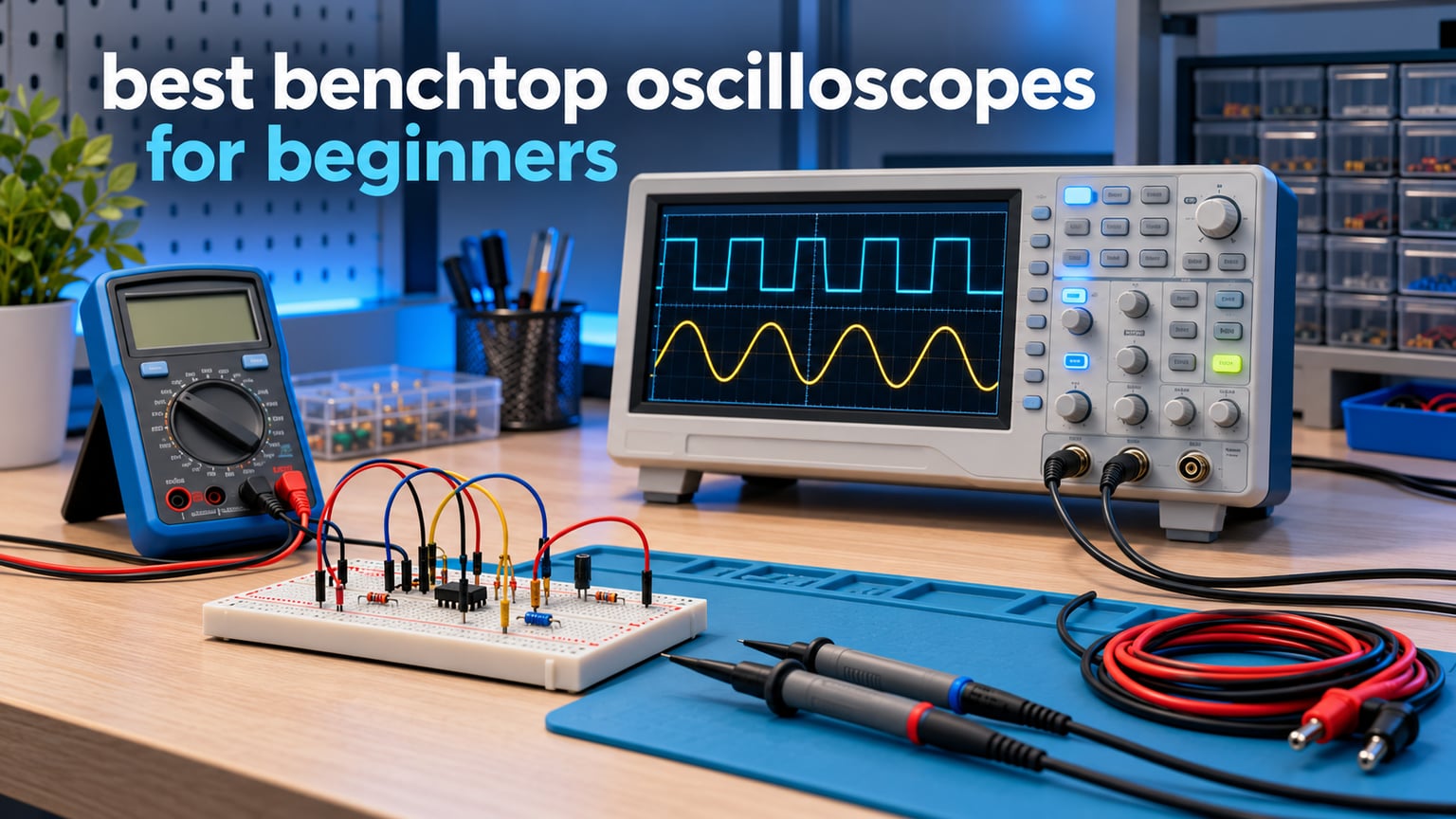
A multimeter tells you the voltage at one point in a circuit. An oscilloscope tells you what that voltage is doing over time, which is a completely different question and usually the one you are actually asking. If you are new to electronics, that difference is the whole reason to buy a scope.
We spent weeks working through the current generation of entry-level benchtop instruments so you do not have to. The best benchtop oscilloscopes for beginners sit in a narrow, well-understood band: 50 MHz to 200 MHz of bandwidth, two or four analog channels, and enough memory depth to catch a glitch that lasts a few microseconds. Higher tiers exist, but they solve problems most first-year builders never meet.
This guide covers ten of them, from a three-in-one handheld unit that fits in a pocket to four-channel bench models with protocol decoding built in. We also cover the specs that actually matter, the ones vendors bury, and the safety mistakes that turn a beginner into a statistic. If you want the wider field rather than just the beginner tier, our hobbyist oscilloscope roundup goes deeper on the enthusiast end.
One quick note before we start. Every beginner scope is only as accurate as the probe attached to it, and the probes in the box are often the weakest link. We come back to that at the end, because it changes what you should buy alongside the instrument.
Table of Contents
Top 3 Picks for Best Beginner Benchtop Oscilloscopes in 2026
Three models cover almost every beginner situation. Here they are in one place, with the reasoning attached.

FNIRSI 2C53T
- 50 MHz 2-channel scope
- 19999-count multimeter
- DDS signal generator
- battery powered
The SDS1202X-E wins the top slot because 200 MHz of bandwidth now sits at the entry tier, and bandwidth is the one spec you cannot add later. The SDS1104X-E is the pick if you need four channels. The FNIRSI 2C53T covers the all-in-one budget case, where a single cheap body has to stand in for a scope, a meter and a signal source. The Rigol DS1054Z, a few places further down, stays on the list because its built-in help system does more for a true beginner than any extra 50 MHz of bandwidth.
Best Benchtop Oscilloscopes for Beginners at a Glance in October
All ten models, with the specs that decide the purchase. Bandwidth, sample rate and memory depth are the three numbers worth reading here; everything else is a preference.
| Product | Specifications | Action |
|---|---|---|
| Siglent SDS1202X-E |
|
Check Latest Price |
 Siglent SDS1104X-E Siglent SDS1104X-E |
|
Check Latest Price |
| FNIRSI 2C53T |
|
Check Latest Price |
 Rigol DS1054Z Rigol DS1054Z |
|
Check Latest Price |
 Rigol DS1202Z-E Rigol DS1202Z-E |
|
Check Latest Price |
 Siglent SDS1102CML+ Siglent SDS1102CML+ |
|
Check Latest Price |
 Hantek DSO2D15 Hantek DSO2D15 |
|
Check Latest Price |
 Hantek DSO5202P Hantek DSO5202P |
|
Check Latest Price |
 Hantek DSO5102P Hantek DSO5102P |
|
Check Latest Price |
 Rigol DS1102Z-E Rigol DS1102Z-E |
|
Check Latest Price |
1. Siglent SDS1202X-E – the best benchtop oscilloscope for most beginners
Siglent Technologies SDS1202X-E 200 mhz Digital Oscilloscope 2 Channels, Grey
200 MHz bandwidth, 2 channels
1 GSa/s sampling
14 Mpts record length
IIC SPI UART RS232 CAN LIN decode
Pros
- 200 MHz bandwidth at an entry-level tier
- 1 GSa/s real-time sampling
- 14 Mpts record length captures long bursts
- Serial decode for six bus types in base firmware
- Heavily reviewed with a large owner community
Cons
- Two-channel limit restricts multi-bus debugging
- Front-panel menus need a few evenings to learn
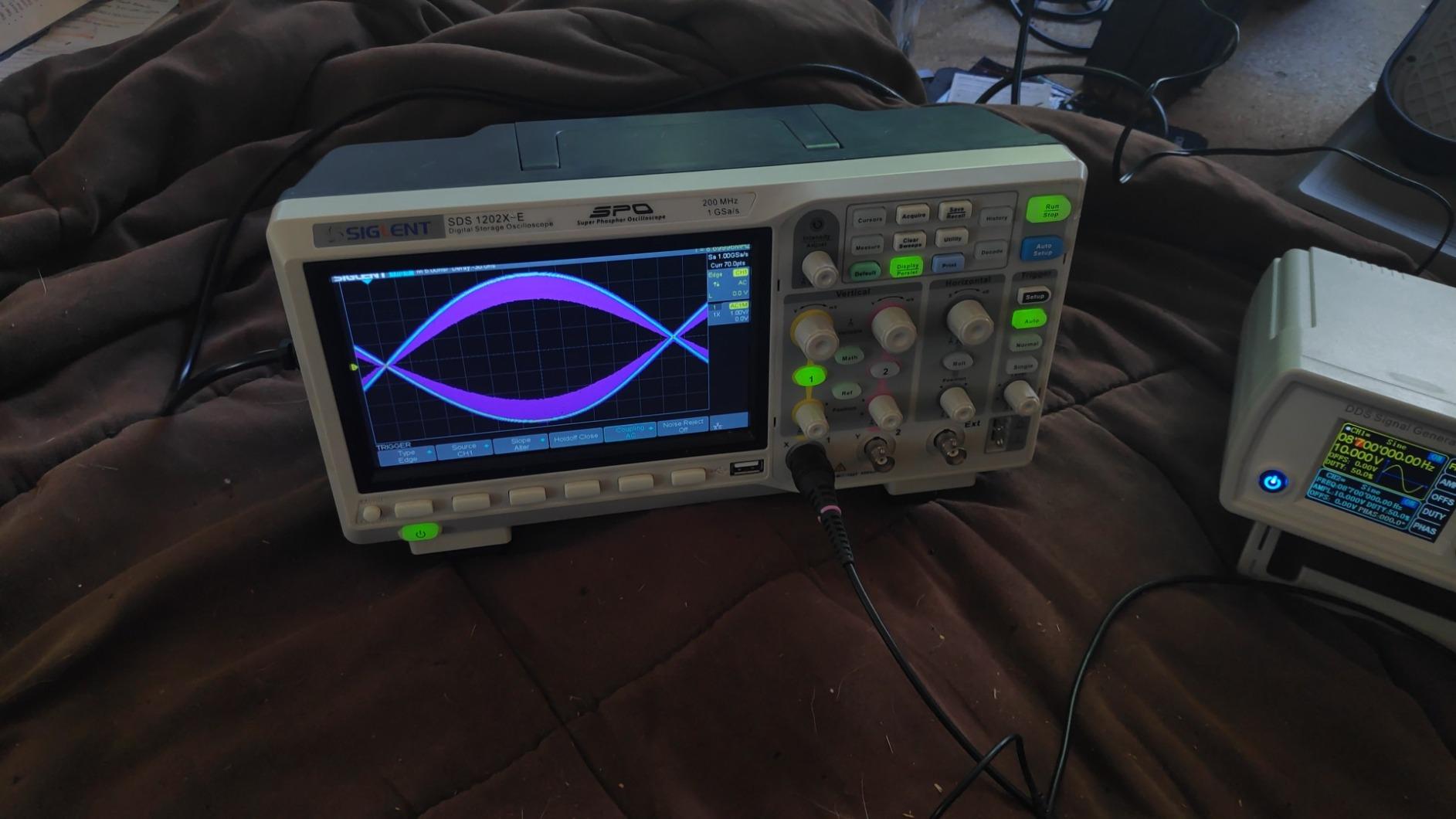
We used the SDS1202X-E as the everyday scope for most of this article. It is the model we keep coming back to, because 200 MHz of bandwidth removes a whole category of beginner disappointment: you can point the probe at a 3.3 V logic edge, an audio signal or a switching regulator’s switching node and the trace still looks like the real thing.
Owners consistently point to the same things. The 14 Mpts record length means a capture that would fill a 1 Mpt scope in a blink holds enough history to scroll back through, and the serial bus trigger and decode list covers IIC, SPI, UART, RS232, CAN and LIN without an unlock key. That decode list is what separates a modern scope from an old one, and it is included rather than sold as an option.
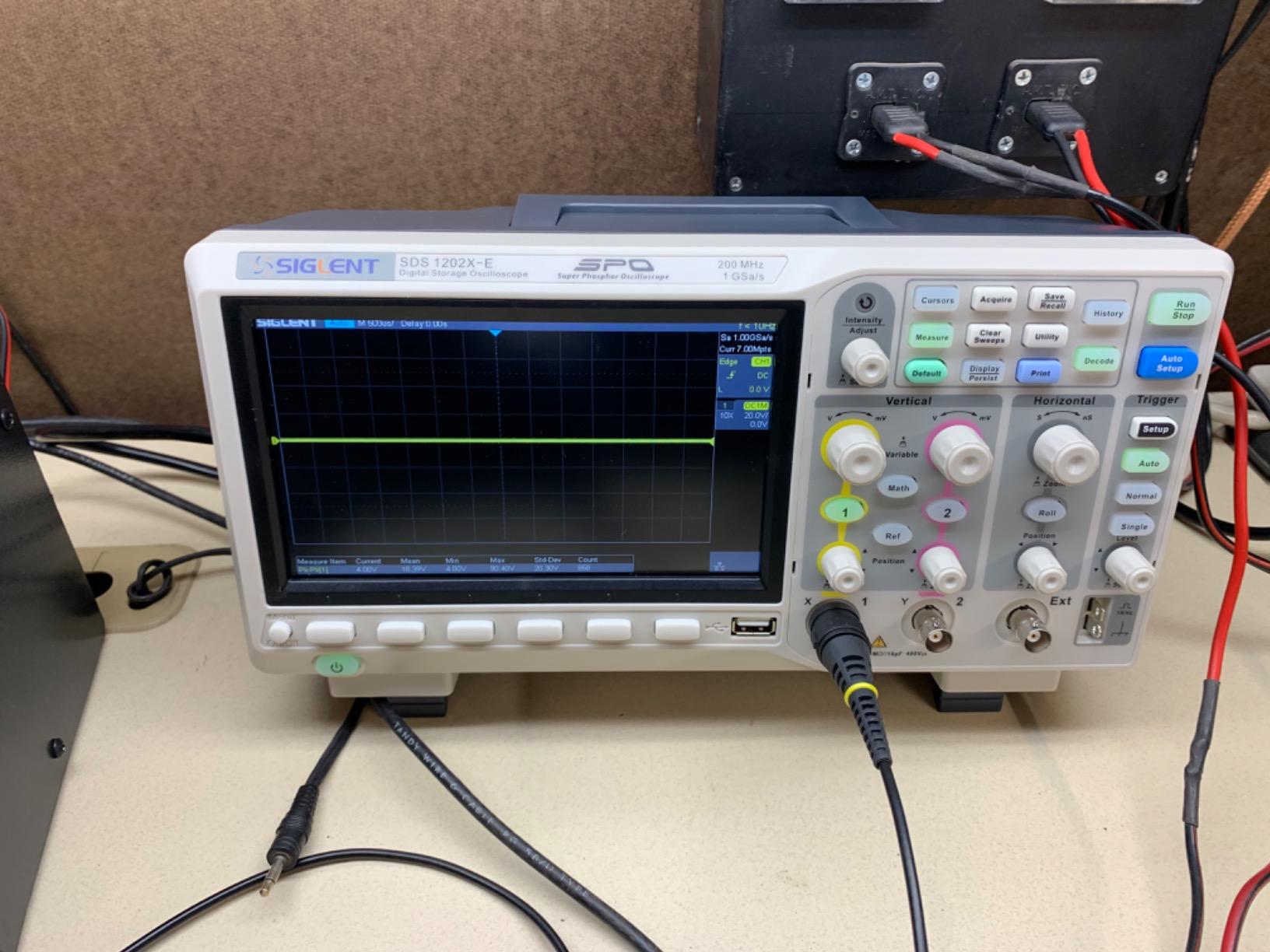
The specification beginners misread most here is sample rate. 1 GSa/s is plenty for essentially anything you will build in your first year, and the figure is not a ranking number you should compare across brands. Read it as a sanity check rather than a score.
Two things annoy owners. With two channels you cannot watch a clock and data line plus a supply rail at the same time, which comes up more often than you would expect when debugging a microcontroller board. The menu structure also takes real time to internalise, and the built-in help is thinner than the Rigol’s.
When 200 MHz is the right amount of headroom
The rule of thumb is to buy at least five times the bandwidth of the fastest signal you expect to measure, so you can see harmonics and ringing rather than a rounded-off edge. At 200 MHz this scope measures cleanly up to roughly 40 MHz, which covers Arduino and ESP32 work, audio, sensor signals and the switching behaviour of a basic buck converter.
If your plan is mains-adjacent work, audio at full studio bandwidth, or any switching supply design work, this headroom is what stops you from buying a second instrument in two years. That is the main reason we rate it first.
Where it will frustrate you
Two channels is a genuine constraint once you start working with three-wire protocols or multi-rail power designs. You end up re-probing constantly, and re-probing means the capture you were hoping to record happened before the second ground clip was attached.
It is also a two-channel-only chassis with no upgrade path to more analog channels, unlike the four-channel Siglent below. For a first instrument on a breadboard, that limitation rarely bites. For anyone coming from a four-channel background, it will.
2. Siglent SDS1104X-E – Top Rated if you need four channels
Siglent Technologies SDS1104X-E 100Mhz Digital Oscilloscope 4 Channels Standard Decoder, Grey
100 MHz bandwidth, 4 channels
Dual ADC architecture
1 GSa/s on paired channels
Ethernet with web server
Pros
- Four analog channels with dual ADC
- Every serial decoder unlocked in base firmware
- Responsive modern interface and clear LCD
- Built-in web server for remote viewing
- Large memory depth and four probes in the box
Cons
- Optional MSO and AWG modules are expensive add-ons
- Select knob can overshoot
- Tilt feet fold easily
- Cooling fan is audible up close
Four analog channels is the feature beginners underestimate most. The first time you put a microcontroller, its clock, a data line and a supply rail on screen at once, a two-channel scope stops being enough. The SDS1104X-E solves that in a chassis that is still firmly entry tier.
The dual ADC architecture is the part worth understanding. Each channel gets its own converter, so two channels running together still deliver 1 GSa/s. Most competing four-channel scopes halve the rate the moment you enable channel two, which quietly ruins your record length at the same time.
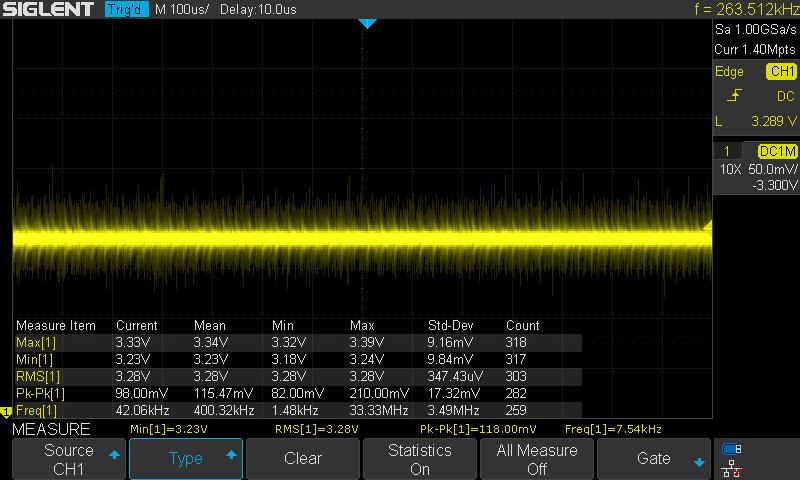
All decoders are unlocked in the standard firmware: IIC, SPI, UART/RS232, CAN and LIN. There is also a built-in web server over Ethernet, which sounds minor until you realise you can open the scope on your phone and see a live waveform from across the room while your hands stay on the circuit.
That four-probe package matters more than the spec sheet suggests, because buying a second and third probe later is something most first-time buyers forget to plan for.
What the four channels change about your workflow
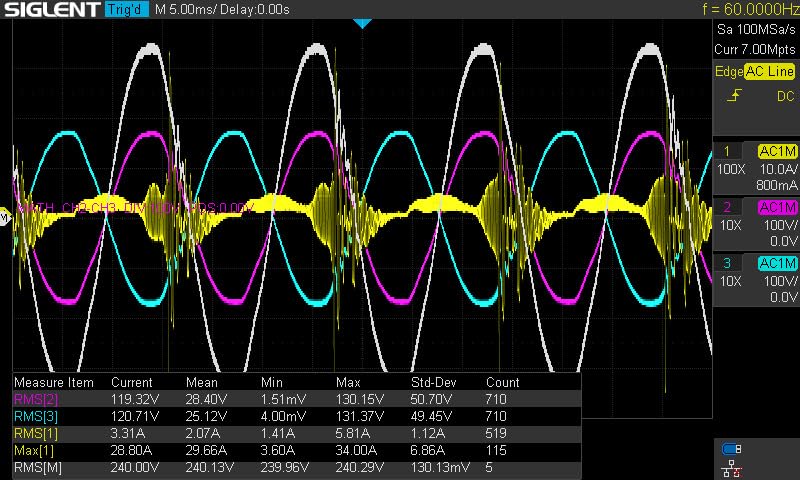
With four channels you can leave the ground and a reference voltage on screen permanently instead of re-establishing the picture after every probe move. That single change removes most of the frustration beginners report in their first month.
The optional 16-channel digital MSO expansion turns it into a mixed-signal scope, which is the natural next step for anyone working with SPI or I2C at speed. The add-on modules are expensive relative to the base unit, so treat them as a later purchase rather than part of the initial decision.
What you give up versus a two-channel model
Bandwidth drops from 200 MHz to 100 MHz, which is still ample for logic, audio and slow switching work but will round off faster edges. A 100 MHz scope measures cleanly up to roughly 20 MHz.
The physical design also has rough edges. Reviewers mention a select knob that overshoots, tilt feet that fold under the weight of cables, a cooling fan audible at close working distance, and time and clock settings that do not always survive a power cycle. None is serious on its own; together they are why the two-channel model above takes the top spot.
3. FNIRSI 2C53T – the best all-in-one starter if budget is the constraint
FNIRSI 2C53T 3-in-1 50MHz 2CH Oscilloscope Multimeter DDS Signal Generator
50 MHz 2-channel scope
19999-count multimeter
DDS generator to 50 kHz
3000 mAh battery
Pros
- Scope multimeter and DDS generator in one unit
- A rare way to get three instruments in one body
- Includes probes leads cable and a storage case
- Battery powered with hours of standby time
- Reference waveform comparison and one-click save
Cons
- Only 1 Kpts record depth limits capture detail
- 50 MHz bandwidth restricts fast-edge work
- Small 2.8 inch display
- Math cursor and XY modes are recent and less mature
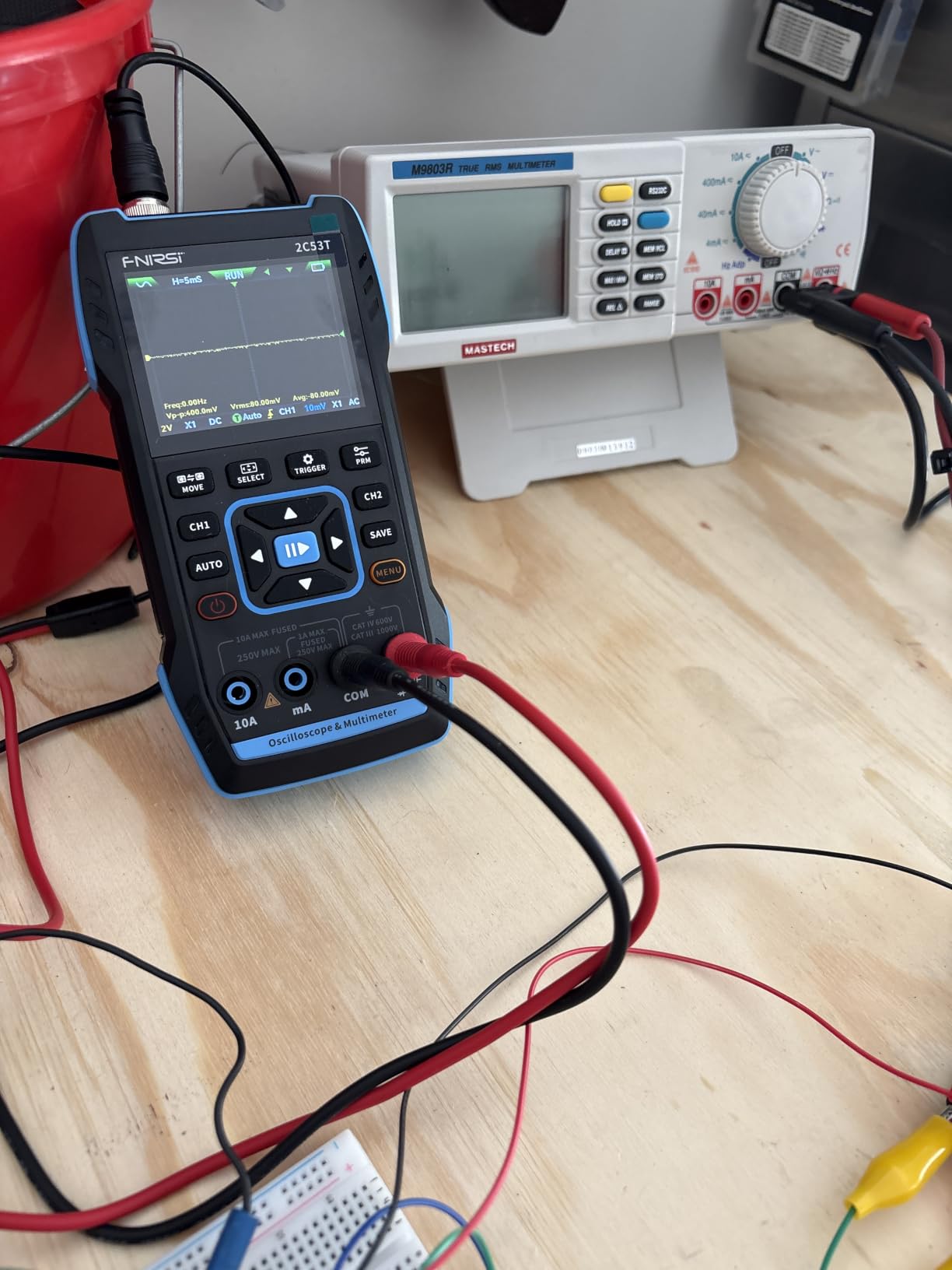
The 2C53T is not really a benchtop scope and we would not recommend it as one. It is a handheld three-in-one that happens to include an oscilloscope, and for one specific beginner it is the correct answer: someone who has a multimeter already, has never touched a scope, and is not sure whether electronics is going to stick.
In that role it is hard to argue with. You get a 50 MHz two-channel scope, a 4.5-digit 19999-count multimeter covering AC and DC voltage, current, resistance, capacitance and continuity, and a DDS signal generator reaching 50 kHz across 13 waveforms. The generator is the underrated part, because having a clean square wave means you can verify your probe and your trigger setup before touching a real circuit.
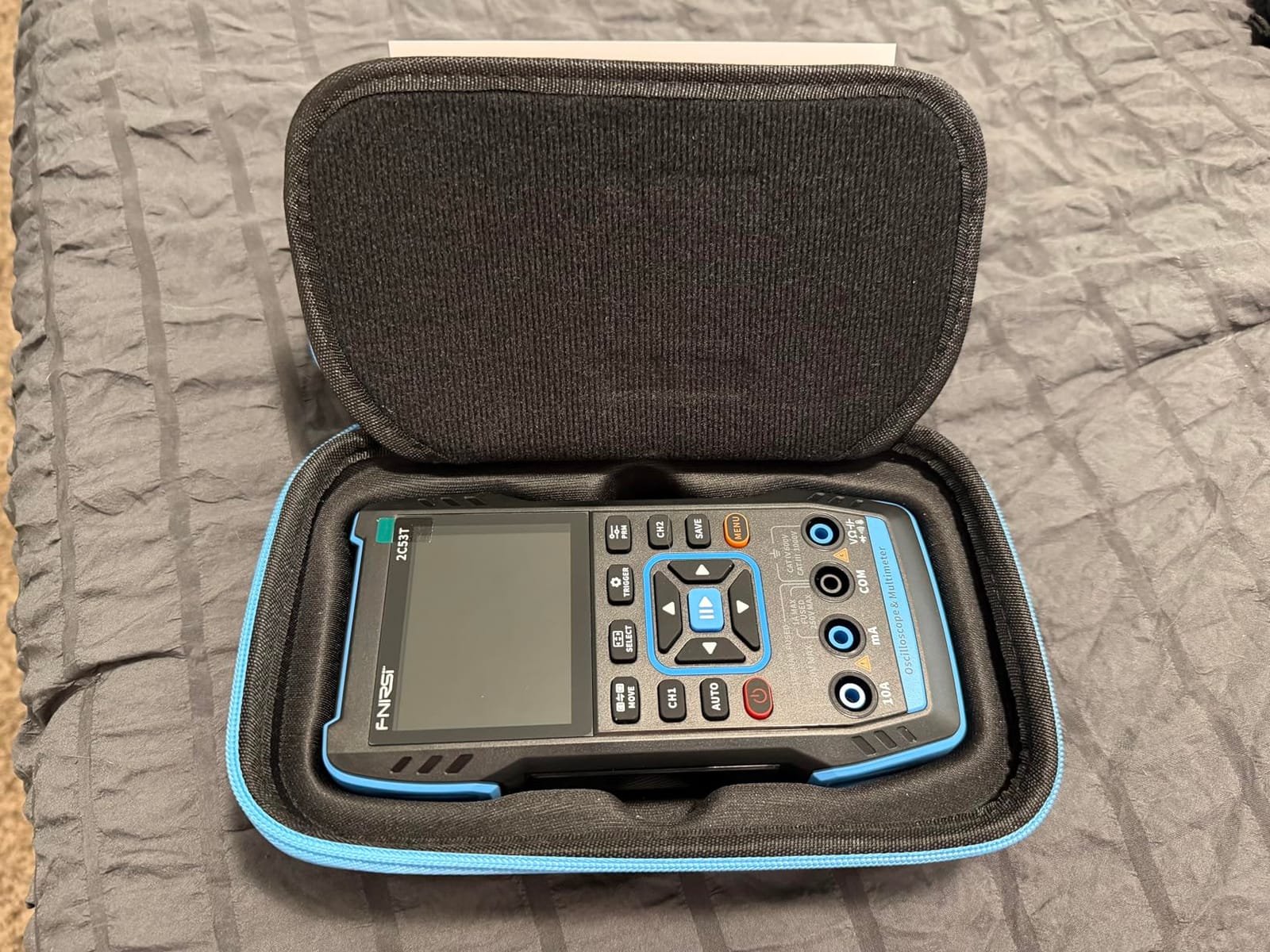
It runs on a 3000 mAh battery, weighs 400 g, and the box contains a 10X probe, crocodile clip probe, multimeter probe, Type-C cable and a storage case.
The honest limitation is the 1 Kpts record depth. That is enough to see a shape, and nowhere near enough to zoom into a glitch, measure a rise time, or capture a burst. If your goal is learning what waveforms look like, it works. If your goal is debugging, it will frustrate you within weeks.
Who this unit genuinely suits
Students who want to practise reading waveforms before committing to bench hardware, and anyone building a field kit where carrying three instruments is impossible. The 2.8 inch LCD is small but high contrast, and the battery means it works away from a desk.
The upgraded 2C53T platform added math operations, cursor measurement, persistence and XY modes, which the earlier version lacked. Those modes are recent additions and reviewers describe them as less mature than the core scope and meter functions, so plan around the basics.
When to skip it
Skip it if you are about to start breadboarding circuits. The 1 Kpts memory and 250 MSa/s sampling will not show you a switching regulator ripple or a clean digital edge, and a beginner who forms their first impressions on a shallow capture tends to distrust the instrument rather than the circuit.
Reviewers also report that the vertical range tops out at a 400 V maximum, and that auto set is less reliable on low-frequency or complicated signals. For a benchtop workflow, the four-channel Siglent or the Rigol below are the more sensible destinations.
4. Rigol DS1054Z – the best pick for a home lab or teaching bench
Rigol DS1054Z Digital Oscilloscope, 50MHz, 4 Channel, 1GSa/s, Best Value
50 MHz bandwidth, 4 channels
24 Mpts memory depth
30000 wfms/s capture
I2C SPI RS232 decode included
Pros
- Deep 24 Mpts memory and 30000 wfms/s capture rate
- Serial decode for I2C SPI and RS232 in base firmware
- Built-in help system walks new owners through functions
- LAN USB host and USB device connectivity
- Compact footprint and solid build
Cons
- Multifunction select knob skips entries
- Included probes are of mediocre quality
- Cooling fan is noticeably loud
- Modest screen with no HDMI output
- USB memory operations can hang occasionally
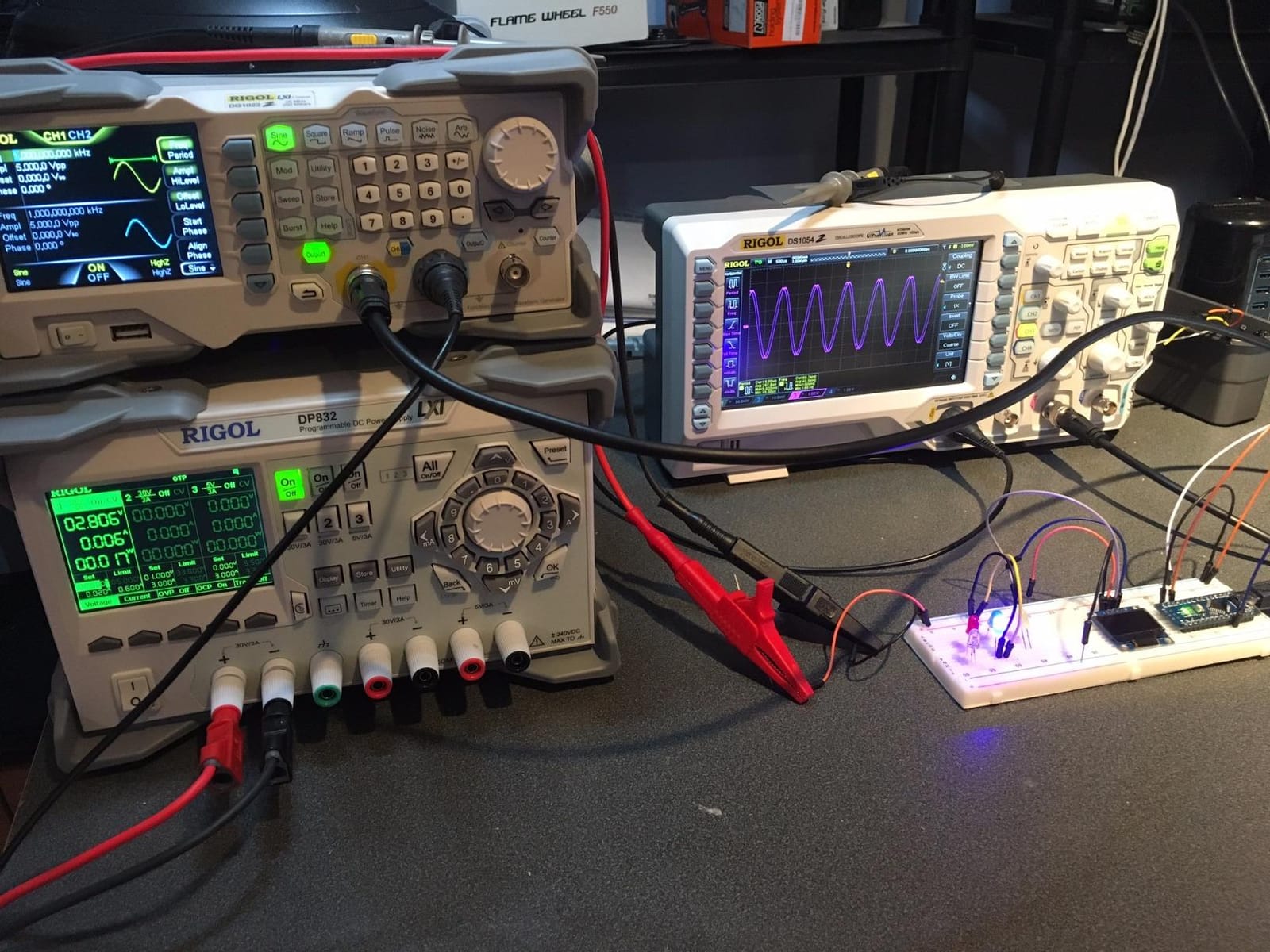
The DS1054Z is the scope the forums keep naming, and for a specific reason that has nothing to do with specs: it ships with a built-in help system that walks a new owner through every function from the front panel. For someone who has never held a digital storage oscilloscope, that is worth more than another hundred megahertz.
Forum consensus across electronics communities names it almost universally as a strong first scope, and it holds up. Fifty megahertz of bandwidth is not a lot, but 24 Mpts of memory, a 30,000 waveform per second capture rate and intensity graded display mean you can actually catch a rare event rather than watching it flash past.
The serial decode for RS232/UART, I2C and SPI is in the base firmware, and the connectivity is generous: USB host, USB device, LAN with LXI, and an auxiliary output that carries trigger-out and pass/fail. Waveform recording and playback stores up to 60,000 frames, which is still rare at this level.
FFT, filters and a hardware frequency counter are all present. The four channels make it easy to watch a supply rail at the same time as the signal that is disturbing it, which is exactly the habit a beginner needs to build.
What the help system actually does for you
Pressing the help key on the DS1054Z shows what a control does, what the menus mean and where a setting lives. Compare that to scoping out a modern touchscreen interface, where the answer is often a PDF. It converts the first month from a hunt through menus into a guided tour.
For university teaching labs the same feature works in the other direction. A demonstrator can hand the scope to a student with no supervision and the student can still get a stable trace on a square wave, which is the single most useful skill in early electronics work.
Where 50 MHz becomes the limit
Fifty megahertz measures cleanly up to roughly 10 MHz. That covers audio, slow analog sensors, power supply ripple and microcontroller signals with room to spare, but it is not enough for USB, fast Ethernet, or the ringing on a modern switching converter edge.
The other recurring complaints are physical rather than electrical. The multifunction intensity and select knob skips entries when pressed, the bundled probes are widely criticised, the cooling fan is loud, and the screen has no video output. Owners who later upgrade this scope almost always start with a better set of probes, so budget for that from the beginning.
5. Rigol DS1202Z-E – best when you want 200 MHz in a two-channel box
RIGOL DS1202Z-E Digital Oscilloscope, 200MHz, 2 Channel, 1GSa/s Sampling
200 MHz bandwidth, 2 channels
24 Mpts memory depth
7 inch WVGA colour TFT
3-year main unit warranty
Pros
- 200 MHz bandwidth in a compact chassis
- 24 Mpts memory and 30000 wfms/s reveal intermittent glitches
- Bright 7 inch intensity graded colour display
- Solid build with smooth well-placed controls
- Built-in help and generous on-screen measurements
Cons
- Select knob overshoots the selection
- Menu structure buries some functions
- USB 2 port makes bulk transfer slow
- Large flash drives not recognised by front USB port
- On-screen legends are small by default
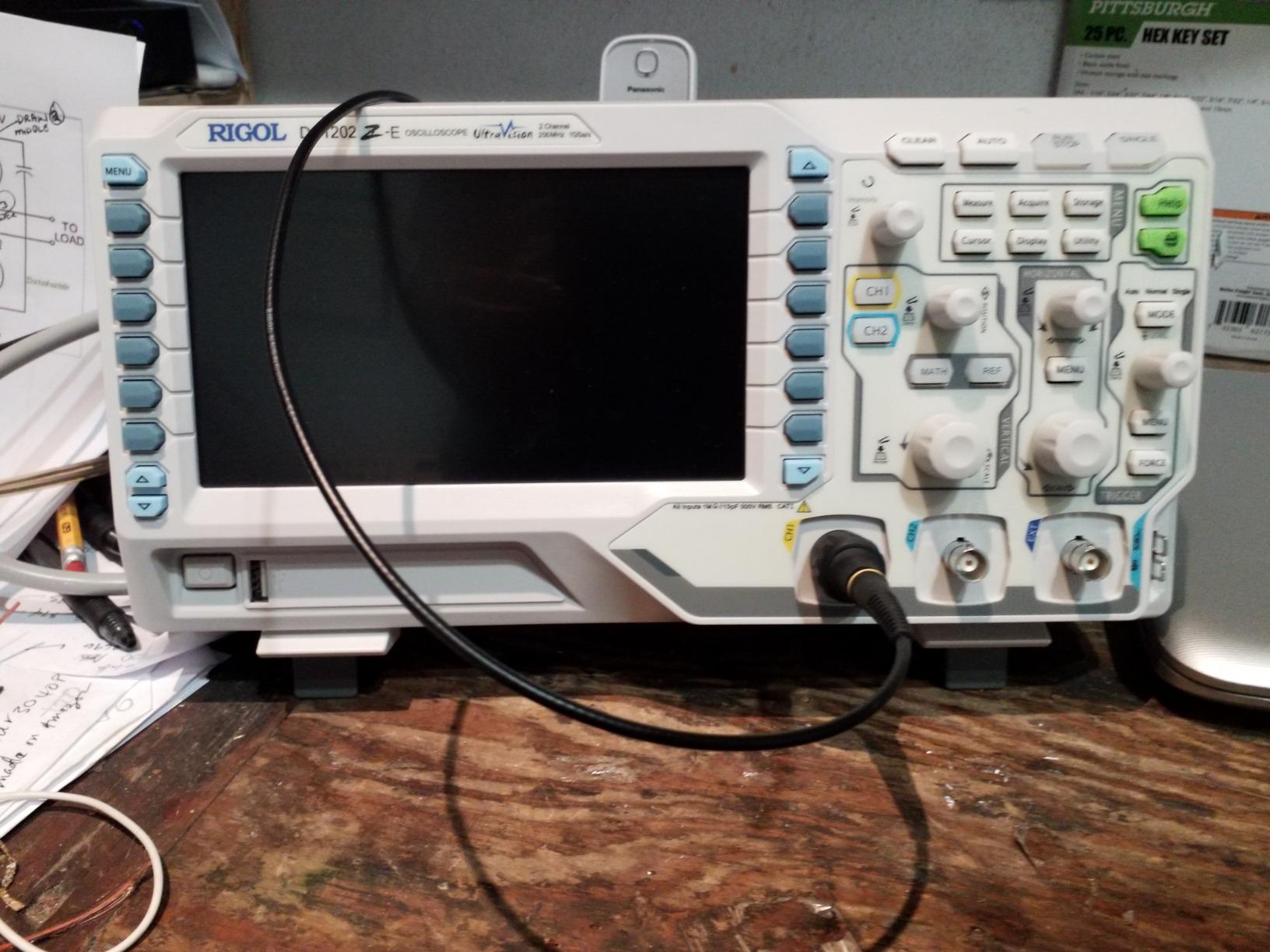
Where the Siglent at number one gives you bandwidth plus a long memory, the DS1202Z-E gives you bandwidth plus a larger display and a longer warranty. The 7 inch WVGA panel with intensity graded colour gives the trace room to breathe, and the intensity grading is what lets you spot a signal that only occasionally occurs.
Three years of warranty on the main unit is unusual in this tier, and for a first instrument that a student expects to keep for the length of a degree, it is a real consideration.
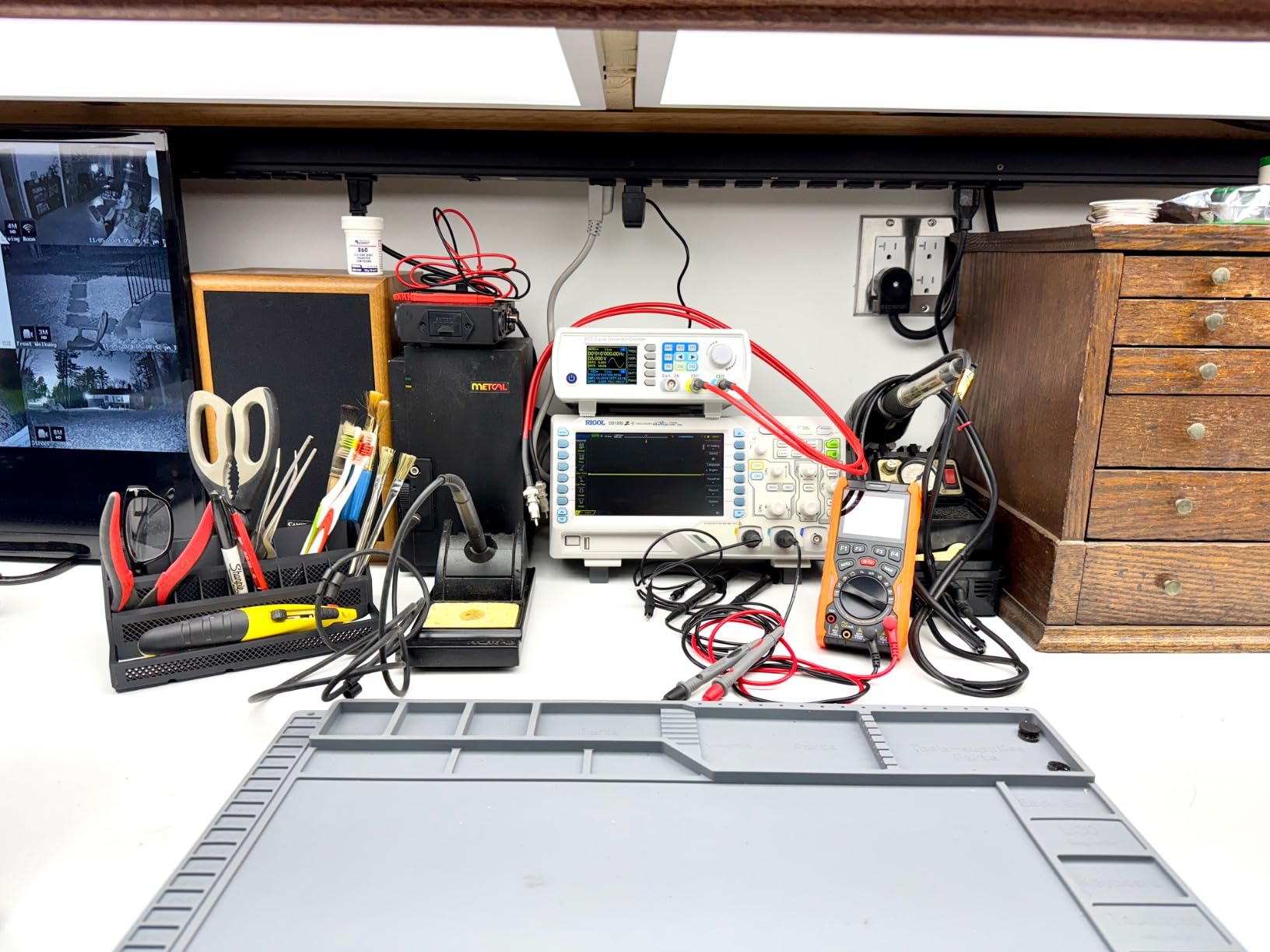
The spec sheet reads like the DS1054Z with the bandwidth knob turned up: 200 MHz, 1 GSa/s, 24 Mpts of memory, 30,000 waveforms per second, 60,000 frames of record and playback, and RS232/UART, I2C and SPI trigger and decode. Connectivity is the same generous mix of USB host, USB device, LAN and auxiliary output.
That memory and capture rate combination is genuinely useful for a beginner because it means a single-press capture of an intermittent fault is likely to contain the fault. On a 1 Mpt scope you would need a long acquisition strategy and luck.
What 200 MHz buys a beginner specifically
Rise-time measurement. A 100 MHz scope can show you a fast edge exists; a 200 MHz scope lets you measure how fast it is, and how much it rings afterwards. That is the difference between a scope you use for digital logic and one you can also use for signal integrity sanity checks.
It also means the instrument stays useful past the beginner stage. If you later move into switching power supplies or higher-speed serial interfaces, you will not hit the bandwidth wall and conclude you picked wrong.
The practical drawbacks worth knowing
The select knob overshoots, which is the most common complaint and the easiest to live with. More annoying is the software side: the USB 2 port makes transferring a full 24 Mpoint capture very slow, and the front USB port does not recognise large flash drives.
The menu structure also buries some functions several levels deep, and the on-screen legends are small until you increase the font. Both are learning-curve items rather than dealbreakers, and the bright display goes some way toward compensating.
6. Siglent SDS1102CML+ – the pick for a very small bench
Siglent Technologies SDS1102CML+ Digital Storage Oscilloscope, 100 MHz
100 MHz, 2 channels
1 GS/s sample rate
1 Mpts record length
2.2 pound chassis
Pros
- Very light 2.2 pound chassis with per-channel vertical controls
- Large display and smooth well-made controls
- Auto mode reliably locks onto signals
- LAN plus USB write for saving screen images
- Comes with two 100 MHz probes
Cons
- No serial protocol decoding
- Measurement readout limited to a single line
- Channel 2 pink display colour is hard to read
- PC software needs extra installs
- Screen captures export as bmp not png
This is the model to consider if bench space is the binding constraint. At 2.2 pounds it is the lightest benchtop instrument here, two 100 MHz probes are included, and it has a display large enough to read comfortably from normal working distance.
The per-channel vertical controls are unusual at this level and genuinely nice. Most budget scopes route every channel setting through a shared menu system, and owners here consistently mention the independent knobs as the reason the instrument feels fast to use.
Auto mode is reported as reliable, which matters more than it sounds. For a beginner the fastest path to a useful first trace is pressing auto and seeing a clean square wave, and this scope does that consistently. Cursors, math, automatic measurements and a built-in frequency counter cover the daily needs.
One GS/s sampling and one megapoint of record length in single-channel mode is enough for audio, analog sensor work and slow logic. It is not enough for anything with a fast edge.
Why the missing decoders matter less here
This scope has no serial protocol decoding at all. If your work involves I2C or SPI traffic, you need one of the Siglent or Rigol models above, because hunting through menus and eyeballing bit timing is a bad way to spend a first year.
For analog and power work, though, decoders are irrelevant. Someone learning op-amps, filtering, rectifiers and regulator behaviour gets a capable instrument with the features they will actually touch.
Where the dated design shows
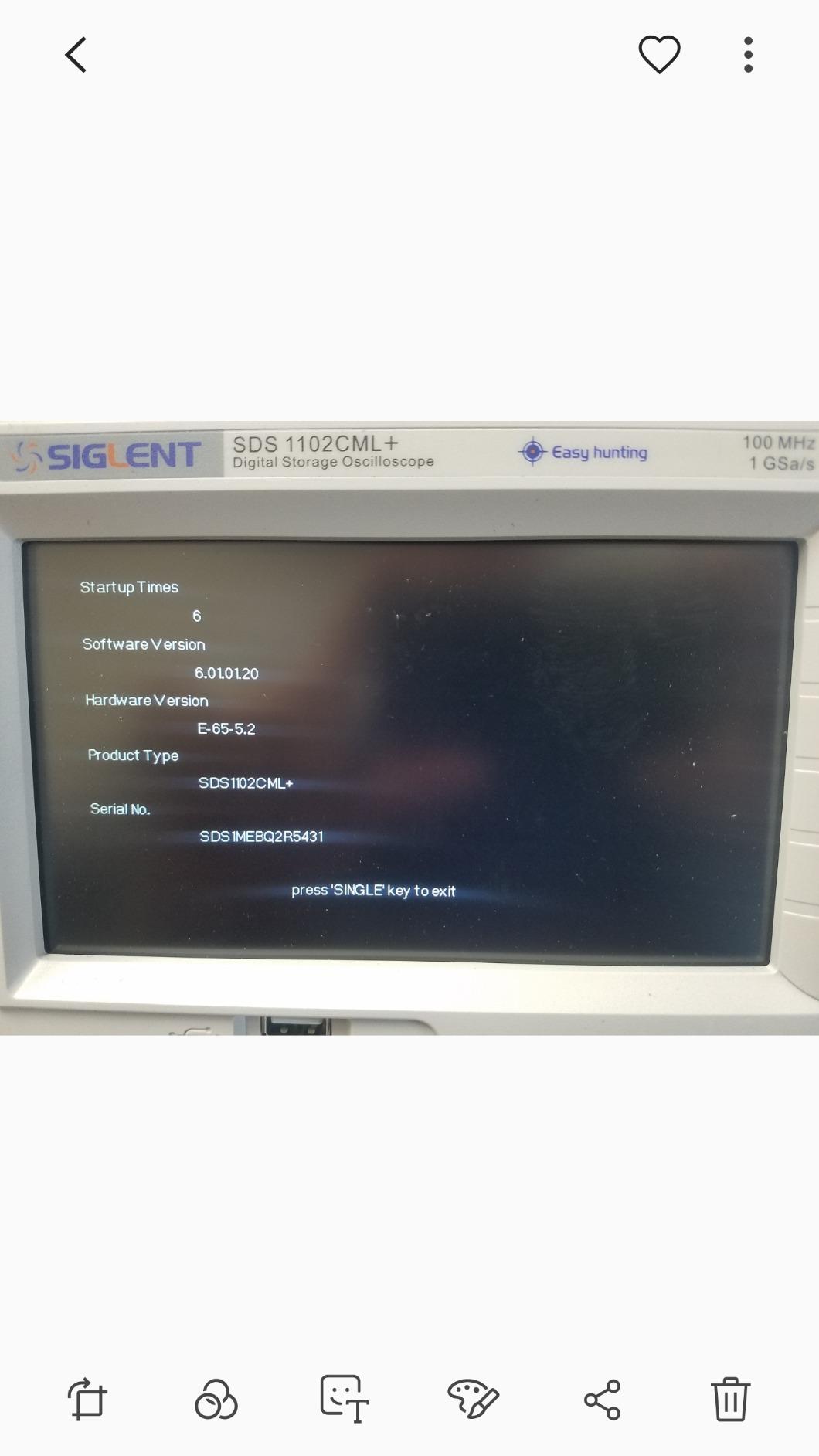
The interface is a generation behind current models. The measurement readout area is limited to a single line, the channel 2 colour is a pink-purple that is hard to read against a graticule, and the EasyScopeX PC software requires installing .NET Framework and NI-VISA before it will run.
Screen captures also export as .bmp rather than .png, which is a small irritation every time you want to put a waveform into a lab report. For a repair bench or a small study desk, that is an easy trade to accept.
7. Hantek DSO2D15 – a two-channel box with a generator and five decoders
Hantek DSO2D15 Digital Storage Lab Oscilloscopes150MHz Bandwidth 2CH
150 MHz bandwidth, 2 channels
Built-in waveform generator
5 serial decoders standard
14 trigger modes
Pros
- Full bench scope feature set at a low entry cost
- Built-in waveform generator with a square wave calibration output
- Firmware updates have resolved much of the early instability
- Default Setup button recovers a lost beginner
- Colour-coded buttons and labelled knobs
Cons
- Slow CPU makes the display and menus sluggish
- Can lock up when settings are misconfigured
- Measurements are not precise above roughly 5 MHz
- Auto Set struggles with complex low-frequency signals
- Front and rear USB share one controller
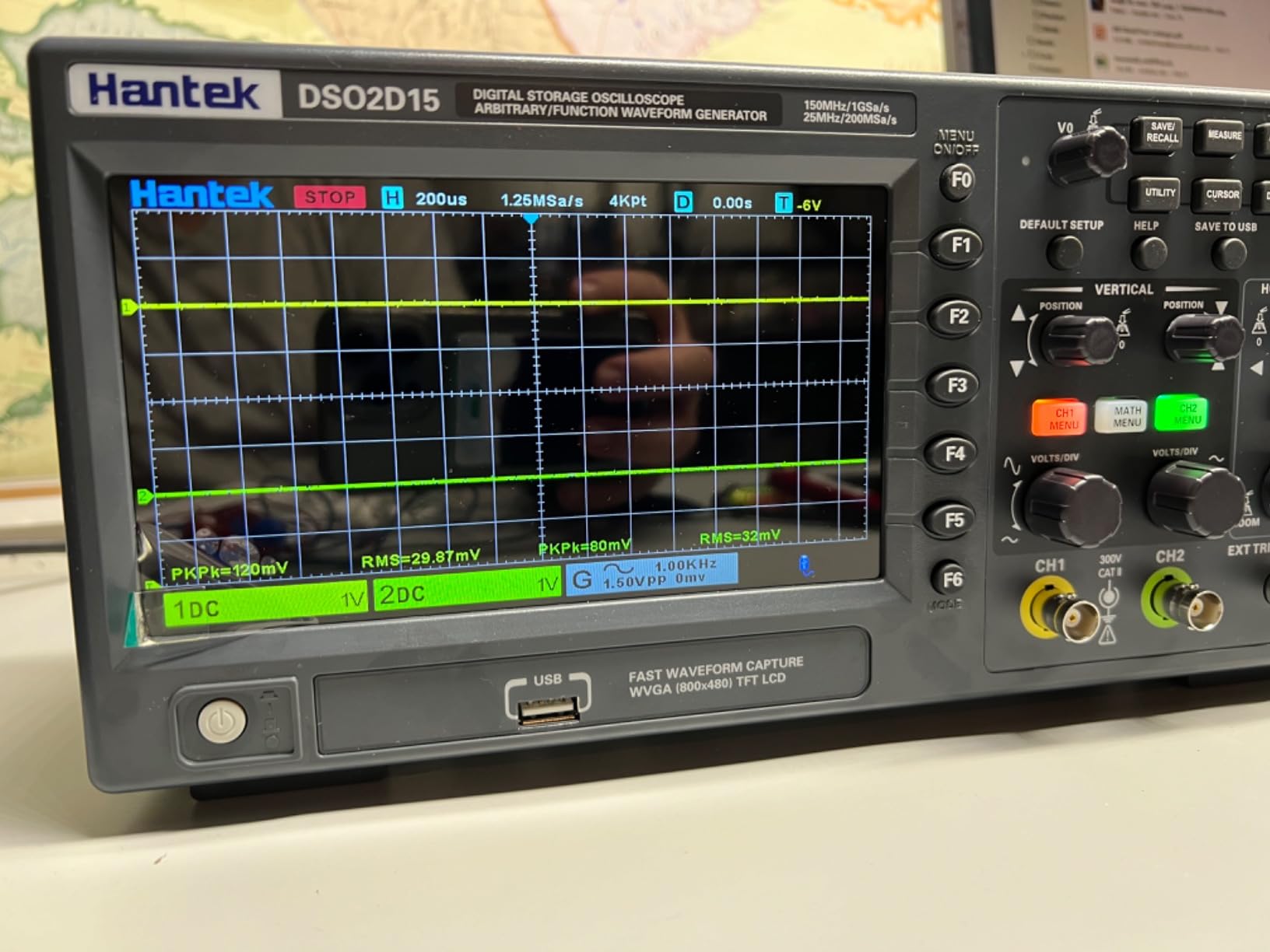
The DSO2D15 answers with a feature list you would not expect from an entry-level model: 150 MHz of bandwidth, two channels, an arbitrary waveform generator output, 14 trigger modes and five serial protocol triggers and decodes in the standard configuration. For a beginner who wants a full bench feature set without stepping up a tier, that list is hard to ignore.
The built-in generator is the feature that separates it from the other low-cost two-channel models here. A calibration square wave on the front panel means you can set volts per division, check probe compensation and confirm the trigger works before you connect anything you care about.
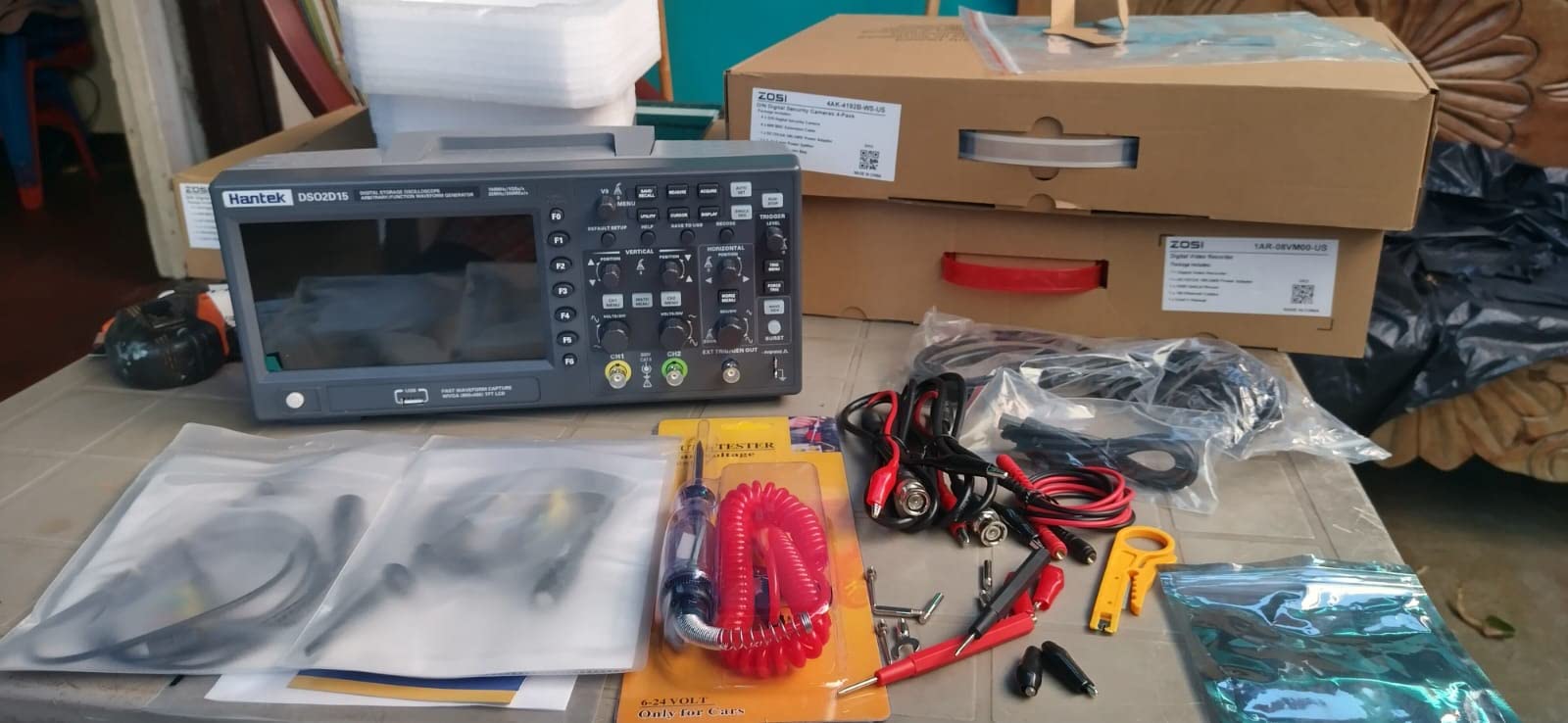
The Default Setup button deserves more credit than it gets. When a beginner has gone three menus deep and lost the picture, one press restores a known state. On slower instruments that single feature can be the difference between a productive evening and a frustrated one.
Owners also note that firmware updates have resolved much of the instability these models originally arrived with, which is worth knowing if you are reading older reviews. The advice from experienced users is to save a copy of your settings before updating.
Where the slow processor shows up
The processor is the weakest part of this instrument and it affects daily use. Menu transitions and redraws are sluggish, and when settings are misconfigured the unit can lock up and need a power cycle, which is a poor experience for someone still learning which settings matter.
Accuracy is also front-loaded. Reviewers report that measurements are not precise above roughly 5 MHz, so treat this as a scope for seeing shapes rather than for trusting numbers on fast signals. Auto Set also struggles with complex or low-frequency signals, which is a limitation you will hit if you work on audio.
Who should buy it and who should not
Buy it if your circuits are digital, low-voltage and slow, and you want a full complement of bench features. The trigger modes, decoders and generator cover an enormous amount of what a first year of electronics involves.
Skip it if you plan to work on analog signal chains where measurement accuracy matters, or if you are impatient with interfaces. In the same general category, the Siglent models above are faster, quieter and better supported, and the comparison comes down to how much the headroom is worth to you.
8. Hantek DSO5202P – a 200 MHz option with a screen worth looking at
Hantek DSO5202P Digital Storage Oscilloscope 200MHz 1GSa/s 2CH Oscillograph
200 MHz bandwidth, 2 channels
1 GSa/s sampling
7 inch 64K colour TFT
U-disk waveform storage
Pros
- 200 MHz bandwidth and 1 GSa/s sampling in this tier
- 7 inch 64K colour TFT display
- 32 automatic measurement functions
- U-disk storage for more than 1000 saved waveforms
- Folding handle design aids portability
Cons
- Very few customer reviews so feedback is limited
- Memory depth of 40k is shallow for long captures
- Overall rating sits below the comparable Siglent and Rigol models
The DSO5202P is the newest model here, only recently released, and on paper it is competitive: 200 MHz, two channels, 1 GSa/s sampling, a 7 inch 64K colour TFT at 800 x 480, and 32 automatic measurement functions. U-disk storage holds more than 1000 waveforms, and a folding handle makes it easier to move between benches.
We are listing it with a clear caveat. It has a customer review base of two, which means there is not enough real-world feedback to recommend it over instruments with hundreds of reviews and established user communities. The spec sheet is promising; the ownership record is not yet there.
The 40k memory depth is the number that gives us pause. Every other 200 MHz scope on this list stores between 14 and 24 Mpts. At 40k you can see a shape, but a brief glitch, a slow ramp or anything requiring zoom is going to be gone.
What the 7 inch display changes
A 64K colour panel at 800 x 480 gives you a generous canvas, and on a crowded screen with four measurement tiles and a menu tree, the extra real estate reduces menu diving.
The 32 automatic measurements are useful for someone who does not yet know which measurement matters for the signal in front of them. Point, select, read is a reasonable default behaviour while you build judgement.
Why we would wait before recommending it
A two-review rating tells you almost nothing, and what little there is sits below the comparable Siglent and Rigol models. For a first instrument, a large user community matters because it is where firmware bugs get reported, decoding recipes get shared and probe recommendations get vetted.
If you are comfortable taking that risk, the display and the 200 MHz headline are the draw. If you want the same bandwidth with a track record, the Siglent at number one and the Rigol at number five are the safer buys today.
9. Hantek DSO5102P – the pick when you want to keep your captures
Hantek DSO5102P USB Storage Oscilloscope Oszilloskope 2 Channels 100MHz 1GSa/s
100 MHz bandwidth, 2 channels
1 GSa/s sampling
1000+ waveform records
7 inch 64K colour TFT
Pros
- 100 MHz bandwidth and 1 GSa/s in this tier
- Stores over 1000 waveform records to USB
- Large 7 inch 64K colour TFT LCD
- Built-in multimeter for voltage current resistance and continuity
- USB firmware upgrades keep the unit current
Cons
- Interface and menu response is slow
- Included probes are entry-level quality
- Limited serial decode compared with Siglent and Rigol
- Documented dimensions do not match the physical unit
Storing more than 1000 waveform records to USB is the headline here, and it is genuinely useful for coursework and for intermittent fault hunting. When a fault happens once a minute, scrolling back through a saved capture is faster than waiting and re-triggering.
The scope also carries built-in multimeter functions covering AC and DC voltage and current, resistance, diode test and a continuity buzzer. That saves you reaching for a separate meter while probing a supply rail, which is where a lot of beginners actually spend their first hour.
USB firmware upgrades and plug-and-play storage support mean the unit stays usable as the vendor improves it, and PC communication with remote control over USB is present for anyone who wants scripted measurement.
Data hold and relative measurement modes round out an unusually generous feature set. The 7 inch 64K colour TFT at 800 x 480 matches the panel on the newer Hantek above.
Waveform storage as a teaching tool
For a student, having dozens of captured waveforms to scroll through is a much better teacher than a single trace. You can compare a correct power-on sequence against a marginal one, or set a working regulator next to a failing one, without having to reproduce the fault.
The same feature helps in a lab demonstration, where the instructor can save a good reference capture and show it against a student’s attempt afterwards.
What slows this model down
Interface and menu response is the recurring complaint, and it is noticeable against the Siglent and Rigol units here. The included probes are entry-level quality, which for a scope is the most common cause of disappointing first impressions.
Serial protocol decoding is more limited than on the Siglent and Rigol models, so anyone working with I2C or SPI will feel the gap. One note of caution on the listing data: the published dimensions do not match the physical benchtop unit, so check the actual footprint before planning your bench space.
10. Rigol DS1102Z-E – the pick for a quiet workspace
RIGOL DS1102Z-E Digital Oscilloscope, 100MHz, 2 Channel, 1GSa/s Sampling
100 MHz bandwidth, 2 channels
24 Mpts memory depth
30000 wfms/s capture
7 inch intensity graded TFT
Pros
- Compact and noticeably quiet in later hardware revisions
- Accurate display readings for voltage and timebase
- Auto button finds good settings quickly
- I2C and SPI decoding included
- Cables and accessories in the box
- Very high share of five-star ratings
Cons
- No quick-start guide in the box
- Steep learning curve from analog scopes
- Heavier than some competing two-channel models
- Display picks up a little more noise than expected
If you share a room, work in a library-adjacent study space, or simply dislike fan noise, this is the one to look at. Owners describe the DS1102Z-E as compact and noticeably quiet in later hardware revisions, and the Rigol ZE chassis is generally regarded as well built.
The spec sheet is the same strong Rigol recipe as the DS1202Z-E with the bandwidth trimmed: 100 MHz, two channels with an external trigger input, 1 GSa/s real-time sampling, 24 Mpts of memory, 30,000 waveforms per second, and 60,000 frames of record and playback.
Serial trigger and decode for RS232/UART, I2C and SPI is included, which reviewers specifically praise as good value next to the equivalent feature on a Tektronix at several times the outlay. USB host, USB device, LAN with LXI and an auxiliary output round out the connectivity.
Display accuracy is called out positively for voltage and timebase readings, and the Auto button is reported to find workable settings quickly, which is the behaviour a first-time owner needs most.
Why the review base is small but positive
This model carries the highest average rating in the group, with roughly ninety percent of ratings at five stars. The base is also much smaller than the Siglent and Rigol units above it, so treat the figure as encouraging rather than conclusive.
A thin review base also means a thinner support community. If you enjoy the way the DS1054Z’s help system teaches while you work, you will be relying on documentation here, because there is no quick-start guide in the box.
Where it fits against the DS1202Z-E
Choose this model if quietness and a two-channel footprint matter more than raw bandwidth, and you are working at 20 MHz or below. Choose the DS1202Z-E if you want 200 MHz for fast edges and rise-time work in the same chassis family.
Reviewers note it is heavier than some competing two-channel models, and that the display picks up slightly more noise than expected. It also has a steep learning curve for anyone coming from an analog scope, which is a fair warning for a first digital purchase.
How to Choose a Beginner Benchtop Oscilloscope
Seven questions cover almost everything that matters on a spec sheet. Work through these in order and the right instrument becomes obvious.
What bandwidth do beginners actually need?
Bandwidth is the highest frequency a scope measures accurately. The working rule is to buy at least five times the bandwidth of the fastest signal you expect to look at, so you can see the harmonics and the ringing rather than a rounded-off corner. On that basis a 100 MHz scope measures cleanly up to roughly 20 MHz, and a 200 MHz scope up to roughly 40 MHz.
Most first-year electronics work is 3.3 V and 5 V digital logic, audio-range signals, sensor outputs and supply rails. Forum consensus is that a 100 MHz scope covers far more than a beginner will ever need, and that is true. The reason we still favour the 200 MHz models at the top of this list is that the extra bandwidth is the one specification you cannot upgrade later.
Sample rate and record length are not the same thing
Sample rate is how many readings per second the scope takes, expressed in GSa/s. Record length, or memory depth, is how many of those readings are kept in one capture, expressed in Mpts. Beginners routinely read the first number as though it were the second, and end up with a scope that samples fast but forgets almost immediately.
The ratio matters. A scope with 1 GSa/s and 1 Mpt of memory gives you one millisecond of capture at full rate. The same scope with 24 Mpts gives you 24 milliseconds. That is the difference between a transient you can scroll back to and one you never see. Judge these models on record length first and sample rate second.
Two channels or four?
Two channels cover the large majority of beginner work: one signal plus a ground reference, or an input and an output. Four channels become necessary the moment you want a microcontroller pin, its clock, a data line and a supply rail on screen at the same time.
Watch for the sample rate penalty when a four-channel scope drops to half rate on two active channels. The Siglent SDS1104X-E uses a dual ADC architecture so paired channels still deliver 1 GSa/s, which is a genuine technical advantage over scopes that halve the rate.
Do you need a built-in function generator?
Not strictly, but it is the most useful accessory many beginners never think to buy. A built-in arbitrary waveform generator or a simple square wave calibration output lets you verify probe compensation, check the trigger and confirm your settings before touching a live circuit. Both the Hantek DSO2D15 and the FNIRSI 2C53T include one.
The trade-off is that optional AWG modules for some four-channel scopes are a significant outlay for something most beginners will never use. If you will use a generator more than a few times, a separate entry-level function generator is usually the better purchase.
Rigol versus Siglent for a first benchtop scope
Both brands are the two safest choices in this category, and forums consistently name them as such. The difference is emphasis rather than quality. Rigol leans on deeper memory, a faster capture rate, intensity graded displays and a built-in help system for new owners. Siglent leans on a more modern interface, higher bandwidth at the entry tier and more protocol decoders unlocked in base firmware.
Community advice repeatedly favours the newer Siglent architecture over the older Rigol design for decoding work. If serial protocol debugging is central to what you do, the Siglent models are the stronger fit. If you are learning from scratch and want the instrument to teach you, the Rigol help system is worth a real look.
Benchtop versus USB versus handheld
A USB scope depends on a computer and vendor software for everything, which is its biggest weakness. Hobbyists who dislike vendor software run open tools such as OpenHantek, h-scope and OpenScope instead, and the stability of that software layer is the most common complaint in the category.
A handheld scope is portable and battery powered, which the FNIRSI 2C53T demonstrates well, but screen size and record depth are always compromised. A benchtop scope has a large display, deep memory and nothing to install, which is why every recommendation on this page is a bench instrument. A USB scope makes sense when your work is genuinely portable, not because the specification looks thinner.
What to buy alongside the scope
Every beginner scope on this page includes at least one probe, and the four-channel Siglent ships with four. The issue is quality rather than quantity, so treat the bundled set as a starting point and check compensation before you trust any reading.
Also budget for extra ground leads and probe bits, because a ground clip that does not seat properly is a common cause of a noisy or unstable trace. Keep a probe compensation tool with the scope rather than in a drawer, and check compensation before every new probe goes on a circuit.
On education, some forum members advise students to skip buying entirely and use a university lab scope or borrow one until a project justifies it. That advice holds if you are not sure this is for you. If you know you will be building things, the scope pays for itself in avoided guessing.
One practical note on the bench itself. A solid, flat surface matters more than most buyers expect, because a scope that vibrates produces a trace that looks like noise. If your current work surface is temporary, our picks for the most stable benchtop drill presses and compact benchtop CNC routers are built around the same idea of a rigid, repeatable station, and both make sensible additions to a small electronics workshop.
Oscilloscope Safety: What Beginners Get Wrong
No competitor in this category covers safety properly, and it is where a beginner can do real harm. Four things to internalise.
Your scope, its probe and everything it touches share one ground. The ground clip is not a measurement point, it is a connection to the protective earth of your building. Clipping it to a live node shorts that node to earth, which can destroy a device, start a fire or injure you. If you are not certain a point is ground, do not clip to it.
Standard passive probes are rated for tens of volts, not mains. On most of the models listed here the vertical sensitivity runs from 10 mV/div to 10 V/div, and the 400 V maximum quoted for the handheld model here is an absolute ceiling rather than a working range. Probing wall voltage requires a properly rated differential or mains probe, and that is a separate purchase with its own safety training.
Never lift a ground clip off a circuit while the circuit is powered. The capacitance in the clip lead can hold a charge, and disconnecting a ground is a well-known way to put a transient into a device at exactly the moment it is least expected.
Finally, check probe compensation. A 10X probe has a small trimmer capacitor adjusted by a screw on the probe body. Connect it to the scope’s calibration square wave output, run Auto, and adjust the screw until the top and bottom of the square wave are level with no rounding or peaking. Owners routinely blame the scope for a distorted waveform that is really an uncompensated probe. This is the first thing to check whenever a trace looks wrong.
Frequently Asked Questions
What is a good beginner-friendly oscilloscope?
A good beginner oscilloscope is a benchtop digital storage scope with 100 MHz to 200 MHz of bandwidth, two or four analog channels, at least 1 Mpt of record length and serial protocol decoding for I2C, SPI and UART in the base firmware. A model with a built-in help system or a responsive front panel saves months of learning time.
Is a 100 MHz oscilloscope enough?
Yes for most beginner work. A 100 MHz scope measures cleanly up to roughly 20 MHz, which covers 3.3 V and 5 V digital logic, audio-range signals, sensor outputs and supply rails. It is not enough for fast serial interfaces, USB or detailed switching converter analysis. Forum consensus is that 100 MHz covers far more than a beginner will need.
What is the best affordable oscilloscope for beginners and makers?
The Siglent SDS1202X-E at 200 MHz with 14 Mpts of record length and six serial decoders is the strongest all-round first instrument. The Rigol DS1054Z is the value alternative, with 24 Mpts of memory, a 30,000 waveform per second capture rate and a built-in help system. The Hantek DSO2D15 packs in more bench features than most when the budget is tight.
What is the best brand for oscilloscopes?
Rigol and Siglent are the two safest beginner brands, and both have large owner communities. Rigol emphasises deep memory, fast capture, intensity graded displays and built-in help. Siglent offers a more modern interface, higher bandwidth at the entry tier and more protocol decoders unlocked in base firmware. Hantek covers the low-cost end.
Is Rigol oscilloscope good?
Yes. Rigol is repeatedly named in electronics forums as a dependable first instrument, and the DS1054Z in particular is described almost universally as a capable first scope. The main complaints are the error-prone multifunction select knob, mediocre bundled probes, a loud cooling fan and a modest screen. Newer models in the ZE range address the noise and build quality.
Is Siglent a good oscilloscope brand?
Yes. Siglent models sit at the top of the ratings in this group, and the SDS1104X-E and SDS1202X-E are regular recommendations for a first benchtop scope. The SDS1104X-E gives you four channels with a dual ADC so paired channels still sample at 1 GSa/s, plus all decoders unlocked and a built-in web server.
What are the key differences between Rigol and Siglent oscilloscopes?
Rigol concentrates on deep memory, high waveform capture rates, intensity graded displays and a built-in help system aimed at new owners. Siglent offers a more modern responsive interface, higher bandwidth at the entry tier and more protocol decoders enabled in base firmware. Community advice favours Siglent for decoding work and Rigol for learning, and both hold resale value well.
Do I need a separate probe with a beginner oscilloscope?
Usually you get usable probes in the box, but they are often the weakest link. Reviewers of the Rigol DS1054Z and the Hantek DSO5102P both single out bundled probe quality as a recurring complaint. A decent 10X passive probe pair plus a small screwdriver for probe compensation is the sensible extra purchase, alongside spare ground leads and probe bits.
Where to Start
Start with the Siglent SDS1202X-E. Two hundred megahertz of bandwidth, 14 Mpts of record length and six serial decoders in the base firmware cover everything a first year of electronics involves, and 200 MHz is the last spec you will ever need to buy again.
Pick the Siglent SDS1104X-E instead if you want four channels from day one, and the Rigol DS1054Z if you are learning from scratch and want a help system that walks you through it. Whatever you choose, budget for a better 10X probe than the one in the box, keep the compensation screwdriver with the scope, and never clip the ground to anything you have not confirmed is ground.
Whichever benchtop oscilloscope you settle on, the debugging skills you build with it transfer to every instrument you own afterwards.