
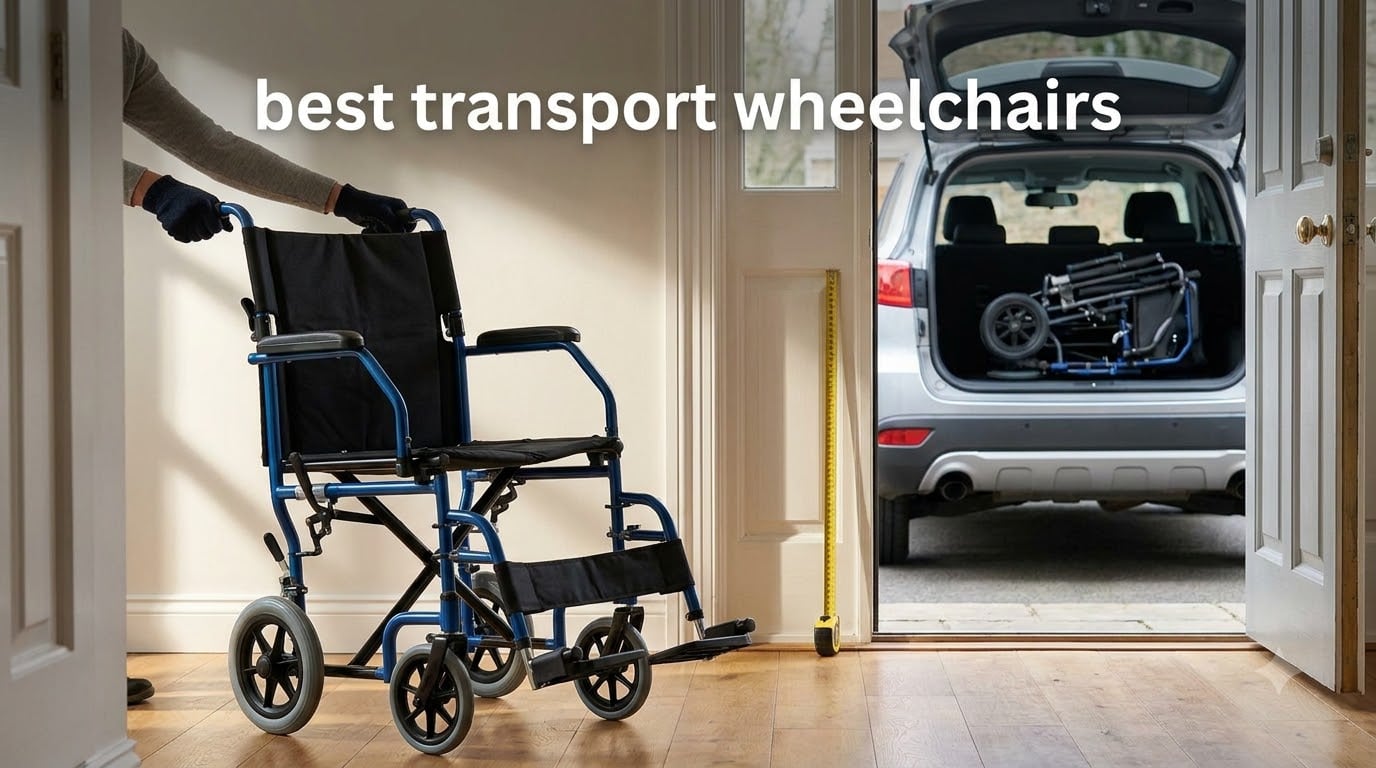
My family has been pushing a transport chair through airports, clinics, and grandma’s narrow hallway for over four years now, and I have lost count of how many models we have folded, lifted, and returned. That experience shaped this guide to the best transport wheelchairs of 2026. We compared 12 chairs across frame weight, seat width, wheel size, brake design, and real owner feedback from thousands of caregivers.
A transport wheelchair is a lightweight, narrow mobility chair pushed by a caregiver, with small wheels and no hand-rims for the rider. It exists for a specific job: getting someone from the car to the appointment, through a bathroom door, or across an airport terminal without a struggle. Choosing the wrong one usually shows up as a sore back, a seat that pinches, or a frame that will not fit in your trunk.
The difference between a good chair and a frustrating one comes down to a handful of numbers. Fifteen pounds versus 37 pounds changes who can lift it. A 17-inch seat versus a 19-inch seat changes whether your parent asks to get out after ten minutes. Eight-inch casters versus 12-inch rear wheels changes whether you can cross a parking lot or get stuck at the first curb.
Below you will find our top three picks, a full comparison table of all 12 chairs, detailed reviews, and a buying guide covering Medicare, caregiver back strain, and fit. Every recommendation is based on verified owner reviews, specification sheets, and the recurring complaints we found in caregiver communities on Reddit’s r/wheelchairs forum.
Table of Contents
Top 3 Picks for the Best Transport Wheelchairs October
If you only have a minute, these three chairs cover most families. Each one earned its badge through a combination of owner satisfaction, verified specifications, and how well it handles daily caregiver use.
Best Overall & Best Ultra-Lightweight: Medline Ultra Lightweight Transport Wheelchair, a 15 lb aluminum frame with a 19-inch seat and 300 lb capacity, arrives fully assembled.
Best Value with Big Wheels: Drive Medical Expedition, a 19 lb frame with 12-inch rear wheels, curb assist, and companion-activated loop-lock handbrakes rated for 300 lbs.
Best Budget Pick: Carex Transport Wheelchair, a 25 lb steel frame with a 19-inch seat, swing-away footrests, and a safety belt at the lowest price in our lineup.
Still deciding? Ask yourself two questions before you scroll further. Who will lift this chair into the car every week, and will the rider ever need to push it themselves?
Medline Ultra Lightweight
- 15 lb aluminum frame
- 19 inch seat
- 300 lb capacity
- Arrives assembled

Drive Medical Expedition
- 19 lb frame
- 12 inch rear wheels
- Loop-lock handbrakes
- 300 lb capacity

Best Transport Wheelchairs in 2026: Quick Comparison
This table shows all 12 chairs side by side so you can filter by the two numbers that matter most: total frame weight and seat width. Weight decides who can lift it, and seat width decides who can sit in it comfortably.
| Product | Specifications | Action |
|---|---|---|
| Medline Ultra Lightweight (15 lb) |
|
Check Latest Price |
| Drive Medical Expedition (19 lb) |
|
Check Latest Price |
 Medline w/ Handbrakes (22 lb) Medline w/ Handbrakes (22 lb) |
|
Check Latest Price |
| Carex Transport Chair (19 in) |
|
Check Latest Price |
 Drive Medical TR37E-SV (26 lb) Drive Medical TR37E-SV (26 lb) |
|
Check Latest Price |
 Drive Silver Sport 1 (37.6 lb) Drive Silver Sport 1 (37.6 lb) |
|
Check Latest Price |
 NOVA Folding Transport Chair NOVA Folding Transport Chair |
|
Check Latest Price |
 VOCIC U12 (28 lb) VOCIC U12 (28 lb) |
|
Check Latest Price |
 Karman T-2700 (Removable Arm) Karman T-2700 (Removable Arm) |
|
Check Latest Price |
 Karman LT-980 (24 lb) Karman LT-980 (24 lb) |
|
Check Latest Price |
 Vive Folding Chair (19 in) Vive Folding Chair (19 in) |
|
Check Latest Price |
 Strongback Excursion (20 in) Strongback Excursion (20 in) |
|
Check Latest Price |
One pattern jumps out immediately. Aluminum frames cluster between 15 and 28 pounds, while steel frames run 25 to 38 pounds, and that gap is the single biggest driver of caregiver fatigue over months of use.
A second pattern matters just as much for fit. Caregivers on r/wheelchairs consistently warn that 17-inch seats feel narrow for most adults, and their common advice is to treat 19 inches as the practical minimum unless the rider is slight.
1. Medline Ultra Lightweight Transport Wheelchair — The 15 Pound Gold Standard
Medline Ultra Lightweight Transport Wheelchair for Adults, Foldable, 19-Inch Seat Width, Red Frame, Black Upholstery
15 lb aluminum frame
19 inch wide x 16 inch deep seat
300 lb capacity
No assembly required
Pros
- Lightest chair we reviewed at 15 lbs
- Spacious 19 inch seat for average adults
- Arrives fully assembled
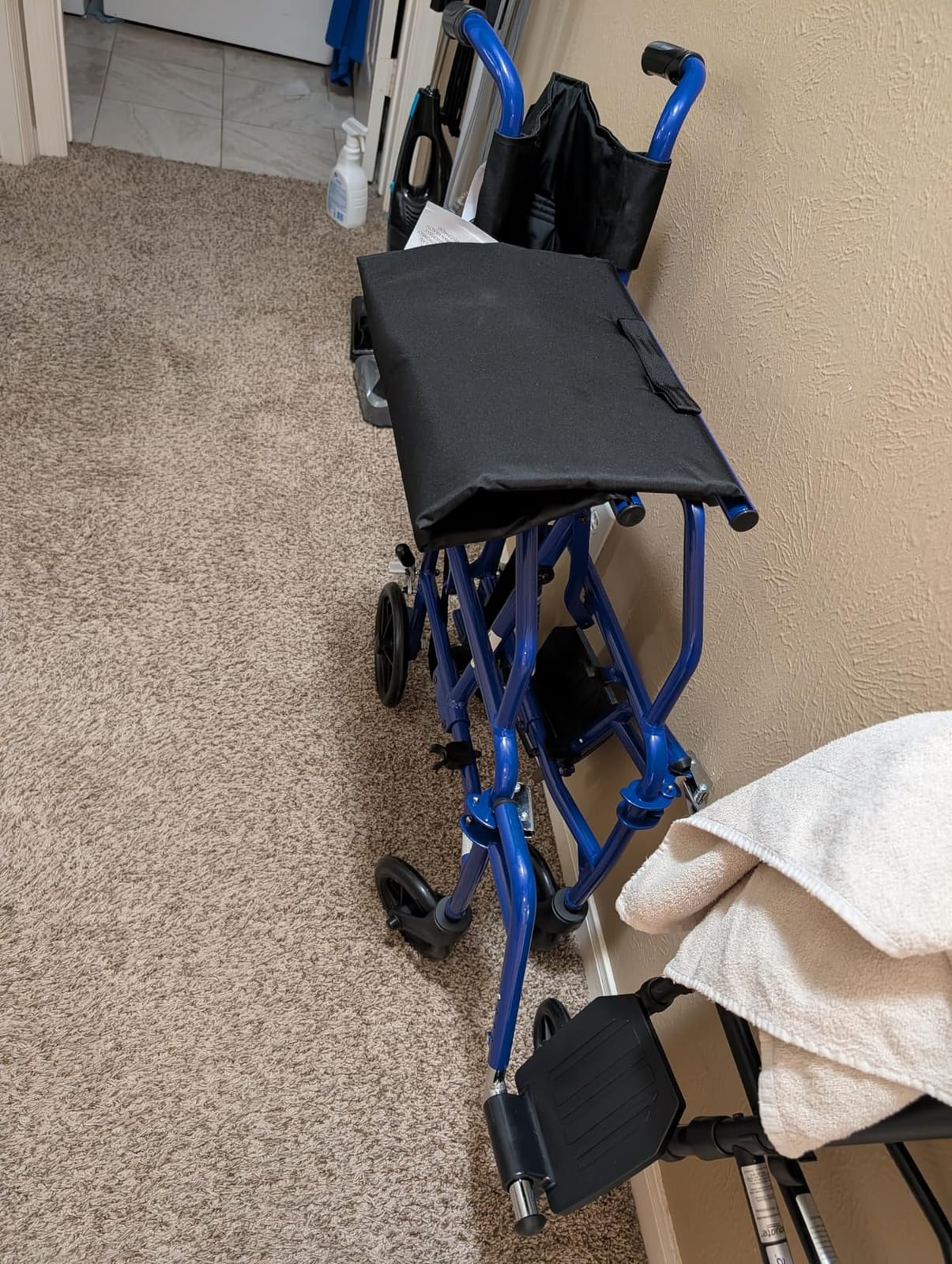
- Folds very compactly for car trunks
- 300 lb capacity on an aluminum frame
Cons
- Push handles sit low for caregivers over 6 feet
- Front casters stall at thresholds above a quarter inch
- Leg clamp can arrive loose
The first time I lifted the Medline Ultra Lightweight with one hand and swung it into a sedan trunk, I understood why caregivers on Reddit call it the gold standard for ultralight transport. At a genuine 15 pounds, it weighs roughly half of what a standard steel transport chair does, and that difference compounds every single time you load it.
Medline builds this one around an aluminum frame rated well beyond its weight class, listing a 300 lb capacity against a 19 by 16 inch seat. The 19-inch width is the number that matters most here, because it accommodates average-sized adults without the pinching that owners of 17-inch chairs complain about constantly.
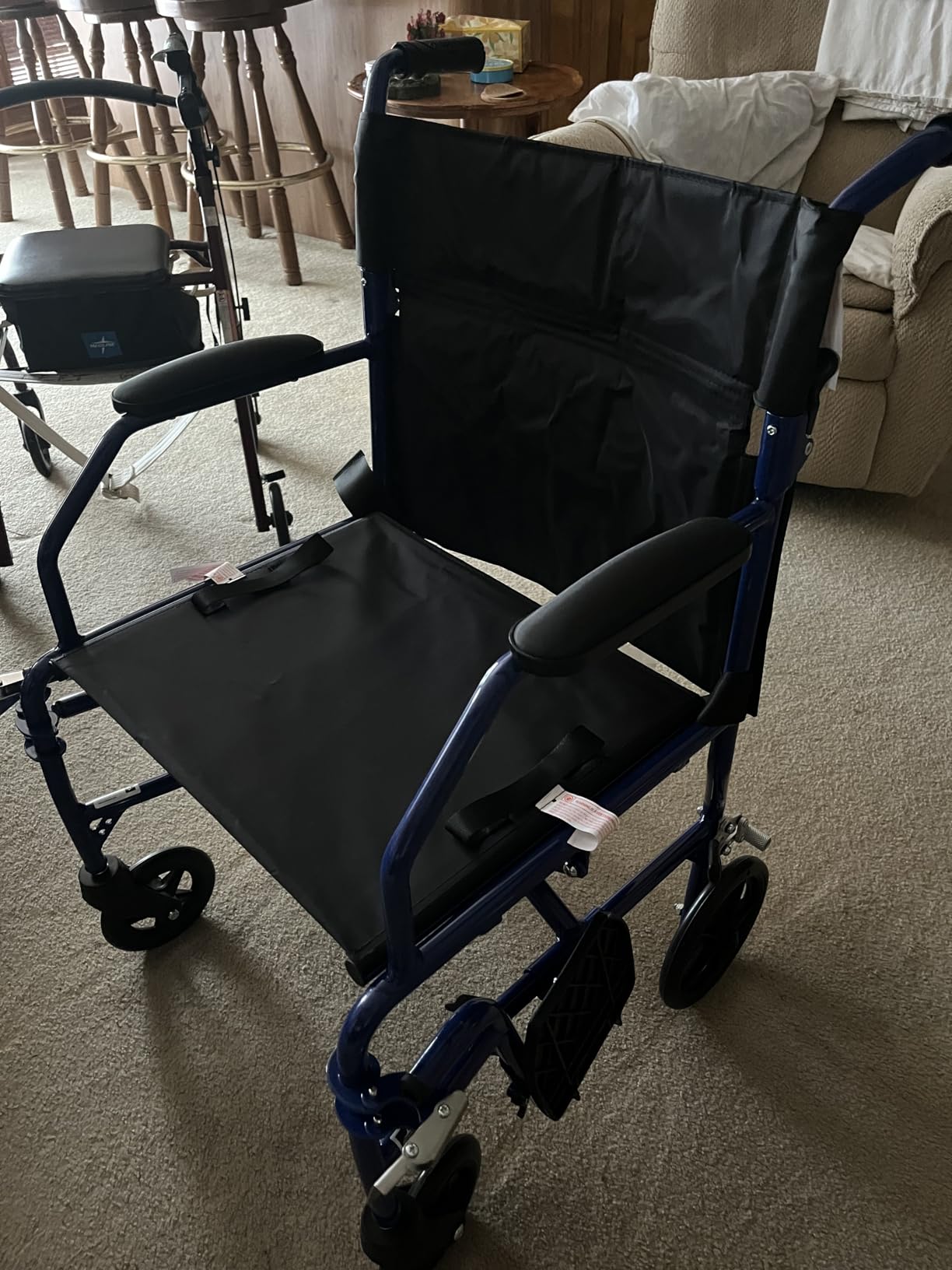
Out of the box, nothing needs assembling, which sounds minor until you have wrestled a steel chair’s footrest clamps in a parking lot. The armrests angle inward so the chair pulls up close to a table, the footrests clip to the side rather than dangling, and Medline even includes a cup holder. Owners report years of reliable service, which is why it sits near the top of the category best-seller list with a 4.6-star average.
The honest limitations are about ergonomics rather than durability. Push handles sit low, so caregivers over six feet end up hunching, and reviewers over that height regularly mention a sore back after long outings. The 8-inch front casters also stop dead at thresholds taller than a quarter inch, so expect to tip the chair back at doorways with raised transitions.
This is one of the best transport wheelchairs for elderly parents when a single caregiver does most of the lifting. It pairs an easy lift with a seat wide enough for all-day comfort.
Who Is the 15 lb Frame Really For?
It is built for someone who loads a chair into a car several times a week and has limited upper-body strength to work with. If you lift solo, or you switch between two vehicles, the aluminum frame removes most of the strain.
It is less essential if the chair mostly lives inside one house and rarely travels.
What to Check Before You Order
Measure your caregiver’s comfort at a low handle height first, because there is no height adjustment on this model. Then walk your entryways and look for thresholds or uneven sidewalk seams taller than a quarter inch.
Also check the leg-rest clamp on arrival, since a small number of owners found it loose and needed to tighten it.
2. Drive Medical Expedition — Best Value With 12-Inch Wheels
Drive Medical Lightweight Expedition Folding Transport Wheelchair, Blue
19 lb frame
12 inch rear wheels with curb assist
Loop-lock handbrakes
300 lb capacity
Pros
- 12 inch rear wheels smooth out bumps and curbs
- Companion-activated loop-lock brakes need no bending
- Folds quickly using a rear lever
- Light 19 lb frame with a 300 lb rating
Cons
- Footrests can rattle or feel loose
- Seat padding is minimal
- Not self-propelled
The Drive Medical Expedition solves the two complaints people have about basic transport chairs, and it does both at a mid-range price. You get 12-inch rear wheels with curb assist instead of tiny casters, and loop-lock handbrakes mounted on the push handles instead of brakes that force you to bend down to wheel level.
Drive lists the frame at 19 pounds, and roughly 27 pounds shipped once you account for packaging and accessories. Either way, it is light enough for most adults to lift alone, and the rear-lever fold collapses it in a few seconds.

In practice, the 12-inch wheels are the headline feature. They roll over expansion joints, driveway lips, and carpet transitions that stop an 8-inch caster chair cold, and the curb-assist geometry makes tilting back onto a sidewalk far less jarring for the rider. The loop-lock brakes let you slow the chair on a ramp while walking behind it, which pusher-only brakes simply cannot do.
The trade-offs are small but real. Footrests can develop a rattle, and the seat padding is thin enough that most long-term owners add a cushion. It is not designed for self-propulsion, so the rider always needs someone behind the handles.
With thousands of reviews dating back over a decade and a 4.5-star average, this is a proven design rather than a gamble. It is the chair I would point most families toward first.

How Do the Loop-Lock Brakes Work?
You squeeze a bicycle-style lever on the push handle to slow the chair while walking, and you push the lever into a locked position to park it. Everything happens at handle height, so you never bend to the rear wheels.
This matters most on slopes, ramps, and long sidewalk routes where a stationary lock is not enough.
Is 19 lbs Light Enough for Daily Lifting?
For most caregivers, yes, and it strikes a practical balance between the 15 lb Medline and heavier steel frames. The heavier shipped weight buys you bigger wheels and a more substantial frame.
If the person lifting has shoulder or wrist problems, the ultralight aluminum chairs above and below are worth the upgrade instead.
3. Medline Transport Wheelchair with Handbrakes — The Most Proven Chair on Amazon
Medline Lightweight Foldable Transport Wheelchair with Handbrakes and 12-Inch Wheels, Red Frame, Black Upholstery
22 lb aluminum frame
19 inch wide x 16 inch deep seat
12 inch rear wheels
300 lb capacity
Pros
- Over 12
- 700 reviews with a 4.5-star average
- Handbrakes plus rear-wheel locking brakes
- 19 inch seat suits most adults
- 12 inch rear wheels handle uneven ground
Cons
- Seat padding is thin
- Brakes are not reachable from the seated position
- Footrests can detach during trunk loading
This is the chair with the deepest track record in our entire lineup, sitting at more than 12,700 reviews with a 4.5-star average. When a design stays at the top of the category for this long, it usually means the manufacturer got the fundamentals right, and here those fundamentals are a 22-pound aluminum frame, a 19 by 16 inch seat, and 12-inch rear wheels.
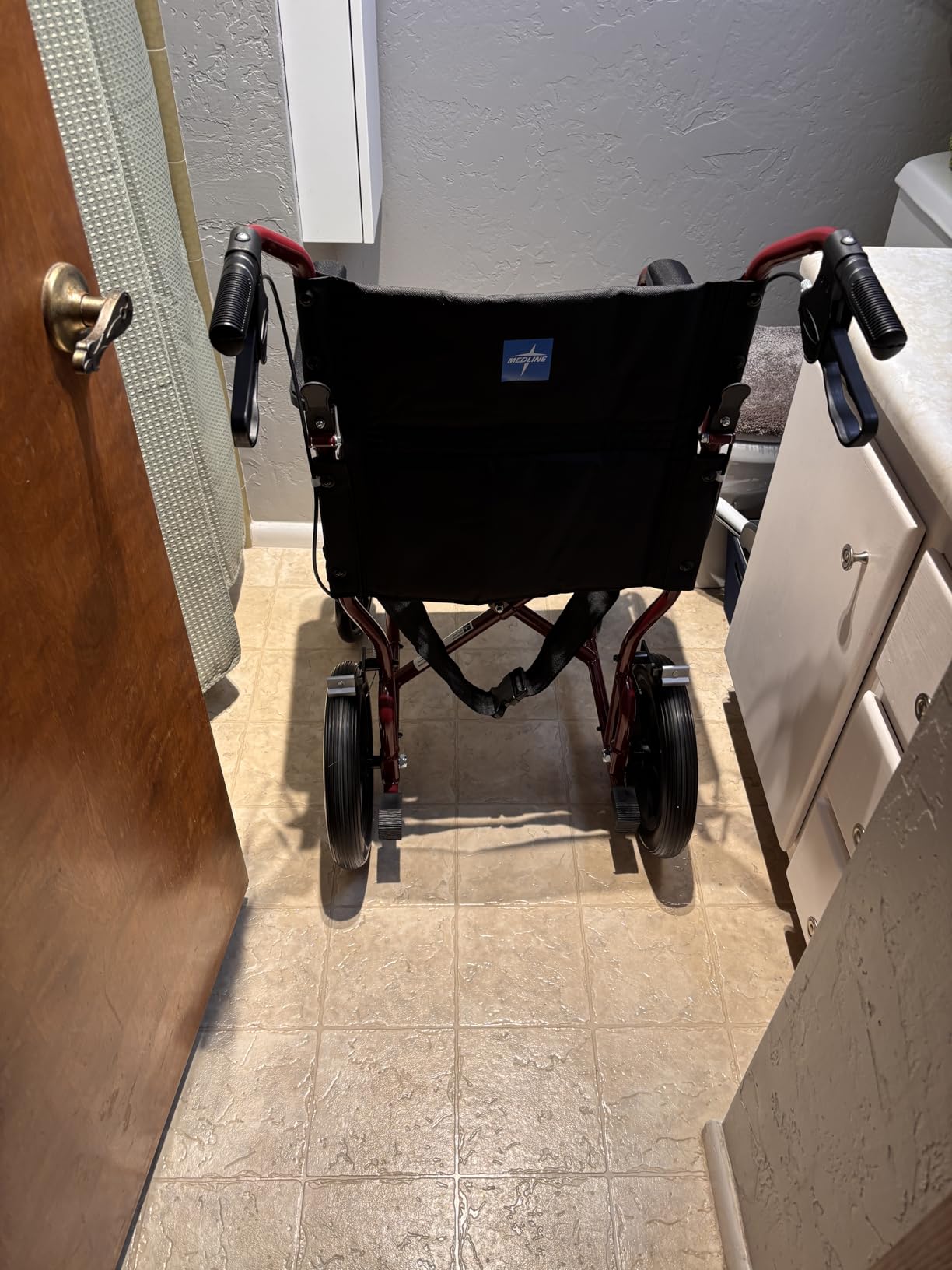
The defining feature is the dual braking setup. You get easy-squeeze handbrakes on the push handles for speed control on the move, plus manual rear-wheel locks you press down to park. That combination gives caregivers confidence on slopes, and it gives you a redundant lock when you step away.
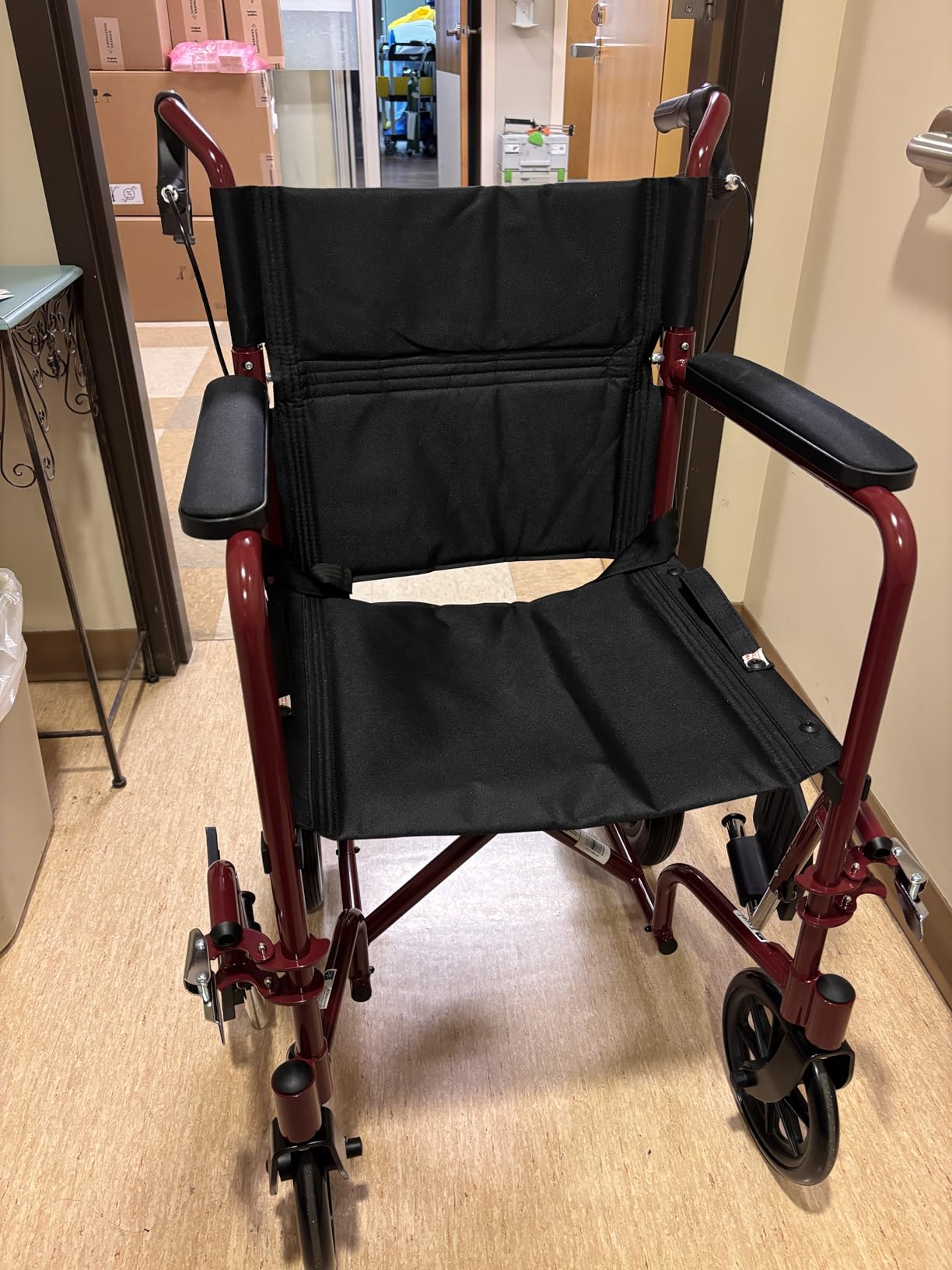
Owners repeatedly describe smooth rolling over sidewalks, thresholds, and parking lots thanks to the 12-inch rear wheels paired with swivel front casters. Full-length cushioned armrests support forearms properly during longer outings, and assembly out of the box takes minutes without tools.
The recurring complaints are familiar ones for the category. The stock seat padding is thin enough that many buyers add a gel or foam cushion, and the footrests can detach when you lift the folded chair from the trunk. The brakes sit behind the rider, so anyone who wants independent control should look at a hybrid model instead.
For caregiver-assisted use, this is one of the safest default choices in the category, and the review volume means you are buying into thousands of reported experiences rather than a handful.
Do You Still Need Rear-Wheel Locks With Handbrakes?
Yes, and the two serve different jobs. Handbrakes control speed and slow the chair while you push, while rear-wheel locks hold it still during transfers.
Having both on one chair is genuinely useful, because transfers are when most falls happen.
How Does It Handle Outdoor Sidewalks?
The 12-inch rear wheels carry it over cracks, tree roots, and curb cuts far better than 8-inch caster chairs. Owners report using it for zoo trips, county fairs, and neighborhood walks.
Loose gravel and deep grass remain weak spots for any transport chair, so plan a firmer route where you can.
4. Carex Transport Wheelchair — Best Budget Pick With a 19-Inch Seat
Carex Transport Wheelchair With 19 inch Seat, Folding Transport Chair with Foot Rests, Foldable Lightweight Wheelchair Foldable for Storage and Travel
25 lb steel frame
19 inch seat
Swing-away removable footrests
Rear-wheel brakes
Pros
- Lowest price in our lineup with a 19 inch seat
- Sturdy all-steel construction
- Folds compactly for sedan trunks
- Reflective strips on the front wheels
Cons
- Small wheels struggle in snow and sand
- Some assembly required
- Fold handle has clicked loose on some units
The Carex Transport Wheelchair is the chair I recommend when a family needs something competent this week without stretching the budget. It is the most affordable model in our group, yet it still delivers a 19-inch seat and a no-nonsense steel frame, which is a rarity at this end of the market.
Steel is the reason the price stays low and the reason the weight climbs to 25 pounds. Owners describe the construction as genuinely sturdy, with no flexy plastic parts, and the chair folds compactly enough to fit in the trunk of a Honda Civic according to multiple reviews.
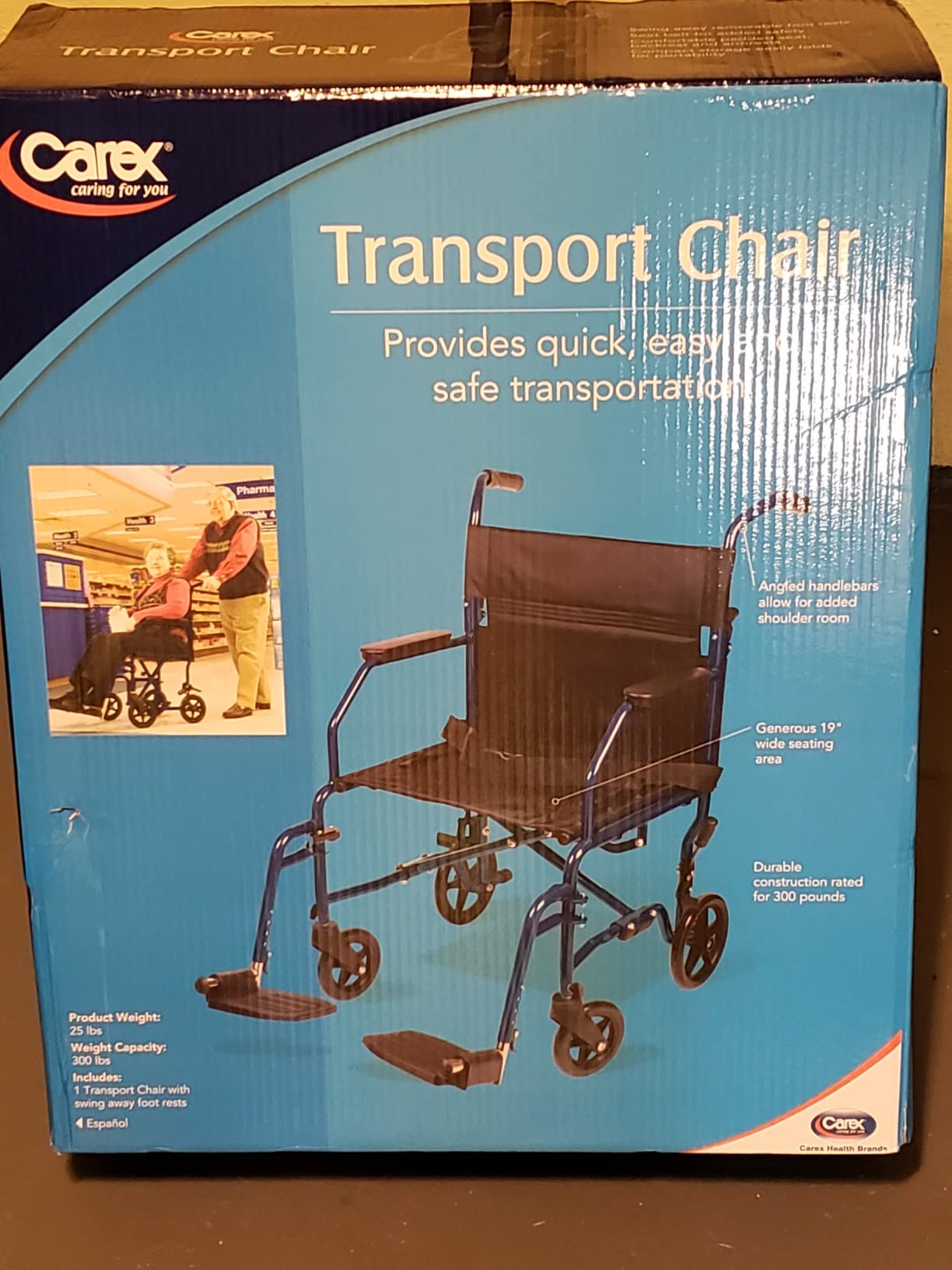
Day to day, it behaves like a solid conventional transport chair. The swing-away removable footrests make standing transfers easier, the rear-wheel brakes lock reliably, and the nylon seat and back pop off for washing. Reflective strips on the front wheels are a thoughtful touch for evening use in parking lots.
Know the limits before you buy. The small wheels bog down in snow, sand, and thick carpet, and reviewers are clear that the seat suits average-sized adults rather than large or heavy builds. A small number of owners also reported the fold-point handle clicking loose, and some assembly is required on arrival.
For indoor use, paved outings, and getting a senior to doctor appointments, it does the job at a price that leaves room for a cushion upgrade.
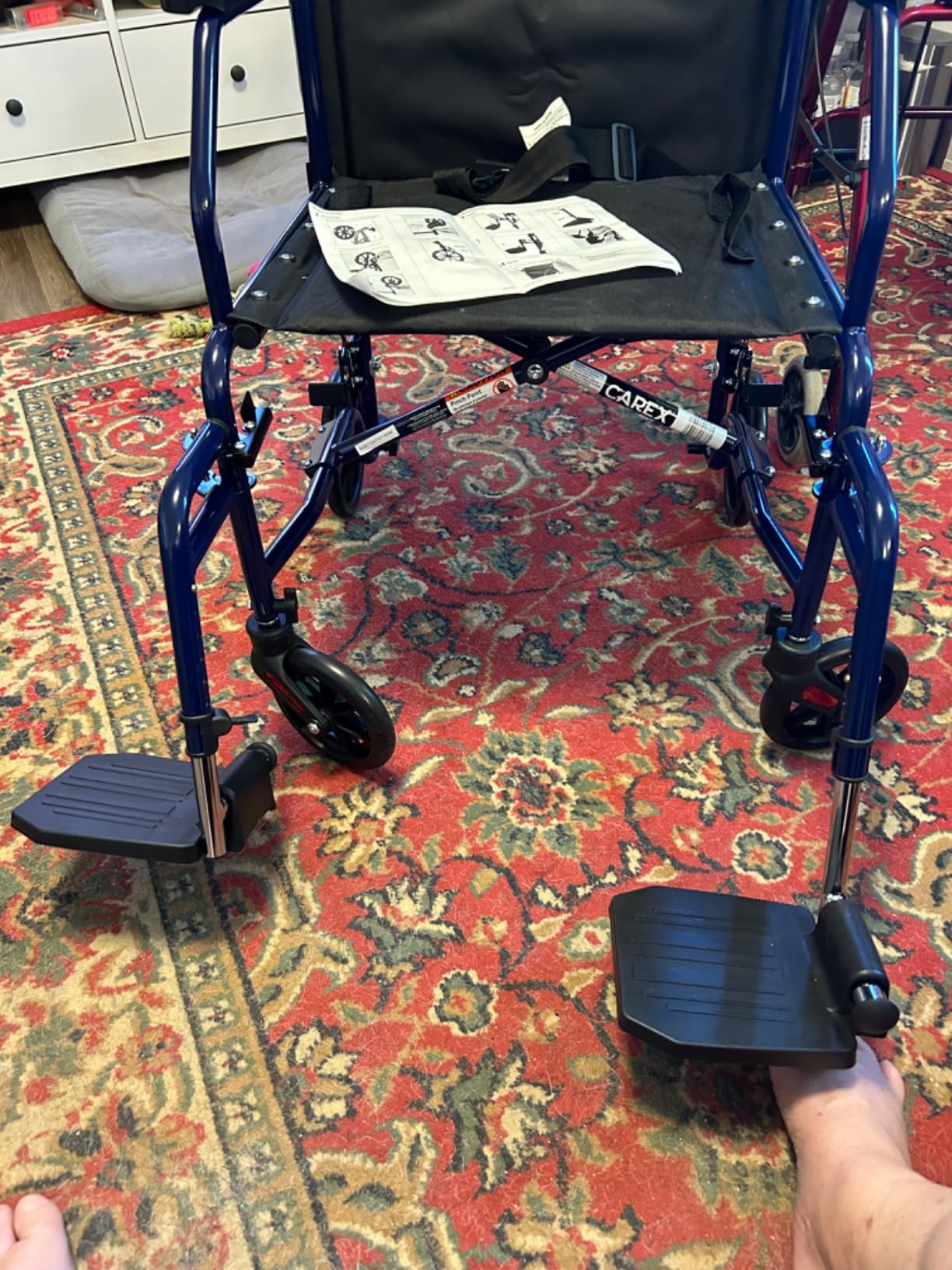
Does the Steel Frame Fit Your Lifting Limit?
At 25 pounds it is manageable for most adults, but noticeably heavier than the 15 to 19 pound aluminum chairs. Lift it the same way you would a packed suitcase, close to your body.
If one smaller person handles every load, factor that in before choosing steel over aluminum.
What Terrain Should You Avoid?
Stick to smooth surfaces, because snow, sand, gravel, and deep carpet will stop the small wheels. Ramps and sidewalks are fine.
For rougher routes, a 12-inch rear wheel model like the Expedition above is the better tool.
5. Drive Medical Folding Transport Wheelchair — Best for Narrow Doorways and Small Cars
Drive Medical Folding Transport Wheelchair, Swing-Away Footrest, Silver
26 lb steel frame
17 inch nylon seat
8 inch wheels
Fold-flat backrest
Pros
- Fits through narrow doorways and small car trunks
- Folds flat including the backrest
- Over 10
- 600 reviews
- Swing-away footrests for simple transfers
Cons
- 17 inch seat is too narrow for larger adults
- Brakes are only accessible to the pusher
- Front wheels can catch footrests in reverse
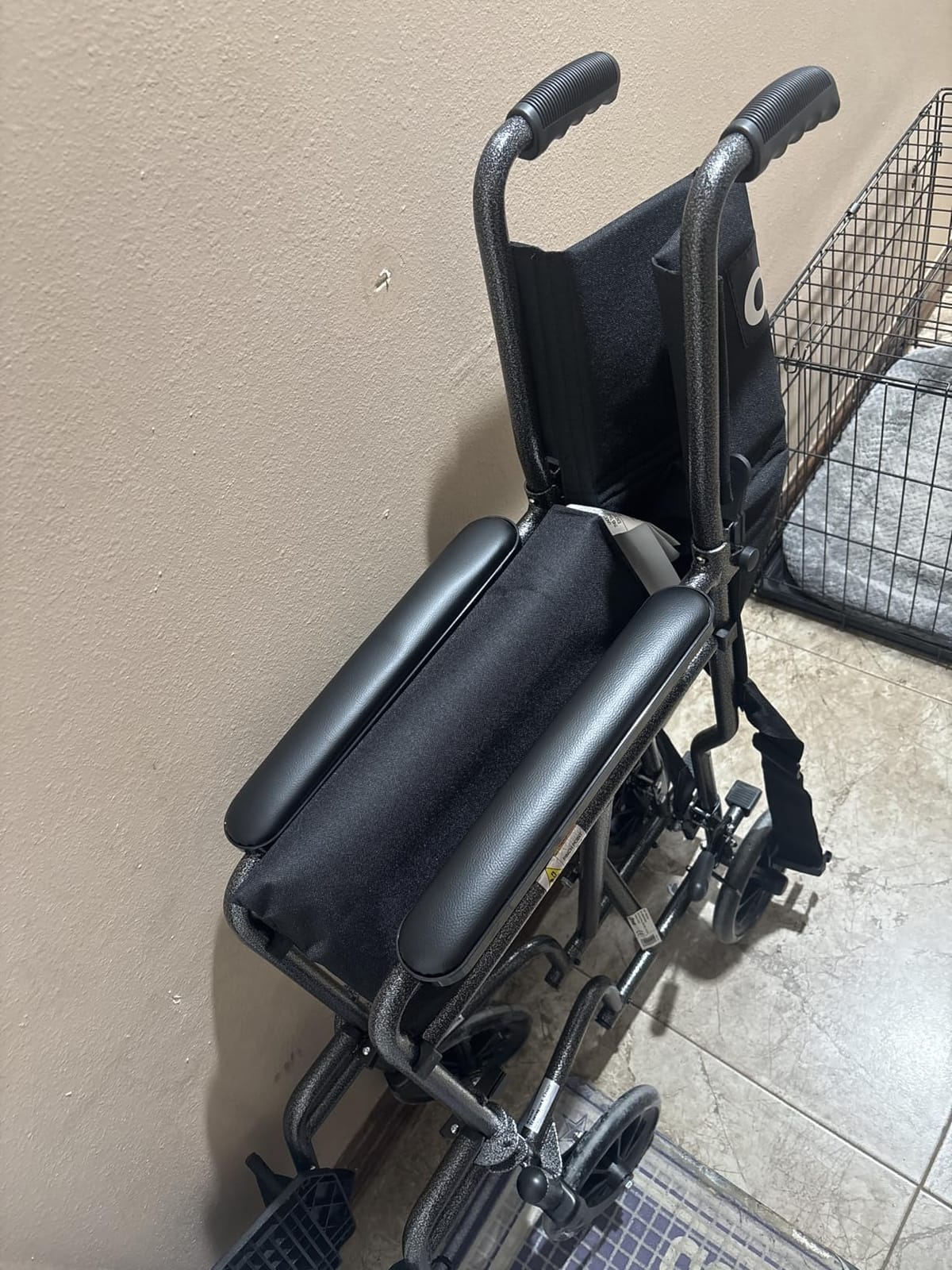
This is the top-selling transport wheelchair on Amazon, with a review count above 10,600, and its popularity comes down to dimensions. At 21.5 inches wide overall with a fold-flat backrest, it squeezes through older doorways and into small car trunks that reject wider chairs.
Multiple owners specifically mention fitting it into a Honda Civic, which tells you how compact the folded package is. The backrest folds down on top of the seat rather than standing tall, so it slides into a trunk cavity instead of fighting it.

Build quality is where the Drive-versus-budget-brand argument shows up, and reviewers consistently rate the steel frame and hardware as solid. Tilt bars near the rear wheels let you tip the front casters over curbs, and the push-to-lock rear brakes hold firmly on inclines.
The limitation you cannot work around is the 17-inch seat. Owners are blunt that it suits smaller adults, with several noting it is uncomfortable for anyone past a slight build, so treat this as a chair for narrower riders or short trips. Brakes also require the pusher to bend down, and the front wheels can foul the footrests when you reverse.
If your house has 24-inch bathroom doorways or your car is compact, this is the chair that actually fits.
Will 17 Inches Be Wide Enough?
Measure the rider’s hips at their widest point while seated, then add an inch on each side for clothing and movement. Anything close to 17 inches means you need a 19-inch seat instead.
Caregivers on r/wheelchairs treat 19 inches as the safer default for most adults, and we agree.
Does It Fit in Your Trunk?
In almost every case, yes, because the folded height drops sharply when the backrest lays flat. Measure your trunk’s lowest clearance point to confirm.
Owners of sedans and compacts report the best fit of any chair in our lineup.
6. Drive Medical Silver Sport 1 — Best When the Rider Wants to Self-Propel
Drive Medical Silver Sport 1 Folding Transport Wheelchair, Black
37.6 lb powder-coated steel frame
Self-propel handrims
250 lb capacity
Carry pocket
Pros
- Rider can self-propel using large rear wheels
- Tool-free assembly in minutes
- Full-length padded armrests
- Scratch-resistant hammered black finish
Cons
- Heavy at 37.6 lbs
- Takes significant trunk space
- Smooth tread can slip on hardwood and carpet
The Silver Sport 1 is technically a hybrid, and that is its whole appeal. Large rear wheels with hand-rims mean the rider can push themselves on good days, while a caregiver can still push from behind on tired ones. Among chairs that keep a companion-push role, it earns one of the highest ratings in our group at 4.6 stars.
The 37.6-pound powder-coated steel frame is the price you pay for that versatility. This is not a chair you sling into the trunk one-handed, and reviewers are candid that smaller adults find lifting it a chore.
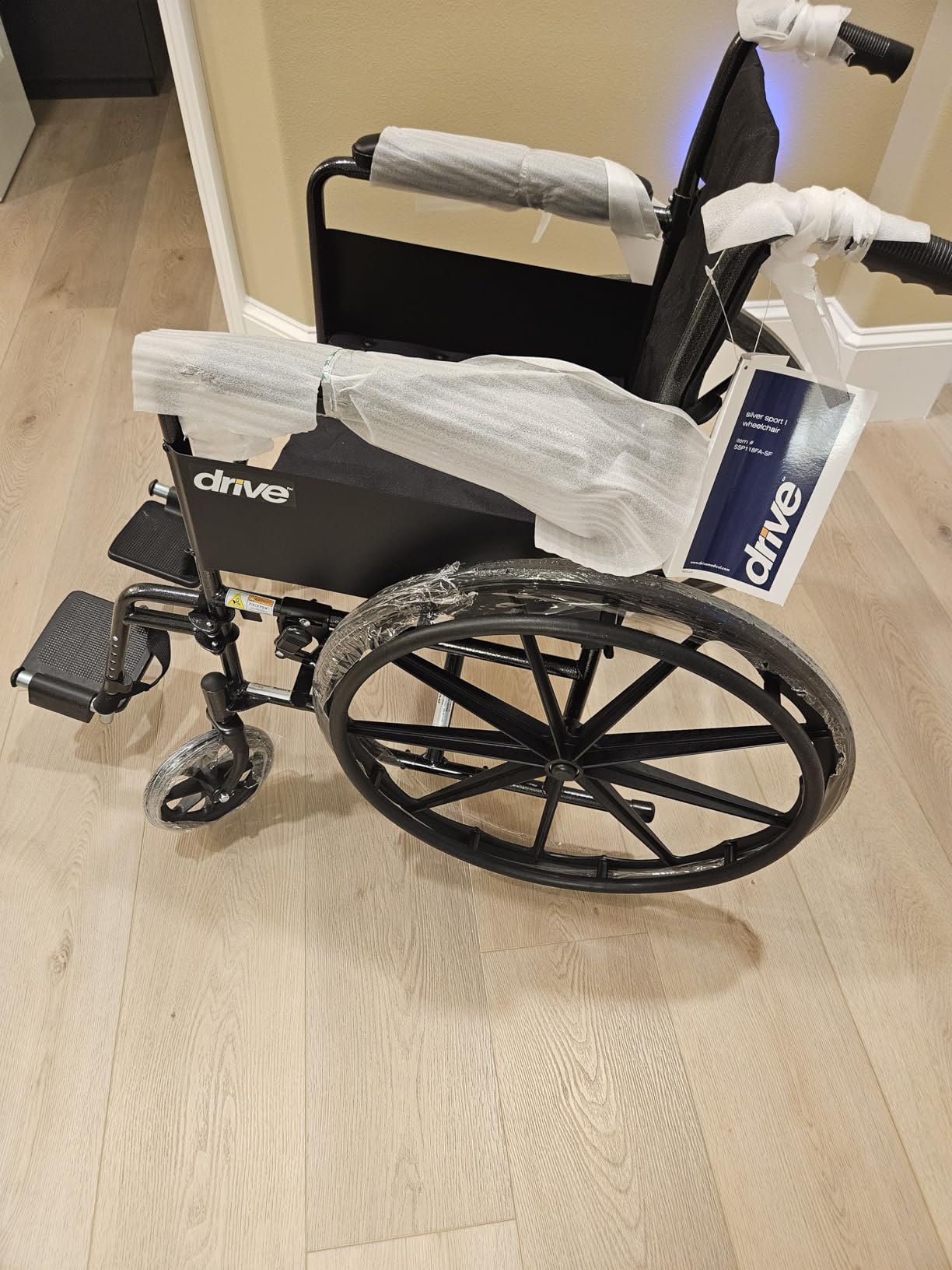
What you get in exchange is genuine durability and comfort. Full-length padded armrests support the whole forearm, the nylon upholstery breathes better than vinyl, and a carry pocket on the back keeps essentials close. Assembly needs no tools, and owners report it folds down to roughly 11 inches thick for a back seat rather than a trunk.
The smooth urethane tread deserves a mention, because it can slip on hardwood and thick carpet during transfers. Keep the wheel locks firmly engaged before standing up, and note that the lock latch sometimes needs a firm push to seat over-center.
For injury recovery and longer-term use where independence matters, this is the smart pick in the lineup.

Is 37.6 lbs Manageable for One Person?
It is liftable, but it is a two-stage lift for most people, and frequent solo loading will wear on you. Consider who loads the car and how often before committing.
A chair that stays mostly at home, or travels in a SUV or van, suits this weight far better.
Can the Rider Really Self-Propel?
Yes, and owners with post-surgery and stroke-recovery users describe exactly that. The hand-rims and full-size rear wheels make short indoor trips independent.
Expect it to be slower and heavier than a dedicated self-propelled wheelchair, because the frame carries extra weight.
7. NOVA Lightweight Folding Transport Chair — Best Safety Package
NOVA Lightweight Folding Transport Chair – Aluminum Travel Wheelchair with Flip-Up Desk Arms, One-Grip Locking Handbrakes, 8” Front & 12” Rear All-Terrain Wheels – Supports Adults Up to 300 lbs – Red
27 lb aluminum frame
One-Grip locking handbrakes
8 inch front and 12 inch rear wheels
Flip-up desk arms
Pros
- Anti-tippers guard against backward falls on ramps
- One-Grip handbrakes lock the rear wheels
- Flip-up desk arms for side transfers
- Heel loops on non-skid foot plates
Cons
- Park brake can slide on smooth wood floors
- Seat support bars snap into plastic clamps
- Some units shipped with missing anti-tippers
The NOVA Folding Transport Chair stands out for stacking safety features that most chairs in this price band skip. Anti-tipper wheels behind the frame, One-Grip locking handbrakes, a seat belt, and non-skid foot plates with heel loops all come standard, which addresses the exact stability worries caregivers raise most often in forums.
The 27-pound aluminum frame is light enough for confident handling, and the wheel pairing of 8-inch fronts with rugged 12-inch locking rears gives it genuine indoor-outdoor range. Owners describe it turning tightly in narrow hallways while still rolling smoothly over sidewalks.
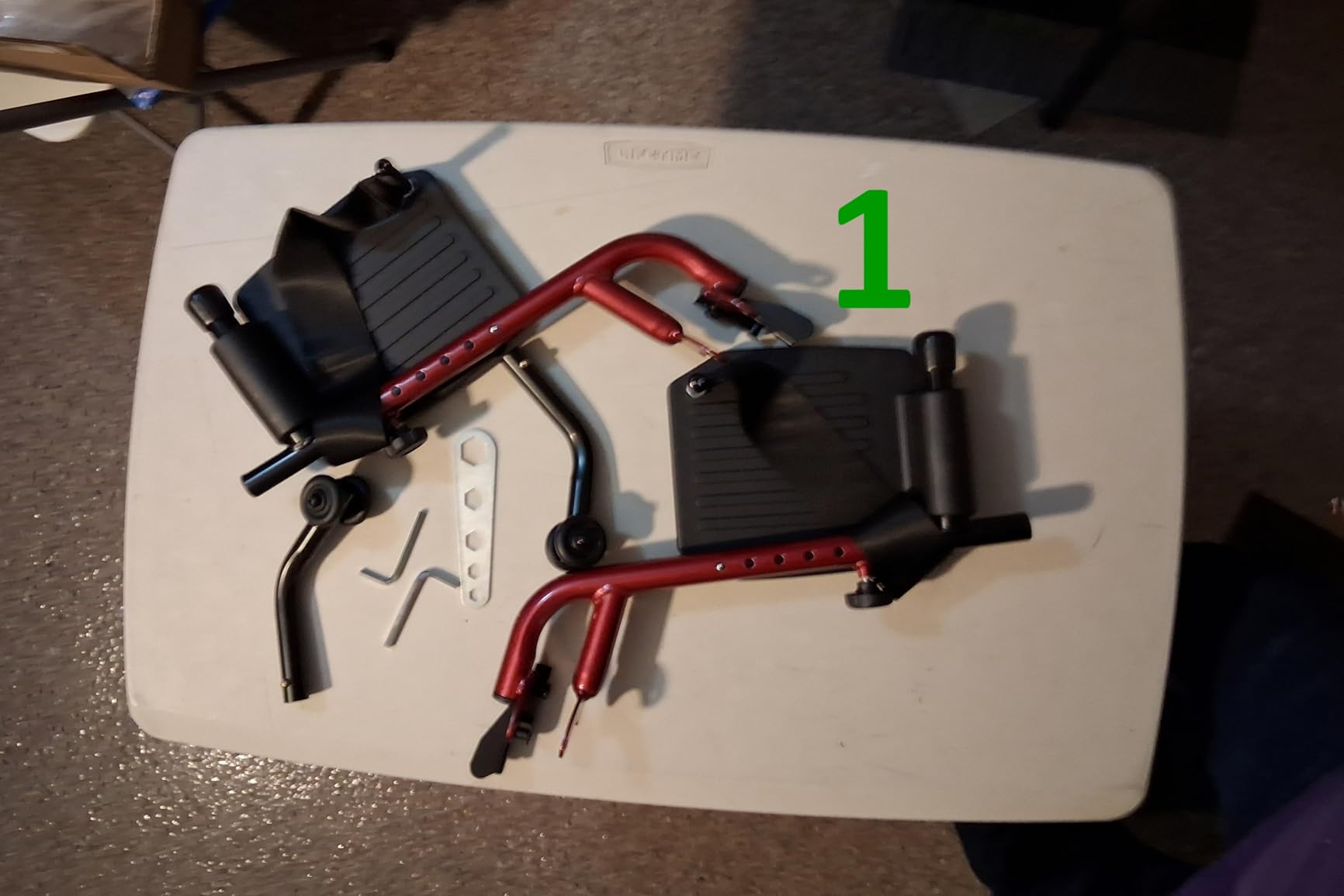
The flip-up desk arms are the feature transfer-givers should notice. Because the armrest swings up and out of the way, you can slide the chair beside a bed or toilet and perform a side transfer instead of lifting the rider over the arm.
Weak points are consistent across reviews rather than random. The seat support bars snap into plastic clamps that may wear if you fold and unfold the chair many times a day, the park brake can slide slightly on smooth wood floors, and a few buyers received units missing the anti-tippers. NOVA’s United States-based support team earns praise for resolving those issues quickly.
With a 4.5-star average and strong value feedback compared to pricier brands, this is the chair for safety-first buyers.
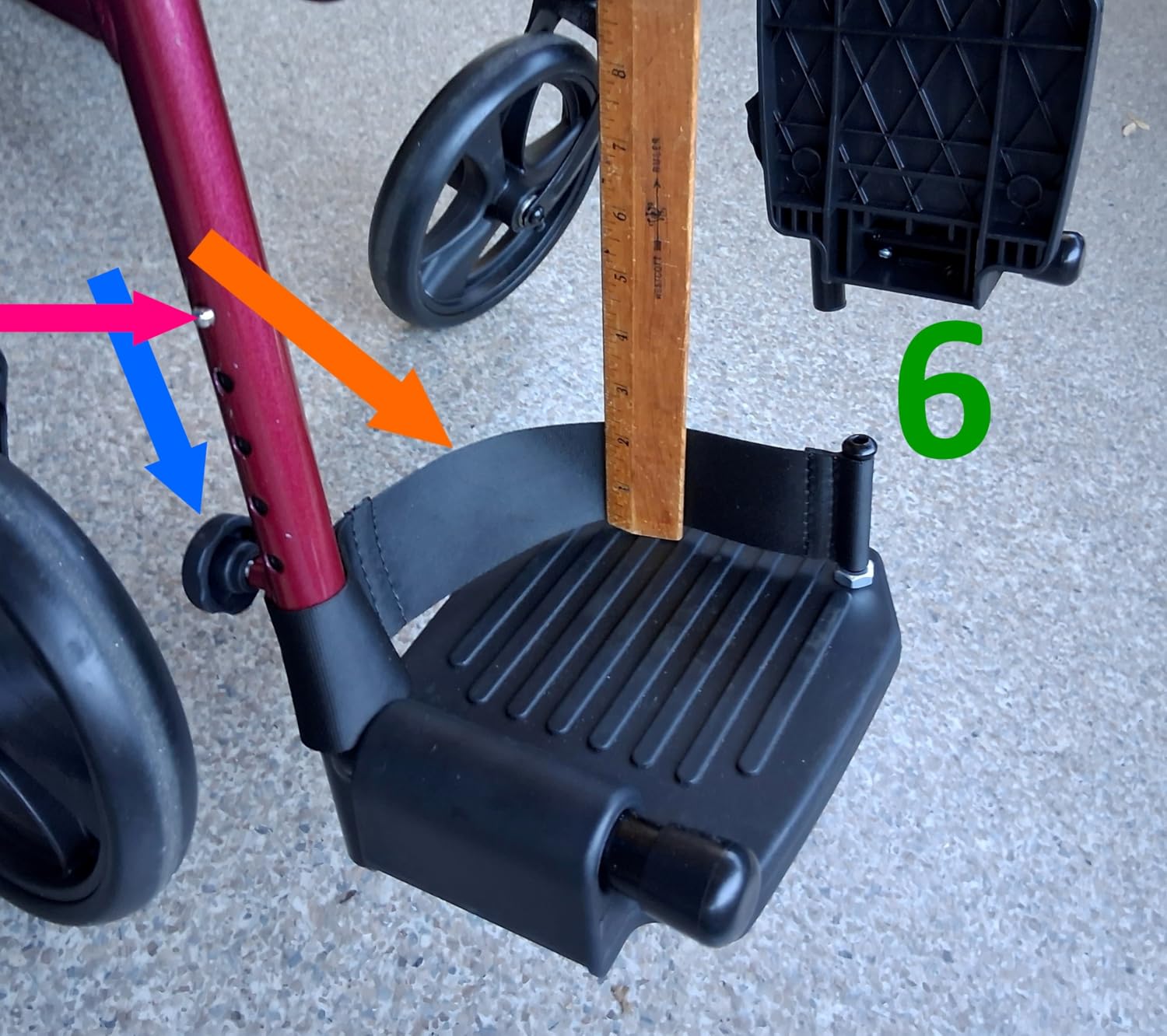
How Do the One-Grip Brakes Compare?
They combine speed control and a parking lock in a single lever you can engage with one hand. Compared to separate push-to-lock wheel brakes, you never let go of the chair to park it.
That is a real advantage when you are holding a door open with your free hand.
Do You Need the Anti-Tippers?
If you regularly push up ramps, driveway inclines, or curb cuts, yes, because they stop the chair from rotating backward if the rider shifts their weight. Most owners leave them installed permanently.
Check that they are included when the box arrives, since a few units shipped without them.
8. VOCIC U12 — Best Adjustable Chair for Caregiver Comfort
VOCIC Lightweight Transport Wheelchair for Adults
28 lb aero aluminum frame
3-height push handle
Dual-control handbrake
300 lb capacity
Pros
- Push handle adjusts to 3 heights for taller caregivers
- Armrests adjust across 3 height levels
- 270-degree swing-in footrests enable close transfers
- Reinforced dual-X base for stability
Cons
- Narrow 17.7 inch seat
- Thin seat padding
- Recently launched with only 22 reviews
The VOCIC U12 is the most caregiver-focused chair in this roundup, and it is the only one that directly addresses the low-handle problem that tall pushers complain about on the Medline Ultralight. The push handle adjusts across three heights, so a six-foot-two caregiver can finally walk upright instead of stooping.
Adjustability runs through the whole design. ErgoLift armrests move across three height levels with contoured pads, and FlexFit footrests adapt to different leg lengths. The footrests also swing through 270 degrees, letting you swing them completely inward for zero-distance transfers from a bed or car seat.
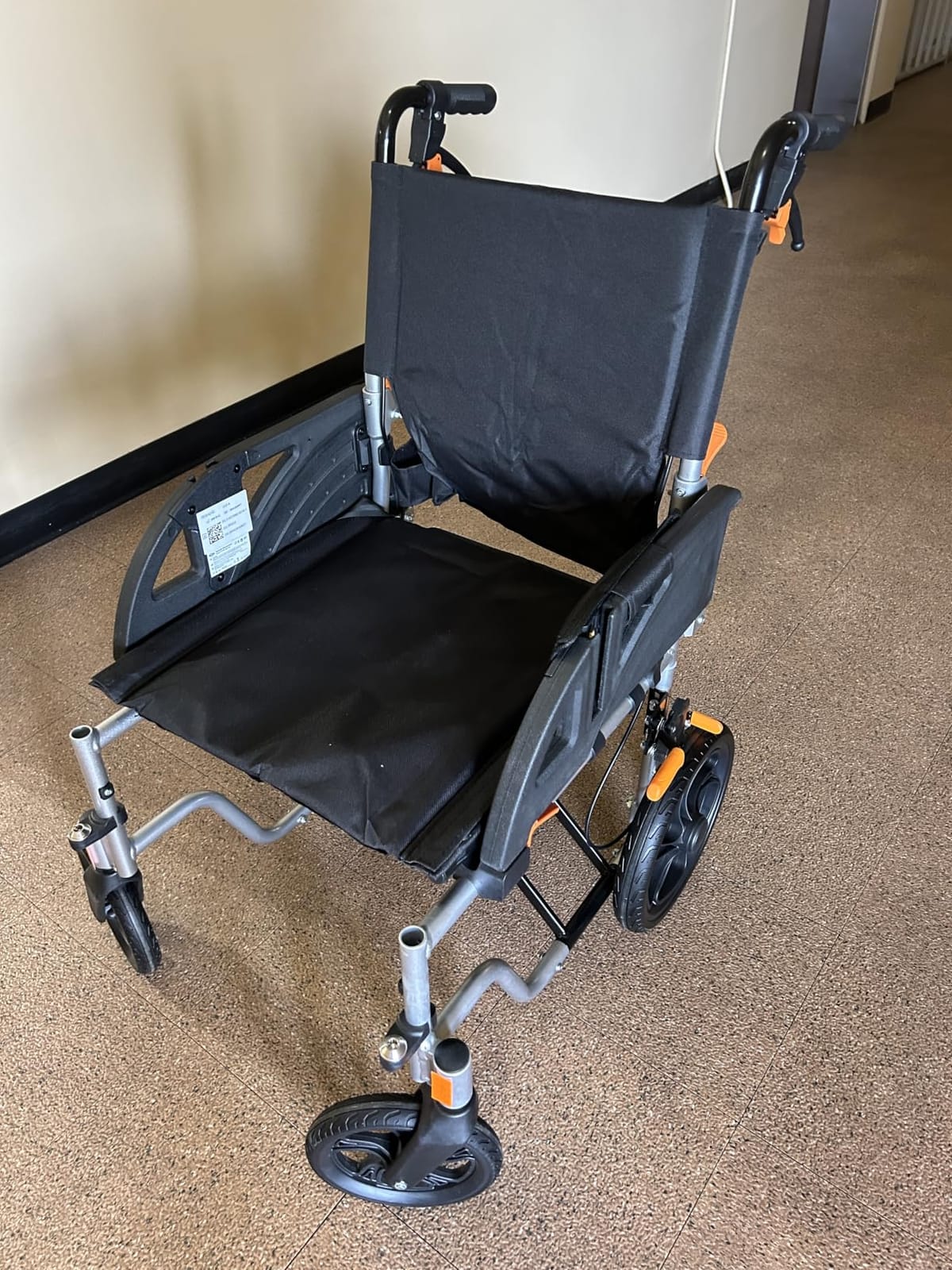
At 28 pounds, the aero aluminum frame sits mid-pack, and the reinforced dual-X base adds a stiffness that lighter chairs sometimes lack. Owners highlight the dual-control handbrake with its parking brake release button, the washable 3D mesh seat cover, and a narrow profile that passes through 23-inch doorways.
The early review record is excellent at 4.9 stars, but it is built on just 22 reviews since the July 2026 launch, so treat that number with caution. The 17.7-inch seat runs narrow for larger adults, the padding is thin, and it ships without Prime eligibility.
If you are a tall caregiver who has been hurting on a fixed-handle chair, this is the one built for you.
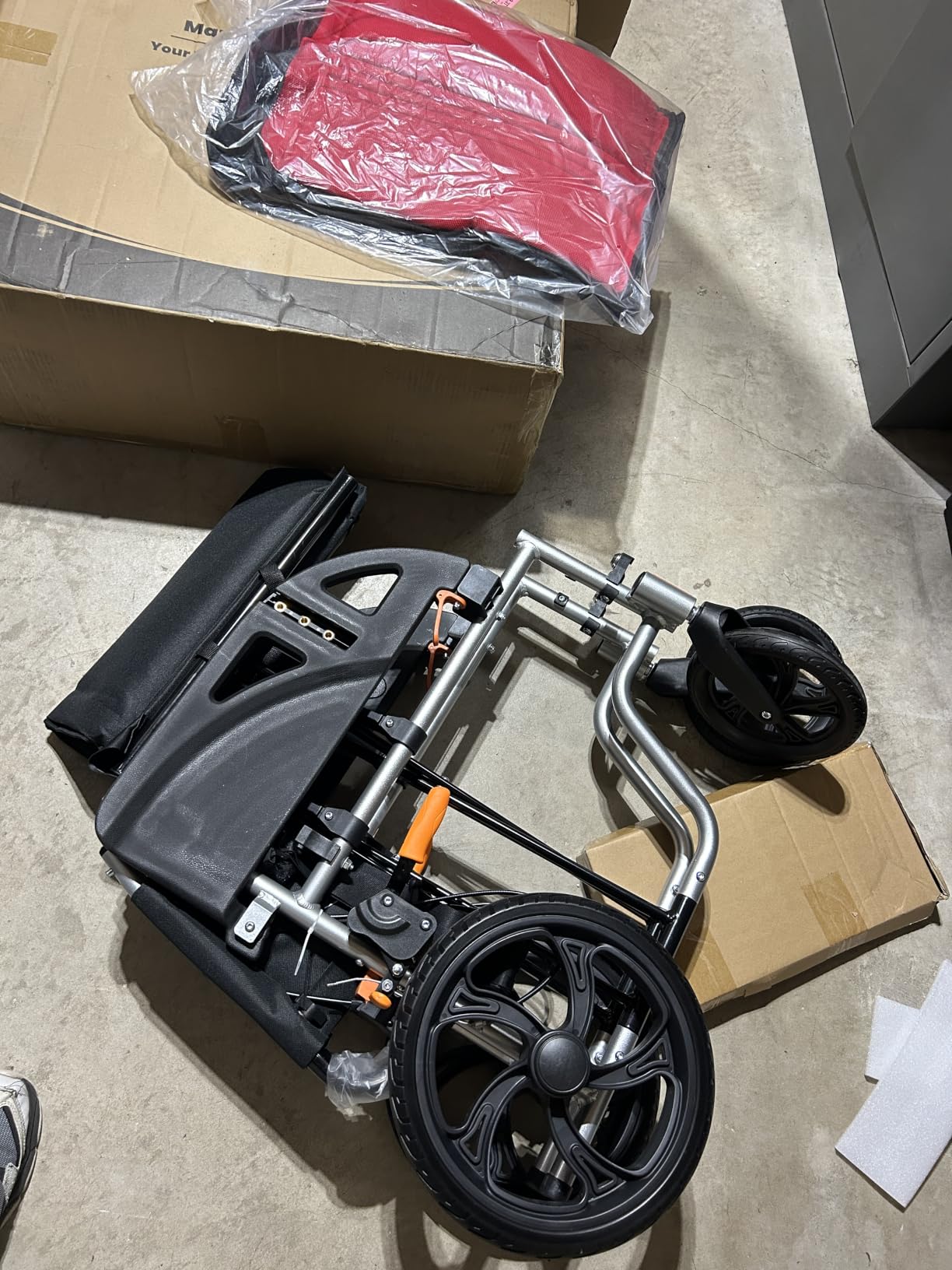
Is a 22-Review Track Record Enough?
The rating is outstanding, but a small sample can shift as reviews accumulate. Buyers who prefer proven designs should weight the Medline and Drive chairs more heavily.
Early owners report no widespread failures, which is a reasonable initial signal.
Which Height Setting Fits Your Caregiver?
Set the push handle so your wrists stay neutral and your elbows bend slightly while standing naturally. Lock it there and note the setting if multiple people push.
The armrest height should let the rider’s forearms rest level, which the three-level system makes possible.
9. Karman T-2700 — Best Removable-Armrest Chair for Transfers
Karman Lightweight Transport Wheelchair with Removable Armrest
Steel frame
Removable armrest
17 or 19 inch seat options
Seatbelt included
Pros
- Removable armrest makes side transfers much easier
- Fits through hallways and bathroom doors
- Recessed armrests slide under tables
- Simple assembly
Cons
- Small front wheels must be carried down stairs
- Construction quality varies between units
- Seat needs a cushion for long use
The Karman T-2700 earns its place on one clever feature: the armrest comes off entirely. Pulling the arm out of the way turns a difficult standing transfer into a simple side-slide, which matters enormously when you are moving someone between the chair and a bed, toilet, or car seat multiple times a day.
The listing shows a shipping weight of 29 pounds with technical documentation referencing a higher operational figure, so expect something in the light steel range rather than an aluminum ultralight. Choose between 17-inch and 19-inch seat widths at purchase, and we strongly suggest the 19 for most adults.
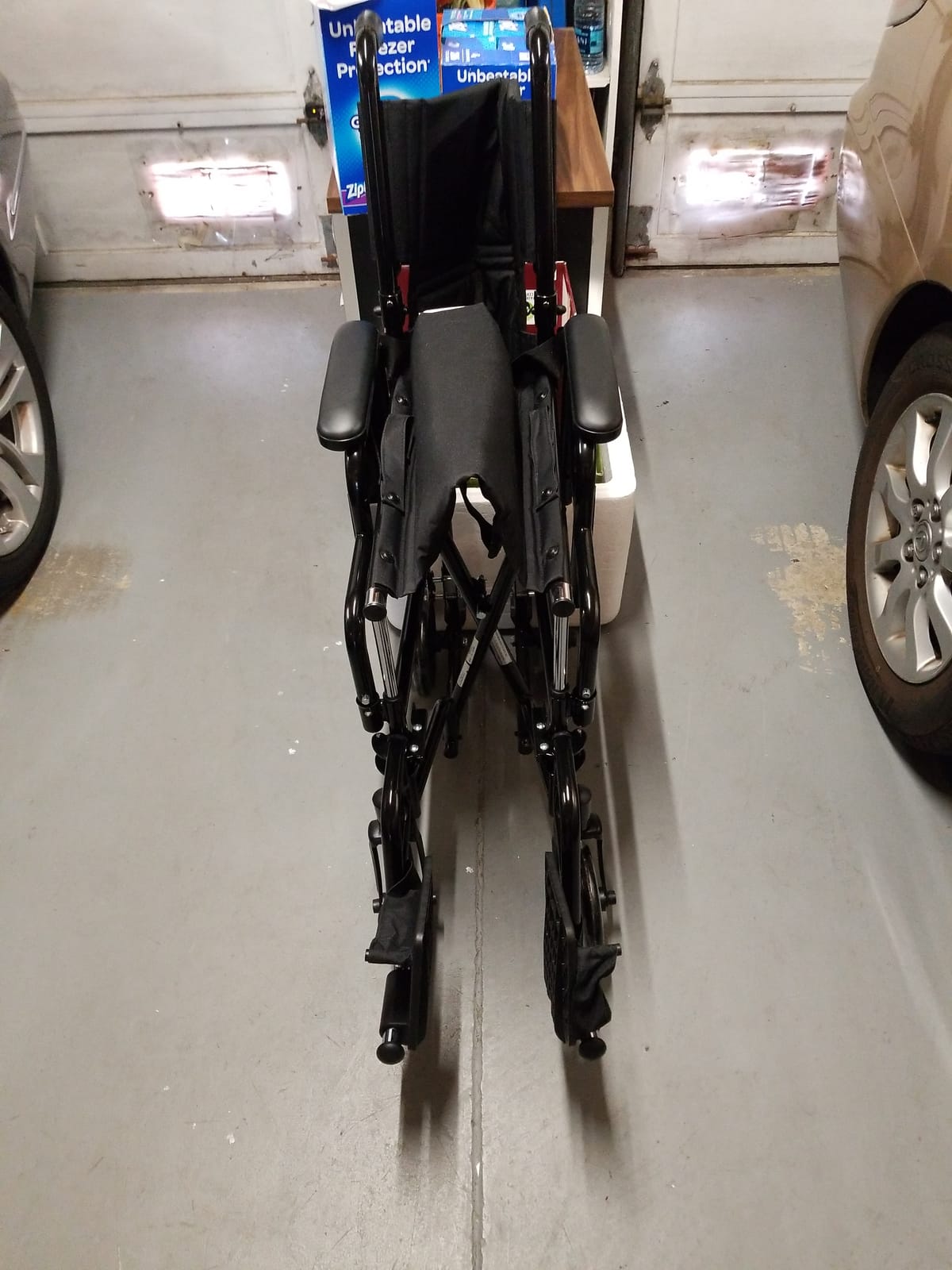
Where this chair shines is indoors. Owners describe it threading through hallways and bathroom doors that defeated wider chairs, and the recessed armrest design lets the rider pull up to a table or desk properly rather than stopping short.
The honest downsides center on wheels and quality control. Small front casters mean you carry the chair down stairs instead of rolling it, the seat needs an aftermarket cushion for anything longer than a short outing, and a minority of buyers received units with assembly defects worth checking on arrival.
For tight older homes and frequent transfers, the removable armrest alone justifies choosing it.

How Much Easier Are Removable Armrests?
They remove the highest obstacle between the rider and the transfer surface. Instead of lifting someone up and over a fixed arm, you slide them sideways with far less effort.
Caregivers managing limited mobility report noticeably less strain over a full day.
What Should You Check on Arrival?
Test every locking point, including the armrest receiver, footrest latches, and brake action, before the first real use. Confirm you received the seat width you ordered.
Contact the seller immediately if anything is missing or misaligned, since defects have been reported on a small share of units.
10. Karman LT-980 — Best Premium Ultralight With Rider-Controlled Brakes
Karman 24 pounds LT-980 Ultra Lightweight Wheelchair, Black
24 lb aluminum frame
22 inch flat-free rear wheels
User-accessible handbrakes
250 lb capacity
Pros
- Among the lightest full-featured chairs at 24 lbs
- Handbrakes reachable by the seated rider
- Flat-free polyurethane tires never need tubes
- Folding backrest and seat for compact storage
Cons
- Higher price than most transport chairs
- Fixed armrests limit transfer flexibility
- 250 lb capacity is lower than comparable models
The Karman LT-980 is the chair for buyers who want an aluminum ultralight but refuse to give up rider independence. It carries 22-inch rear wheels with flat-free polyurethane tires, and the handbrakes sit where the seated user can reach them, which is nearly unique in this group.
At 24 pounds without the footrest, it sits in genuine ultralight territory while still behaving like a hybrid chair the rider can propel. The frame folds, the backrest folds, and the seat folds, collapsing into a package that fits behind a car’s rear seats.
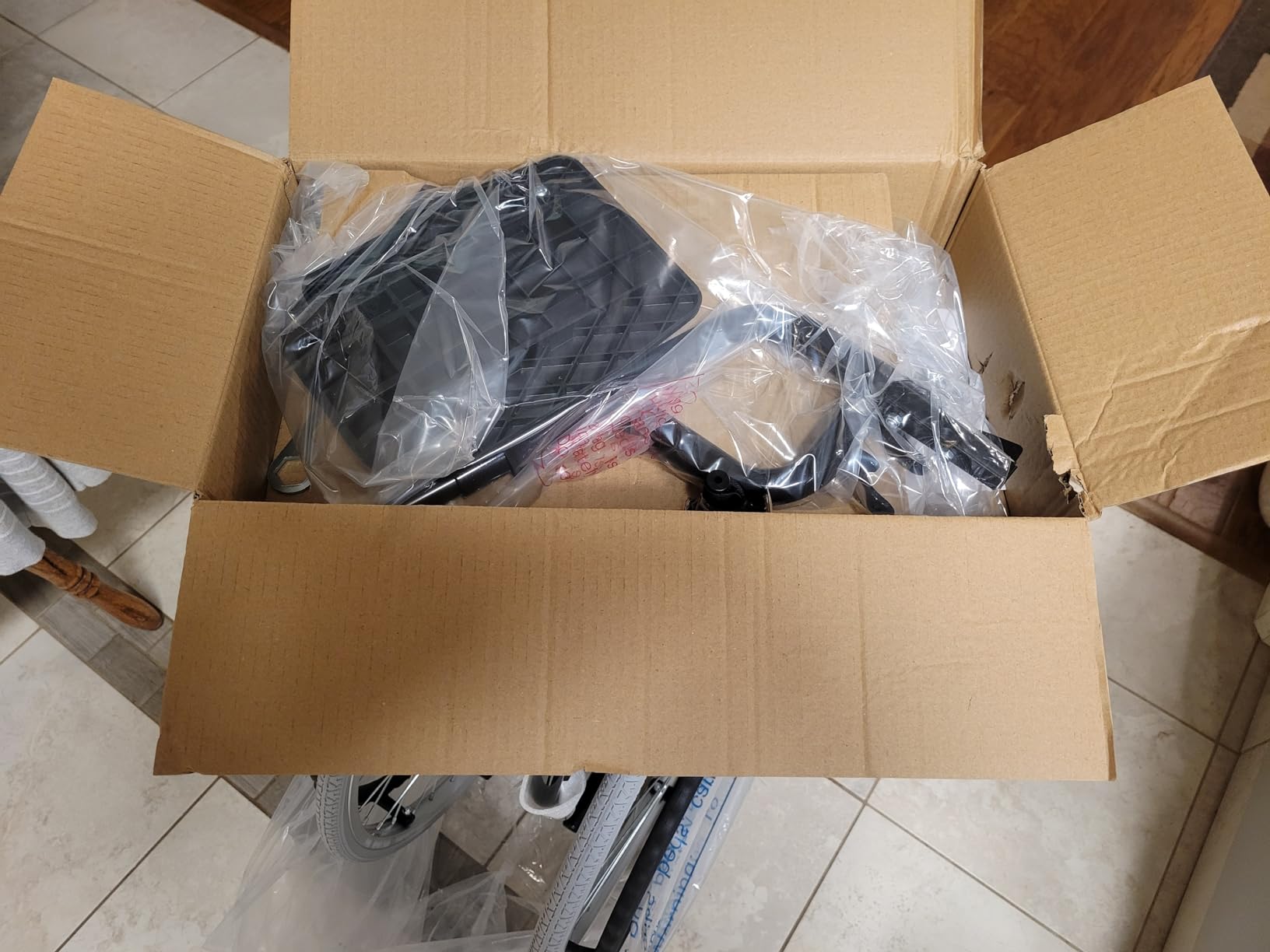
Practical touches add up over time. A backrest pouch holds keys and medication, adjustable-height footplates suit different leg lengths, and desk-length armpads let the rider pull up to a table. The padded nylon upholstery wipes clean and the seat belt is standard.
Three trade-offs define the ownership experience. It is the priciest mainstream option here, the weight capacity stops at 250 pounds where aluminum rivals reach 300, and the fixed armrests mean no side transfers. An eight percent one-star rate also signals reliability issues for a subset of owners, and assembly takes longer than simpler models.
For riders who value light weight and brake control above all else, it is still the strongest choice in the premium tier.
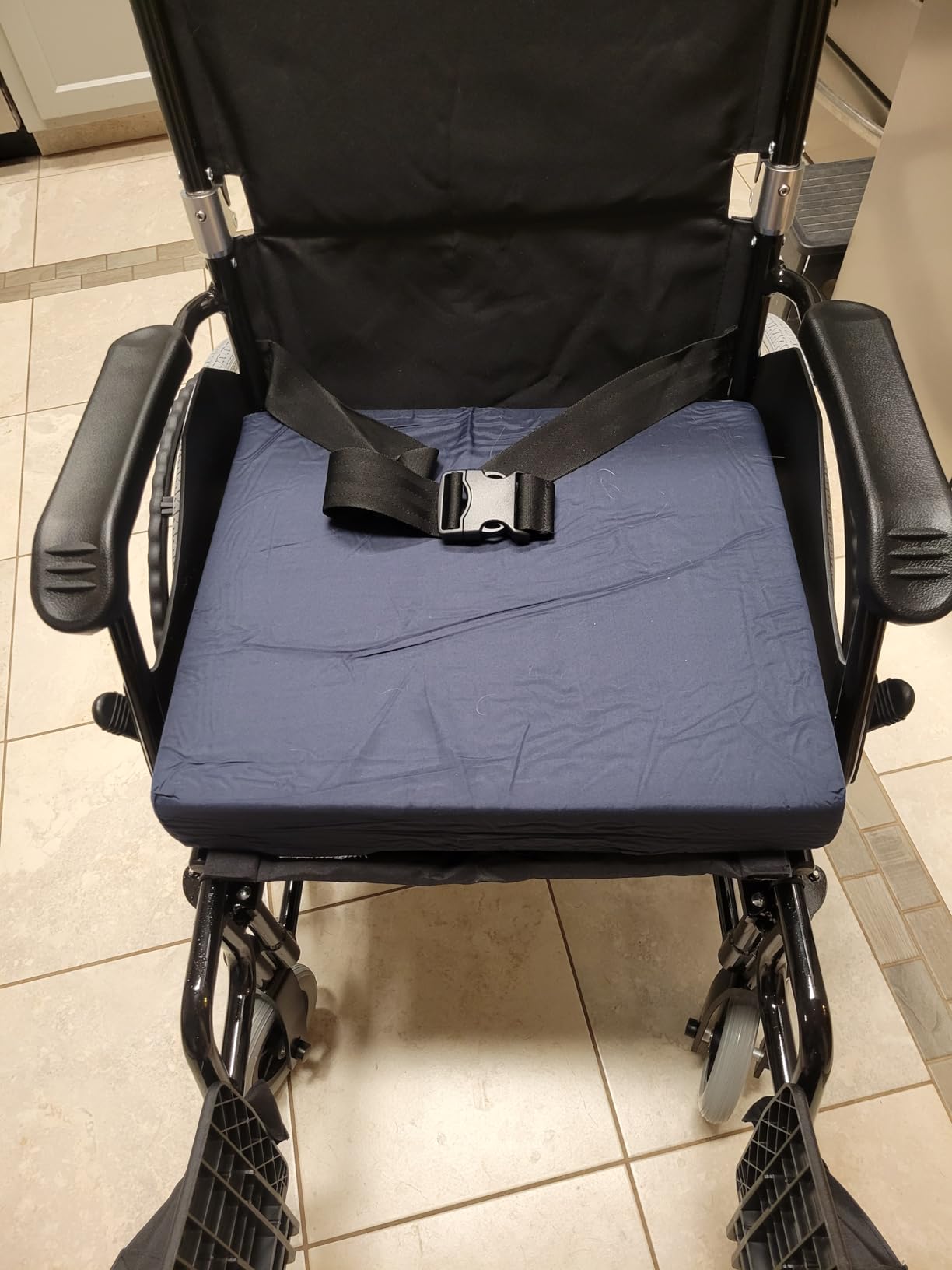
Can the Rider Really Reach the Handbrakes?
Yes, and that is the defining feature. The rider can slow or stop the chair and hold it parked during a caregiver’s momentary absence.
Riders with limited grip strength or restricted arm mobility should still rely on caregiver braking.
Why Only 250 lbs Capacity?
The ultralight aluminum tubing and hybrid wheel setup cap the rating below the 300-pound aluminum transport frames. Riders near the limit should choose a dedicated 300 lb model instead.
Staying well under the rated capacity also extends frame life on any chair.
11. Vive Folding Transport Wheelchair — Widest Seat at a Low Price
Vive Lightweight Transport Wheelchair for Seniors – Portable, Folding, 19”
19 inch padded seat
Arrives pre-assembled
250 lb capacity
Fold-down push handles
Pros
- Wide 19 inch seat at a budget price
- No assembly required out of the box
- Fold-down handles lower the storage profile
- Quick-release safety belt
Cons
- One verified report of a user tipping sideways
- Heavier at 29 lbs
- Not Prime eligible
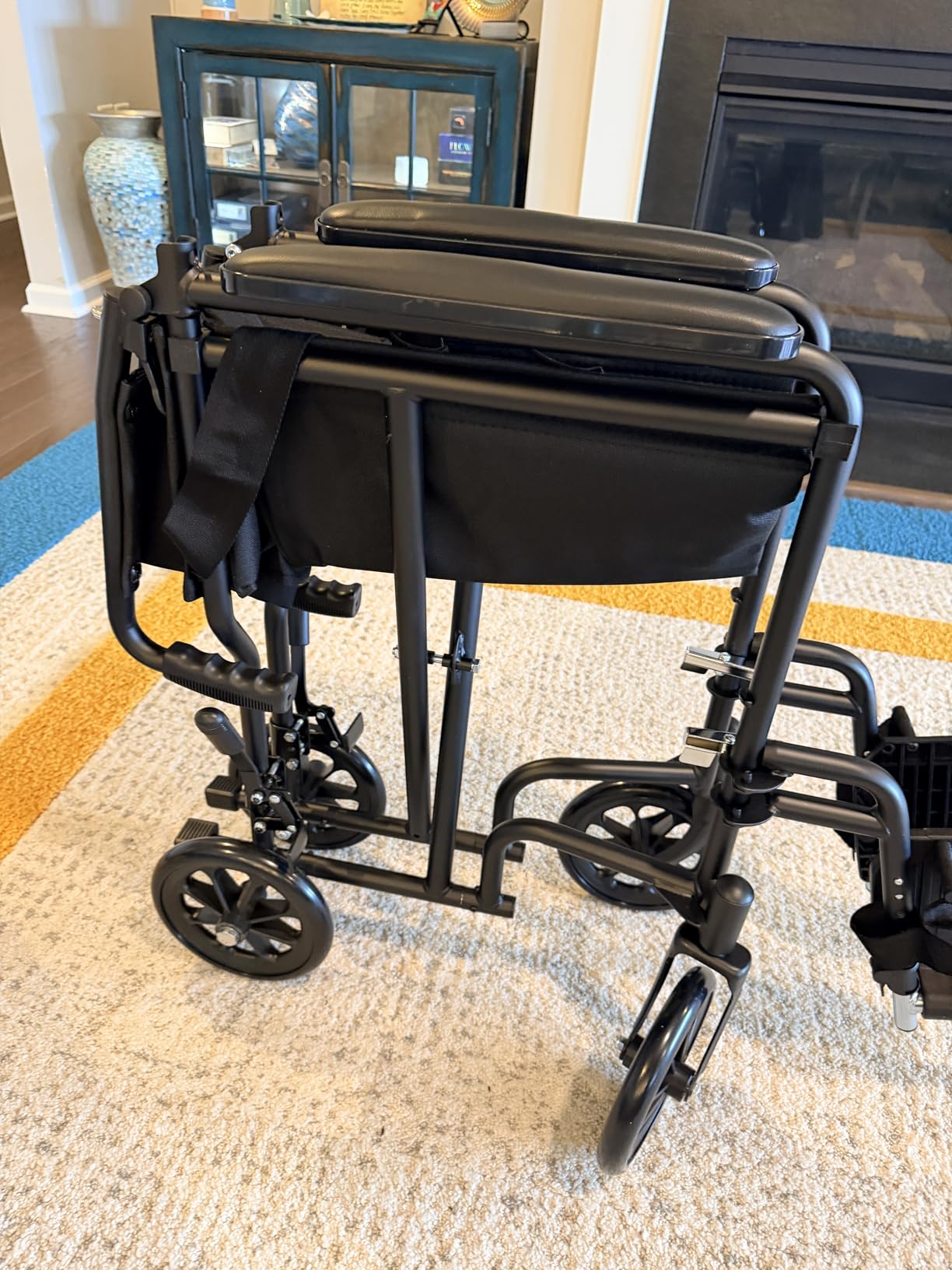
The Vive Folding Transport Wheelchair pairs a wide 19-inch padded seat with a pre-assembled, fold-in-seconds design at one of the lower prices in our lineup. For families who need roomier seating without paying for an aluminum frame, it is an appealing package on paper.
It arrives ready to use, which removes the assembly friction that trips up elderly buyers. The push handles fold down and the backrest collapses, so the storage footprint shrinks enough to fit a compact SUV trunk according to owner reports.
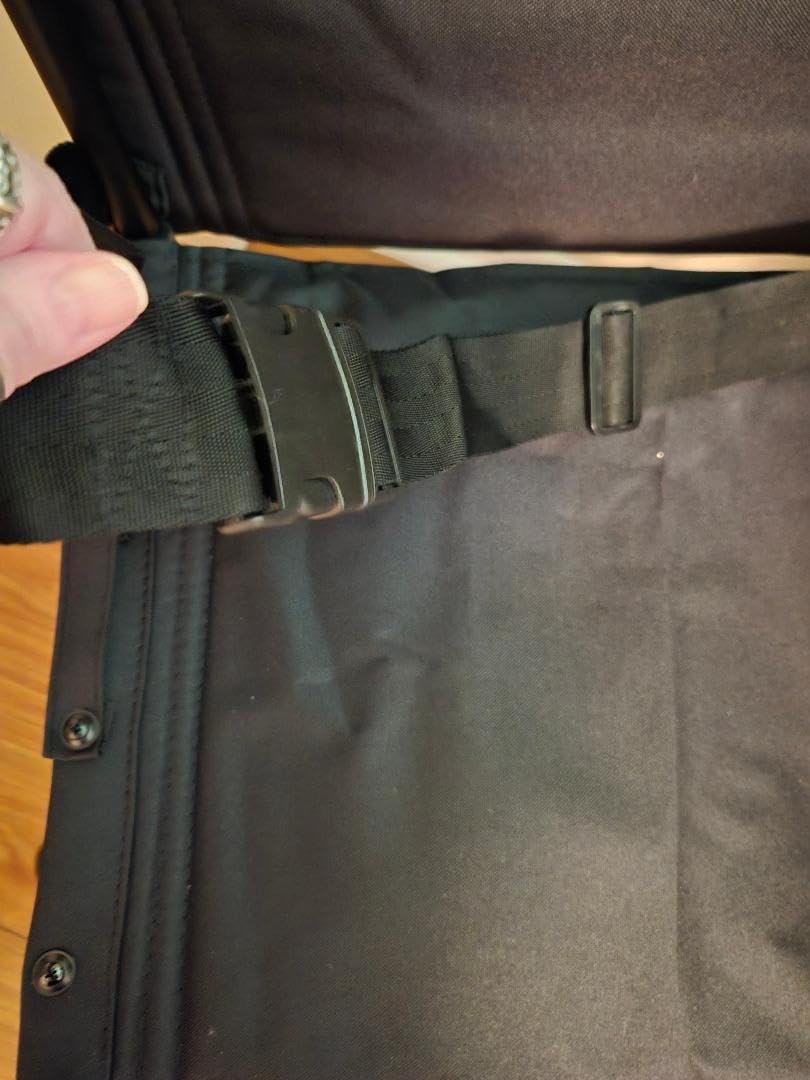
Owners praise the sturdy steel construction, the textured ergonomic push grips that reduce hand strain, and smooth movement on paved surfaces. The quick-release safety belt and built-in wheel locks cover the basics of daily safety.
We do need to flag a serious outlier. One verified reviewer reported their 90-pound user tipped the chair sideways and broke a thigh, with the caveat that the caregiver’s hands were off the handles, and the listing carries a one-star rate around twelve percent. Keep a hand on the chair during any shift in weight, and treat the 250 lb capacity as a ceiling for smaller adults rather than a target.
It also ships without Prime eligibility, so delivery timing may differ from what you expect.
How Stable Is a New Model With Mixed Reviews?
Moderately stable, but not proven. The majority of the small review pool is positive, and the tipping report appears tied to an unattended moment rather than a design collapse.
Constant hand contact during transfers is the rule for any transport chair, and doubly so here.
Seventeen or Nineteen Inch Seat — Which Do You Need?
Vive sells both widths, and the 19-inch version is the one most adults need based on the hip-measurement rule. Choose 17 inches only for a slight build or a very narrow doorway.
The wider seat also leaves more room for a cushion upgrade.
12. Strongback Excursion 20-Inch — Most Comfortable Transport Frame
Strongback Mobility Excursion 26.7 lb Light Wheelchair w/Brakes, 20″ Seat
Patented ergonomic backrest
20 inch seat
12 inch rear wheels
300 lb capacity
Pros
- Built-in adjustable lumbar support promotes proper posture
- Curved frame relieves the strain of a rigid 90-degree seat
- Wide handle grips reduce caregiver hand fatigue
- Arrives fully assembled
Cons
- Hubcaps detach easily
- Brake set screw can loosen and need retightening
- Chair can tip backward if the rider pushes back while wheels are locked
The Strongback Excursion attacks a problem almost every other transport chair ignores: posture. Its patented backrest builds in adjustable lumbar support on a curved frame, so the rider sits in a supported recline instead of a rigid right angle, which is why owners report sitting comfortably for hours.
Caregivers with neurological conditions, post-stroke rigidity, or significant weakness in their care describe this chair as transformative. The ergonomic hand brakes lock securely, the wide grips reduce hand fatigue, and the curved arms let the chair slide under tables that stop conventional armrests.
This 20-inch-seat version pairs the ergonomic frame with 12-inch rear wheels and a 300 lb capacity, arriving fully assembled at roughly 25 pounds. Reddit caregivers specifically praise Strongback’s 12-inch-wheel models as the best compromise between rolling performance and a liftable weight.
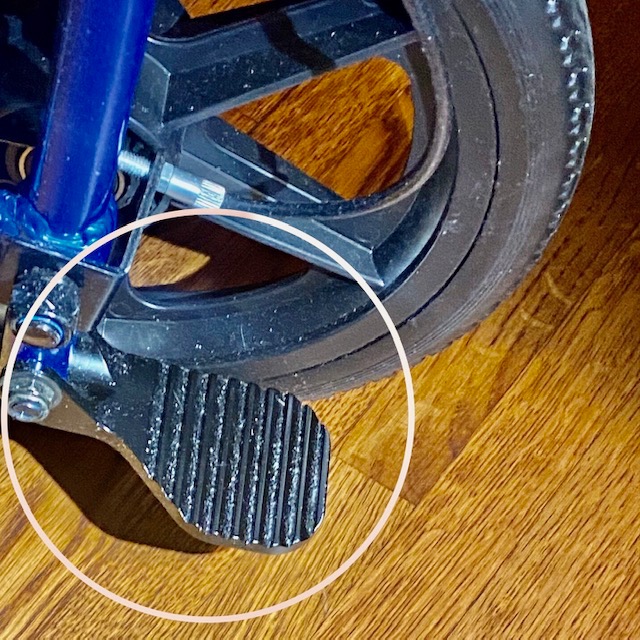
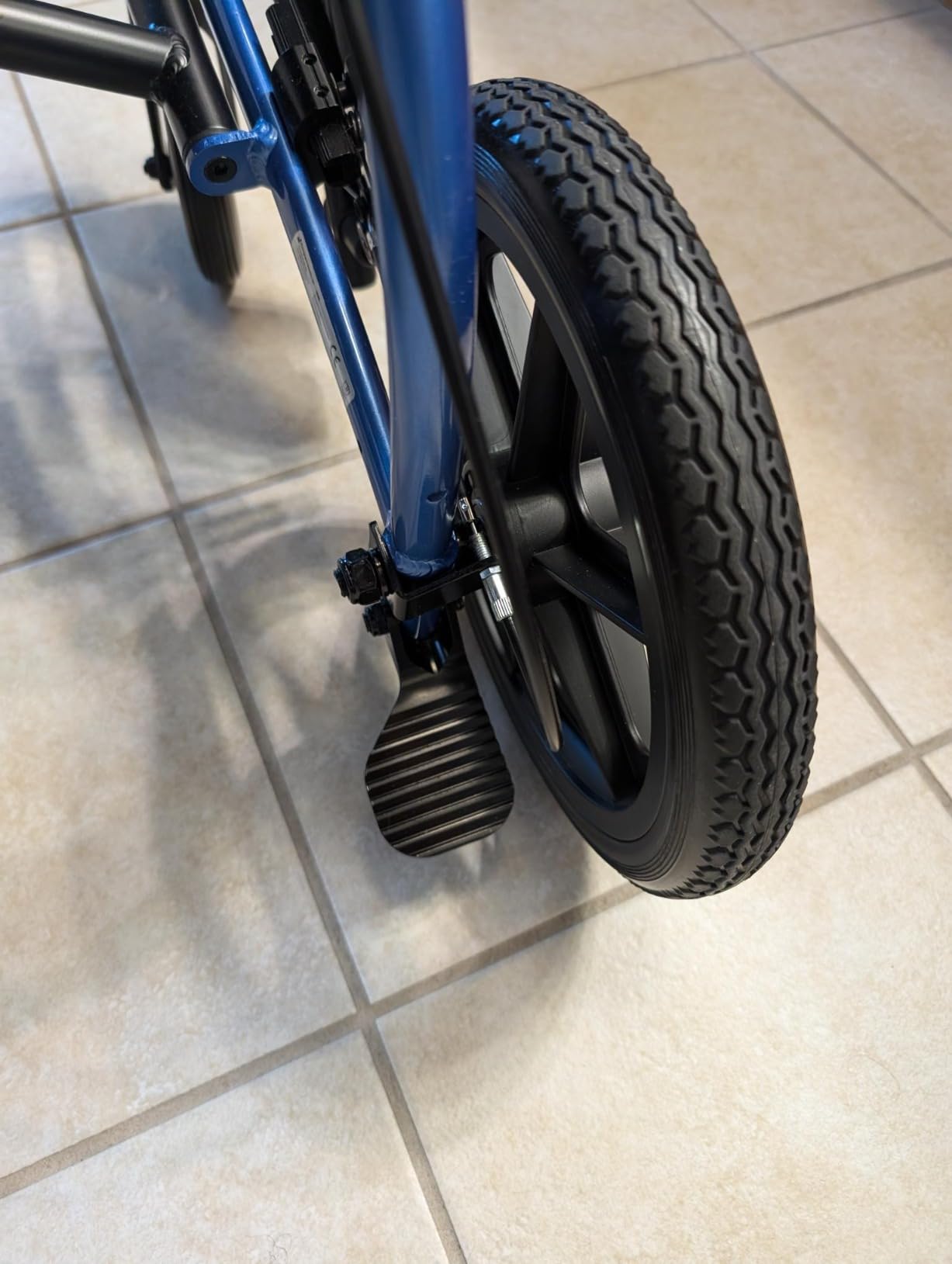
The imperfections are small but worth knowing. Hubcaps separate from the chair easily, the brake set screw can work loose and needs an Allen key now and then, and the handbrake levers have edges that can catch your hands on long uphill pushes. Most importantly, the chair can tip backward if an unattended rider pushes back hard while the wheels are locked.
It commands a premium price, and owners consistently describe it as worth every dollar for the comfort alone.
Is the Ergonomic Backrest Worth It?
If the rider spends more than an hour at a time in the chair, absolutely. Lumbar support prevents the sliding slouch that standard sling seats encourage.
For short trips from the car to a clinic, a standard seat plus a good cushion performs nearly as well.
What Does the Tipping Warning Mean in Practice?
When the rear wheels are locked and the rider leans or pushes backward, the chair can rotate onto its anti-tip limit. Never leave a rider unattended with the brakes set.
Position the chair against a wall or stable surface during transfers for an extra margin.
How to Choose the Best Transport Wheelchair?
Every chair above is a competent product, which means the right choice depends entirely on your situation. Work through these factors in order and the shortlist usually shrinks to one or two models fast.
Transport Chair vs Standard Wheelchair
A transport chair has four small wheels, no hand-rims, and exists to be pushed by a caregiver. A standard wheelchair has large rear wheels the rider uses to propel themselves.
Choose a transport chair for occasional outings, travel, and recovery periods where someone is always available to push. Choose a standard or hybrid wheelchair when the rider wants to move independently, even indoors.
The Silver Sport 1 and Karman LT-980 in our list blur this line by adding hand-rims to a transport-style frame.
Weight: The Number That Matters Most
Frame weight determines who can actually use the chair over months, not just on day one. Aluminum models here run 15 to 28 pounds, while steel models run 25 to 38.
Be aware that advertised weights sometimes exclude footrests or reflect the shipping box, as we saw with the Expedition and the Karman T-2700. Ask specifically for the weight as you will lift it.
Caregivers on r/wheelchairs repeatedly recommend buying lighter than you think you need, because lifting fatigue accumulates.
Seat Width and Weight Capacity
Measure the rider’s hips while seated and add two inches for a comfortable fit. That single measurement puts most adults into a 19-inch seat rather than the 17-inch default.
Weight capacity works the same way. A rider near a 250 lb rating will strain the frame and the brakes, so choose a 300 lb model for anyone close to the line.
Wheel Size and Where You Plan to Push
Eight-inch casters are superb indoors and terrible outdoors. Twelve-inch rear wheels absorb curbs, cracks, and uneven pavement far better.
If your routine includes sidewalks, parking lots, or cruise ship decks, prioritize the models with 12-inch rear wheels. If the chair lives inside one home, small casters are more maneuverable in tight halls.
Handbrakes vs Rear-Wheel Locks
Handbrakes are levers on the push handles that slow the chair while you walk behind it, and many lock for parking. Rear-wheel locks are push-down tabs at the wheels that hold the chair still for transfers.
Handbrakes protect you on slopes; wheel locks protect the rider during transfers. Chairs with both, like the Medline Handbrakes and NOVA models, offer the safest combination.
Will It Fit in Your Trunk?
Folded height is the measurement that causes surprises, especially with fixed push handles. Measure your trunk’s opening and its lowest point, then compare against the folded dimensions.
Forum members regularly warn that real folded sizes run larger than advertised specs, so leave a margin of a few inches. Chairs with fold-down handles or fold-flat backrests pack smallest.
Caregiver Ergonomics: Protecting Your Back
Push with your whole body rather than your arms, and keep the chair close when you lift it. A handle height that lets your elbows stay slightly bent prevents the hunched posture owners of low-handle chairs describe.
Use curb-assist bars and tilt bars instead of muscling the chair up steps. When transferring, position the chair at the same height as the bed or car seat and swing armrests out of the way rather than lifting over them.
Your own durability is part of the purchase decision, and no chair is worth a caregiver injury.
Will Medicare Pay for a Transport Wheelchair?
Yes, in limited circumstances. Medicare Part B covers a transport chair as durable medical equipment only when it is medically necessary for use inside the home, which typically means the person cannot operate a manual or power wheelchair on their own.
The process requires a face-to-face examination and a written order from a doctor or treating practitioner within specific timeframes, followed by rental or purchase through an enrolled supplier. Coverage for a chair used mainly for outings and travel is generally denied.
Because a caregiver-propelled chair used outside the home rarely qualifies, most families in our research buy outright rather than pursuing a claim. Check current requirements at Medicare dot gov before you commit either way.
Frequently Asked Questions
Will Medicare pay for a transport wheelchair?
Medicare Part B can cover a transport chair as durable medical equipment, but only when it is medically necessary for use inside the home and the person cannot operate a manual or power wheelchair. A doctor must document the need after a face-to-face visit, and you must use an enrolled supplier. Chairs bought mainly for travel and outings are usually not covered.
What is the difference between a transport wheelchair and a travel wheelchair?
The terms overlap heavily, and many sellers use them interchangeably for the same folding, caregiver-pushed chair. Strictly, a transport wheelchair is any light chair with small wheels designed to be pushed by a companion, while a travel wheelchair emphasizes portability features like an ultra-light frame, a carry bag, and compact folded dimensions for planes and cars.
Which is easier to push, a wheelchair or a transport chair?
A transport chair is easier for the caregiver on smooth, level ground because it is lighter and more compact. A standard wheelchair rolls easier over rough terrain thanks to its large rear wheels, and it lets the rider share the work. For a companion doing all the pushing on pavement, the transport chair wins.
Which transport wheelchair is best rated?
Among the chairs we compared, the VOCIC U12 holds the highest average rating at 4.9 stars but from a small pool of 22 reviews. The best rated at scale are the Medline Handbrakes model at 4.5 stars across more than 12,700 reviews and the Medline Ultra Lightweight at 4.6 stars from roughly 7,800 buyers.
How much does a transport wheelchair weigh?
Most transport wheelchairs weigh between 15 and 38 pounds. Aluminum ultralight models like the Medline Ultra Lightweight sit at the bottom near 15 pounds, mid-weight aluminum chairs run 19 to 28 pounds, and steel-framed models climb to between 25 and 38 pounds.
Can a transport wheelchair fit through bathroom doors?
Many can, but bathroom doors are the tightest passage in most homes. Older houses often have openings around 24 inches, so compare that number against the chair’s overall width, not its seat width. Models near 21 to 23 inches wide, such as the Drive TR37E and the Karman T-2700, are the safest bets for narrow bathrooms.
Final Word on the Best Transport Wheelchairs
After comparing 12 chairs, our top pick remains the Medline Ultra Lightweight for the simple reason that a 15-pound frame with a 19-inch seat solves the two problems caregivers complain about most. The Drive Medical Expedition is the value choice if you want 12-inch wheels and handbrakes, and the Carex covers basic needs at the lowest cost.
Choose the Strongback Excursion for long days out, the Silver Sport 1 when the rider wants independence, and the NOVA when safety hardware comes first. Whichever way you go, measure the hips, measure the trunk, and lift the chair yourself before committing.
Finding the best transport wheelchairs in 2026 comes down to matching one chair to one person and one caregiver, not chasing the highest rating. Take the time to get that match right, and both of you will feel the difference on every outing.